

Contents(4)
Starting in March, ocean-opening events are held across Okinawa Prefecture, and you can gradually begin to see people swimming and playing in the sea. By April, the water temperature rises to 23°C, and fish activity intensifies. Although night diving in a wetsuit during this period still feels a little chilly, these past few days have made it easy to sense that summer is just around the corner!
In my previous article, "The Thrilling Twilight Hour," I wrote about the joy of observing the spawning behavior of the Flame Angelfish. Those who read that first installment may have already guessed the subject of this second one — and yes, you're right! It's the Banded Goatfish (goatfish)! This fish belongs to the family Mullidae and is a widely distributed, common species in Japan, ranging from the Pacific-facing southern coast of Japan to the Ryukyu Islands. This time, we'll be observing the spawning behavior of this goatfish during a night dive.

Perhaps everyone has had an experience like this: a dive instructor points to a school of small fish and jokes, "These are juvenile goatfish (laughs)" or "This is a female goatfish ♀." Maybe I'm the only dive instructor who does this, but that kind of joke is surprisingly well-received. Getting back on topic — you've surely watched with great interest as a goatfish skillfully manipulates its two barbels to forage. You might not pay much attention to this common fish anymore, but in fact these ubiquitous, ordinary species are the most suitable subjects for behavioral observation. Just take my word for it, and turn your attention back to the goatfish you've been overlooking!
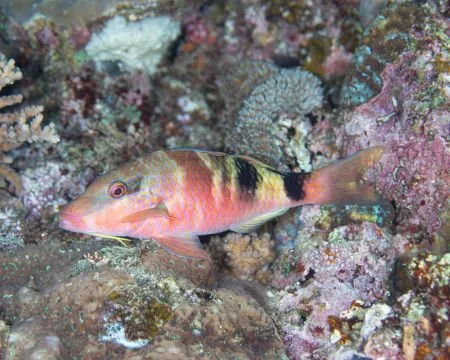
If you observe the Banded Goatfish for an extended period, you'll notice that its body color sometimes turns red.
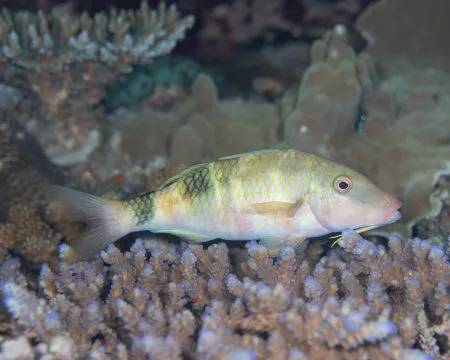
The Banded Goatfish — a common, everyday species.
Pay Attention to the Goatfish's Barbels
The subject of this observation — the Banded Goatfish — is known in Japan as "Ojisan (オジサン)", while in Taiwan it is commonly called a goatfish. Whether the individual is young or an older female, it's still called Ojisan — whatever the case, this fish is called Ojisan. The name comes from the two barbels beneath its snout, which serve as sensory (taste) organs, allowing the fish to search for crustaceans and other prey hiding in sandy substrates.
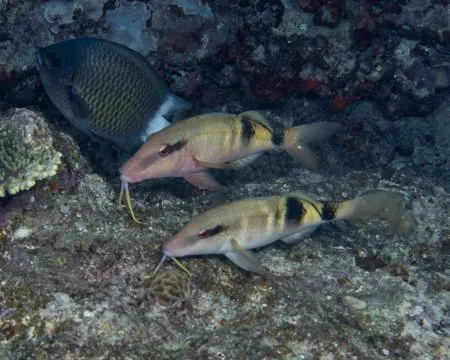
A goatfish in the act of foraging.
When you observe the goatfish closely, you'll notice it moves slowly across rock surfaces, then suddenly bursts into a sprint when a small fish darts out from a crevice. The two barbels beneath the snout are critical for foraging, but when observing their spawning behavior, be sure to pay special attention to these barbels as well — because during the breeding season, the goatfish uses them to perform some rather eyebrow-raising moves.


The Dashing Goatfish That Guards Its Territory
Before getting to the barbels, let's first introduce how the goatfish spawns. Like the Flame Angelfish, the goatfish spawns in pairs. The pelagic eggs released drift freely in the water. During spawning, the male and female rise together into the water column to release their eggs and sperm — quite different from their usual image of crawling along sandy or rocky seabeds. They ascend together to heights you'd never expect, then spawn.
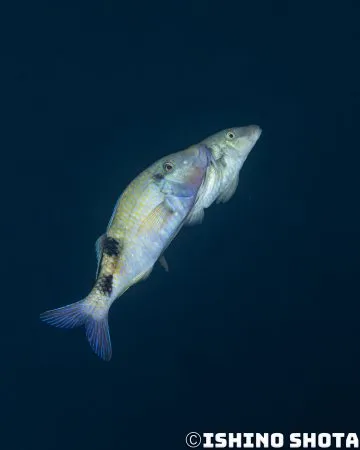
Goatfish ascending together to spawn.
It's difficult to distinguish males from females by appearance alone, and group sizes are also hard to gauge. However, toward evening, you can see them gathering on particular rocks, where the strongest male forms a loose harem with several females. The reason I describe it as "loose" is that spawning outside the group can occasionally be observed, suggesting the boundaries of the harem are rather vague.
Even so, the strongest male still wants to spawn with as many females as possible. In the reef area I regularly observe, the dominant male swiftly chases off any rival males that try to approach the harem — so fast that you can sometimes almost hear a "whoosh." No matter what that male was doing beforehand, the moment it spots an intruder, it tucks in its barbels and fins, minimizes drag, and launches a rapid pursuit, defending its harem with zero mercy.
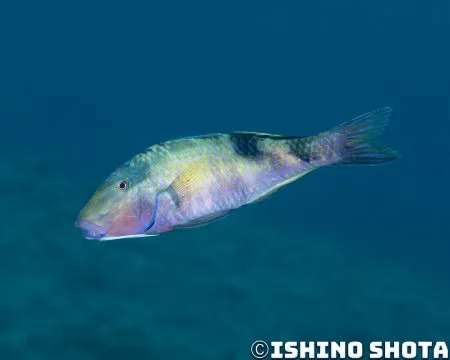
When swimming at speed, the goatfish tucks in its fins and barbels.
The sight of a goatfish spawning majestically within its own territory is incredibly cool! Goatfish are awesome! As for those goatfish spawning outside the group mentioned above — they've probably been outcompeted by the dominant male and are forced to sneak around for a secret rendezvous. It's a little sad, really.

A male goatfish selecting females within its harem.
The Goatfish's Barbels Pull Off a Strange Move
Simply anthropomorphizing the rivalry between the sneaker males and the No. 1 dominant male makes the goatfish's spawning process endlessly entertaining. However, there's one more thing we must not forget — the barbels! You simply cannot talk about goatfish courtship and spawning without them. I believe the most spectacular part of goatfish reproduction lies in the barbel movements during courtship. The same barbels used for foraging take on an entirely different role during mate attraction.
The normally plain-looking goatfish transforms during courtship, its body shifting to a striking purplish hue so beautiful it seems like a completely different species. The male, now dressed in nuptial coloration, erects his dorsal fin as high as it will go and swims in front of the female — then, in the very next instant, vibrates his barbels at ultra-high speed in an irresistibly alluring display.
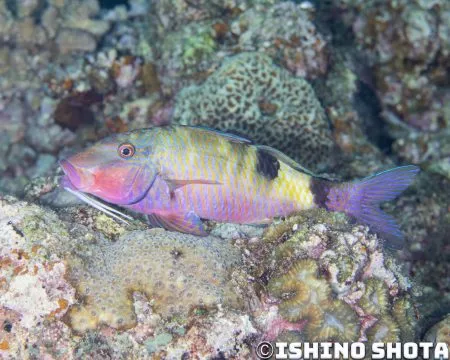
A beautiful goatfish in nuptial display.
If I had to describe the scene in words, the onomatopoeia "bero-bero" fits best — imagine the moment when a comedian licks an idol's toothbrush, which is a little gross. This unusual courtship behavior is unlike anything seen in other fish species.
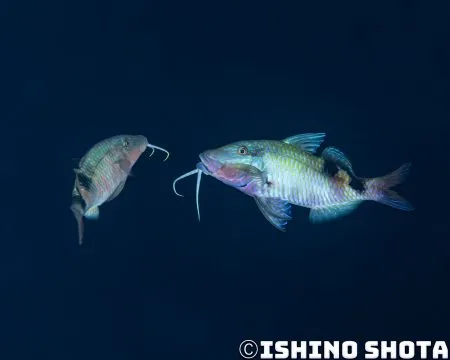
A courting male goatfish ♂ and the responding female ♀.
The goatfish pouring its heart into courtship, going all out no matter what. Some of you might even feel a slight twinge of revulsion — but do you know that feeling of wanting to look at something disturbing, or more precisely, peeking at it through the gaps between your fingers while covering your face? That high-speed tongue-like motion is burned into the back of my eyelids and simply won't fade.
Ah, perhaps this counts as a kind of trauma.
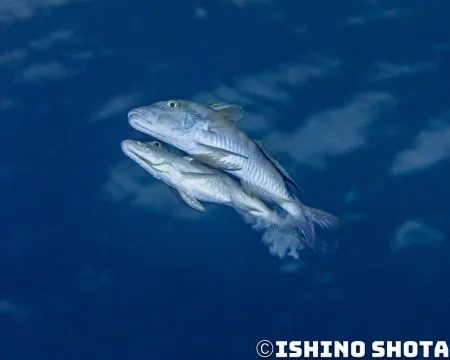
The Banded Goatfish's passionate courtship plays out every single night.
Related Links
Frequently Asked Questions
How is a BlueTrend dive trip different from an unknown, no-name dive group?
Choosing us means full peace-of-mind protection and a smooth experience from start to finish. Every trip we run holds to three things.
First, full legal protection and a professional dive leader: we strictly follow Taiwan's travel regulations and provide complete travel-agency liability insurance, travel insurance, trip-inconvenience insurance and dive insurance. Every group is accompanied by a certified, foreign-language dive leader who joins you on both the dives and the land itinerary, liaising seamlessly with local dive shops and operators on your behalf to keep things running smoothly — the person our travellers trust most.
Second, fully licensed with secure payments: every payment goes into a licensed travel agency's account, with multiple safe payment channels (bank transfer, credit card and more) and a legal collect-and-remit receipt, so every transaction is open, transparent and protected, avoiding the fraud and dispute risks of transferring money privately to an individual.
Third, hand-picked quality we vet in person: every trip, dive site and partner shop is scouted on the ground by our own team, from the guides' professionalism and safety standards to the food, lodging, environment and service details on land, all vetted by us so you don't get caught out.
I want to sign up for a dive trip. Are there certification-level or logged-dive requirements?
Each dive site is different, so the entry bar varies. 'Bali Tulamben', for instance, is relatively beginner-friendly. 'Malapascua in the Philippines' is also beginner-friendly, but since thresher sharks tend to cruise between 20 and 30 metres, we recommend AOW certification with 20+ logged dives to enjoy this trip comfortably. For 'the Maldives' or 'Palau', we suggest AOW with 50+ logged dives for a more relaxed experience. If you're not sure whether your experience fits the trip you want, message us and our dive editors will assess it and help you find the trip you'll feel safest on.
Can I join if I'm signing up alone? How are rooms arranged?
Plenty of our travellers sign up solo! For rooms and beds, we prioritise pairing you with a same-gender traveller, and if you'd rather have your own space you can pay the difference to upgrade to a single room. For the diving, our professional leader will pair you with a suitable buddy, and with the happy vibe on our trips you'll quickly make a great group of dive friends. Many people sign up alone, make new friends, and end up organising the next trip together!
Does the trip fee include dive insurance, gear rental, taxes and instructor tips?
It depends on the trip, the destination's regulations and the local operators. Every BlueTrend dive trip has a detailed web page with a clear 'included / not included' list, transparent and with no hidden charges. All payments are collected by a licensed travel agency, with a standard-form contract for your protection.
I'm a new diver / haven't dived in a long time — will I fall behind the group?
Before you complete your booking, our team assesses a suitable trip based on your certification level and experience. Before departure, we strongly recommend taking time to refresh in Taiwan with an instructor, or a fun dive to get your feel back. On the trip itself, our professional dive leader groups and pairs everyone by experience, keeps a close eye underwater on travellers who need extra care, and steps in to help right away.
Will the photos and videos taken during the trip be shared with us?
During the dives, 'safety' is always the leader's top priority, so whenever it's suitable and safe the leader will capture great shots and record the best moments. During or after the trip, we compile a cloud album for all travellers to download, so you go home loaded with memories!
Besides your scheduled trips, can you arrange a private group charter or independent travel for me and my friends?
Absolutely! Besides group trips, we also arrange private group charters and independent travel. We can communicate, enquire and coordinate services with local operators based on your needs, saving you time and effort and taking the language barrier off your plate, to tailor the smoothest, most reassuring dive trip just for you. Contact our LINE support and our editors will arrange it for you!


![[Palau] First Dive in Palau — 3 Must-Dive Sites: Blue Hole, Blue Corner & German Channel, Warming Up for Spawn Diving](/_astro/DSC09052_Z1Gbc8g.webp)