Contents(3)
The Editor says: Did you know that in 2020, Taiwan experienced a large-scale coral bleaching event, with a mortality rate of up to 40%, posing a serious threat to coral reef ecosystems and their economic value? In response to rising ocean temperatures, NOAA has expanded its alert system from 5 levels to 8, in the hope of helping coral reef ecosystems recover their once-vibrant vitality. <Full article reprinted from the Environmental Information Center, compiled from international sources; translated by Hsieh Ming-shan; reviewed by Chen Wen-zi and Lin Da-li, 2024.02.07>
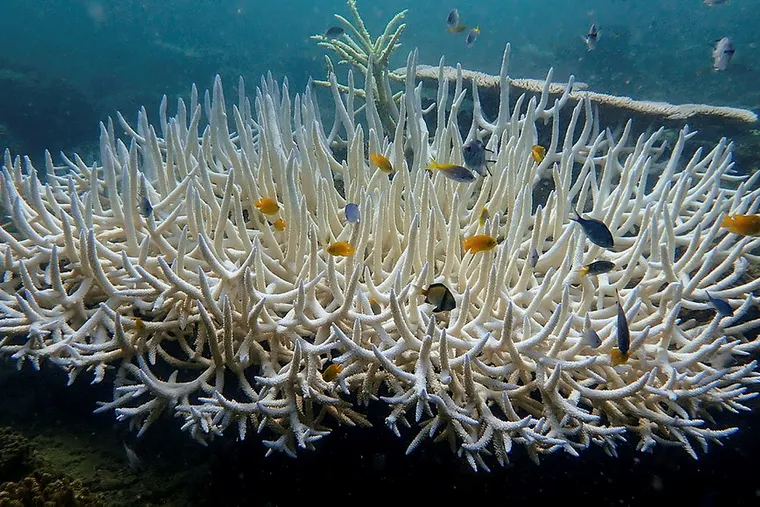
In the summer of 2020, Taiwan's waters experienced a large-scale coral bleaching event, with 30–40% of corals dying. Many areas reached "Alert Level 2" on the coral bleaching warning scale — the most severe level in the National Oceanic and Atmospheric Administration (NOAA) warning system, indicating that "severe coral bleaching and mortality are likely."
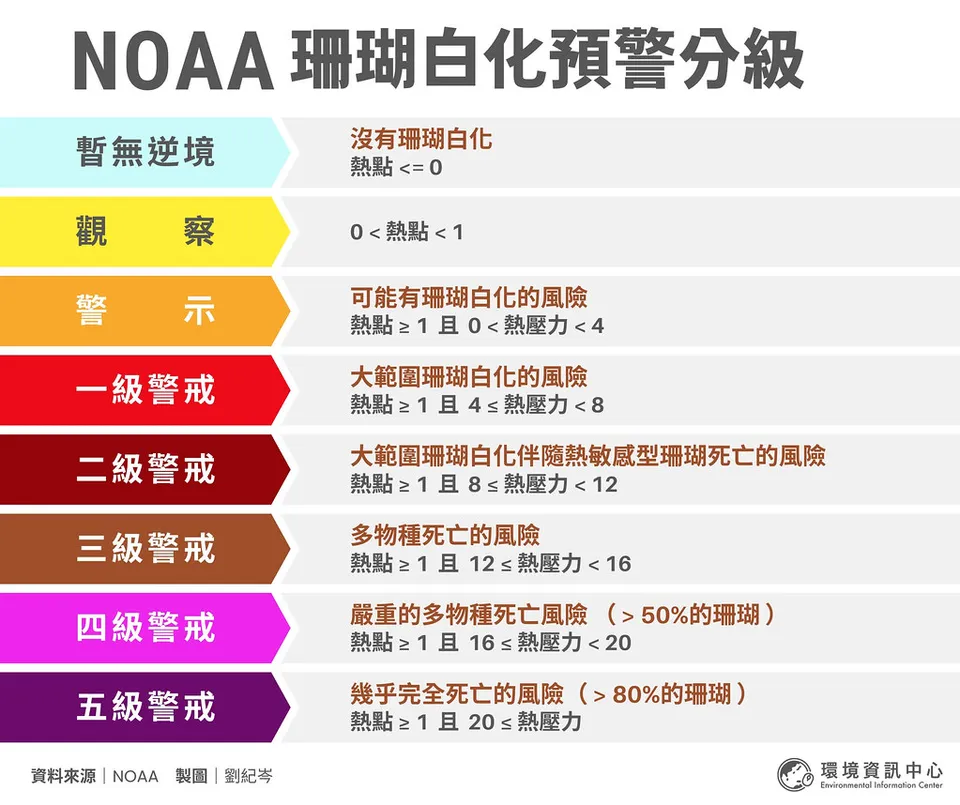
As ocean temperatures have continued to surge in recent years, the existing warning classification has proven inadequate. At the end of 2023, NOAA added three new coral bleaching alert levels in one go, expanding the system from five levels to eight.
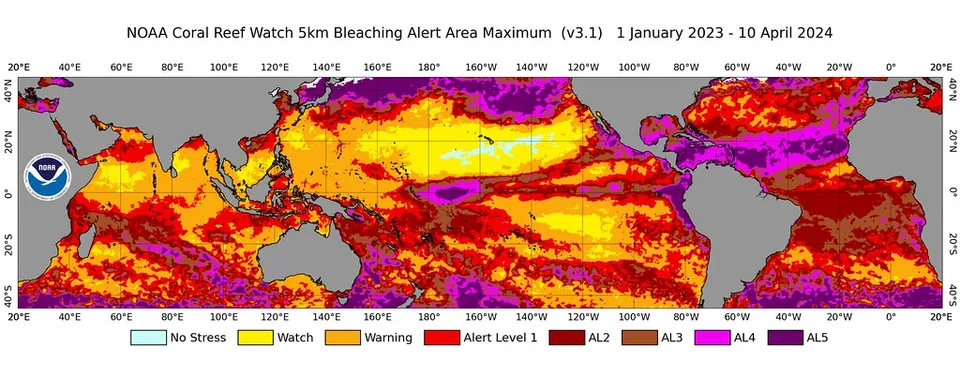
Daily coral bleaching alert status, as of February 3, 2024. Image source: NOAA
The Coral Reef Watch (CRW) program, operated under NOAA, provides a global coral bleaching early-warning system using tools such as satellite sea surface temperature monitoring, in-situ measurements, and model analysis. The original five levels were: No Stress, Watch, Warning, Alert Level 1, and Alert Level 2.
Starting December 15, 2023, CRW updated its alert system by adding three new levels. "Alert Level 3" indicates a risk of multi-species mortality; "Alert Level 4" indicates a risk of severe multi-species coral mortality (>50%). The most extreme level, "Alert Level 5," indicates a risk of near-complete coral mortality (>80%).
The primary cause of coral bleaching is elevated ocean temperature, which causes coral polyps to expel the algae living within their tissues, turning them white. This typically occurs during sustained, anomalous warming events. Bleaching does not necessarily kill coral, but surviving corals may become more susceptible to disease and less able to reproduce.
The key metric of the alert system is the Degree Heating Week (DHW), which represents the cumulative effect of thermal stress. For example, if sea surface temperatures are forecast to exceed the maximum monthly mean by 2°C for four consecutive weeks, the DHW value would be 8 (2°C × 4 weeks).
Previously, once the DHW exceeded 8, it was automatically classified under the most severe Alert Level 2. In 2020, corals in southern Taiwan's waters endured a DHW exceeding 15 — yet were still only listed as Alert Level 2.
This classification system, established in 2009, has gradually become unable to keep pace with a warming planet. As reported by The Guardian, the summer of 2023 was the hottest on record, with DHW values at many coral reef sites far exceeding 8, and some even surpassing 20.
Derek Manzello, CRW's Federal Coordinator, told the Canadian Broadcasting Corporation (CBC) that Alert Level 5 represents the most extreme and dire scenario possible. According to the scientific literature, thermal stress at this level had only been recorded three times before 2023.
As reported by the environmental news site Earth.org, coral reefs are not only the most biodiverse marine ecosystems on the planet but also serve as natural barriers protecting coastlines from erosion. Coral reefs generate an estimated US$2.7 trillion in revenue for global food industries, tourism, and the pharmaceutical sector. Yet under the mounting pressures of global warming, ocean acidification, and pollution, coral reefs are now facing a dire struggle for survival.
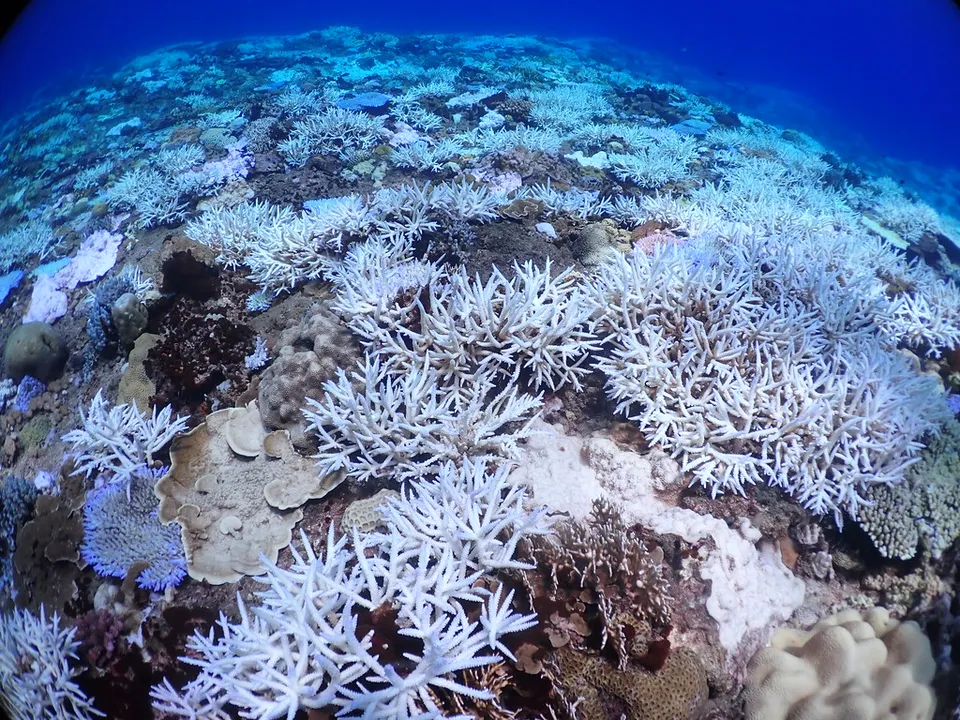
Taiwan experienced its largest-ever coral bleaching event in 2020. Pictured here are bleached Acropora coral colonies at a depth of 10 m in Turtle Bay, Green Island. Photo courtesy of Kuo Chao-yang.
References
- NOAA Coral Reef Watch official website
- Ecowatch (January 31, 2024), NOAA's Coral Reef Watch Adds New Alerts Due to Record-Breaking Heat
- The Guardian (January 31, 2024), 'Literally off the charts': global coral reef heat stress monitor forced to add new alerts as temperatures rise
- Earth.org (February 2, 2024), Global Coral Reef Monitor Adds New Heat Stress Alerts Amid Rise in Climate Change-Driven Mass Bleaching Events
- CBC (February 2, 2024), Coral reef monitor adds new alert levels to keep up with soaring ocean temperatures
- Science Monthly (October 1, 2022), Warning from the Ocean: Stopping the Coral Bleaching Crisis Caused by Marine Heatwaves


Related Links
- Environmental Information Center
- Original article: 熱到「破表」 NOAA珊瑚白化監測新增三個警戒級別
Further Reading