The Editor says: Although scuba diving is a remarkably safe activity, incidents still occur every dive season. Accidents may seem to strike without warning, but they are always preventable. The most important thing is having the right mindset — when your diving safety fundamentals are deeply ingrained, you'll be able to handle unexpected situations with ease. Master these 12 diving safety guidelines, and we're confident you'll have fun and dive safely for years to come. This article is reprinted in full from Green Island Bay Diving Center.
12 Essential Diving Safety Concepts
-
Don't treat your dive guide as a babysitter: In many places overseas, the dive guide's job is simply to show you the sights, point out currents, and introduce the terrain. If you don't listen during the briefing and have no idea what's going on underwater, don't expect anyone to look after you!
-
The dive buddy system: Whether you're travelling solo or joining a group on the boat, once you're aboard, if the operator or dive guide hasn't proactively assigned you a dive buddy, speak up immediately — or find one yourself. Don't let pride stop you from saying something, thinking you'll just stick close to everyone. If buddy groups are formed and you surface, someone needs to know you're there. And of course, actually follow through: stay with your dive buddy at all times, ideally within arm's reach of each other.
-
Why everyone on a boat dive must surface together: Some divers feel they have plenty of air left and stay down while everyone else has already surfaced. The boat will then motor over to the main group — and underwater, there are always blind spots. If you suddenly ascend right as the boat moves, you could end up directly beneath the propeller. What then?
-
Stay well clear of the propeller on boat dives: If a boat's design requires divers to exit near the propeller at the stern, the operator must have a dive guide standing watch nearby. Such boat designs are rare, and it's best to avoid joining trips that use them.
-
Never swim under the boat: If the ladder is on the port side but you're on the starboard side, many divers think it's faster to swim under the hull. This is wrong. The correct approach is to swim around the outside of the boat, keeping your eyes on the hull — especially the engine — the entire time, because you never know when the engine might suddenly start.
-
Confirm your entry method on boat dives: When heading out on an inflatable, the instructor or dive guide will count 1-2-3. Confirm whether the back-roll happens on "3" or on the "jump" after 1-2-3. A timing difference of just 0.3 seconds can send a scuba tank crashing into the head of the person who went first — no joke. If you miss the moment for the back-roll, don't go. Wait until everyone has cleared the side of the boat, then roll in once you're certain no one is in the way. Also confirm the assembly point: in some locations with strong currents, the plan is to meet up underwater immediately after entry. If you're floating on the surface waiting, you could be swept away before anyone notices.
-
Deploying a surface marker buoy (SMB) is an art: A group ascending together can have one person deploy a single SMB — one is sufficient for groups of five or fewer. For more than five divers, deploying two provides better coverage. Everyone should stay close during the ascent. Smaller groups or individuals who have separated from the main group should also deploy an SMB so surface vessels can see them. The reason we say "should" rather than "must" is that in a surge or current, insisting on deploying an SMB when you're not proficient could put you in an even more dangerous situation.
-
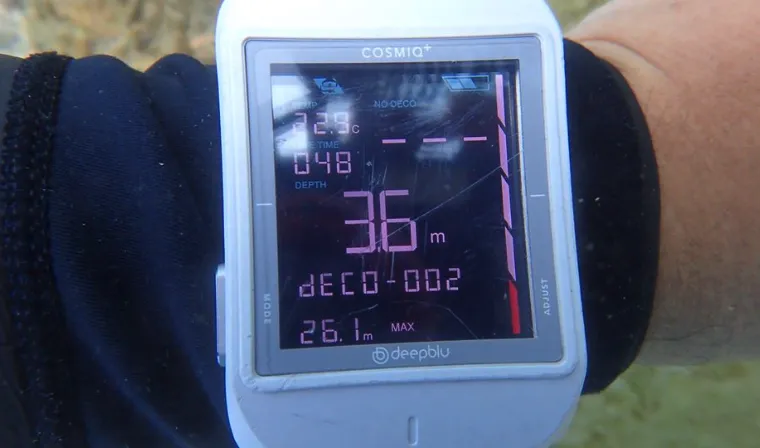
The safety stop is not always mandatory: The 3-minute safety stop at 5 m is not a required decompression stop — it simply helps your body off-gas nitrogen more effectively. If you encounter a current or are running low on air, you may ascend directly, provided your dive computer has not entered mandatory decompression (Deco) mode.
-
Getting back on the boat is critical: Before you grab the ladder, make sure the person ahead of you has completely cleared it and is fully back on the boat. Never wait directly beneath the ladder — if the person above slips halfway up, a scuba tank to the head is no laughing matter.
-
A dive computer should be the first piece of equipment you buy: Don't assume that as long as you stay shallower than your instructor or dive guide, you're fine — your life is your own responsibility. And once you have a dive computer, don't just wear it for show. Study how to use it properly. It's also a good idea to familiarise yourself with what the display looks like when you enter decompression, so you're not caught off guard if it ever happens.
-
Instructors are not all-powerful: An instructor is just one person with two hands and two eyes — there's only so much they can watch over. Stop expecting to hand yourself off to the instructor. Training yourself to be a competent, independent diver is the best safety strategy of all.
-
Insurance, insurance, insurance: Always take out insurance before a dive trip, regardless of whether you're joining an instructor-led group or not. Only you can take responsibility for your own life — never skimp on insurance. Standard travel insurance and certain activity-specific comprehensive policies cover most risks. For overseas trips to more remote destinations, international dive insurance is also worth considering.
To say it one more time: your life is your own. In a genuine underwater emergency, only you can save yourself. Please make sure you have a thorough understanding of diving safety before you enter the water — for your sake and for everyone else's.
If you agree with what we've shared, pass this article on to more friends. Let's dive safer together and explore inner space!
Cover photo: Photo by Sebastian Pena Lambarri on Unsplash
Further reading: