Contents(4)
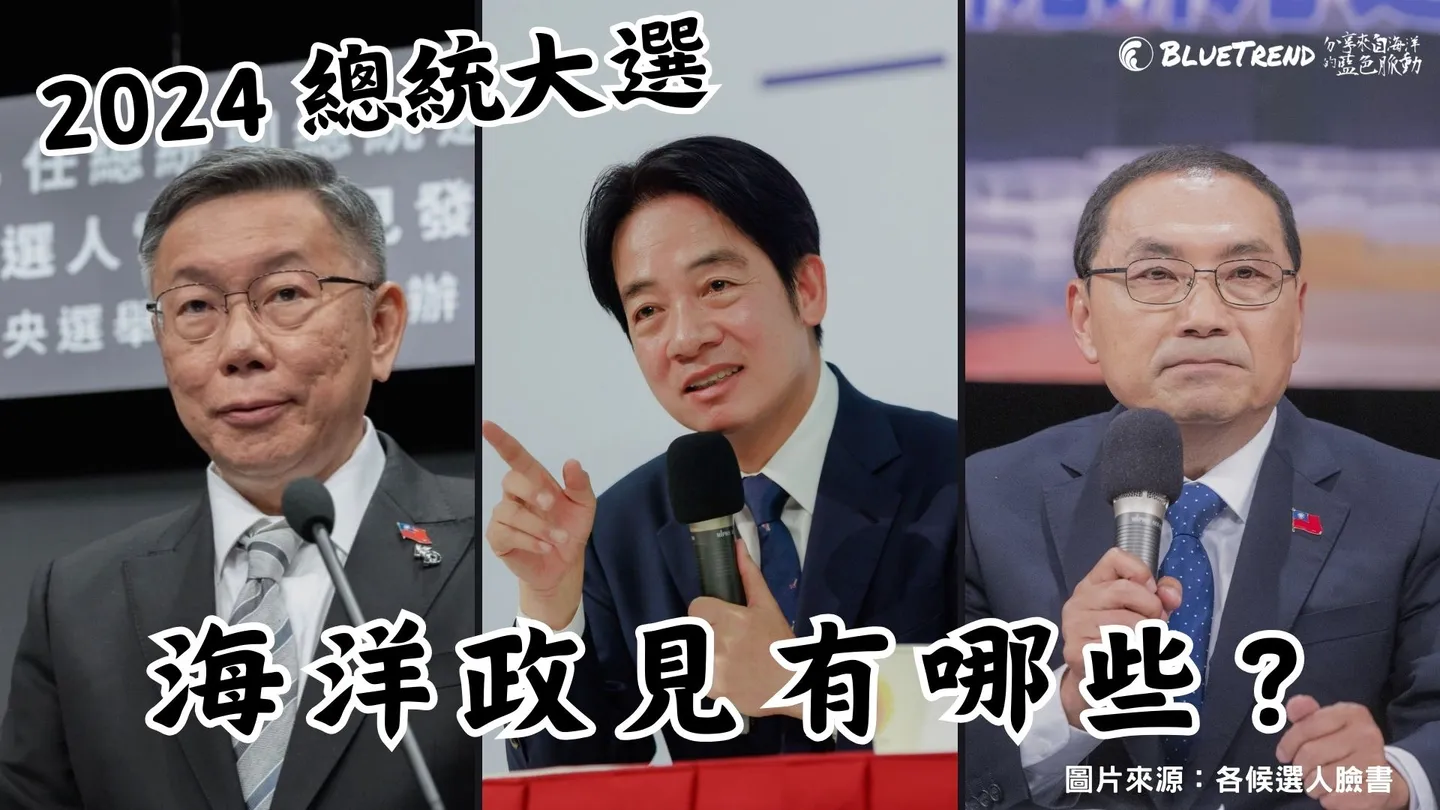
The 2024 presidential election is set for January 13, and the campaign is entering its final countdown. Candidates from all camps have been sparring on a wide range of issues — and BlueTrend (being the ocean-loving cat that it is) is naturally paying close attention to ocean-related policies! Unfortunately, ocean issues appear to be something of a niche topic, and they rarely get discussed in mainstream media. So BlueTrend and the Editor team spent some time combing through the official websites of all three presidential and vice-presidential candidate pairs, as well as their social media posts, to compile the ocean-related policy positions put forward by the three presidential candidates. We invite everyone who cares about the ocean to take a look!
In the following article, we examine each candidate's ocean-related policies under three broad themes. However, in gathering the data, we also found that not every candidate has put forward a comprehensive ocean policy platform. BlueTrend and the Editor team have done their best to collect and present all publicly available information. If you've noticed any other ocean-related policy proposals worth sharing, ocean enthusiasts are welcome to let us know via Facebook or our official LINE account.
*The order in which the presidential candidates appear below follows their ballot number.
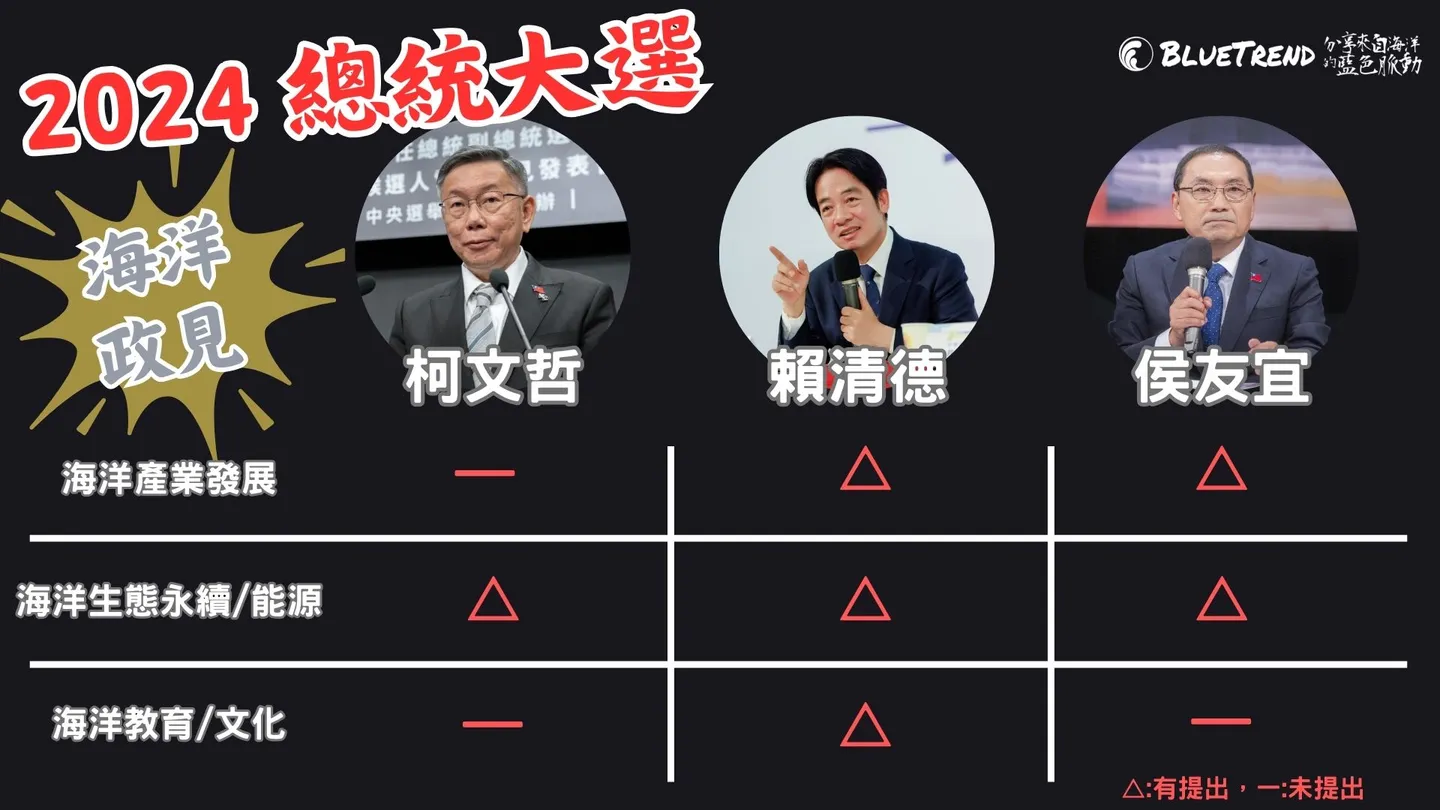
Ocean Industry Development Policies
-
Ko Wen-je: -
-
Lai Ching-te:
-
The "National Ocean Policy White Paper" was passed in 2020; continuing to promote diversified development of the ocean industry.
-
Balance multi-use ocean spatial planning and actively develop offshore wind power.
-
Develop Taiwan's marine recreational resources and strengthen the marine leisure industry.
-
Ensure transportation access for offshore island residents and promote island revitalization programs.
-
-
Hou Yu-ih:
-
Develop Keelung Port, Hualien Port, Kaohsiung Port, and Penghu Port as international cruise home ports and supply ports to increase incentives for international cruise ships to call on Taiwan.
-
Under the principle of marine conservation, develop coastal ecology and marine leisure activities to fully showcase Taiwan's identity as a maritime nation.
-


Ocean Ecology & Sustainability / Energy Policies
-
Ko Wen-je:
- Advance the three ocean bills — the Marine Industry Development Act, the Marine Conservation Act, and the Marine Territory Management Act — to not only preserve marine biodiversity but also maximize the function of ocean carbon sinks.
-
Lai Ching-te:
-
Strengthen the management of marine protected areas (MPAs) and expand the effectiveness of marine conservation.
-
Survey and enrich coastal ecosystem resources to enhance ocean carbon sink capacity.
-
Reduce marine plastic pollution and promote marine debris recycling.
-
Marine conservation is both an obligation and a responsibility. In the future, dedicated budgets, organizational capacity, and personnel must be allocated so the international community can see that Taiwan is not only "a beacon of Asian democracy and freedom," but also "a model student in marine species protection and ocean ecosystem stewardship."
-
Develop diverse green energy and plan for forward-looking energy sources. Beyond traditional solar and wind power, accelerate geothermal power generation, hydrogen energy, bioenergy, and ocean energy.
-
Build Penghu into a net-zero demonstration city, utilizing solar, wind, and future tidal power generation.
-
-
Hou Yu-ih
- Prioritize offshore wind power before 2030; in addition to seabed-fixed turbines, floating offshore wind in deep waters should be pursued, with active future development of deep geothermal energy, ocean currents, and more.
Ocean Education / Culture Policies
-
Ko Wen-je: -
-
Lai Ching-te:
-
Continue to advance the "Salute to the Sea" initiative to cultivate ocean literacy among all citizens.
-
Pass down diverse ocean cultures and promote the development of underwater cultural heritage.
-
Strengthen the ocean education system and cultivate professional maritime talent.
-
Deepen ocean scientific research capacity for sustainable use of the ocean.
-
-
Hou Yu-ih: -
In preparing this report, BlueTrend reached out to each campaign office, inviting them to supplement and share additional policy positions and information. A unified editorial deadline of January 10 was set for the information presented above.
To date, only Lai Ching-te's official campaign website has set up a dedicated page for ocean policies. While the Ocean Affairs Council was established during Lai Ching-te's tenure as Premier in 2018, the Ocean Basic Act was passed in 2019, and the "National Ocean Policy White Paper" was passed in 2020 during Su Tseng-chang's tenure as Premier — over the eight years of Democratic Progressive Party governance, during which the party also held a legislative majority, two of the three ocean bills — the Marine Territory Management Act and the Marine Conservation Act — have been stalled and have yet to pass their third reading.
At the 2022 United Nations Biodiversity Conference, nearly 200 countries agreed to protect 30% of the world's land and oceans by 2030. On March 4 this year, the United Nations adopted the High Seas Treaty, establishing a legal framework to bring more of the high seas under protection. In the face of marine conservation challenges, Taiwan can no longer afford to stand still.
As the battle over national security, economic, and energy issues has reached a fever pitch, BlueTrend and the Editor team have quietly noticed that ocean issues are receiving very little discussion from candidates across all camps. We sincerely hope that in future elections, more candidates will be willing to dedicate resources to deepening their ocean-related policy positions and discourse.
Mentions of "Ocean/Sea" in the Policy Sections of the Official Election Bulletin
In addition to compiling the ocean-related policies raised by presidential candidates, BlueTrend and the Editor team also used a very hands-on approach to search the electronic version of the official election bulletin for the word "ocean" or "sea" (海) appearing in the policy sections submitted by legislative yuan candidates. Take a look and see if any candidate from your constituency made the list!
A note from BlueTrend: if a candidate presented their policy platform as an image file that could not be searched, they were not included in this compilation. Also, the following content is quoted from publicly available information in the official election bulletin and does not represent the editorial position of this publication.
Taipei City Constituency 2 — Wang Shih-chien
Strongly urges the government to accelerate reservoir dredging, promote comprehensive water quality testing, and increase the construction of seawater desalination plants and reclaimed water facilities.
Taipei City Constituency 5 — Chang Hua-te
Amend legislation to assist police, fire, and coast guard personnel in forming unions to protect labor rights and secure entitled benefits.
Taipei City Constituency 8 — Chang Wei-hsueh
-
Food Safety: Ban the import of ractopamine-containing meat; strengthen the testing of radioactive substances (plutonium, strontium, cesium, tritium…) in marine fish.
-
Strengthen the detection of radioactive substances in Taiwan's sea waters.
New Taipei City Constituency 1 — Hsu Pai-ti
-
Establish a Tamsui River Basin public law entity and build a Cultural North Coast: Promote a national-level plan for dredging and remediation of the Tamsui River to restore the watershed.
-
Develop water transport, recreational water sports, and other waterfront functions; leverage cultural functions to transform the North Coast into an international cultural exchange platform, expand Taipei Port into an international tourism hub, promote a North Coast tourism corridor, revitalize the Fisherman's Wharf, and establish a beach, grand theater, sports arena, hotel, and a retro audio-visual cinema celebrating Taiwan and Hong Kong.
-
International Freshwater Metropolis: Leverage Tamsui's history, culture, hydrology, green corridors, and new town areas to develop a commercial center, leisure center, and tourism center (including maritime tourism, an international gourmet center, and an international conference and exhibition center).
New Taipei City Constituency 12 — Yang Mu-huo
-
Promote the revocation of the Nuclear Power Plant 4 nuclear site, and protect the Greater Taipei water source area:
- On the day Nuclear Power Plant 4 begins operating, residents of Gongliao, Shuangxi, Ruifang, communities along the coastal highway, and Keelung will begin drinking irradiated water.
-
Promote the demolition of Nuclear Power Plant 4's heavy-equipment wharf to protect the golden sandy beaches of Fulong and Yanliao, and allow natural resources to be sustainably utilized:
-
The golden stretch of sand from Fulong Beach to Yanliao — a beach that holds beautiful memories for many Taiwanese — has been experiencing massive sand loss due to the headland effect created by the construction of the "Nuclear Power Plant 4 heavy-equipment wharf," and the erosion has yet to stop.
-
Prevent the rocky transformation seen at Toucheng Beach from recurring at Fulong-Yanliao, ensuring the "Fulong International Sand Sculpture Festival" always has sand to sculpt with, and the "Gongliao International Ocean Music Festival" always has a beach on which to be held.
-
Kaohsiung City Constituency 8 — Lai Jui-lung
-
Successfully secured funding for a new Kaohsiung Airport terminal and the redevelopment of Kaohsiung Port; will continue to advocate for both sea and air port infrastructure, elevating Kaohsiung's image as an international harbor city.
-
Successfully secured the redevelopment of Qianzhen Fishing Harbor, facilitated the third reading passage of the Ocean Basic Act and the Marine Industry Development Act, and established the Ocean Affairs Council in Kaohsiung along with related construction for surrounding fishing harbors. Will continue to promote the marine industry, developing urban maritime features, fishery tourism, yacht and cruise industries, and more.
-
Successfully secured the initiation of planning for a Second Cross-Harbor Tunnel, the life extension of the existing Cross-Harbor Tunnel, three electrically powered ferries, the revitalization of Qijin tourism, the opening of Qijin waters for recreational water activities, and coastal restoration. Will continue to develop a new Qijin as a major marine tourism island.
Kaohsiung City Constituency 8 — Chan Hsiu-ying
- Food Safety First, Ban Nuclear-Contaminated Food: Oppose Japan's discharge of nuclear-contaminated water into the sea, which damages the marine environment, harms the entire world, impacts our marine industries that sustain our livelihoods, and endangers our food safety. Comprehensively ban the import of Japanese seafood, agricultural, livestock, and processed food products to safeguard public health and food safety.
Yunlin County Constituency 1 — Su Chih-fen
-
Coastal New Economy: build a Taixi hydrogen energy, energy storage, and carbon economy climate technology base; promote Mailiao-Taixi as a forward-looking energy and advanced materials industrial park.
-
Sihu Taiwan Coastal Botanical Garden; 230-hectare integrated agricultural photovoltaic park.
Yunlin County Constituency 1 — Wu Ping-hui
- Integrate coastal port resources to expand international logistics development; develop a coastal yacht tourism corridor to drive expanded external transportation along Provincial Highways 78 and 61, boosting comprehensive prosperity in coastal population centers and industrial, fishery, and commercial sectors.
Nantou County Constituencies 1 & 2 — Chen Kuo-jung
-
Founded Hualien whale-watching boat services in 1997, generating an annual tourist influx of 260,000 visitors.
-
Founded Indigenous ocean whale and dolphin interpretation services in 1998, helping coastal Amis people create employment.
-
Advocate for the designation of dedicated tribal fishing rights in ocean waters, enabling communities to co-manage and operate their economic sea territories.
Yilan County — Chen Chun-yu
- Advocate for the buyback of aging fishing vessels and the release of berths to develop offshore leisure sports.
Hualien County — Hsu Yuan-shen
- Use kitchen waste to raise fish along the Hualien coast — fish will come to feed and increase foreign exchange earnings, sparking an economic takeoff for Hualien.
Mountain Indigenous Peoples Legislative Yuan Candidate — Chung-jen · Talus
- Land: Enact the "Indigenous Peoples' Land and Sea Territory Act." Promote a service window program for "Indigenous land and protected land administrative cases," providing assistance with land inheritance or protected land application procedures, with central-level case tracking synchronized with local processing, and open online inquiry, ensuring Indigenous land rights are not delayed or compromised by complex administrative procedures across different levels of government.
Mountain Indigenous Peoples Legislative Yuan Candidate — Kung Wen-chi
- Continue to promote the Indigenous Peoples Self-Government Act, the Anti-Ethnic Discrimination Act, the Land and Sea Territory Act, and amendments to the Wildlife Conservation Act, so that Indigenous peoples may enjoy the right to self-determination, and to enhance equality and ethnic harmony among all peoples in Taiwan.
Mountain Indigenous Peoples Legislative Yuan Candidate — Lu Hsien-yi
- Accelerate the legislative process for the "Indigenous Peoples' Land and Sea Territory Act" to realize the spirit of traditional territories.
Mountain Indigenous Peoples Legislative Yuan Candidate — Hu Huang Kuang-wen
- Promote legislation for the "Indigenous Peoples' Land and Sea Territory Act," combining it with the National Land Planning Act framework to establish cultural territorial rights for Indigenous peoples' lands and safeguard ancestral territories.
Mountain Indigenous Peoples Legislative Yuan Candidate — Chen Kuo-jung
-
Founded Hualien whale-watching boat services in 1997, generating an annual tourist influx of 260,000 visitors.
-
Founded Indigenous ocean whale and dolphin interpretation services in 1998, helping coastal Amis people create employment.
-
Advocate for the designation of dedicated tribal fishing rights in ocean waters, enabling communities to co-manage and operate their economic sea territories.
Penghu County Constituency — Yang Yao
-
Three rounds of NT$500 million, continued: Healthcare advancement, ocean sustainability, tourism upgrade
-
Secure NT$500 million or more to allow two hospitals to continuously upgrade medical and diagnostic equipment, recruit outstanding medical professionals; assist health centers in updating equipment, build comprehensive remote medical care, and enhance the quality of local healthcare.
-
Secure NT$500 million or more to expand efforts to remove submerged ghost nets and marine debris; strengthen the restoration of marine habitat and ecosystems, leaving this beautiful sea for future generations.
-
Secure NT$500 million or more to deepen Penghu's tourism content, build landmark tourism infrastructure, and enhance the quality of recreation; while considering the island's environmental carrying capacity, continue to promote autumn and winter tourism.
-
-
Demand the central government maintain fuel subsidies for the fishing industry; assist underutilized fishing harbors in transitioning to shared use and dredging navigation channels to maintain port facility safety; demand the Ocean Affairs Council intensify efforts to expel Chinese vessels fishing illegally in Taiwanese waters, and conduct ecological monitoring of the marine environment surrounding Penghu.
Penghu County Constituency — Wu Cheng-chieh
-
Penghu New Vision 5A New City (1A: Ocean Culture City)
-
Ten Major Proposals (1. Build an Ocean Innovation City)
Lienchiang County Constituency — Lee Wen
-
【Marine Environment】
-
Establish a central-level fisheries research station to guide local aquaculture industries.
-
Utilize environmental recycling technology to address marine debris pollution.
-
Advocate for enhanced coast guard capacity, with an across-the-board increase in personnel and vessels.
-
-
【Industry and Human Resources】
- Plan water activities in Matsu and establish beach facilities.
Sources:
-
Ko Wen-je & Wu Hsin-ying — Keep Promise, Believe in a Better Taiwan · 2024 Official Campaign Website
-
Lai Ching-te & Hsiao Bi-khim | 2024 Official Campaign Website
Further Reading: