Contents(3)
The Editor says: I still remember a certain plane crash, when many firefighters were deployed to the Keelung River for search and rescue. The frigid water was laced with oil — and the answer we got was a shortage of drysuits, let alone any formal drysuit training. I sincerely hope that senior fire department leadership in Taiwan will stop engaging in empty talk on paper, and instead appoint people with real hands-on experience to comprehensively review Taiwan's public safety diving training. This article is reprinted in full from Coach Ken (黃春源) on Facebook.
We Have Lost a Young Firefighter Brother
The Mid-Autumn Festival is one of the most cherished holidays among all Chinese communities — a time for family reunions.
Sadly, just a few days ago, we lost yet another young firefighter brother.
He lost his precious life in an accident that occurred during a diving training exercise.
He and his family have been separated forever, never to be reunited in this world again.
Related link: Accident During Water Training! Drowning Firefighter Rushed to Hospital but Dies
Several days have passed since the incident. Compared to firefighters who die in the line of duty fighting fires, this accident generated relatively little public outcry.
Yet a training accident involving firefighters and a recreational diving accident involving ordinary civilians
have distinctly different dimensions that are worth exploring.


Diving Training Held on an Ad Hoc Basis
This is how the firefighting diving structure works in Taiwan.
Municipal and county fire departments hold diving training on an irregular basis.
Firefighters can also obtain relevant diving certifications from the private sector — what insiders call a "dive card."
Most county and city fire departments, regardless of certification system, accept and recognize this dive card.
A firefighter who holds one is considered to have diving capability.
More proactive units will also organize rescue diving training for their own personnel.
Sometimes this is done in conjunction with volunteer firefighters or dive instructors who have relevant expertise.
Sometimes a small budget is scraped together to hire a vendor to run the training.
County and city governments consistently allocate very little funding for training.
I'm not sure whether it's the ingrained culture of receiving free ambulance service, free oxygen, and equipment donated by the public —
but I genuinely believe the training budget is embarrassingly meager.
The screening of personnel before dive training is its own ecosystem.
The standards and methods of dive training are an ecosystem unto themselves.
These divers who already hold a dive card may log fewer than 15 dives per year (and that may even be an overestimate).
On top of that, most of their training takes place in the ocean —
which is quite different from the ponds and reservoirs they actually encounter in real operations.
I want to circle back to this point:
For many years, the diving culture has been to apply recreational diving course content to firefighting water-rescue operations.
I cannot go into extensive detail here about the differences between recreational diving and public safety diving.
I can only say that doing it this way carries enormous risk.
Yet the units responsible for overseeing training often don't understand diving —
and therefore cannot anticipate the level of risk involved.
The truth is, we did make an effort once.
Years ago, Taiwan's National Fire Agency Training Center, with the support of the then-Director Xiao, cultivated a cohort of public safety diving instructors.
The following year, training was extended to firefighters in the six special municipalities, with public safety dive team development programs.
Personnel were later even sent to the United States for further study.
What came of that first instructor training class? I imagine most of those who are still actively teaching in their own counties and cities are few and far between now.
The reason is that county and city governments never seriously committed to mainstreaming firefighter public safety diving —
leaving those instructors without students, and they gradually faded away.
This is a systemic problem. Change the people, and you change the priorities. There are always reasons and excuses that prevent what should be maintained from being maintained.
And what about the results of the six-municipality dive team training?
To my knowledge, not a single dedicated PSD (Public Safety Diving) team has been established anywhere.
The problem goes back to the ecosystem of how personnel are selected for dive training in each county and city.
Having the chance to train and get a certification is treated as a perk —
that's the prevailing attitude.
Those who push to attend training, those who select trainees, and those who truly should be trained
have never been able to achieve genuine fairness in the selection process.
This status quo remains without a solution.
On the surface, all six municipalities filled their rosters and completed the training.
But after the course ended, the participants — drawn from various brigades and districts across their respective cities — all returned to their own areas.
Personnel and equipment could not be consolidated.
It is very, very difficult for them to ever come together again as a structured team capable of executing diving operations —
whether in terms of equipment or in terms of skills that quickly grow rusty.
But please — do not wait until someone dies before issuing the standard official line: "We will definitely strengthen our equipment."
Waiting for corporate donations or buying brand-new gear and calling it done
may easily satisfy public opinion on the surface,
but it does nothing to reduce the training risks faced by frontline personnel.
Do you know what I'm getting at?
- First: The current state of using recreational diving as the basis for firefighters performing public safety diving is fundamentally and completely wrong.
- Second: County and city agencies should evaluate whether dedicated Mountain/Water Response Fire Teams need to be established (this idea later evolved into the functional volunteer firefighter system)… I welcome that development.
- Third: Building a correct public safety rescue diving system within the fire service structure is urgently needed and cannot wait.
Professional is Professional, Amateur is Amateur — These Are Two Clearly Separate Paths
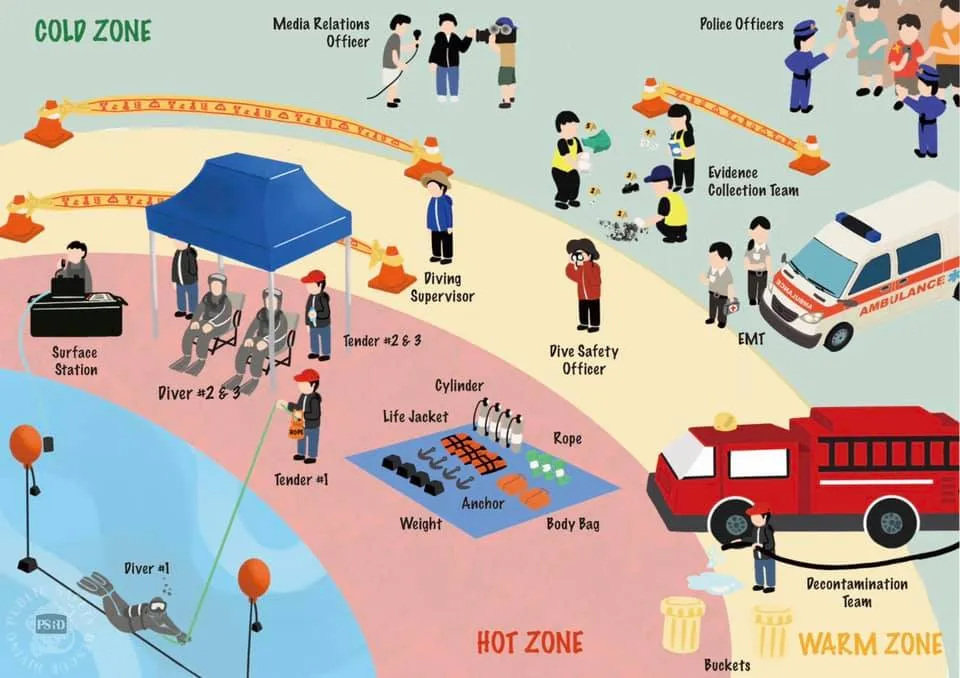
Let me share a look at how things are done in Japan — see if the moon really does shine brighter there.
In Japan's fire service, the Water Rescue Unit is a dedicated, structured role.
Personnel who become water-response responders receive all their water-related training through official government programs.
For diving specifically, training runs for 12 weeks, starting from zero —
and it uses no recreational diving curriculum whatsoever.
After completing the practical portion, candidates must sit for the national diver qualification exam held that year.
Only after passing both the practical and written components do they officially become certified divers (sensuishi).
Many of my Japanese students are firefighters with more than 500 dives logged.
Not a single one of them holds any recreational diving certification —
so they come to me to take recreational diving courses,
simply because they want to be "qualified" as recreational divers.
They have to start from scratch all over again just to enjoy the beautiful underwater scenery.
Let me give another example I've mentioned before: firefighters who use disaster-response radios
must also obtain a Special Land Radio Operator license before they are legally qualified to operate radio frequency equipment at the scene.
(Ask yourself honestly: how much do you actually know about disaster-response radios?)
It comes back to the same point: professional is professional, amateur is amateur — these are two clearly separate paths.
The training accident in Chiayi County has unfortunately already happened.
I gave myself a few days to reflect before writing this article.
My purpose is not to attack anyone.
From the moment the incident occurred, I gathered information from many firsthand sources.
I can understand that, given this particular accident,
the county's available diving knowledge, capability, and the risk management they arranged for this training session
represented the best they could do.
I hope this unit understands that your training approach still carries very significant risk.
I sincerely hope you will take the time to properly establish a better training framework going forward
and reduce the risk of accidents to your personnel.
At the same time, I hope that those who once worked hard for firefighter public safety diving will see this —
from the position and height you now occupy,
a simple "Regrets. R.I.P." is simply not enough.
Review the current diving training structure of fire departments across every county and city in Taiwan.
Improve this training content to reduce the risks firefighters face during dive training.
Do not treat talented people as expendable consumables.
That is my expectation as an ordinary citizen.
This Mid-Autumn Festival, a young firefighter can no longer be reunited with his family.
They are separated forever — because we failed to build the right training system.
How can this be justified?
How can this be justified?
Just so no one dismisses me — let me briefly state my credentials: I am the first person in Taiwan, after my own training officer, to become a public safety diving instructor in one particular system. I am also the sixth person in Japan to obtain instructor certification in a second public safety diving system. My work in Japan is carried out under the Ministry of Foreign Affairs, supporting disaster response capacity-building in developing countries.
My gratitude to Coach Qi-Yuan for bringing this team together — to the dedicated students, I hope you do not feel alone.
Please, to those outside the firefighting community: support and share this. I have always hoped this conversation doesn't stay confined to an echo chamber.
Throwing a stone at a tank — if it's just me, it may be very difficult. But if you join in too,
Coach 黃春源, author of this article
Related links: