Contents(3)
<the Editor says: Did you know? Healthy coral reefs can absorb up to 97% of wave energy, shielding coastal areas from the impact of storms, waves, and flooding. But because coral grows extremely slowly, some scientists have begun training AI to assist with coral restoration efforts, helping coral grow and recover more quickly. Follow along with the Editor to find out more! Full article republished from the Low-Carbon Life Blog, co-produced by the Environmental Information Center; author: Chen Mei-ling.>
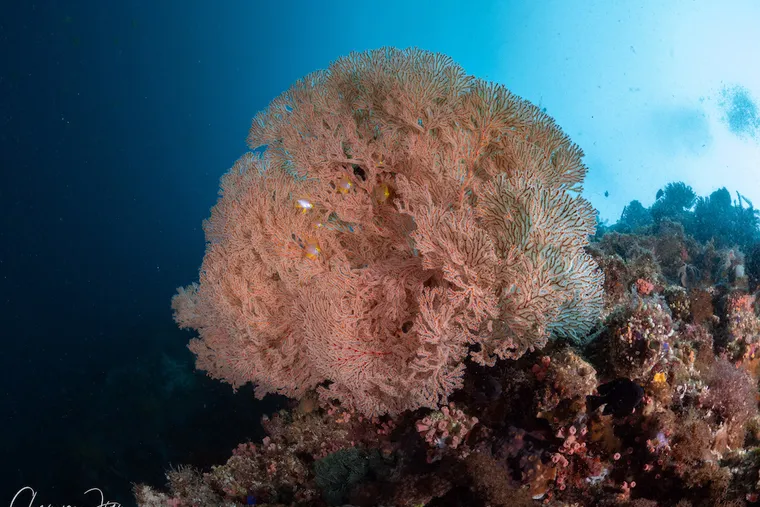
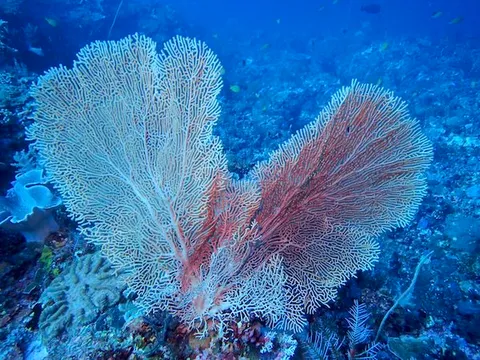
On the seafloor, you often see clusters of tree-like coral — animals that grow primarily in tropical waters and are made up of many individual coral polyps (Polyps). These polyps absorb calcium carbonate from seawater to form hard outer shells, and over time, today's coral reefs take shape. Although coral reefs cover only about 0.2% of the ocean floor, they provide habitat for more than 1/4 of all marine species.
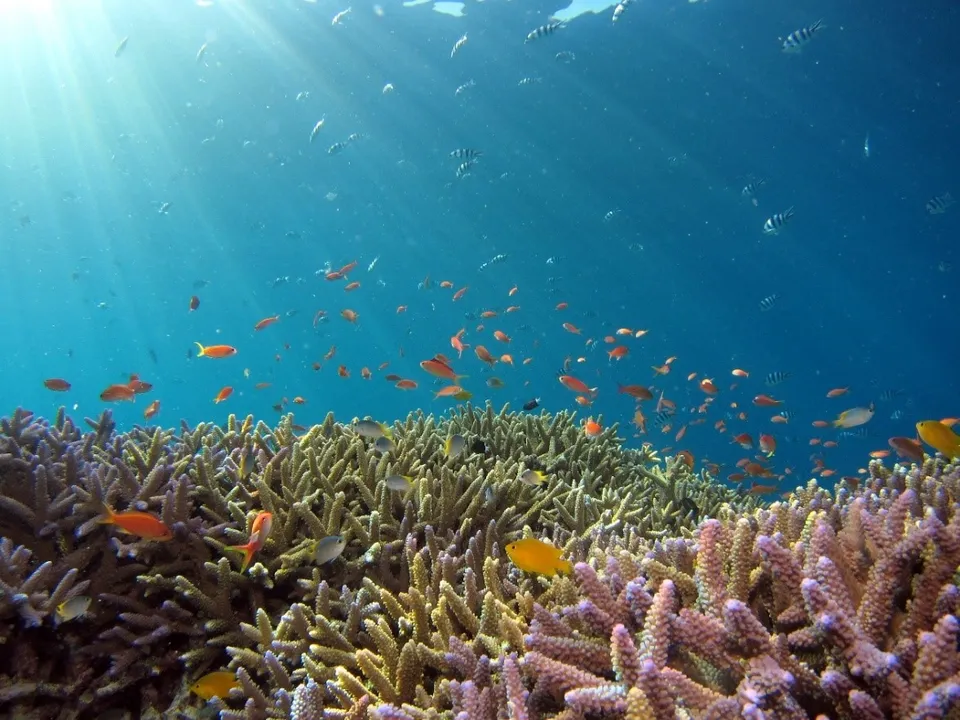
Although coral reefs cover only about 0.2% of the ocean floor, they provide habitat for more than 1/4 of all marine species. Photo credit: Hiroko Yoshii/Unsplash
Coral is highly sensitive to changes in ocean temperature and acidity. Rising ocean temperatures and increasing acidity can both cause coral to become diseased or die. According to a report by the Global Coral Reef Monitoring Network (GCRMN), a sea temperature rise of just 1.5°C could cause 70% to 90% of the world's coral to disappear. Some scientists have even estimated that, under the threat of warming, coral could be completely extinct by 2070.
Coral grows very slowly. The conventional approach to coral restoration typically involves cultivating small coral fragments in land-based nurseries before transplanting them onto damaged reefs. However, this method is not only costly and time-consuming, but can only prioritise the most critically endangered reefs. To counter the impact of warming on coral, researchers around the world have developed many new technologies to support coral restoration and conservation efforts.
Robots Step Up as Coral Restoration Heroes
About 60 kilometres off the coast of Western Australia, in the shallow waters of the Abrolhos Islands — often called the Great Barrier Reef of Western Australia — scientist Taryn Foster and her team are training artificial intelligence (AI) to assist with coral restoration work.
Foster's team has designed a flat, concrete disc with grooves and a handle to serve as a base for growing coral reefs. Scientists train robots to produce plugs sized to match coral fragments, saving the labour of routine manual restoration tasks, before placing these discs in batches into the ocean.
The results to date have been encouraging. Foster notes, "We've deployed several models of different reef structures and tested them with four different coral species — they've all been growing really well."
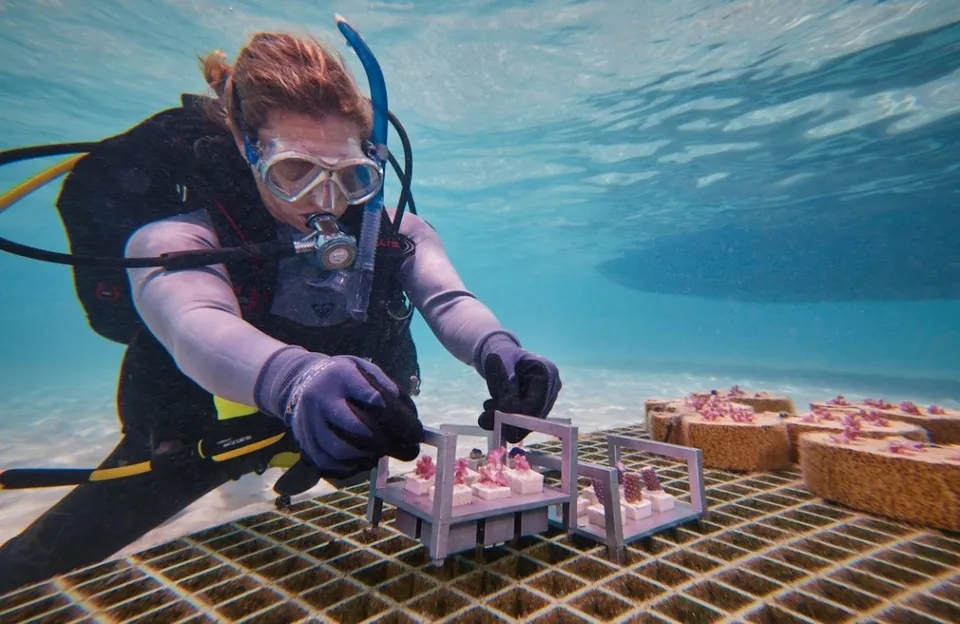
Scientist Taryn Foster places coral-growing base discs into the ocean in batches. Photo credit: AUTODESK press release
The startup Coral Maker, founded by Foster, has gone a step further by partnering with software giant Autodesk to train AI and collaborative robots (cobots), enabling robots and humans to work together on coral restoration and accelerate the recovery process.
The robots are primarily responsible for repetitive pick-and-place actions during the coral restoration process. Robotic arms produce plugs sized to match coral fragments and attach them to the growing bases, while researchers use imaging to determine how to grip each piece. Even fragments of the same coral species vary greatly in shape, so the robots require extensive training to recognise coral shapes and produce bases that fit each fragment accordingly.
Coral Maker's next step is to move the proof-of-concept (PoC) out of the laboratory within the next year and a half. However, returning coral to the ocean floor is also no small feat — doing so without damaging either the coral or the equipment remains a significant challenge.


Training AI to Listen: Health Checks for Coral
Beyond using robots to aid restoration, AI can also help monitor the health of coral reefs. In recent years, considerable effort has gone into studying the soundscapes of coral reefs. However, coral soundscapes are highly complex, and experts often find it painstaking to determine coral health from audio recordings.
In 2022, a study published in the journal Ecological Indicators marked a new breakthrough. Scientists from the University of Exeter, conducting a coral restoration project in Indonesian waters called the Mars Coral Reef Restoration Project, collected and recorded sounds from both healthy and declining coral. They then trained AI to distinguish between the two, achieving an accuracy rate of 92% — a method that holds great promise for tracking the progress of coral restoration projects.
Ben Williams, a doctoral candidate at University College London's Centre for Biodiversity and Environment Research, noted that traditional survey methods relying on visual and acoustic analysis of coral demand enormous amounts of intensive labour. Furthermore, deploying hydrophones in the water — especially in remote areas — is far easier and more economical than bringing in expert divers to conduct large-scale surveys in person.
The organisms and fish living within coral reefs can produce a wide variety of sounds whose meanings are not always clear. Using machine learning algorithms, research teams can use computers to filter out sound patterns (patterns) that the human ear cannot detect. Through artificial intelligence, it becomes possible to determine whether a reef is healthy overall — with greater speed and accuracy than traditional methods allow.
Bleaching and Cryopreservation: Innovative Technologies to Help Conserve Coral
Another new technology for protecting coral reefs comes from a research team at Texas A&M University: "isochoric vitrification." The technique involves selecting coral fragments and preserving them through a combination of strategic bleaching and liquid nitrogen, storing coral at an ultra-low temperature of -196°C without causing freeze damage.
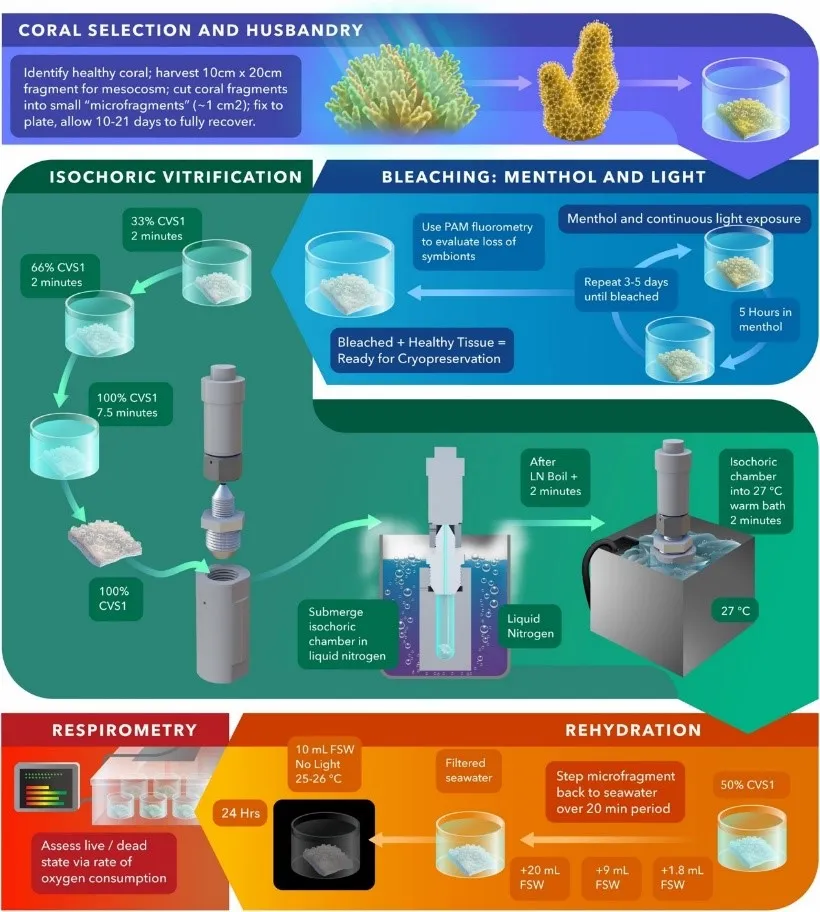
Scientists are testing the use of "isochoric vitrification" technology to assist coral conservation efforts. Photo credit: Cryopreservation and revival of Hawaiian stony corals using isochoric vitrification paper/Nature Communications
Coral has only a brief reproductive window each year — just a few days. In the past, scientists have used cryopreservation to collect reproductive cells during this period, but in addition to having to time collection precisely, the difficulty of accessing coral growing locations has also been a challenge. The innovative technique developed by Texas A&M University is not constrained by time or location, and eliminates the need to maintain delicate equipment underwater, opening a new chapter in coral restoration.
Scientists first need to "bleach" the coral samples, removing the photosynthetic algae that live symbiotically within them. The coral is then placed in a glassy state inside a specialised aluminium container and rapidly frozen with liquid nitrogen. It is subsequently warmed slowly, and seawater is introduced within 20 minutes to revive the coral — with successfully thawed coral surviving for up to 24 hours. This research is still in its early stages; the next challenge is to improve long-term coral survival rates.
Editor in charge: Jenny Tsai
Further reading: