The Editor says: Like Blu, do you find yourself instinctively stopping in front of an aquarium tank every time you pass one, marvelling at the beautiful tropical fish inside? Watching them glide through the water is so soothing — but do you know how those fish got there in the first place? Research has found that rising demand from the aquarium trade is pushing many species to the brink of overfishing, causing their populations to decline sharply... No demand, no harm. Come dive with Blu and see the fish in their natural home instead! <Full article reprinted from the Environmental Information Center, compiled from international sources; translated by Xie Mingshan; reviewed by Xu Zuling>
Full Article
Colourful tropical fish bring life to home aquariums, but the Banggai Cardinalfish (學名:Pterapogon kauderni) — with its striking black stripes and white spots — has seen its population collapse due to the aquarium trade, declining by as much as 90% since the 1990s. Driven by advocacy from conservation groups, the United States is now moving to impose an import and export ban, pressuring Indonesia to take habitat conservation seriously.
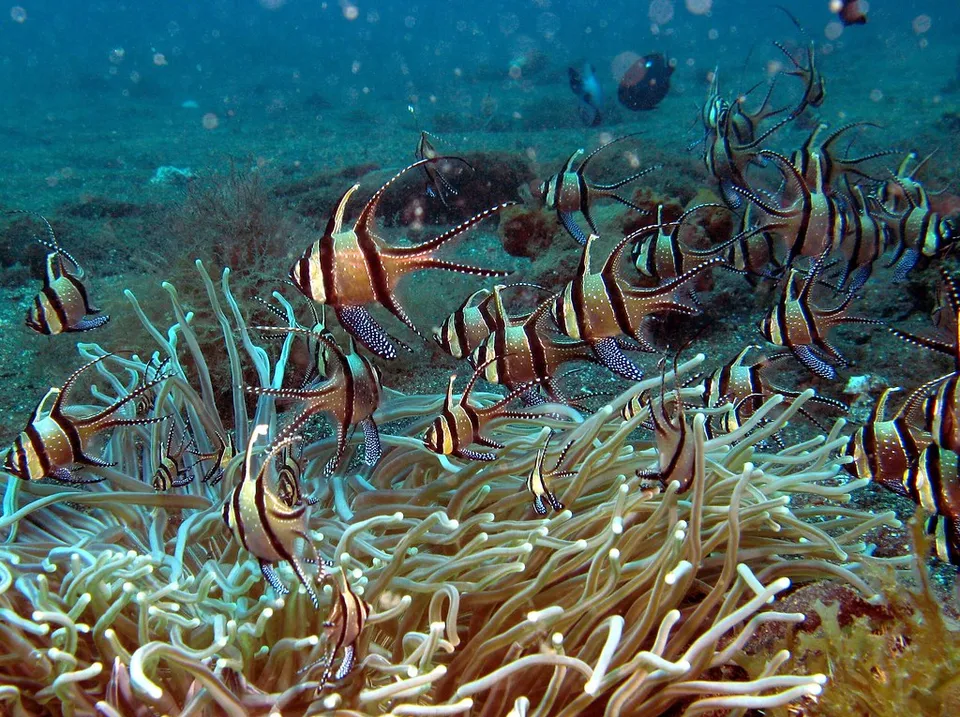
Banggai Cardinalfish gliding among Indonesia's coral reefs have suffered dramatic population losses due to the aquarium trade. Image credit: Silke Baron (CC BY 2.0)
The Banggai Cardinalfish is a small saltwater fish that inhabits Indonesia's coral reefs. In 2021, the Animal Welfare Institute, the non-profit Center for Biological Diversity, and Defenders of Wildlife jointly submitted a petition urging the government to formally establish a ban.
Conservation groups stated that the United States is the primary importing country for Banggai Cardinalfish, bringing in approximately 120,000 individuals per year. The booming aquarium trade has driven wild Banggai Cardinalfish to the edge of overfishing, with populations falling by 90% since the 1990s. Scientists estimate that 75–80% of wild-caught fish die before they are even exported.
According to The Associated Press, the National Oceanic and Atmospheric Administration (NOAA) listed the Banggai Cardinalfish as a threatened species under the Endangered Species Act back in 2016 — yet it was not until mid-August of this year that a proposal was put forward to ban imports and exports in order to prevent further decline of wild populations.
The Banggai Cardinalfish is found primarily in Indonesia's Banggai Islands and faces a triple threat of the pet trade, habitat loss, and climate change. "This is an encouraging, if long overdue, step," said Jane Davenport, a senior attorney at Defenders of Wildlife.
D.J. Schubert, a wildlife biologist at the Animal Welfare Institute, described the proposal as an important first step toward preventing the export of Banggai Cardinalfish to the United States, and as a clear message to Indonesia that the government must do more to protect the species and its habitat.
The proposal has not yet been finalised. NOAA will accept public comment and, depending on the response, may hold hearings before reaching a final decision.


References
- Associated Press (August 17, 2023), US looks to ban imports, exports of a tropical fish threatened by aquarium trade
- Center for Biological Diversity (August 15, 2023), U.S. Proposes Ban on Imports, Exports of Banggai Cardinalfish Threatened by Aquarium Trade, Indonesian Fish Has Declined up to 90%

![[BlueTrend Mini Classroom] The Star Killer & Most Venomous Shrimp: The Devoted Harlequin Shrimp](/_astro/002_vivipic_2vdzYS.webp)