Contents(3)
The Editor says: This blue whale, which stranded and died off Taitung, is a stark reflection of human selfishness… The deep depressions on both sides of its skull are the scars left by a thick nylon rope that had been tightly wound around the whale while it was still alive. Through the concerted efforts of the Ocean Conservation Administration, the National Museum of Marine Biology and Aquarium (NMMBA), and other parties, a complete specimen is now on display at the NMMBA in Pingtung, in the hope that it will awaken public awareness of marine conservation. <Full article reprinted from the Environmental Information Center, reported by reporter Li Yu-chin from Kaohsiung>
In January 2020, a dead blue whale stranded on the beach at Changbin, Taitung. When discovered, the animal was emaciated, its head tightly entangled in a thick nylon rope — a shocking sight. Through a collaboration between the Ocean Conservation Administration (OCA) under the Ocean Affairs Council, the Marine Biology and Cetacean Research Center of National Cheng Kung University (NCKU), and the National Museum of Marine Biology and Aquarium (NMMBA), the skeletal specimen was painstakingly preserved and prepared over more than three years. On the 15th, the blue whale specimen was officially unveiled at the NMMBA, carrying forward the story of the whale and the cause of marine conservation.
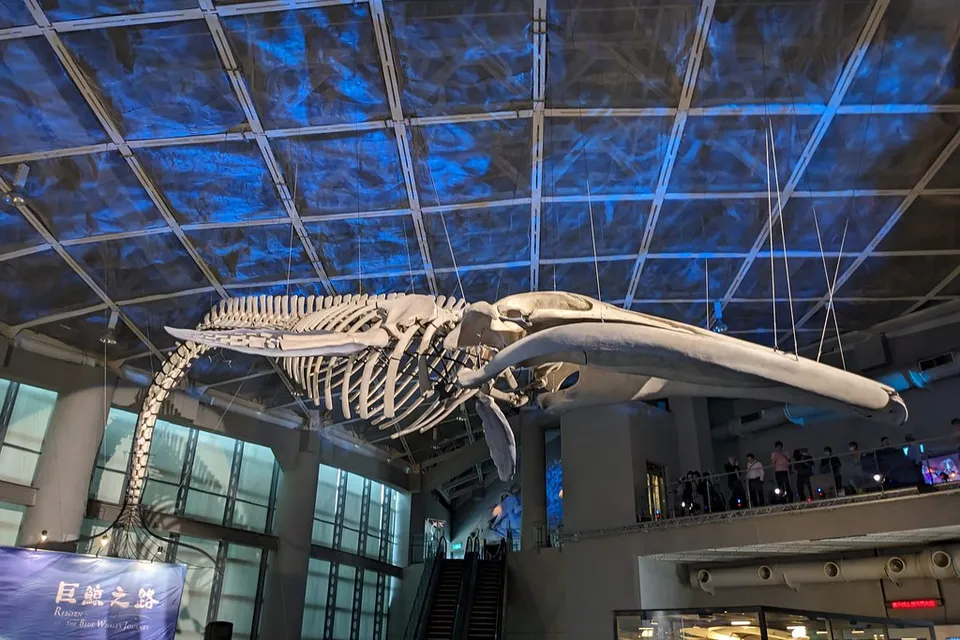
The NMMBA's complete blue whale skeletal specimen — the first stranded blue whale ever recorded in Taiwan. Photo by Li Yu-chin.
Taiwan's First Stranded Blue Whale Specimen on Display
Step into the main hall of the NMMBA's World of the Sea exhibit, and beneath deep-blue projected light, a skeletal specimen measuring over 20 metres hangs overhead, simulating a blue whale diving into the ocean. This specimen represents the first stranded blue whale ever recorded in Taiwan; only 25 complete blue whale specimens are on public display worldwide.
OCA Director Huang Hsiang-wen noted that when the blue whale carcass was first discovered, relevant research and conservation units and volunteers were immediately mobilised to begin preserving the specimen. In 2021, the OCA, NCKU, and the NMMBA signed a "Memorandum of Cooperation on Blue Whale Skeletal Specimen," jointly undertaking the reconstruction, assembly, display, and archiving of the skeletal remains for academic research and educational outreach. Nearly four years later, the blue whale is now fully exhibited at the NMMBA in Pingtung, symbolising its rebirth.
The NMMBA used a triaxial keel-mounting method to assemble the specimen. For safety considerations, the suspended whale's head is a moulded replica. The NMMBA further explained that the original skull is displayed at floor level using an exploded-view presentation — each individual bone mounted separately — allowing visitors to observe the internal structure up close, while also preserving the possibility of future scientific measurement and sampling. This marks the first time in the world that the detailed structure of a blue whale skull has been displayed in this manner, offering genuine value for future blue whale research.
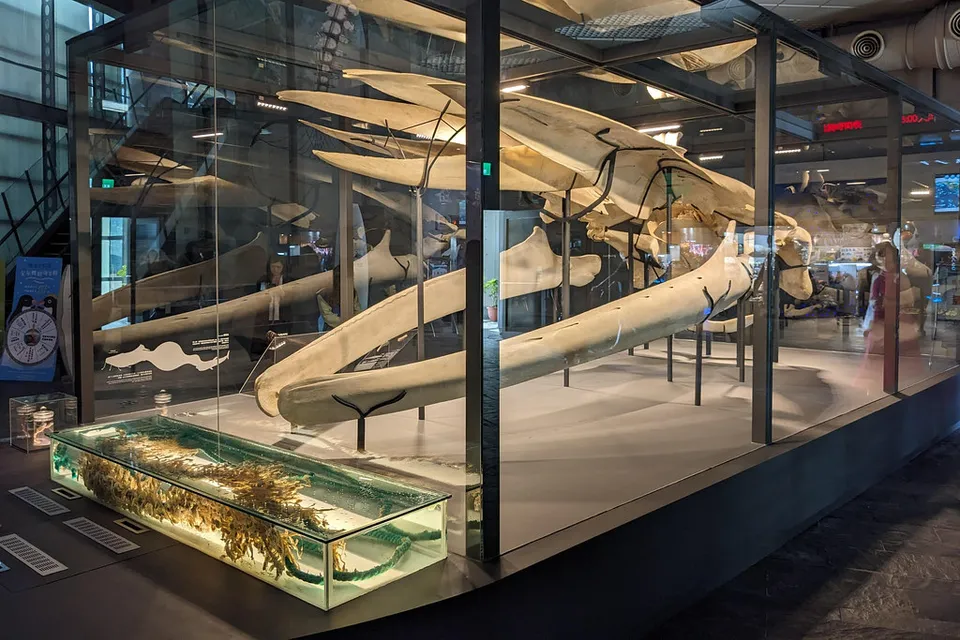
The original blue whale skull specimen and the rope that once tightly bound it, displayed at floor level. Photo by Li Yu-chin.


Discarded Nylon Rope Displayed Alongside the Skeletal Specimen
Wang Hao-wen, Director of the NCKU Marine Biology and Cetacean Research Center, explained that the blue whale is the largest animal on Earth, with the largest individuals exceeding 30 metres in length and weighing up to 180 metric tonnes. This 20-metre individual was a juvenile whose skeleton had not yet fully ossified and still retained considerable cartilaginous tissue — a significant challenge for producing a complete specimen.
In the floor-level display, deep depressions of more than 10 cm are visible on both sides of the upper jaw, where the thick nylon rope had been tightly wound during the animal's lifetime. Wang pointed out that the rope, embedded deep into the bone, had restricted the whale's ability to open and close its mouth while it was alive, impairing its capacity to feed. Prolonged malnutrition stunted the young individual's growth — making it easy to imagine just how much larger a healthy blue whale would be.
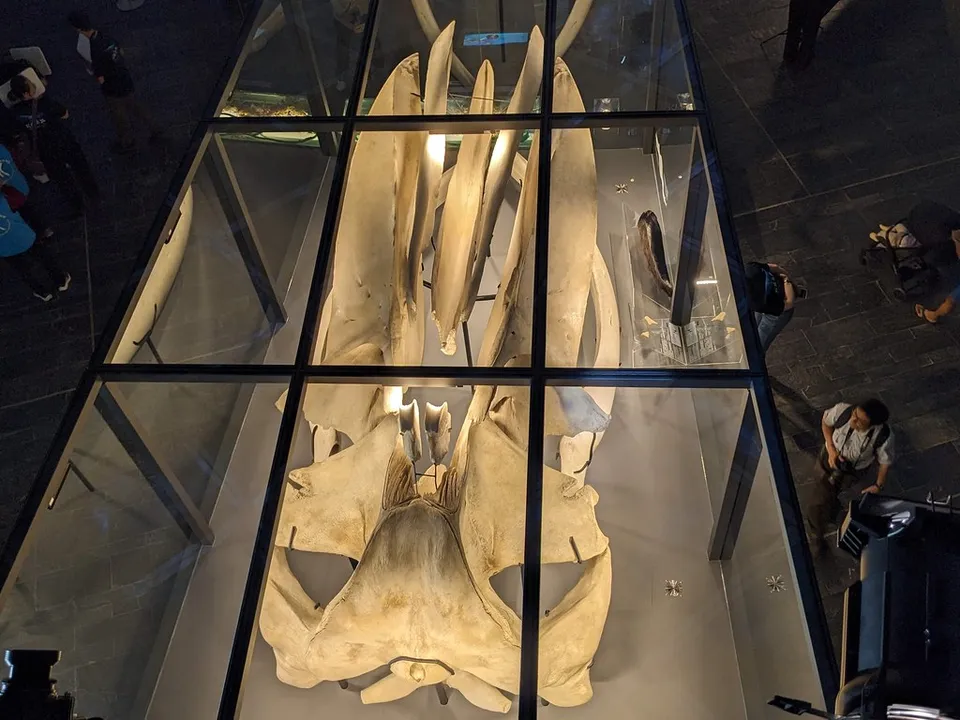
Deep rope-mark depressions are visible on both sides of the upper jaw of the blue whale skull. Photo by Li Yu-chin.
In addition to the skeletal specimen, the nylon rope that entangled the whale — along with the gooseneck barnacles attached to it — is also on display nearby. Huang Hsiang-wen stated that exhibiting the rope is a deliberate reminder that gear entanglement is one of the most common causes of death among large whales and other marine life. "Although Taiwan is not within the blue whale's migratory range, ocean protection knows no borders." She called on the public to voluntarily collect and dispose of abandoned fishing nets and gear, reduce the use of single-use items, minimise the threat of marine debris to marine life, and collectively contribute to marine conservation.
Using the Blue Whale Specimen to Keep Telling the Ocean's Story
The waters of the Hengchun Peninsula were once frequented by whales. During the Japanese colonial period, the Japanese government established a whaling harbour and whale processing facility at South Bay in Kenting. In 2022, a complete whale fossil dating back approximately 85,000 years was unearthed at Tougou in Hengchun. "The available data suggests that the Hengchun sea is a home for whales," said NMMBA Director Chen Chi-hsiang, adding that this is precisely why the museum was established here — to welcome visitors into the world of the ocean through the presence of whales. "It is the NMMBA's unshirkable duty to receive this blue whale and preserve and display it."
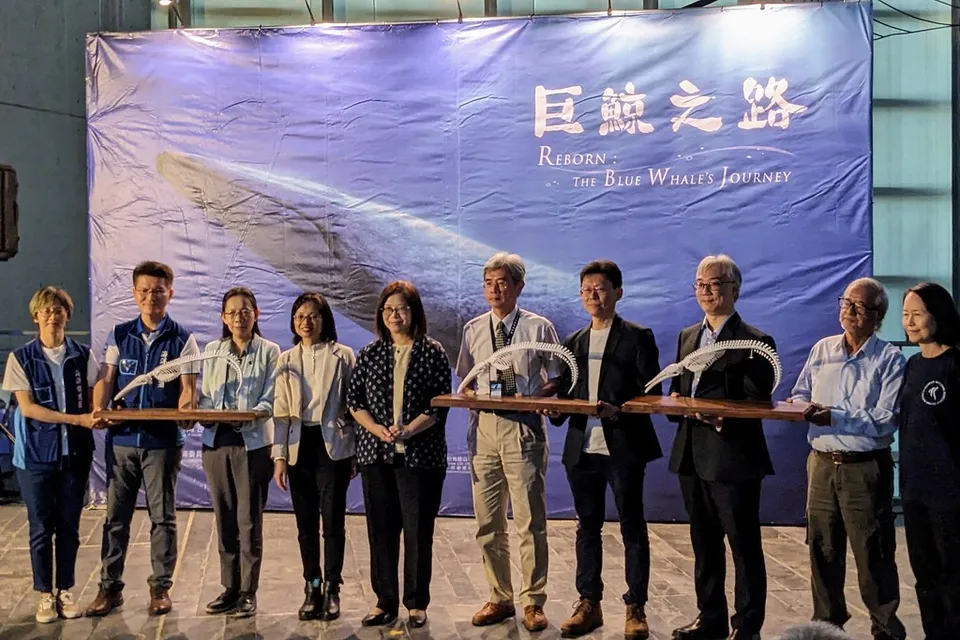
The OCA, NCKU, and NMMBA signed a memorandum of cooperation on the blue whale skeletal specimen, making its preservation and display possible. Photo by Li Yu-chin.
Chen Chi-hsiang said that the successful preservation and display of the blue whale specimen is the result of collective teamwork. This whale has been speaking to us from the very beginning, and through every person who has handled it, its story has been told. Although it has arrived at the NMMBA in this manner, the skeletal specimen gives the blue whale a second life — and through science education, exhibition, research, and outreach, its story and the story of marine conservation will continue to be told.
Editor-in-charge: Jenny Tsai
Further Reading:
Full article reprinted with permission from the Environmental Information Center. Original title: NMMBA Exhibits Complete Blue Whale Specimen from Changbin — Rope Marks on Skeleton Spark Conservation Reflection