Contents(5)
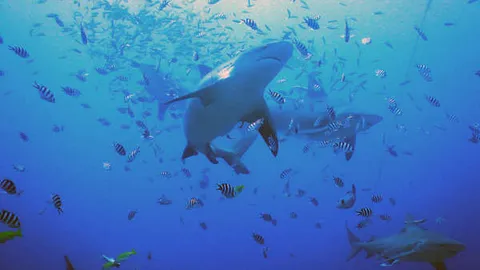
Diving with sharks is, without a doubt, one of the most beautiful experiences of my life so far — even more moving than the first time I learned to breathe underwater.
Cast your mind back to 2016, and a trip to Fiji I took just before wrapping up my working holiday in Australia. That island-hopping and diving adventure cemented my resolve to become a dive instructor.
Fiji is said to be the only place in the world where you can encounter 8 species of sharks at the same time — no cage required. So the moment I confirmed I had enough savings for the trip, shark diving was already locked into my itinerary.
I did a lot of research beforehand and quickly discovered that shark diving is incredibly popular. For my October trip, I booked as early as May. Here's my (totally unofficial) rundown:
Choosing a Dive Shop in Fiji
The shark diving site is near an island called Beqa, and only two dive shops are licensed to legally operate shark diving tours there:
1. The one we went with — Beqa Adventure Divers — charges 350 FJD for two dives without equipment, or 400 FJD with equipment (2016 prices). I honestly can't remember whether the park entry fee was included or paid separately (Fiji has established a marine protected area in this stretch of ocean, so a national park entry fee applies).
Updated rates: http://fijisharkdive.com/rates/daily-diving-rates/
2. The reportedly larger operation, Aqua Trek, charges 165 USD for two dives without equipment, with gear an additional 30 FJD and a 20 FJD park entry fee on top.
Reference: http://www.aquatrek.com/rates.cfm
In the end I chose Beqa. After reading through the relatively few trip reports available and getting quotes from both shops, Aqua Trek was a little cheaper, but a fellow diver who had dived with both said Beqa's sites were better and that they run smaller groups.
Aqua Trek is more internationally recognised and is a larger operation (Beqa is locally owned), with groups of anywhere from 1 to 20 divers. Although coordinating the booking by email with Beqa was a masterclass in "Fiji Time" (see note below) — I spent over a month going back and forth before finally caving and making an international phone call to confirm my reservation — it was absolutely, completely worth it. Beqa's dive guides and the lovely woman at the front desk were both warm and thoroughly professional!
Note: "Fiji Time" refers to the local philosophy of slow living — everything moves slowly, and slow is the main rhythm of life. City folks used to a fast pace may find it a bit disorienting, but it's also the perfect nudge to decelerate, unwind, and actually enjoy the journey.
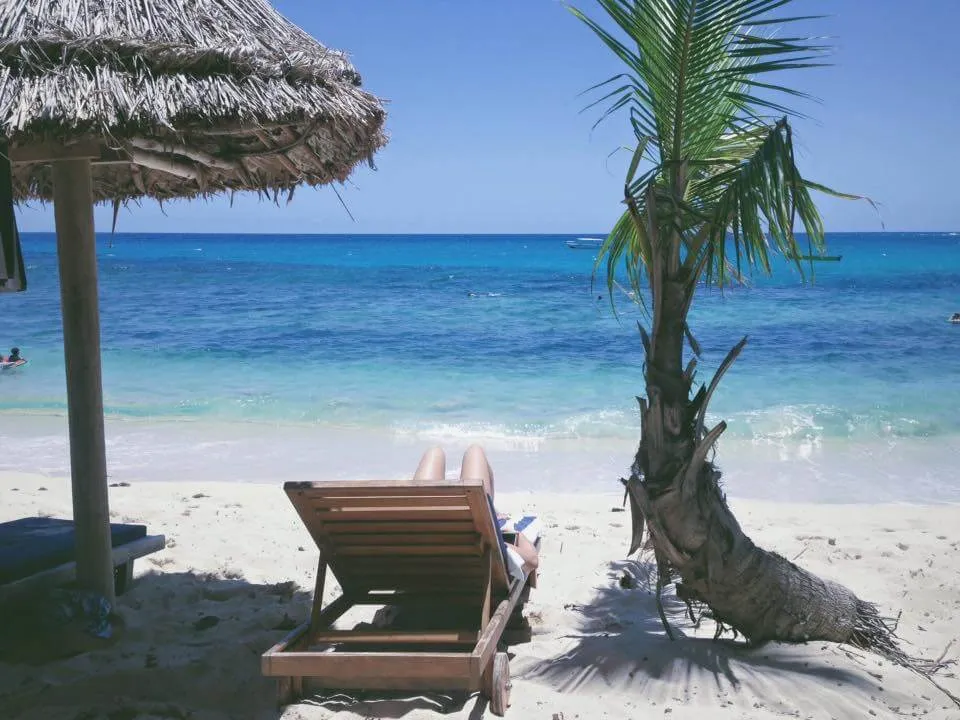


Qualification Requirements for Shark Diving
The minimum certification required to join a shark dive is an Open Water Diver (PADI/SSI cert) scuba diving licence. However, the dive shops recommend at least 10 logged dives and ideally an Advanced Open Water Diver (PADI cert) certification, since the shark viewing depths are 25 m and 30 m respectively — beyond the recommended depth range for Open Water. That said, if you only hold an Open Water certification, an assistant instructor will stay with you throughout to ensure extra safety.
How Dangerous Are the Sharks?
According to the dive shop, there have been zero attack incidents since shark diving tourism began here. The shop does advise, however, that if you bring a GoPro, don't use a long selfie pole — sharks may mistake you for a feeder. Beqa thoughtfully provides short buoyancy wrist mounts for GoPros. White fins and accessories are also best avoided, as sharks might mistake the reflective glare for the scales of a fish and take an accidental nip.
Accommodation in Fiji
The departure pier is at Pacific Harbour. I originally booked Uprising Beach Resort because it looked cheaper than The Pearl Resort on Booking.com — only to be told they had no dorms, so I ended up booking a double room for around 160 AUD.
What followed was a series of disasters: being overcharged, being asked to bear the exchange-rate difference on a refund, and dealing with a front-desk manager whose attitude was nothing short of appalling. In the end the general manager had to step in to apologise and arrange a refund — which itself took another month because they transferred the money to the wrong person and came up short by more than 20 AUD. I didn't book The Pearl Resort until the day before my flight to Fiji, and found a special deal on Agoda for just 140 AUD — for a double room!
The Pearl Resort earned a perfect 10 out of 10 from both me and my then-boyfriend. From the welcome, to the room, the food, and every member of staff — we genuinely felt right at home.
Back to the Shark Dive
Because we had a local SIM card, we'd confirmed with the dive shop which hotel we were staying at. They sent someone to pick us up at 7:45 a.m. for an 8:00 a.m. muster at the shop. Beqa also runs its own accommodation, a place called Lagoon Resort — though from the outside it honestly looked like a haunted house to me.
Beqa provides 5 mm wetsuits, which are more than warm enough (I wore my own 3.2 mm one and nearly froze to death). After boarding the boat, it's roughly another 15 minutes to reach the marine protected area. The dive guide briefed us on the topography and the shark species we might encounter, walked us through how to position ourselves during the dive, and mentioned that a portion of the revenue from the shark diving operation goes toward marine conservation and to the communities living adjacent to these waters.
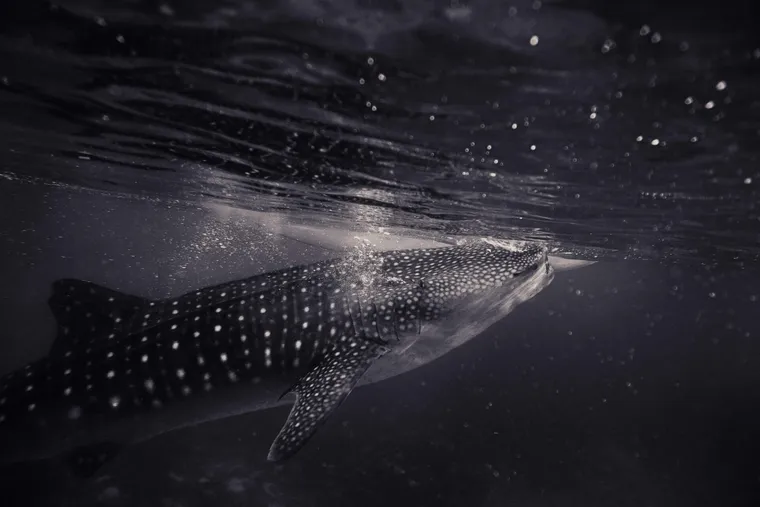
This model is, in fact, quite similar to the Whale Shark diving in Cebu and carries a fair share of controversy. The protected dive site was originally a fishing ground, and establishing a marine protected area directly affects the livelihoods of local fishermen. It's a tension well worth reflecting on in Taiwan — how do we strike a balance between tourism, people's livelihoods, and conservation? Taiwanese fishermen currently bear enormous public criticism, yet without marine policy or proper support measures from the government, short-sighted blame will always fall on ordinary people at the bottom.
Although it's called "diving," we actually barely moved for most of it. We descended directly to 30 m and knelt on the reef to watch the feeding show — neutral buoyancy control wasn't really a concern, so the dive guide gave us extra weights to stay firmly planted on the bottom. (And honestly, when you're kneeling there screaming internally, buzzing with excitement, and frantically photographing and filming everything, neutral buoyancy is the last thing on your mind. Extra weights: absolutely the right call.)
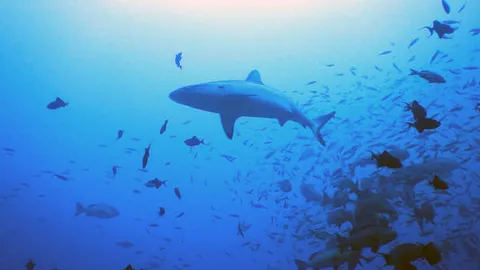
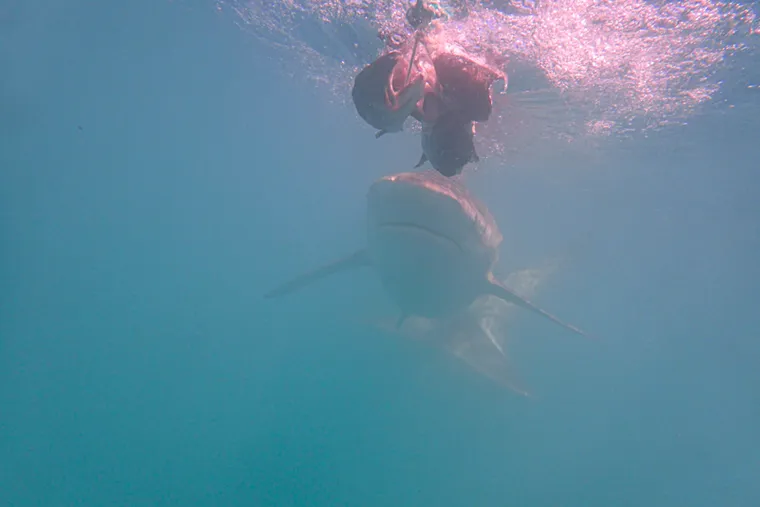
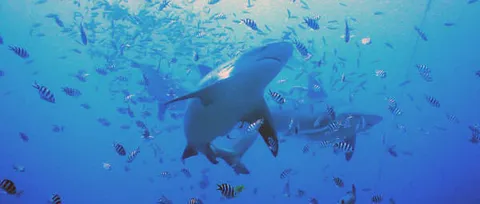
The stars of the first dive were Tiger Sharks, Blacktip Reef Sharks, and Greytip Reef Sharks. Several instructors stood guard around the group like bouncers (we were told to kneel — out on the street that would probably get us mistaken for prisoners, especially since the instructors were holding long poles for protection). One instructor then held open a large bucket, letting blood and small chunks of fish drift out to lure the sharks in. At this point a huge swarm of damselfish showed up to gatecrash the feast. At first I thought they were adorable — by the end they were absolutely infuriating.
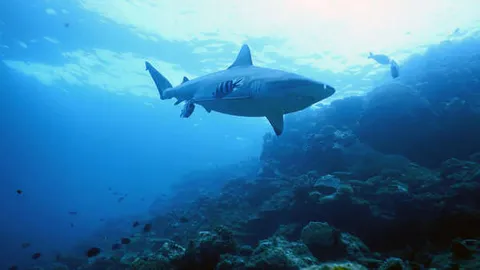
Once the big boys arrived (cue internal screaming), the feeders would pull out chunks of fish and toss them over to be eaten.
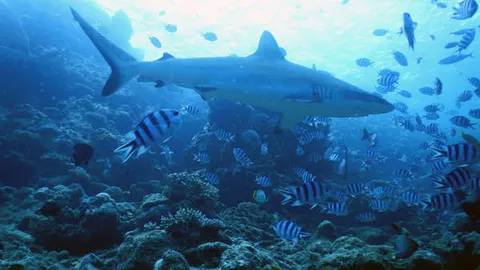
Then, after about 20 minutes or so (I've lost track), we began our two-stage safety stop — probably the coolest safety stop I've ever done!!! Unfortunately my camera wasn't great at the time, and as a complete beginner I had no idea about fill lighting or white balance, so everything came out blue.
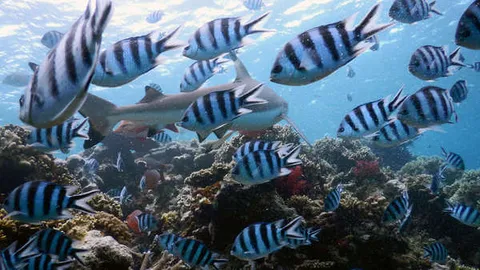
The second safety stop — one look at my photos tells you exactly why I despised those little fish. Every time I tried to get a shot of a shark's face, they were in the way...
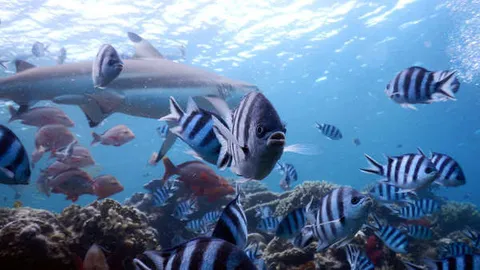
Back on the boat, we completed our surface interval and headed to the next site (not far at all), with the dive guide giving us another quick briefing on the layout.
The highlight of the second dive: Bull Sharks!
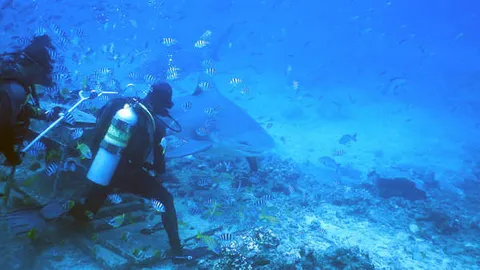
The person on the far right of the photo is the one pulling fish chunks out of the bucket to feed the sharks. It struck me then that sharks really aren't interested in live fish — they only go for bloody pieces of flesh. Which goes to show, they certainly have no interest in humans. Please, stop misunderstanding them!
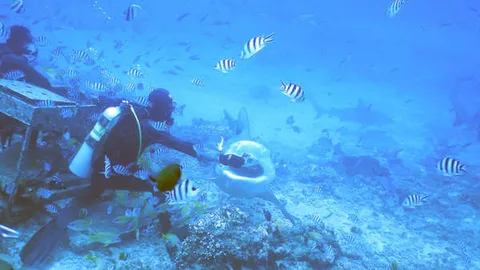
The younger instructor in charge of feeding got a bit carried away and tried to play with the sharks — and promptly got smacked by the more senior instructor beside him. Each shark here has its own record and name. All the sharks must swim past from left to right before the feeders will offer them fish (this way the feeder's hand is never in danger of being accidentally bitten). There is one exception: an old female called Scar. They've known her for a long time, and she has a scar on her right cheek from an old injury — she's the only one allowed to swim right to left and still get fed.
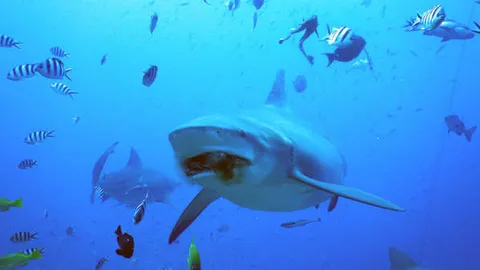
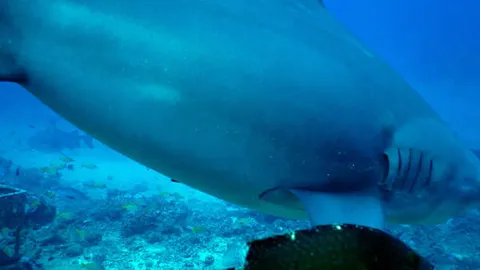
That distance? Close enough that I could have reached out and touched him.
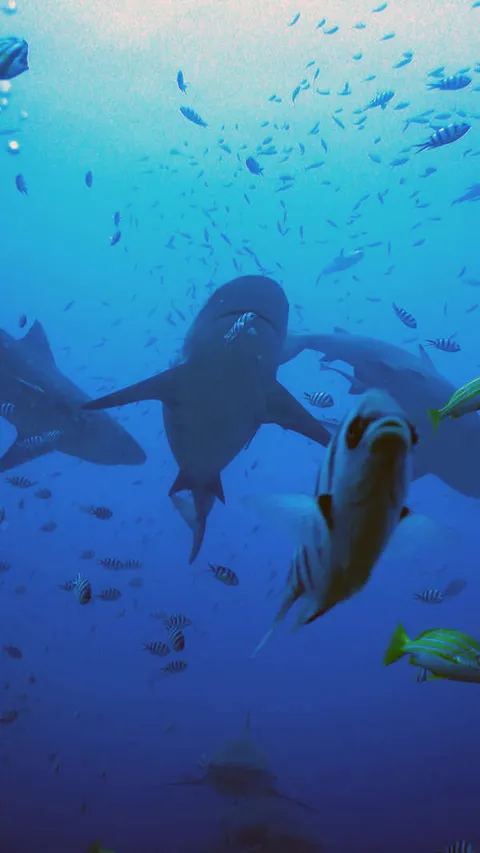
The safety stop on the second dive had far fewer sharks around, but right beside us was the most stunning coral reef garden! We even spotted a cute little Clownfish. Seeing such beautiful coral here made me genuinely happy, because on the few islands I'd snorkelled around in Yasawa, the coral was either very limited in variety or almost entirely bleached...
After we surfaced, the instructors actually apologised to us, saying there hadn't been very many sharks??? We were completely baffled — we'd seen around 15 or 16 large Tiger Sharks and Bull Sharks, plus countless reef sharks. "Not many," they said. Turns out during peak season, sometimes 70 or 80 sharks gather at once — that must be an absolutely jaw-dropping sight. Now that I have more experience — and while my photography still has plenty of room to improve — I know that one day I will return to Fiji to recapture that sense of awe and wonder.
Extended reading:
Frequently Asked Questions
How is a BlueTrend dive trip different from an unknown, no-name dive group?
Choosing us means full peace-of-mind protection and a smooth experience from start to finish. Every trip we run holds to three things.
First, full legal protection and a professional dive leader: we strictly follow Taiwan's travel regulations and provide complete travel-agency liability insurance, travel insurance, trip-inconvenience insurance and dive insurance. Every group is accompanied by a certified, foreign-language dive leader who joins you on both the dives and the land itinerary, liaising seamlessly with local dive shops and operators on your behalf to keep things running smoothly — the person our travellers trust most.
Second, fully licensed with secure payments: every payment goes into a licensed travel agency's account, with multiple safe payment channels (bank transfer, credit card and more) and a legal collect-and-remit receipt, so every transaction is open, transparent and protected, avoiding the fraud and dispute risks of transferring money privately to an individual.
Third, hand-picked quality we vet in person: every trip, dive site and partner shop is scouted on the ground by our own team, from the guides' professionalism and safety standards to the food, lodging, environment and service details on land, all vetted by us so you don't get caught out.
I want to sign up for a dive trip. Are there certification-level or logged-dive requirements?
Each dive site is different, so the entry bar varies. 'Bali Tulamben', for instance, is relatively beginner-friendly. 'Malapascua in the Philippines' is also beginner-friendly, but since thresher sharks tend to cruise between 20 and 30 metres, we recommend AOW certification with 20+ logged dives to enjoy this trip comfortably. For 'the Maldives' or 'Palau', we suggest AOW with 50+ logged dives for a more relaxed experience. If you're not sure whether your experience fits the trip you want, message us and our dive editors will assess it and help you find the trip you'll feel safest on.
Can I join if I'm signing up alone? How are rooms arranged?
Plenty of our travellers sign up solo! For rooms and beds, we prioritise pairing you with a same-gender traveller, and if you'd rather have your own space you can pay the difference to upgrade to a single room. For the diving, our professional leader will pair you with a suitable buddy, and with the happy vibe on our trips you'll quickly make a great group of dive friends. Many people sign up alone, make new friends, and end up organising the next trip together!
Does the trip fee include dive insurance, gear rental, taxes and instructor tips?
It depends on the trip, the destination's regulations and the local operators. Every BlueTrend dive trip has a detailed web page with a clear 'included / not included' list, transparent and with no hidden charges. All payments are collected by a licensed travel agency, with a standard-form contract for your protection.
I'm a new diver / haven't dived in a long time — will I fall behind the group?
Before you complete your booking, our team assesses a suitable trip based on your certification level and experience. Before departure, we strongly recommend taking time to refresh in Taiwan with an instructor, or a fun dive to get your feel back. On the trip itself, our professional dive leader groups and pairs everyone by experience, keeps a close eye underwater on travellers who need extra care, and steps in to help right away.
Will the photos and videos taken during the trip be shared with us?
During the dives, 'safety' is always the leader's top priority, so whenever it's suitable and safe the leader will capture great shots and record the best moments. During or after the trip, we compile a cloud album for all travellers to download, so you go home loaded with memories!
Besides your scheduled trips, can you arrange a private group charter or independent travel for me and my friends?
Absolutely! Besides group trips, we also arrange private group charters and independent travel. We can communicate, enquire and coordinate services with local operators based on your needs, saving you time and effort and taking the language barrier off your plate, to tailor the smoothest, most reassuring dive trip just for you. Contact our LINE support and our editors will arrange it for you!