The other day I was chatting with a friend who said his favourite dive computer is the S-brand, because it lets you stay underwater longer and its calculations are the most conservative and safe (I had a good laugh inside...). Then the topic turned to Deepblu — someone said the decompression stop is fixed at 5 m, and another person claimed that without buying the decompression feature you can only do recreational diving... That reminded me I had actually filmed a dedicated walkthrough back in July and then got too busy to post it.
Key Features of the Deepblu Dive Computer
The most important function of any dive computer is understanding the No-Decompression Limit (NDL) at your current depth — if you don't know what that means, come find me for a refresher (laughs).
I've put together a step-by-step record of the most common scenario: triggering a decompression procedure on Deepblu, so you can learn how to read the information and follow the correct process.
Video 1 shows the normal dive state (the top-right corner displays 1 minute remaining within the NDL), with the vertical bar on the right down to its last red segment.
Video 2 shows the moment the NDL is exceeded: the Deepblu screen flashes an alert and sounds an alarm (the top-right corner now shows "CEL," indicating that a decompression procedure has been initiated), and the vertical bar on the right disappears entirely.
Image 3 shows the display once a decompression procedure is well underway. The second-to-last row shows dECO-000, which is the elapsed time since entering decompression. Most importantly, the bottom row reads 05.0 08:00 — meaning you must ascend to 5 m and hold a decompression stop for 8 minutes.
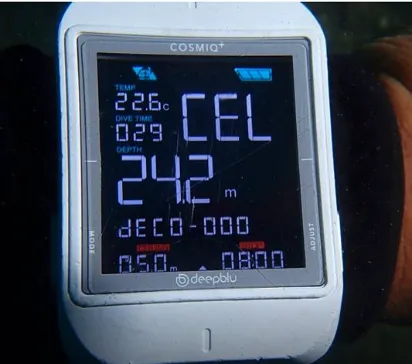
At this point the diver should ascend at a normal rate; continuing to remain at depth will cause the required decompression time (currently 8 minutes on the display) to keep increasing.
Image 4 shows the decompression calculation still in progress during ascent, at a depth of 18.1 m.
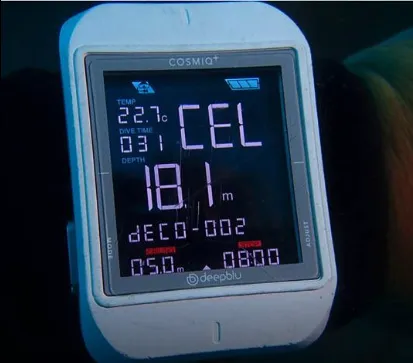
Image 5 shows the moment during ascent, at 17.7 m, when the nitrogen partial pressure drops enough for the decompression procedure to pause (the explanation is a bit complex — it relates to the different tissue M-values in ZHL-16). The top-right corner now shows an NDL, meaning you can remain at this depth for another 4 minutes; exceeding that will restart the decompression procedure and add more decompression time.
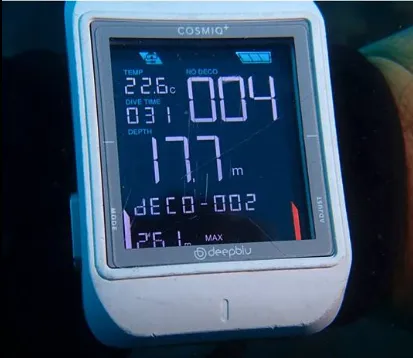 (Note 1) dECO-002 indicates that 2 minutes have elapsed since entering decompression. (Note 2) Although the top-right corner shows a 4-minute NDL, dECO-002 still indicates that there is outstanding decompression to complete.
Video 6 shows the return to 5 m (3–5 m) to begin executing the decompression stop; the countdown in the top-right corner is now displayed in seconds.
Image 7 shows the display during the decompression stop: the top-right corner reads 73 seconds, while the bottom-right corner shows a red "STOP" symbol with a time of 01:13.
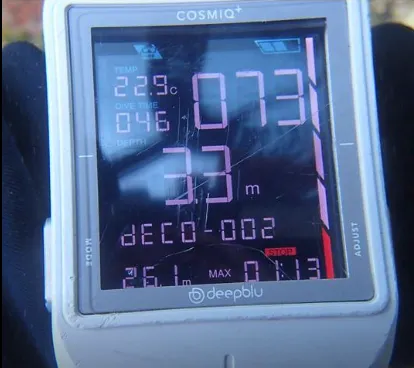
Image 8: if your depth is shallower than 3 m, the decompression countdown pauses — you must return to at least 3 m for it to resume.
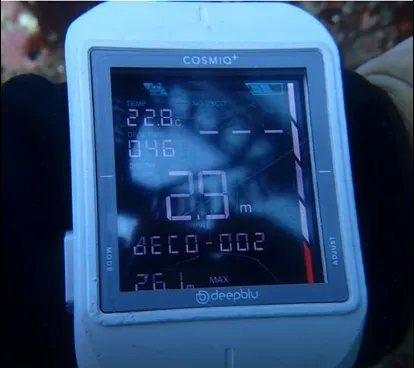
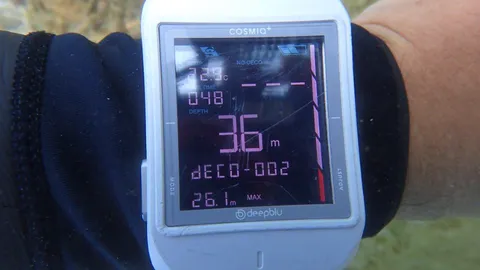
Image 9: once the decompression procedure is complete, the top-right corner displays "---" and the red "STOP" symbol in the bottom-right corner disappears.
Instructor's notes:
- If you enter a decompression procedure, begin ascending at a normal rate immediately to reduce your depth — there is no need to panic.
- The sooner you ascend, the slower nitrogen continues to load into your body, keeping the required decompression time from growing too long. Aim to get within 10 m of the surface as quickly as possible.
- Once you reach your decompression depth, simply complete the stop as directed — it will have no adverse effects on your body, no different from a regular recreational dive.
- What matters most, however, is that an unplanned entry into a decompression procedure may leave you with insufficient air in your scuba tank to complete the stop, and that is where the real risk lies.
Additional information:
On 11 December 2018, DiveMate Club edited and produced the footage below with a heartfelt voiceover, making the whole thing much easier to follow. Share it widely so we can all dive more safely in the future!