The Editor says: Over the past few days I noticed a lot of debate in online groups about whether the 5-metre safety stop is truly necessary. Deepblu co-founder Brad shares his perspective from his experience developing the Deepblu dive computer, hoping to help everyone dive more safely and debunk some long-standing myths circulating in the diving community.

Deepblu co-founder Brad Chen
The following article was posted by Brad Chen on his personal Facebook page (2017.7.12)
Yesterday I responded to some questions on a diving forum about decompression theory and stops, so I'd like to consolidate those thoughts here and invite more people to join the discussion. On one hand, I hope instructors can explain these concepts accurately so students learn through the right channels; on the other, I hope divers can more fully understand the underlying reasons behind these ideas.
Does Recreational Diving Require a Safety Stop?
First, recreational diving is also known as no-decompression diving. Much of the debate centres on whether the 5-metre, 3-minute safety stop is absolutely necessary. The purpose of the safety stop is to give the faster half-time theoretical tissues more time to off-gas nitrogen — doing it is certainly beneficial, since theoretically the fastest half-time tissues will have off-gassed about 70% of their nitrogen within those 3 minutes. However, if completing the 5-metre, 3-minute stop poses difficulty or risk on a particular dive (strong current, heavy surge, hazardous marine life, equipment issues, physical discomfort, etc.), you should not and need not force that stop. Breathing enriched air nitrox (EANx) or extending your surface interval by an extra half hour can compensate for the accumulated nitrogen.
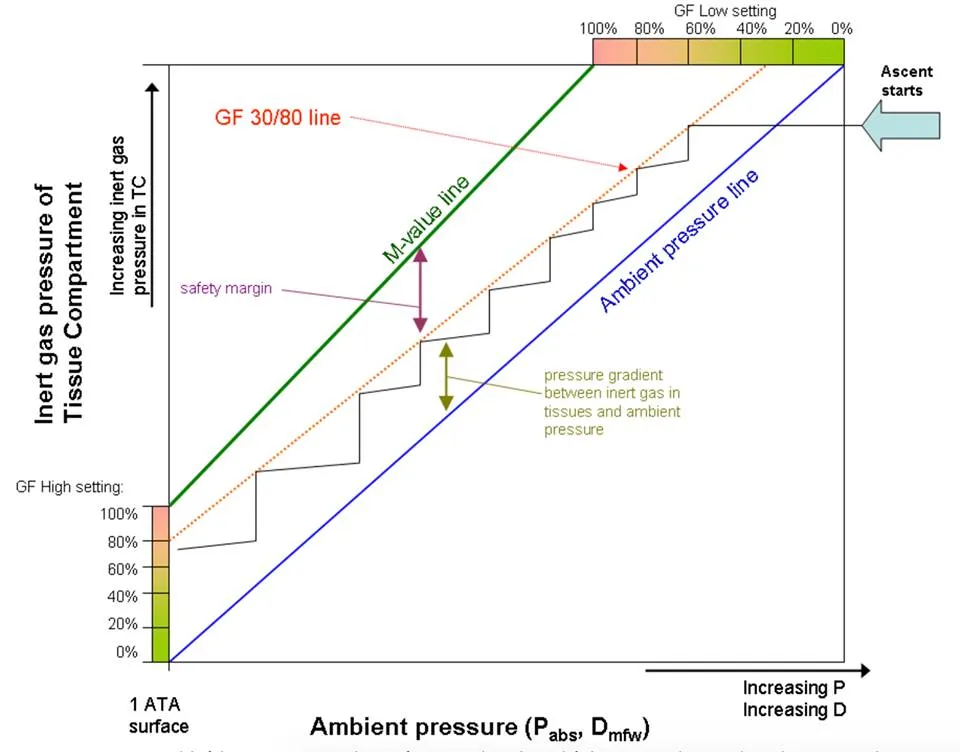
For most recreational dives that are properly planned, all compartment tissues theoretically should not reach the M-Value or GF limit (the green zone in the chart below). Honestly, the pressure difference between the surface and 5 metres is only 0.5 bar, and you actually off-gas nitrogen faster at the surface. But does staying underwater always help? Not necessarily. A deep stop, for example, actually increases nitrogen absorption in the slow half-time tissues. In the short term, the tissues that affect multi-day diving are the fast half-time ones — because according to the ZH-L16C table, the 635-minute half-time tissue would need you to stay at its M0 depth for over 3 days to reach saturation. On the other hand, for the 5-minute fast half-time tissue, spending just 5 minutes below 38 metres already requires a decompression stop (not just a safety stop).


Understanding the Safety Stop Through Theory
From my personal experience working with VPM, Bühlmann ZH-L16C, and the Deepblu algorithm, decompression theory is ultimately just that — theory. It is not like F=MA or H=½GT², which are established laws. Only by understanding the reasons and purposes behind decompression stops and safety stops can you truly convey these concepts to students, because diving techniques, practices, and procedures are constantly evolving. There is no need to rigidly follow any one doctrine. Take the deep stop example mentioned above — it has only been in recent years that some decompression sickness (DCS) cases have been linked to divers forcing deep stops at inappropriate depths.
Furthermore, the greatest risk in diving is ascent rate — ascent rate — ascent rate. It bears repeating three times. No matter how deep you go or how long you stay, as long as you have sufficient time and gas to complete the off-gassing process, you will not get DCS. However, each person's nitrogen tolerance varies with circumstances, which is exactly why Haldane and Bühlmann used "theoretical tissues" to calculate nitrogen uptake and release in the body rather than directly measuring your heart, liver, spleen, lungs, and kidneys.
So looking back at the cause of DCS — everyone already knows it's caused by the body accumulating too much nitrogen, but strictly speaking that's only half the answer. More precisely, it is the nitrogen pressure accumulated in the body that becomes too high. Because we continuously breathe underwater, it is as though we are constantly pumping high-pressure nitrogen into our bodies, so the gas built up inside dissolves into our tissues under high pressure. Once the nitrogen pressure in the tissues and the ambient pressure reach a specific differential (known as the gradient), nitrogen will come out of solution directly as bubbles, leading to various DCS symptoms. To meet this condition — an excessive gradient between the nitrogen pressure in the body and ambient pressure — the ascent must be fast enough that nitrogen cannot be eliminated through metabolic processes (breathing, excretion, etc.) and instead emerges as bubbles. Therefore, regardless of depth or bottom time, a slow ascent and any necessary decompression stops are essential.
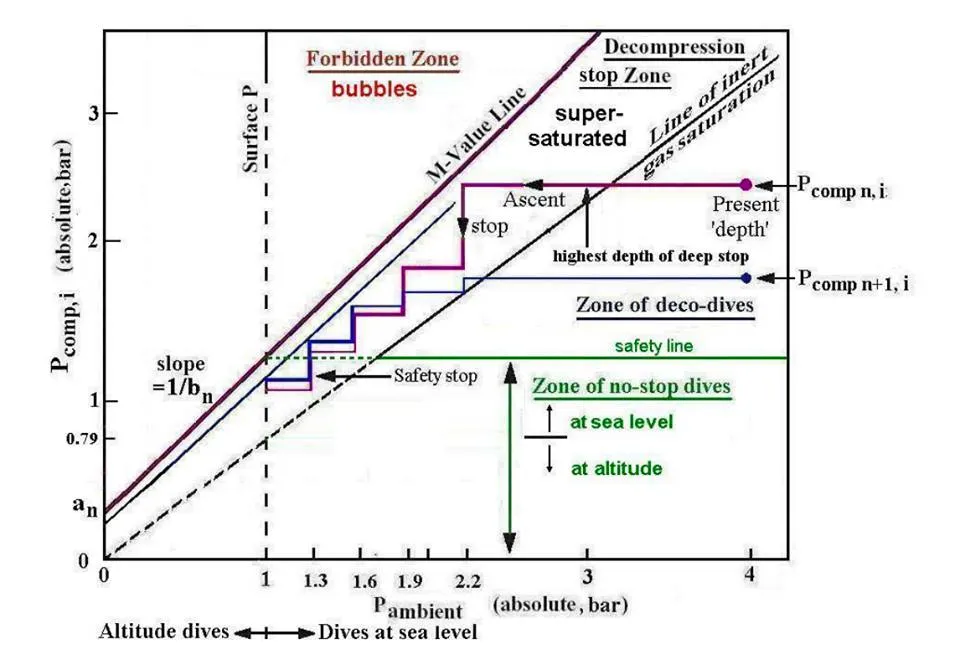
Looking at the chart above, for a typical recreational dive, my algorithm does not allow any tissue compartment to touch the Safety Line at all, so ascending directly to the surface theoretically requires no decompression stop. But the moment your ascent rate becomes too fast, the slope of your M-Value changes — in other words, the gradient between your body's internal pressure and ambient pressure widens rapidly. Once any half-time tissue compartment reaches the gradient limit, you had better be ready for a safety stop; otherwise… This is why the ascent rate limit applies equally regardless of your certification level or which algorithm you use — shoot up too fast and you are headed to the hospital.
Conclusions:
- The 5-metre, 3-minute safety stop helps the fast tissues off-gas nitrogen, but in risky situations it can be skipped — provided you extend your surface interval accordingly.
- Regardless of depth or bottom time, a slow ascent is the golden rule. DCS cases from dives shallower than 15 metres are not unheard of. The shallower you are, the more attention you need to pay to your ascent rate. Even after completing a safety stop, ascend slowly to avoid headaches.
- Should you go to a hyperbaric chamber after years of diving? Opinions vary. Based on my understanding of dive medicine, this is really only warranted for saturation divers who work under pressure day in and day out — it is well established that prolonged pressure saturation impairs circulation in hip bone tissue and can even cause avascular necrosis. There are many cases of saturation divers abroad who have had hip replacements. As for feeling better after a session in the chamber, well — breathing pure oxygen continuously for three or four hours is quite comfortable even just lying at home.
- A dive computer is important — a million times more important than your camera. I'll leave the product promotion out of this.
Related links: