

Contents(5)
The Editor says: When it comes to Penghu dive sites, everyone's first instinct is to think of the Southern Four Islands — and when you think of the Southern Four Islands, you think of the ferocious currents! The Wolf of Dongji is one of the most well-known strong-current dive sites in Penghu's Southern Four Islands. But where there's strong current, there's fish — here you have a chance to see massive schools of yellowtail barracuda, and you might even run into a silvertip shark or a southern guitarfish! Strong currents? No sweat. This article is contributed by 徐志綸 (Lancehsu)
Penghu Southern Four Islands Dive Site — The Wolf of Dongji
On this dive, the current in the Wolf Zone was running at 1.5 knots. The barracuda were no longer hugging the bottom, and I was able to hold my camera steady and get close enough to photograph them properly. (Editor's note: According to the experience shared by Brother Ye of Island 77, once the current exceeds 2 knots, the barracuda will be pushed down to the bottom by the force of the water, making it impossible to capture the spectacular sight of a baitball storm.)
Tides are generated by the gravitational forces produced by the relative positions of the sun, Earth, and moon. Because tidal cycles are fixed, scientists can predict the timing and direction of incoming and outgoing tides well in advance.
In nautical terms, current distance and speed are measured in "nautical miles and knots." The Kuroshio Current along Taiwan's east coast can reach 3–4 knots in summer and 2–3 knots in winter, while coastal currents typically run at 1–2 knots — which is why so few people dive off Taitung or Hualien. It's not that it never happens, but the risk is extremely high. At 1 knot, water travels 30.8 metres per minute, or 1.852 kilometres per hour; one nautical mile equals 1,852 metres.
Encountering a whole school of barracuda is something you can only hope for — Photography: 徐志綸


1.5 Knots: A Relaxed Dive
The Wolf Zone is one of the most telling places to feel the current at work. Below 1.5 knots, conditions usually correspond to neap or moderate tides. The barracuda move in tight, coordinated schools. You can still swim slowly into the current, and when you need to hold your position, a gentle grip on the reef is all it takes.
2 Knots: Your Heart Will Start Pounding
At 2 knots — typically during a moderate tide — a diver fighting the current might just barely hold position for about 10 seconds. After that, the strength drains fast and you'll find yourself drifting further and further from the group. It's also easy to start hyperventilating. For beginners or anyone who has never dealt with current before, this is a serious challenge.
2.5 Knots: You'll Only Catch a Fleeting Glimpse of the Barracuda
When the current reaches 2.5 knots, even swimming hard in carbon-fibre long fins (freediving), I can barely hold position for 10 seconds. You have to grab onto the reef. Let go and drift, and you'll likely be swept out of the Wolf Zone in under 10 minutes — and the wolf pack will be gone from sight.
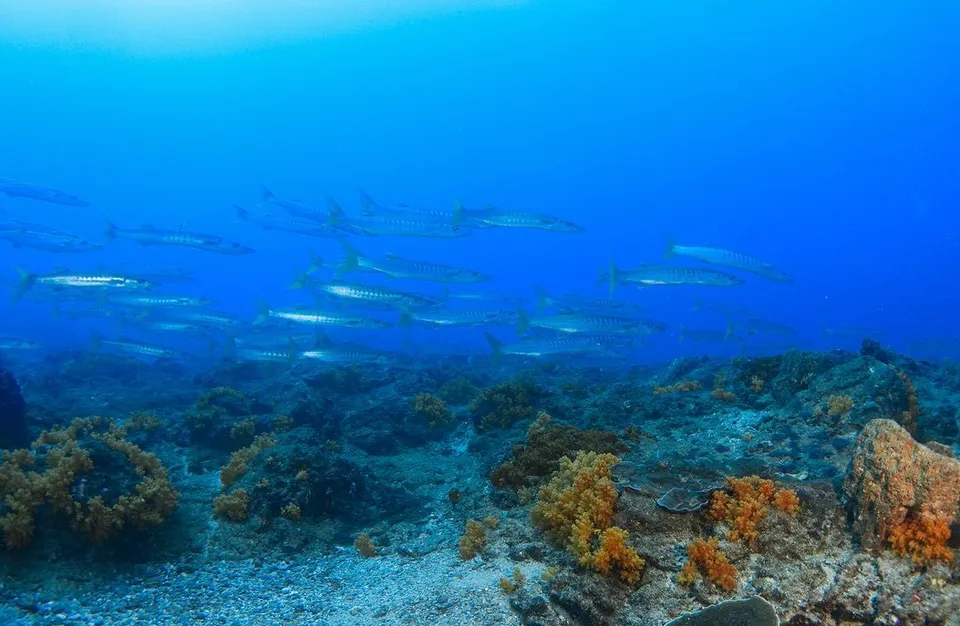
Once the current exceeds 2 knots, the barracuda start dropping to the bottom to avoid the flow — Photography: 徐志綸
3 Knots: Bring Every Trick You Have — It's Going to Be Wild
At 3 knots, you're usually in spring tide territory. Your second stage regulator may start free-flowing heavily; if you're not facing into the current, water will flood straight in. Your surface marker buoy (SMB) could get blown open unexpectedly. No matter how many times you clear your mask, water keeps rushing back in. Air consumption will be far higher than normal. At this point, your dive guide, instructor, and dive buddy may all be fully occupied dealing with their own situations. If you can't resolve these basic problems on your own underwater, you could be in very serious danger.
For this reason, dive shops operating in the Southern Four Islands typically require divers to hold at least an Advanced Open Water Diver (PADI cert) certification with a minimum of 50 logged dives. Anything less and you're punching above your weight — proceed at your own risk.
A boat captain's most fundamental duty is to understand the tides. If the dive instructor also understands tidal patterns, they can anticipate current direction and predict where marine life is likely to appear. When the captain and instructor work together with a shared understanding of the tides, they can bring you safely through demanding conditions — and reveal an underwater world you'd never see otherwise.
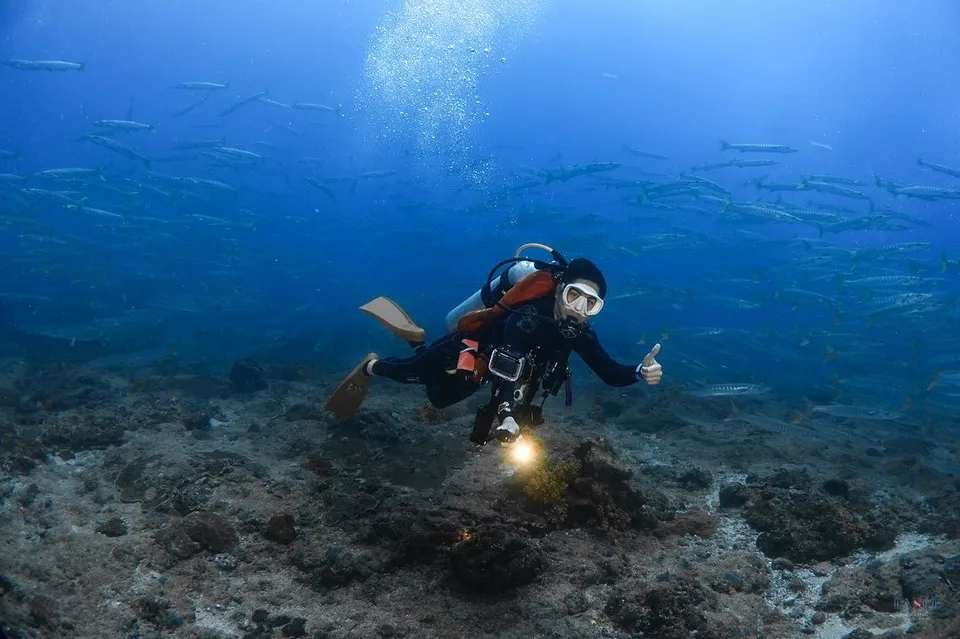
Diving in current zones is thrilling, but a dive shop that truly understands the tides can dramatically raise the safety margin — Photography: 徐志綸
Related links:
Frequently Asked Questions
How is a BlueTrend dive trip different from an unknown, no-name dive group?
Choosing us means full peace-of-mind protection and a smooth experience from start to finish. Every trip we run holds to three things.
First, full legal protection and a professional dive leader: we strictly follow Taiwan's travel regulations and provide complete travel-agency liability insurance, travel insurance, trip-inconvenience insurance and dive insurance. Every group is accompanied by a certified, foreign-language dive leader who joins you on both the dives and the land itinerary, liaising seamlessly with local dive shops and operators on your behalf to keep things running smoothly — the person our travellers trust most.
Second, fully licensed with secure payments: every payment goes into a licensed travel agency's account, with multiple safe payment channels (bank transfer, credit card and more) and a legal collect-and-remit receipt, so every transaction is open, transparent and protected, avoiding the fraud and dispute risks of transferring money privately to an individual.
Third, hand-picked quality we vet in person: every trip, dive site and partner shop is scouted on the ground by our own team, from the guides' professionalism and safety standards to the food, lodging, environment and service details on land, all vetted by us so you don't get caught out.
I want to sign up for a dive trip. Are there certification-level or logged-dive requirements?
Each dive site is different, so the entry bar varies. 'Bali Tulamben', for instance, is relatively beginner-friendly. 'Malapascua in the Philippines' is also beginner-friendly, but since thresher sharks tend to cruise between 20 and 30 metres, we recommend AOW certification with 20+ logged dives to enjoy this trip comfortably. For 'the Maldives' or 'Palau', we suggest AOW with 50+ logged dives for a more relaxed experience. If you're not sure whether your experience fits the trip you want, message us and our dive editors will assess it and help you find the trip you'll feel safest on.
Can I join if I'm signing up alone? How are rooms arranged?
Plenty of our travellers sign up solo! For rooms and beds, we prioritise pairing you with a same-gender traveller, and if you'd rather have your own space you can pay the difference to upgrade to a single room. For the diving, our professional leader will pair you with a suitable buddy, and with the happy vibe on our trips you'll quickly make a great group of dive friends. Many people sign up alone, make new friends, and end up organising the next trip together!
Does the trip fee include dive insurance, gear rental, taxes and instructor tips?
It depends on the trip, the destination's regulations and the local operators. Every BlueTrend dive trip has a detailed web page with a clear 'included / not included' list, transparent and with no hidden charges. All payments are collected by a licensed travel agency, with a standard-form contract for your protection.
I'm a new diver / haven't dived in a long time — will I fall behind the group?
Before you complete your booking, our team assesses a suitable trip based on your certification level and experience. Before departure, we strongly recommend taking time to refresh in Taiwan with an instructor, or a fun dive to get your feel back. On the trip itself, our professional dive leader groups and pairs everyone by experience, keeps a close eye underwater on travellers who need extra care, and steps in to help right away.
Will the photos and videos taken during the trip be shared with us?
During the dives, 'safety' is always the leader's top priority, so whenever it's suitable and safe the leader will capture great shots and record the best moments. During or after the trip, we compile a cloud album for all travellers to download, so you go home loaded with memories!
Besides your scheduled trips, can you arrange a private group charter or independent travel for me and my friends?
Absolutely! Besides group trips, we also arrange private group charters and independent travel. We can communicate, enquire and coordinate services with local operators based on your needs, saving you time and effort and taking the language barrier off your plate, to tailor the smoothest, most reassuring dive trip just for you. Contact our LINE support and our editors will arrange it for you!

![[Fall in Love with Sailing with a Young Captain] Offshore Living — Sailing to Penghu Southern Four Islands National Park: Dongyu Ping](/_astro/%E5%B0%81%E9%9D%A2-1_Z6ryfN.webp)