Contents(3)
From Seven-Figure PM to Diving Entrepreneur
In the first half of his life, Chen Hong-Ru — known to most as Brad — built his career in Taiwan's highly envied IC semiconductor industry. He started from the most technically demanding trenches: BIOS firmware and graphics card driver engineering, then transitioned to a Field Application Engineer (FAE) role, and ultimately rose to product manager (PM) overseeing an entire product line, cycling through numerous companies and supply chains along the way. This well-rounded background trained him to understand a product's technical possibilities through an engineer's eye, while also thinking at a strategic level about the full product lifecycle, marketing plans, pricing strategy, and the upstream-downstream relationships across an entire industry. After twenty years of hard work, his late-career salary — bonuses and stock options aside — was approaching NT$3 million a year. Yet this man, widely regarded as a golden bachelor, chose to leave behind his comfortable life and plunge headfirst into an uncertain maker's dream. Why?
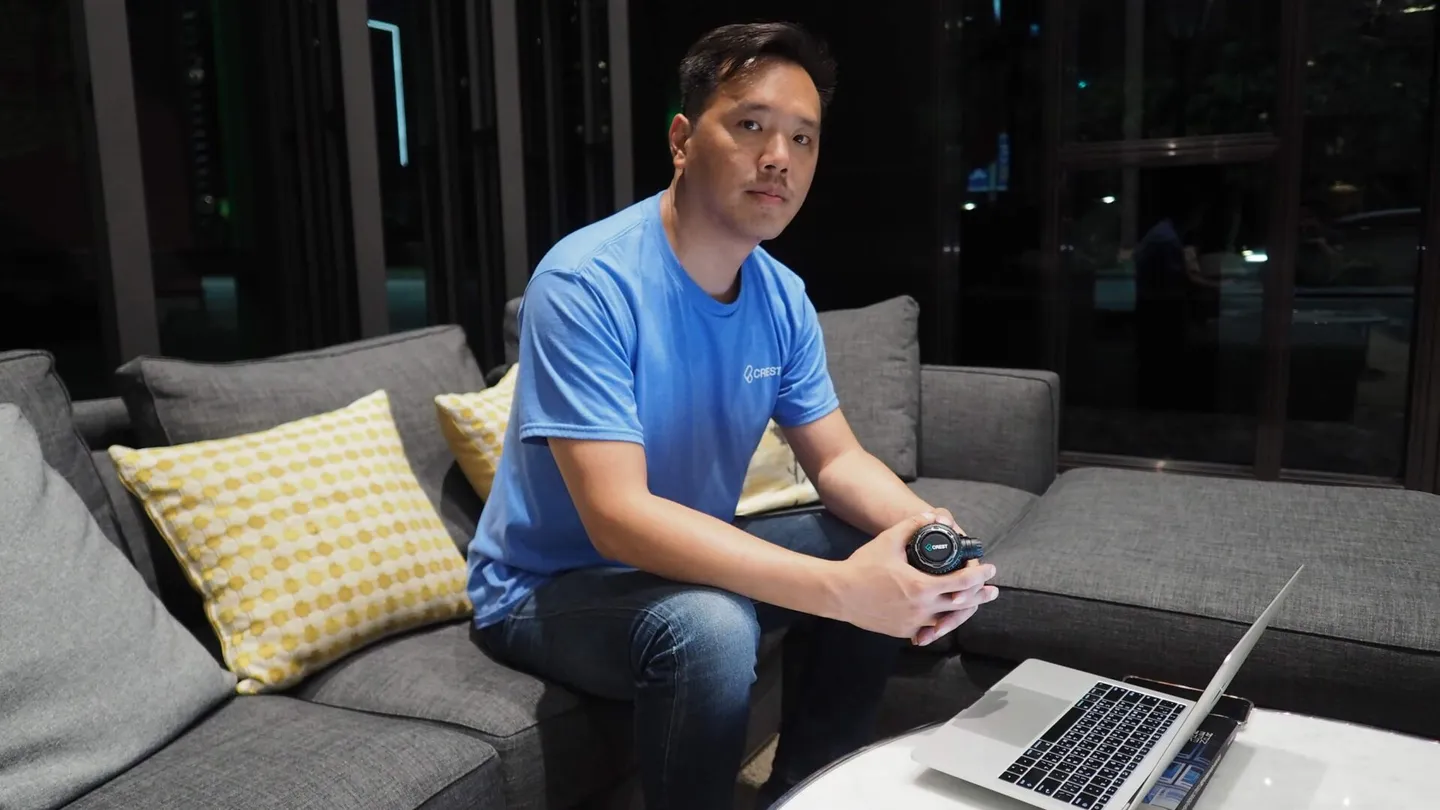
Brad has always been drawn to the outdoors. Even while working in the semiconductor industry, he was constantly seeking adventure — hiking, rock climbing, kayaking, you name it. It was out on the water, paddling a kayak on the open sea, that curiosity struck: what exactly lies beneath that deep blue surface? That small, simple thought forged his first connection with the ocean.
In 2008, he earned his first certification — Open Water Diver — and was immediately captivated by scuba diving. The first time he found himself surrounded by a wall of fish left him so moved by the ocean's raw vitality that he couldn't stop. He went on to complete Advanced Open Water Diver, Rescue Diver, and Divemaster, eventually earning his PADI (certification agency) dive instructor rating. Along the way, however, a pivotal incident would completely alter his perspective on life.


An "Accident" That Built a Taiwanese Brand
During what seemed like an ordinary dive, Brad's buddy's inflator valve jammed without warning, causing the BCD to over-inflate and rocket both of them toward the surface. They did manage to disconnect the hose to release the air, but the ascent was still far too fast. Back on the surface, Brad waited in vain for his buddy to appear, then kicked back to shore alone — only to find an ambulance parked nearby, with paramedics working frantically to resuscitate another diver. He describes that moment as the most terrifying of his life: he was convinced that the stricken diver was his buddy. He burned his last reserves of energy sprinting back to shore, and only when he confirmed it was not his companion did he exhale — though grief and a profound new respect for the sea immediately took the place of his relief. From that day on, he threw himself into the study of dive safety, decompression theory, and the foundational knowledge behind it all.
After stepping away from the semiconductor world, Brad began researching dive computers and decompression theory in earnest. He had the good fortune to join the development of a dive computer, becoming one of the early co-founders of that team. Drawing on his deep background in semiconductors and PCBA (printed circuit boards), combined with his decompression research, he channeled his expertise in electronic circuits and software development — driven simply by a desire to help more people share the wonder of diving.
After a little over a year, he departed from the dive computer project. Several well-known international brands approached him about developing various dive products, and beyond taking on consulting roles for companies in France, Germany, and the United States, he repeatedly walked away from attractive and stable career offers. Instead, he chose entrepreneurship once again — this time tackling something even more demanding than a dive computer, because it sits at the very heart of every diver's survival underwater: the regulator.
The regulator market is crowded with established players, but here is something many may not know: the vast majority of the world's regulators are assembled in Taiwan. Brad asked himself: if Taiwan already has that mature craftsmanship, why does it not have a home-grown brand to show for it? Like so many consumer goods, foreign brands still dominate purchasing decisions — they entered the market earlier, enjoy stronger consumer loyalty, and offer more comprehensive warranty and service networks. Facing those daunting odds, Brad resolved to design and manufacture a regulator held to an exceptionally high standard, letting the product speak for itself through quality alone.
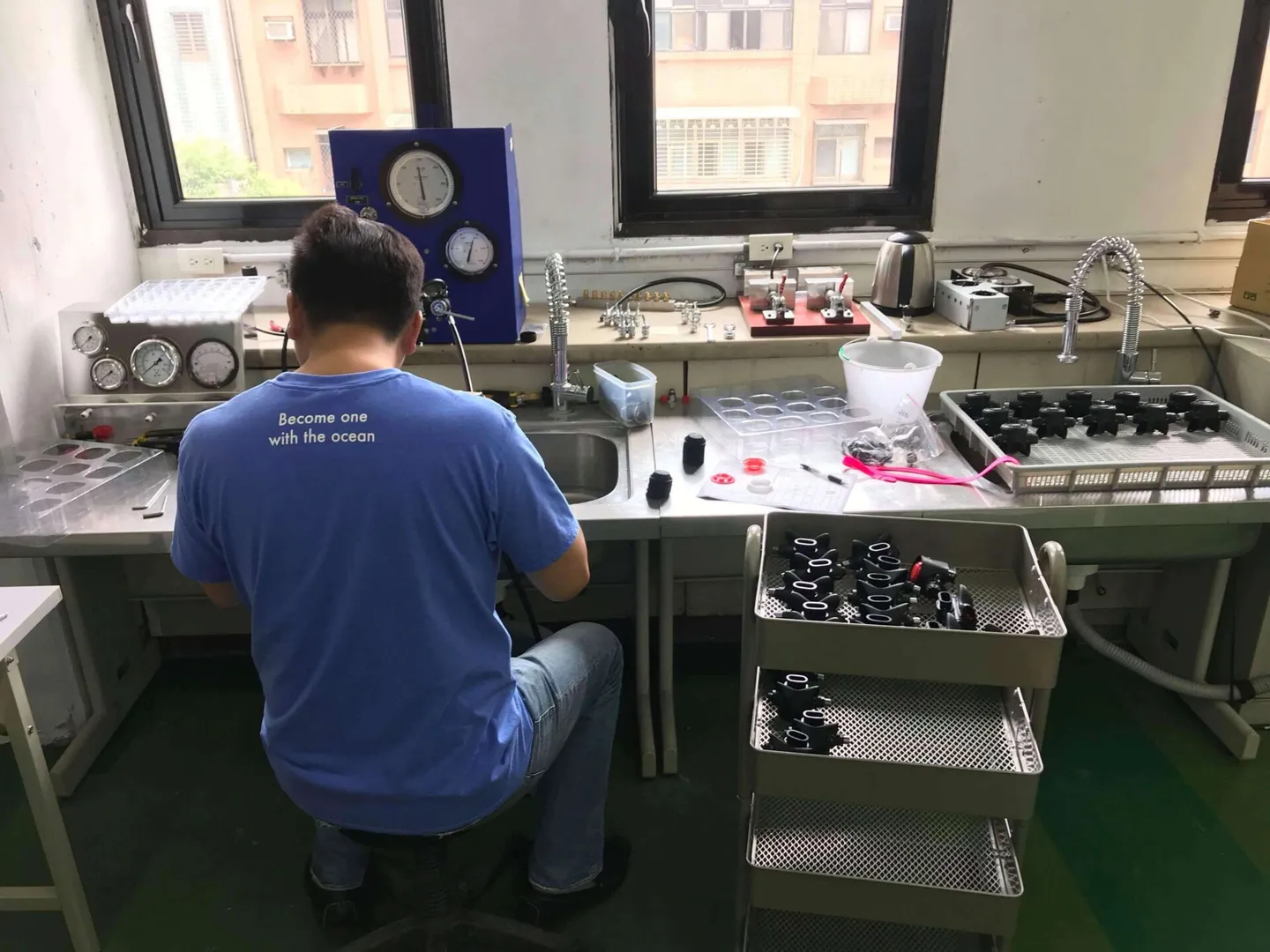
Everyone asks what makes a good regulator. In Brad's eyes, it's simple: a good regulator is one that brings the diver safely home every single time. True to his engineering nature, he lets the numbers do the talking. He set a higher bar for his own product by targeting EN250A certification rather than the EN250 standard that most regulators aim for. The expensive CE testing process is, of course, a necessary cost of entering international markets. He also set an in-house shipping standard of 90 liters per minute — well above the CE benchmark of 62.5 liters per minute.
EN250 is a European Union standard ensuring that a regulator can simultaneously supply two divers with a stable and adequate air supply at a specified depth. It also certifies that the regulator delivers consistent performance in colder water temperatures.
The All-New Crest Regulator
Taking his cue from the care Ferrari invests in each engine leaving the factory, Brad insists that every single Crest regulator be individually tuned and signed off by a technician before it ships. Every time a new sample comes off the production line, Brad personally dives it through more than hundreds of scuba tanks' worth of use, proving through action that quality is non-negotiable.
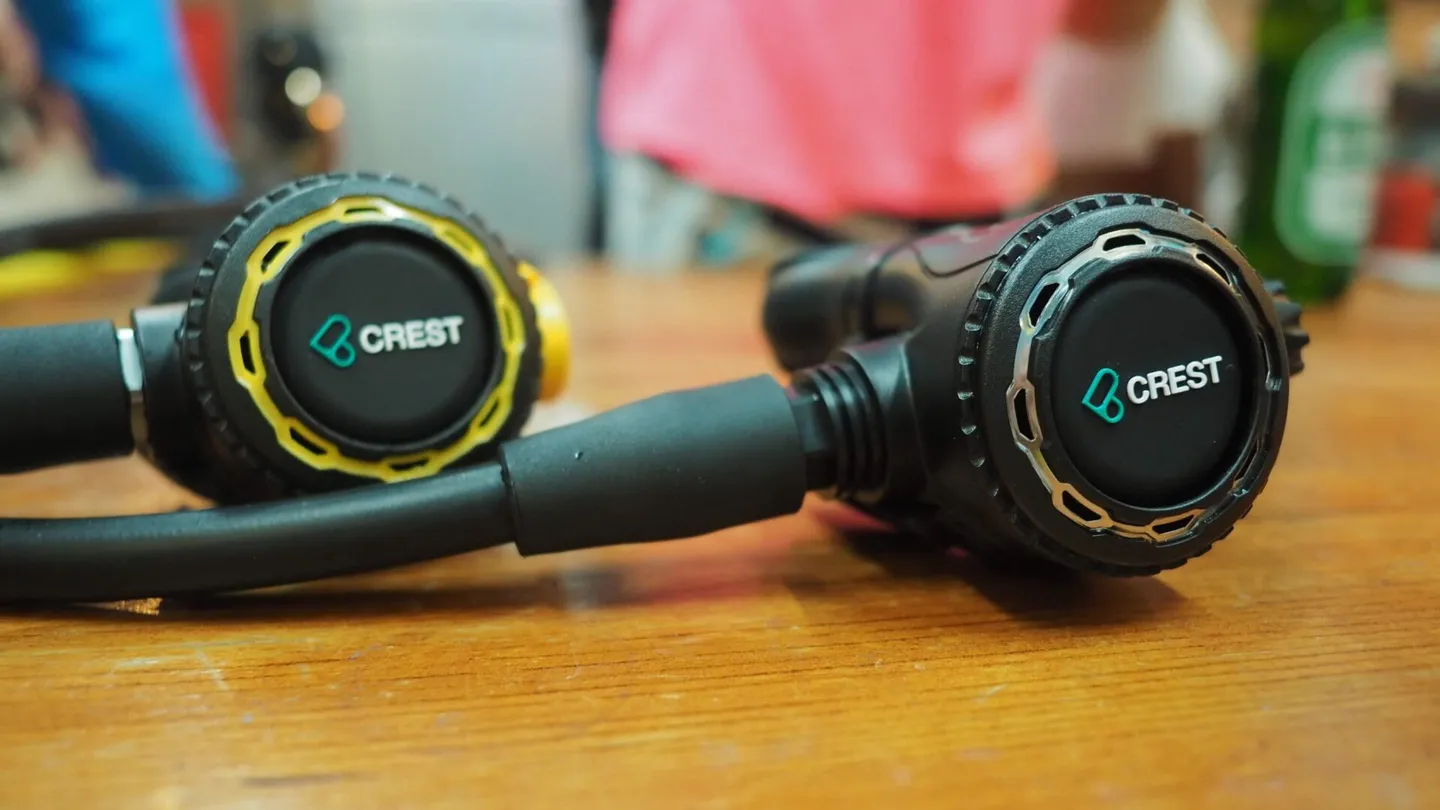
The greatest challenge in manufacturing the regulator, Brad says, is sustaining that relentless commitment to quality. His obsession with precision goes as far as specifying thread tolerances to three decimal places — add a few more zeros and you're practically in the realm of nanometers. Some upstream component suppliers simply couldn't meet that standard and had to bow out. Fortunately, one of his team members is the mechanical designer behind several of the world's most prestigious regulator brands. Through that partner's professional design and development expertise, countless rounds of tenacious iteration, and Brad's deep familiarity with the product and market, they produced something that even European and American brands have praised. Through international supply chains, they also found domestic manufacturers willing to collaborate, and by nurturing those suppliers' growth they quietly elevated the precision manufacturing capabilities of Taiwan's own industry — now applied to diving equipment.
Brad's vision for Crest goes far beyond producing regulators. In addition to the entry-level piston regulator already on the market, a high-end diaphragm regulator is simultaneously in development. Brad's aim for 2018 is to establish a firm foothold across Asia — conversations are already underway in Taiwan, Japan, the Philippines, and China. For 2019, the plan is to extend into the United States and Europe, with a service and maintenance network built out in step with sales expansion, so that the founding commitment to the highest quality flows through to after-sales support as well. It may not be long before Brad — never one to rest on his laurels — grows Crest into an even broader range of diving products. Watch this space.
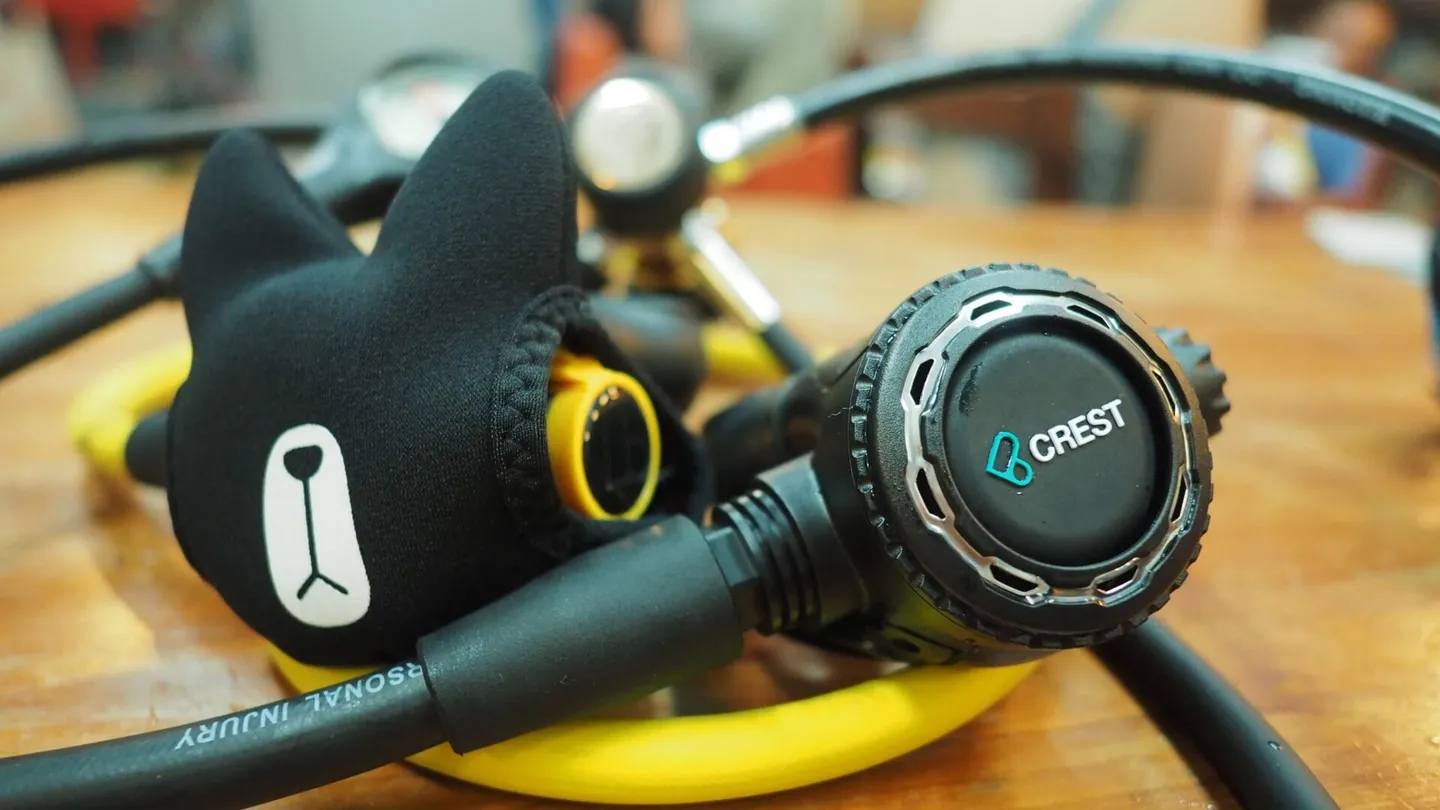
Crest in collaboration with ocean-inspired creative brand 鉄市設計
Finally, with the gravity and weight of someone who has put everything on the line, Brad described this venture — in his Yilan-accented Taiwanese — as a "life-or-death gamble." In other words, he has poured every available resource into Crest, and it is the unwavering support of his wife that keeps him going. Brad hopes that people will one day experience his love of the ocean through the products he makes — just as he declared at Crest's first product launch with the brand tagline: "As an Engineer, As a Diver, As an Instructor." The engineer's demand for production quality, the diver's firsthand understanding of need, and the professional instructor's insistence on safety — all of it goes into every regulator they build. It takes a very special kind of love to make diving your livelihood. As Brad often says: "If we can make even one more person as crazy about the ocean as we are, the future of the sea will be just a little bit clearer."
Further reading: