Contents(12)
- Scope of Dive Insurance:
- What Is DAN:
- DAN Fee Overview and Comparison:
- DAN Advantages (the following analysis reflects subjective opinions only — take as suits your personal preference):
- What to Understand Before Purchasing DAN (the following analysis reflects subjective opinions only — take as suits your personal preference):
- Other Insurance Options:
- Travel Accident Insurance?
- Premium Calculation:
- Fubon Property Insurance Exciting Life Advantages (the following analysis reflects subjective opinions only — take as suits your personal preference):
- Combine Travel Insurance for a Worry-Free Trip Abroad!
- Conclusion!
- Special Thanks:
The Editor says: Dive insurance has been mentioned ever since Open Water Diver days, but honestly, almost every time I dive locally or abroad, I have no idea whether the dive shop has covered us under a dive insurance policy. Overseas DAN feels like it's a world away — the fine-print terms strain my aging eyes, the premiums aren't cheap, and I've always worried that after paying up, a real accident might happen only for me to discover the policy doesn't apply in Taiwan. Fortunately, I happen to have a friend who both dives and knows insurance inside and out, so of course I had to pick their brain!
After we shared this topic, it generated a tremendous response. We'd also like to thank the long-serving Taiwan DAN support team for providing some replies, sharing their practical experience assisting DAN operations in Taiwan. We hope this helps everyone gain a deeper understanding of dive safety!
Scope of Dive Insurance:
Scuba diving is a high-risk sport. In addition to ordinary bodily injuries, there is the more serious matter of decompression sickness (DCS) treatment. According to a friend who once worked as a dive instructor in the Maldives, a friend of theirs once underwent hyperbaric chamber treatment — three sessions came to roughly NT$200,000, and that didn't even include the cost of medical evacuation. Understanding how to use existing insurance plans to mitigate these risks is therefore something every diver should know.
If we run through just a few examples, it quickly becomes clear that all sorts of minor mishaps lurk throughout a dive trip and need insurance to spread the risk — from common incidents like throwing out your back hauling gear, tripping and falling, getting stung by a jellyfish, or being bitten by a fish, to more serious situations like going too deep and getting narced, diving too long and ending up bent, or spending seven days in hospital before making it home. All of these fall within the scope of insurance coverage. So how do you choose the right plan for yourself? First, you need to understand what each plan actually covers.


What Is DAN:
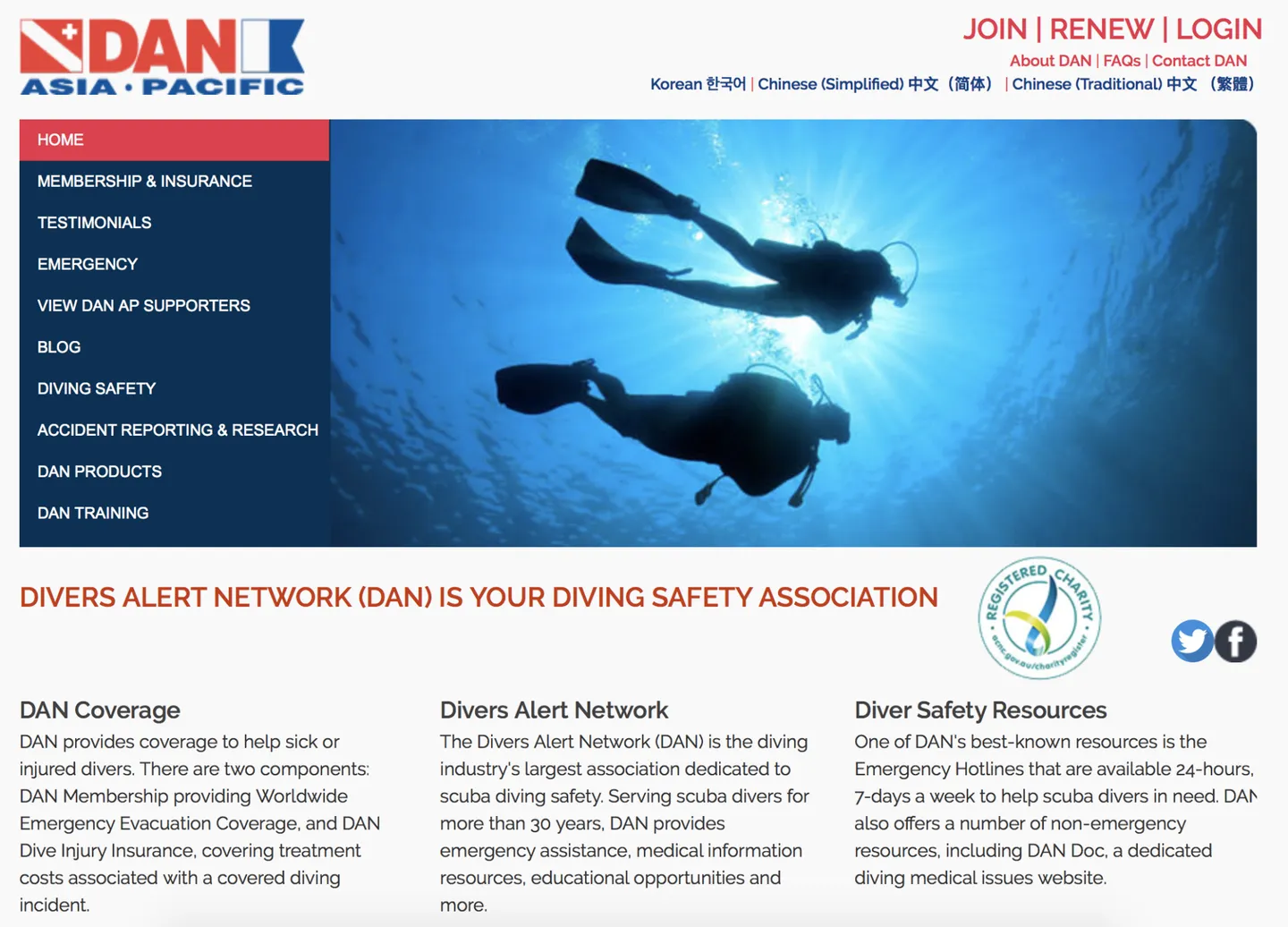
When talking about dive insurance, we have to start with DAN — a system well known to divers everywhere. DAN is not a commercial organization but rather a non-profit organization, and it operates through different chapters for different regions. Below we focus on DAN ASIA PACIFIC, which most Asians are most likely to encounter. All information is excerpted from the DAN ASIA PACIFIC official website; if there is any lag in updates due to timing, please refer to the announcements on the DAN website as the authoritative source.
- DAN Asia-Pacific is an independent non-profit organization headquartered in Melbourne, Australia.
- DAN is not an organization owned by any training agency, corporation, or shareholder — it is an association.
- Accident & General Insurance Company, Ltd. (hereinafter "AGI") has issued a group diving accident insurance policy (hereinafter "Group Policy") to Divers Alert Network (DAN) Asia-Pacific Limited.
- Any recreational diver or snorkeler (including instructors and Divemasters supervising recreational diving activities) who holds DAN Asia-Pacific membership and is at least 12 years of age, including some research divers and underwater photographers. However, other commercial diving activities are not covered.
DAN Fee Overview and Comparison:
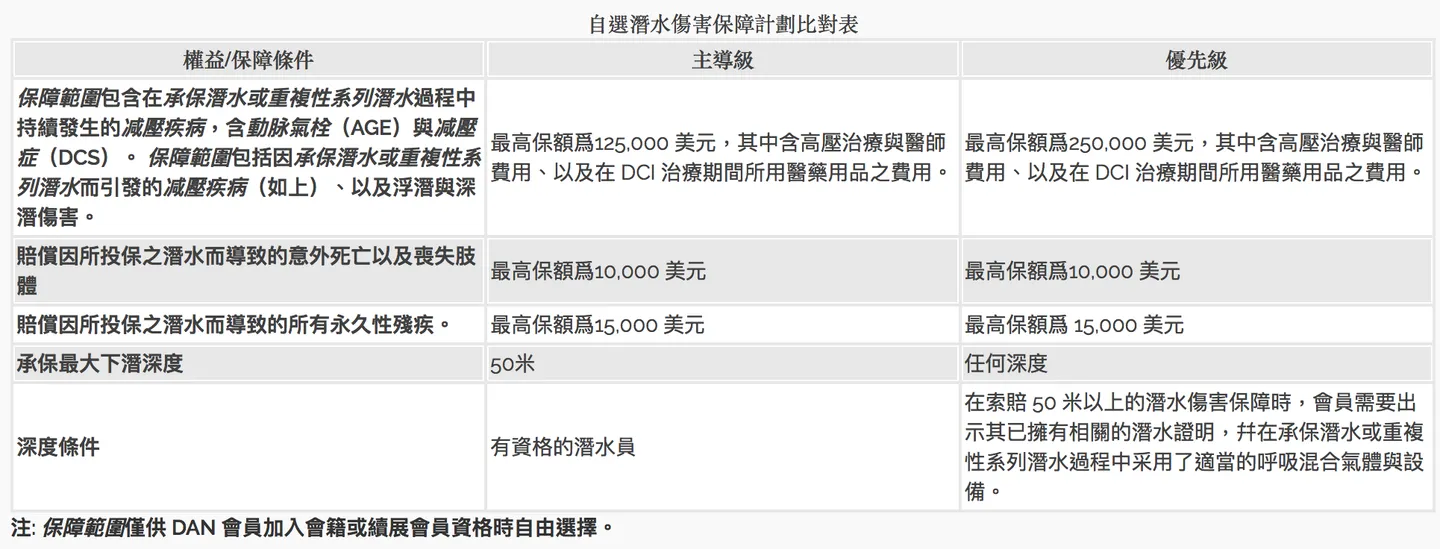
TravelAssist Membership: includes worldwide emergency evacuation coverage, 24/7 medical support, access to member-exclusive value-added programs, and more. Annual fee: AUD 75.
Membership + Optional Dive Treatment Coverage:
- Membership + Primary Coverage = AUD 170.
- Membership + Premier Coverage = AUD 224.
DAN Advantages (the following analysis reflects subjective opinions only — take as suits your personal preference):
- DAN is international, with service points around the world, making it ideal for divers who travel abroad frequently.
- In the event of an emergency medical need, DAN TravelAssist can provide coordination and evacuation services, reducing medical expenses.
- High coverage amounts reduce the financial stress if an accident occurs.
What to Understand Before Purchasing DAN (the following analysis reflects subjective opinions only — take as suits your personal preference):
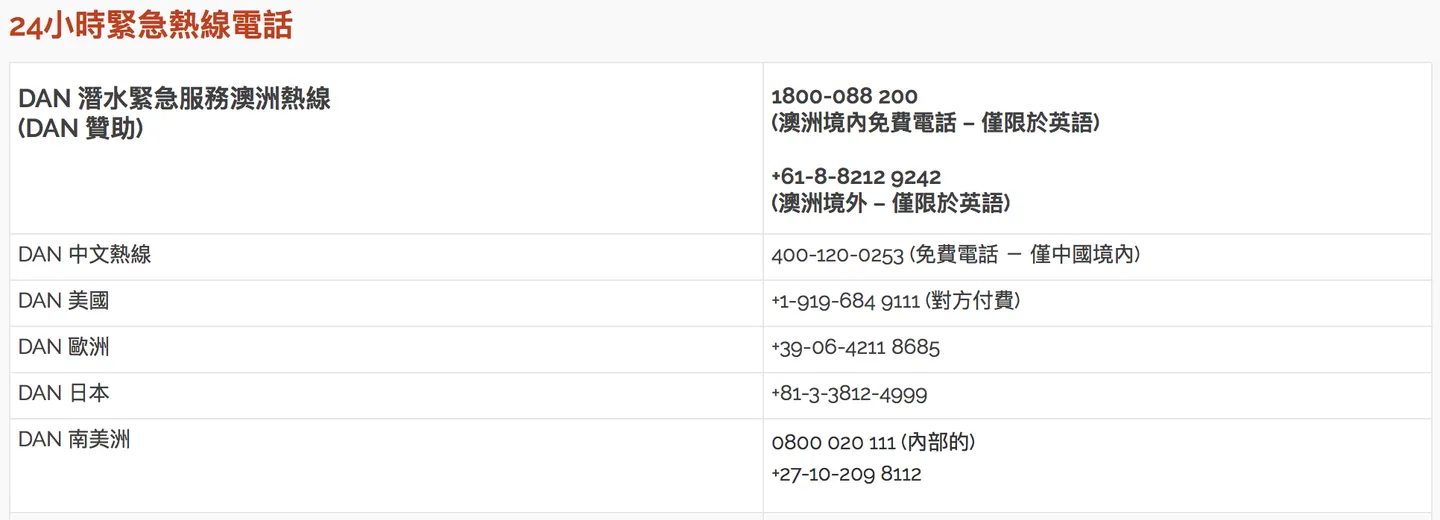
- In the unfortunate event of a medical incident, you need to call the Australian office or another regional chapter. There is no DAN office in Taiwan; the nearest 24-hour service hotline is the China line. TravelAssist requires you to call the U.S. DAN TravelAssist office for assistance. Some hotlines only accept calls in English. (Supplement from the Taiwan DAN Support Team, 2018/3/20: When a DAN member has an accident and needs assistance, they must immediately notify the emergency hotline of any DAN global chapter. Members requiring Chinese-language service may call the Chinese-language line in China. Even when calling an English-language emergency hotline, members can request that the professional who answers arrange for a Chinese-speaking staff member to contact the member as soon as possible. When calling, as long as the member can provide the DAN professional with their name, membership number, coverage level, and membership expiry date, DAN will, after confirming membership status, promptly arrange for a Chinese-speaking staff member to reach out to understand the situation and help the member communicate and coordinate incident handling with DAN's English-speaking staff. For Chinese-language contact, you may reach out via the following email: china@danap.org.)
- DAN plan insurance is secondary insurance — after other insurance has paid out, the DAN Asia-Pacific plan will cover 100% of the remaining eligible medical expenses. In other words, if you hold a relevant policy from a Taiwanese life insurance company, that company's payout must first be deducted before DAN steps in to cover the remainder. (Supplement from the Taiwan DAN Support Team, 2018/3/20: In general, DAN members use DAN coverage as their primary insurance, because the scope and amounts covered for emergency medical evacuation and medical expenses are usually sufficient to cover all evacuation, transport, and medical costs incurred within one year of an accident. It is rare for a DAN member's case to require additional coverage from another insurer to make up a shortfall. If a DAN member chooses to use another insurer's policy as the primary payer and that coverage proves insufficient, the member's DAN coverage can then step in to supplement and cover the gap left by the other insurer.)
- Claims require English-language documentation, and the document review period is relatively long. (Supplement from the Taiwan DAN Support Team, 2018/3/20: The insurance companies that provide coverage under DAN are all foreign companies, so the claims documentation required is naturally primarily in English. However, because DAN's service area spans more than 130 countries worldwide and not all regions use English as their primary language, after an accident occurs, DAN members may submit all payment receipts — even those in non-English languages — together to the DAN chapter to file a claim. DAN staff will send them to professional translators before forwarding them to the insurance company for settlement.)
Other Insurance Options:
Besides the DAN insurance plans described above, we don't necessarily have to look far afield — we can explore what Taiwan's own life insurance companies offer. The plan most discussed in diving circles among domestic insurers is Fubon Property Insurance's Exciting Life Comprehensive Insurance (精彩人生綜合保險), which is primarily designed as a supplementary policy for outdoor sports enthusiasts. Note the emphasis on supplementary — we'll share later how to combine policies into the most cost-effective package. All information below is subject to the Fubon Property Insurance Exciting Life Comprehensive Insurance official website.
Travel Accident Insurance?
Is Fubon Property Insurance's Exciting Life Comprehensive Insurance the same as the travel accident insurance (旅平險) we commonly hear about? We use the table below to give you a quick overview. In general, standard travel accident insurance does not cover decompression-related illnesses that can arise during diving, whereas the Exciting Life Comprehensive Insurance explicitly states that decompression treatment is included within its claims coverage.
[caption id="attachment_2885" align="aligncenter" width="1268"]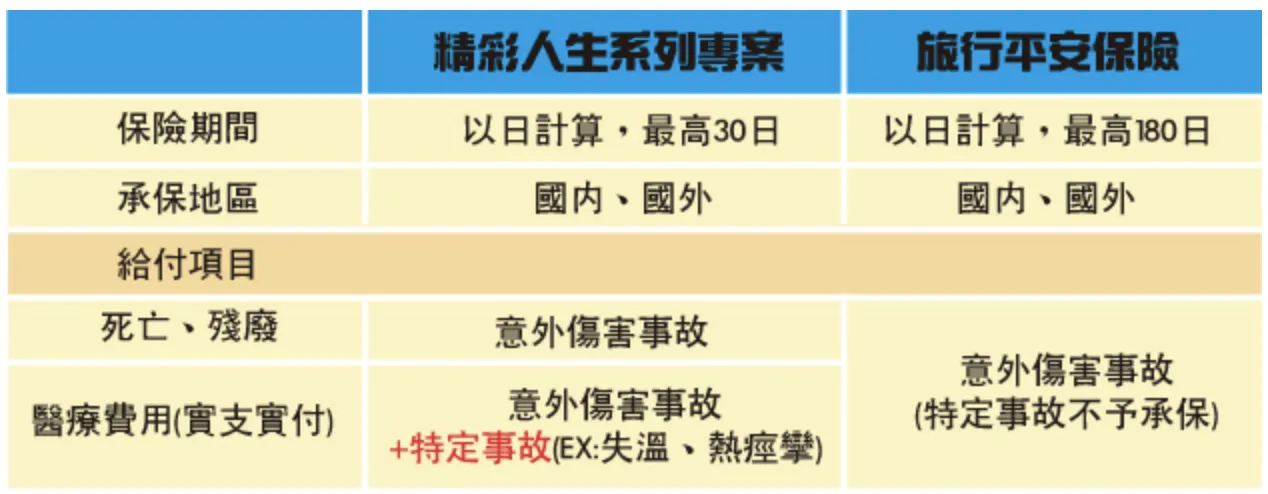 Fubon Official Website[/caption]
Premium Calculation:
Fubon Life's Exciting Life Comprehensive Insurance first divides activities into two specified categories. Category 1 covers "paragliding (hang gliding), powered paragliding, parasailing, skydiving, rock/ice climbing, equestrian sports, martial arts competitions, and scuba diving," while Category 2 covers "camping, cycling, road running, hiking, and other activities outside Category 1." Premiums are then determined by the plan you need (based on age and number of insured days).
For example: a 30-year-old diver planning a 5-day diving trip, choosing Plan 4, would pay a premium of NT$789. From the table, you can also see that scuba diving — belonging to Category 1 — is classified as a high-risk sport in the insurer's risk assessment (under the same conditions: Category 1 is NT$789, Category 2 is NT$411).
[caption id="attachment_2886" align="aligncenter" width="1194"]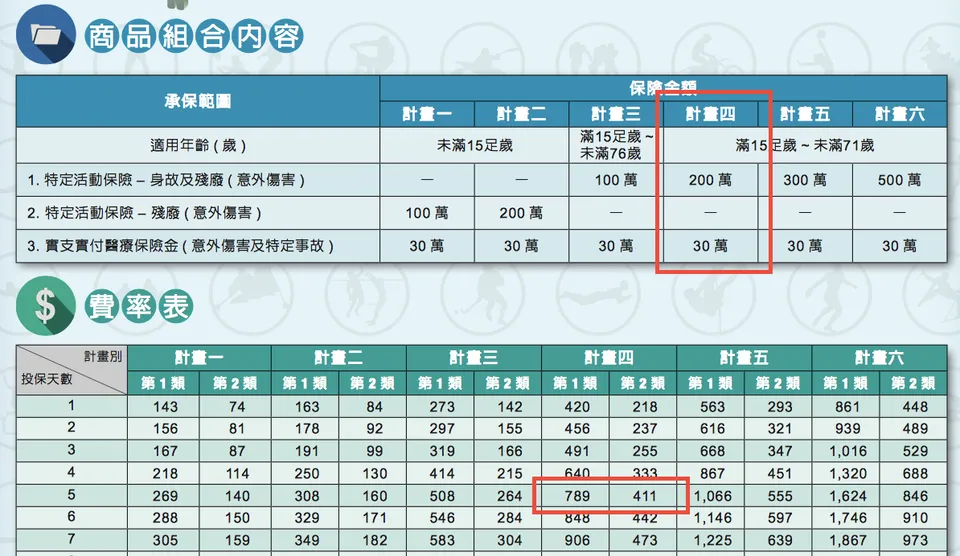 Fubon Official Website[/caption]
What about international medical services, which divers care about? This policy also provides an SOS Overseas Emergency Rescue hotline, with a compensation cap of US$10,000 per incident.
Fubon Property Insurance Exciting Life Advantages (the following analysis reflects subjective opinions only — take as suits your personal preference):
- Customer service hotline offers Chinese-language support (goes without saying!), and there are plenty of Fubon insurance agents nearby you can consult.
- Day-based premiums allow you to plan the most suitable coverage for your needs.
- Claims procedures within Taiwan follow the same process as any ordinary insurance claim — no special English-language documents or overseas mailing required.
Combine Travel Insurance for a Worry-Free Trip Abroad!
In fact, simply pairing the commonly used travel accident insurance and travel inconvenience insurance with your existing coverage can fully encompass every mishap that might arise on a dive trip — from minor setbacks like flight delays and lost luggage to more serious situations like overseas medical treatment and decompression sickness (DCS) treatment — giving you peace of mind throughout your dive travels.
Conclusion!
- DAN offers sufficient coverage amounts and comprehensive overseas support, but local on-the-ground service is unavailable. It is recommended for divers who take 3 or more overseas dive trips per year (or those heading to exceptional diving destinations such as the Galápagos, ice diving, etc.).
- Fubon Property Insurance travel accident insurance + Exciting Life Comprehensive Insurance can be tailored to actual needs and can cover all potential risks of a dive trip, while local service minimizes the hassle of communication and document submission.
[caption id="attachment_2887" align="aligncenter" width="980"]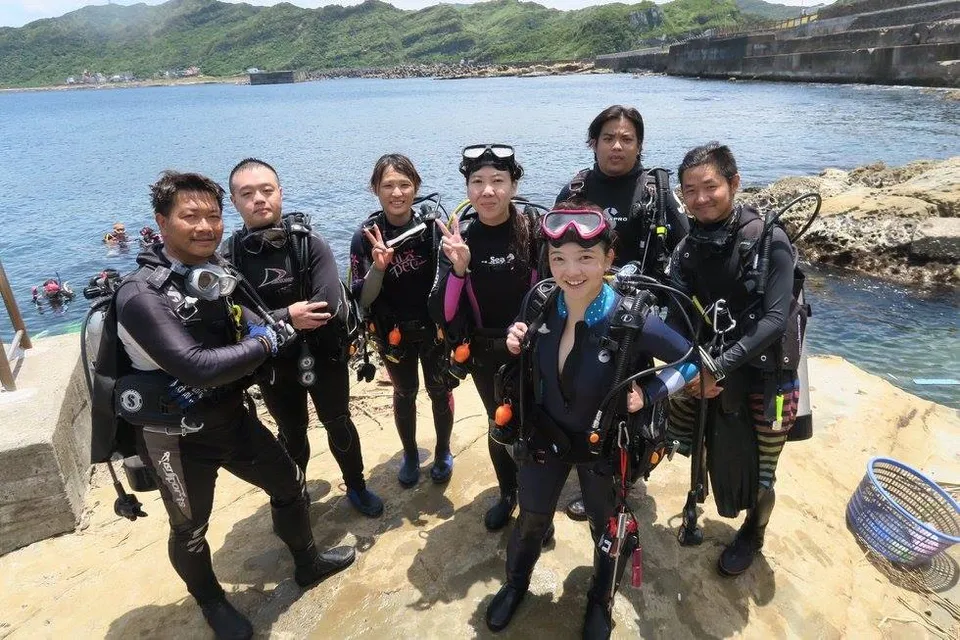 Happy diving — safety is the only priority[/caption]
Special Thanks:
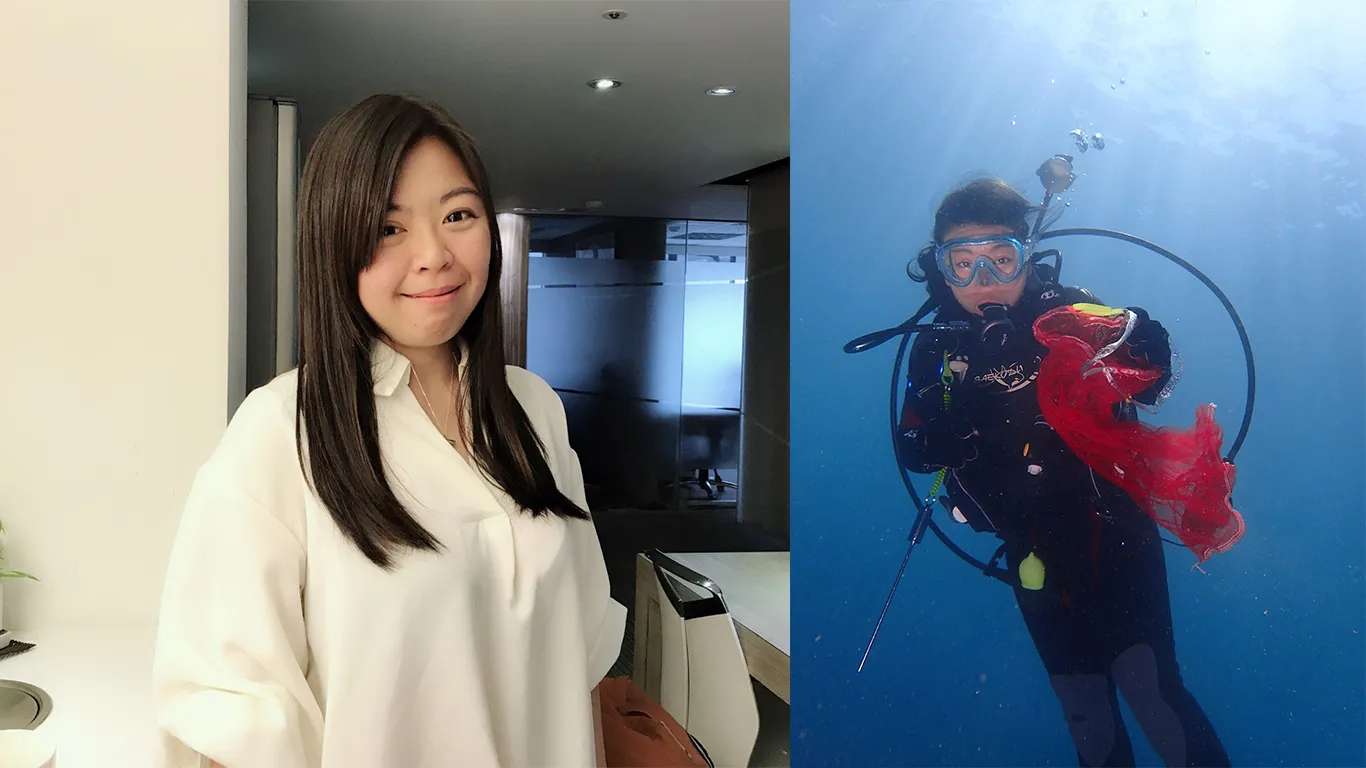
Special thanks to Alice from the "Let's Dive Together" diving community for sharing her insurance knowledge. She is herself an avid underwater conservation diver. If anyone has questions about insurance for diving activities, feel free to reach out to her!
- 林微錚 0937-995972
- undertheseaalice@gmail.com
- LineID:@559CLJCZ