Contents(7)
- Diving Safety — What Types of Currents Are There?
- If You Encounter 3–4 Knots of Chaotic Current, What Should You Do Right Now? (You can also learn about current speeds in this article)
- Getting Separated During a Safety Stop
- Weighting in Current Zones
- What You Can Do Before the Dive
- Throughout the Entire Dive, Here Are the Diving Safety Points to Keep in Mind
- What If You've Lost Your Dive Guide, Been Separated from Your Buddy, or Accidentally Run Out of Air?
The Editor says: Divers have a love-hate relationship with currents. We all prefer to dive when there's no current, but no current usually means no fish. Some dive sites overseas are famous for their powerful flows — so what should you do when you encounter washing-machine currents, upwellings, downwellings, or double-layer currents? We thank instructor 徐志綸 (Lancehsu) for his expert insights, which will help us stay calm and composed no matter what kind of current we face!
Diving Safety — What Types of Currents Are There?
After leaving Penghu, some instructor friends asked me about diving safety in currents. Here I'll put what's in my head into words. Don't take my articles as gospel — by the end it may all sound like rambling. Take it as a reference, and stay safe, everyone. How should we dive in current zones? How do we prevent problems, and how do we handle them? Currents vary in movement and speed depending on topography and tidal range. We can broadly categorize them into five types:
- Unidirectional current (the most common and most straightforward — introduced in a previous article about wolf packs and current speed)
- Upwelling (rare)
- Downwelling (rare)
- Washing-machine current (extremely rare)
- Double-layer current (rare — a dedicated article on Penghu's unique double-layer currents is coming later)
When all of these combine, we call it chaotic current (extremely, extremely rare).
If you encounter chaotic current exceeding 3 knots — good luck.
Today I'll use the "East-West Ji Corridor" dive site at the Southern Four Islands of Penghu as an example. Let me first introduce this site. The "East-West Ji Corridor" is an isolated reef located between Dongji and Xiji Islets. The reef top sits at 5 m and the reef base at 18 m. The channel formed between the two islands is, as the name implies, a waterway — and a waterway is where currents converge. As the current accelerates through the channel and passes the isolated reef, it splits into branching flows. The reef is also surrounded by numerous large and small rocks, each generating its own branching current. About 150 m south of the isolated reef, the depth is 20–25 m; as you approach the reef, the depth gradually shallows to 18 m. Approximately 150 m beyond the reef on the other side, the depth drops from 18 m to a 25–30 m ledge.
Using the flood tide at the East-West Ji Corridor as an example: during flood tide, the current flows from south to north. As it passes the isolated reef, the topography shallows from deep to shallow, causing the current to converge and producing a brief upwelling. Combined with the large boulders and low-lying terrain near the reef, this generates S-shaped branching flows and downwellings. Passing through this section of terrain, you'll experience what people call washing-machine currents, upwellings, and downwellings all at once. Current convergence causes acceleration — the speed is typically 1 to 2 knots higher than the surface prediction. If the captain predicts 1 knot at the surface, the current near the isolated reef could reach 2–3 knots, and so on.
Below, the Editor shares footage of the strong current previously encountered at Eluanbi, Kenting.


If You Encounter 3–4 Knots of Chaotic Current, What Should You Do Right Now? (You can also learn about current speeds in this article)
First, stay close to your dive guide. Your dive guide may choose one of the following options:
- Drift directly with the current (high risk of group separation): If you drift freely, you may miss the dive site entirely, and dive buddies may become separated. If visibility is below 10 m, the likelihood is even higher.
- Stay in place (wait for the current to ease before moving, though the current may remain strong throughout the entire dive): Sheltering in a low-lying hollow is absolutely the best way to avoid the current — it's very safe. You'll feel the water rushing powerfully overhead and may even hear the sound of the current. The air bubbles you exhale will swirl around you.
- Slowly rock-climb your way to the dive site (less experienced team members may still be swept away): If you pause on top of a reef and grip the rocks while moving, you'll feel the current suddenly coming from the east, then from the west, with bubbles circling around you. When you turn and exhale, your bubbles spiral away in a rotating motion — this is what's known as a washing-machine current. You may also encounter an upwelling: it will feel as though, in addition to gripping the rocks with both hands, someone behind you is grabbing your scuba tank and pulling you upward. (If you are inadvertently lifted, immediately change your diving posture to head-down/feet-up, vent air from your BCD, and kick against the current back to the bottom to seek shelter.)
- Cancel the dive (surface immediately and end the dive).
There is no single best approach. The dive guide must assess the situation in real time, along with the skill level of the group, to decide how to proceed.
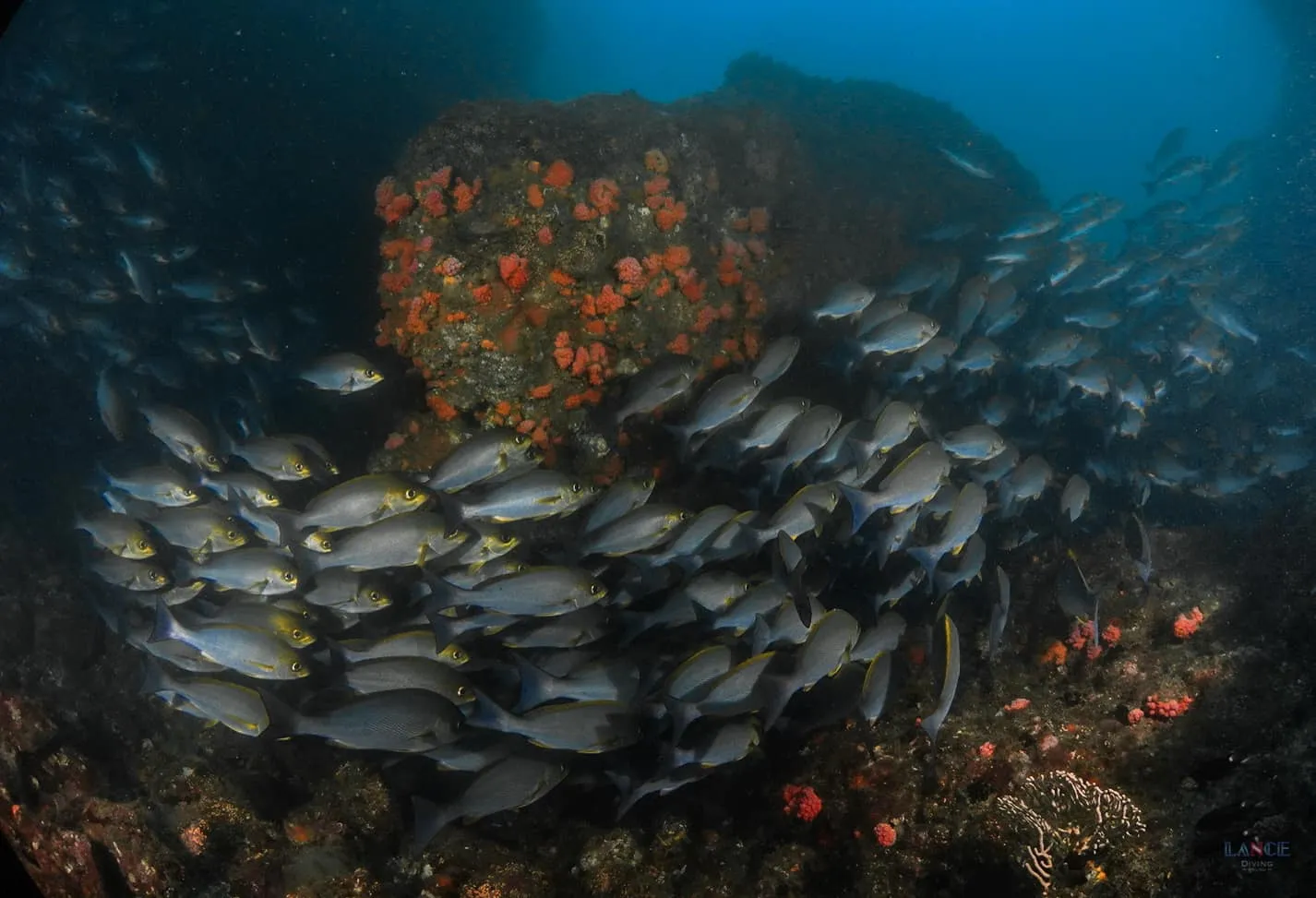
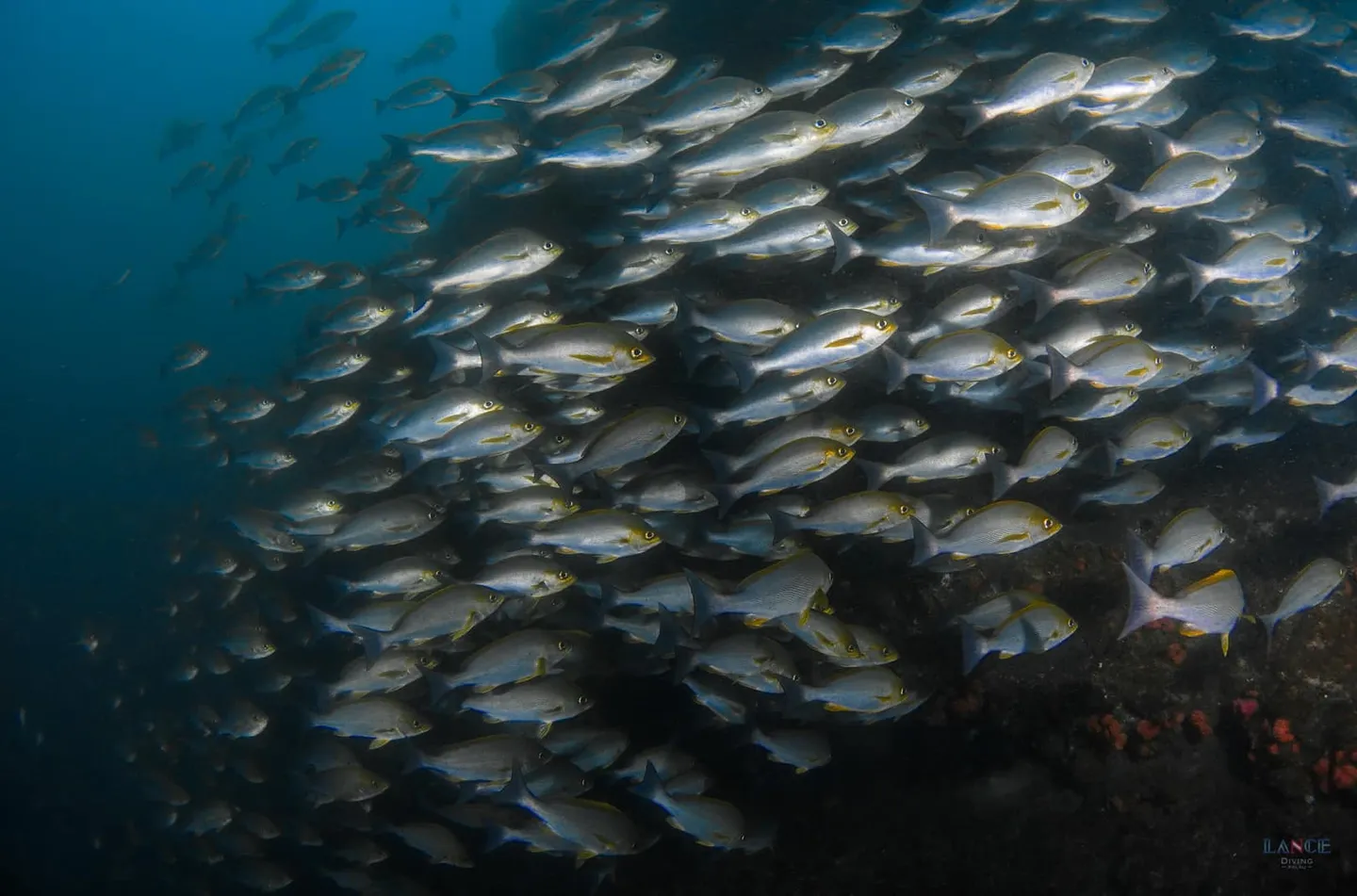
If your group is highly experienced and you successfully navigate your way to the isolated reef, you'll discover a spectacular "waterfall" of fusiliers holding station in the current. All the sweetlips, red sea bream, and various rare species shelter on the north side of the reef away from the flow — the scene is truly breathtaking. Even Lance, who has been to Palau, will stand in awe and be completely captivated.
Diving Safety — Currents
But the moment you approach the top, east side, or west side of the isolated reef, you will encounter strong currents. A particularly important note about this dive site: when you are ready to ascend for your safety stop, you will inevitably leave the isolated reef. Stay close to your dive guide. Many people become separated precisely because they let their guard down during the safety stop.
Getting Separated During a Safety Stop
The moment you leave the isolated reef — whether heading toward the surface or away to any side — the current will quickly carry you away. Visibility at this site is typically below 10 m. Depending on current speed, groups are prone to separation. At just 2 knots, roughly two minutes in — after drifting approximately 120 m — you may encounter a 30 m ledge to the north of the isolated reef. At any speed above 2 knots, this spot will have an irresistible downwelling. If you're not careful, you can be pulled from 5 m down to 30 m in under 30 seconds. During the two months Lance spent as a dive guide in Penghu, he encountered this type of downwelling twice at this spot — both times when the current exceeded 2 knots, and once at 4 knots. If you don't have enough air in reserve and the downwelling causes panic combined with critically low air, the risk increases significantly. This is why risk management at this dive site is stricter than at others, and why you must reserve more air for your stop. It is also why dive time is always shorter when currents are strong. During the safety stop, stay tightly together — hold onto each other, and onto your instructor.
Weighting in Current Zones
In general, for those of us without extensive experience diving in currents, it is recommended to add 1–2 kg more weight than usual. Prioritize comfort and balance underwater. When encountering an upwelling, it is easier to stabilize your buoyancy; and in an emergency, ditching your weights provides a faster buoyancy boost.
What You Can Do Before the Dive
The five basic safety check steps: BWRAF
- B — Confirm the BCD can be inflated and deflated normally, with no damage
- W — Check the weight system; it must be easily ditchable in an emergency
- R — Check all five quick-release buckles, especially the tank strap
- A — Confirm both parties' air is turned on and the alternate air source functions properly
- F — Final check of your fins, mask, surface marker buoy (SMB), and hose routing
Proper safety checks can prevent 80% of problems from occurring underwater.
Throughout the Entire Dive, Here Are the Diving Safety Points to Keep in Mind
- Stay close to your dive guide: Be aware of the dive guide's position at all times, and listen for the dive guide's bell/rattle signal.
- Buddy system: Keep track of your dive buddy's position. Remind your dive buddy to check their air, note the dive guide's position, and pay attention to the direction of travel. If you are accidentally swept away, first notify the dive guide. If that's difficult, stay together with your dive buddy. If the dive guide notices two people have gone missing at once, they can at least feel somewhat reassured.
- Observe the direction of your bubbles: The direction your bubbles travel indicates the direction and strength of the current.
- Air management: Check your air supply more frequently than usual. Reserve at least 80 bar for your safety stop, and inform your dive guide.
- Don't panic — stay relaxed: If you encounter a situation beyond your experience, don't worry. Focus on your depth, ear equalization, no-decompression time, and air management.
- Different currents in different topographies call for different responses. Here we focus on the more dangerous downwelling.
The following is Lance's firsthand experience with downwellings in Orchid Island, Palau, and Penghu. Dive guides will typically brief you in advance about currents you may encounter at a site and how to handle them.
- If it is only a gentle downwelling, simply relax your body and softly equalize your ears. You may only descend 1–2 m; once you exit the current zone, continue diving normally.
- If you are on a wall and the current is not too strong, you can rock-climb along the wall and slowly work your way back to the reef top. If the current is too strong to hold on, simply push away from the wall. You may descend 10 m or more, but just focus on equalization. Once you leave the wall, the downwelling will ease; follow your dive guide and slowly ascend.
- If visibility is poor and you have no reference points in mid-water, pay close attention to your dive computer's depth reading. Switch to a head-up/feet-down position and swim toward the surface. If you continue to descend, equalize your ears; you may need to slightly inflate your BCD. Keep your hand on the inflator, controlling your buoyancy at all times. Watch your computer depth — as you approach the surface, vent air promptly to avoid an uncontrolled ascent. During the ascent, your bubbles may surround you or drift slowly downward. Your vision may be obscured — you may not be able to see your dive buddy or instructor clearly. You may feel flustered, but don't panic. Control your buoyancy, slowly return to the surface. It's even okay to skip the safety stop entirely.
- If during the downwelling you unexpectedly run out of air and cannot locate your instructor or dive buddy, perform an emergency ascent: immediately ditch your weights and return to the surface. Float on your back to increase surface buoyancy, keep kicking steadily with your fins, and orally inflate your BCD to establish positive buoyancy.
What If You've Lost Your Dive Guide, Been Separated from Your Buddy, or Accidentally Run Out of Air?
It isn't always entirely your fault. Maybe the instructor spotted something big and went after it; maybe your dive buddy got lost in the moment watching marine life; maybe the current separated you; maybe you breathed too heavily from nerves; maybe the instructor overestimated your group's abilities. None of these are entirely your fault, so don't take all the blame on yourself. Just deploy your surface marker buoy (SMB), slowly return to the surface, and everything can be sorted out from there.
Three steps when something goes wrong — Stop, Think, Act:
Stopping is what allows you to think calmly and solve the problem. As long as you still have air, you still have time to deal with whatever is happening underwater.
One-minute emergency procedure:
If you become separated from your dive buddy or dive guide, do a 360-degree rotation for one minute. Then surface to regroup. If possible, deploy your SMB before surfacing.
One more thing: Lance is 33 years old, has been a dive instructor for 10 years, and has accumulated over 6,000 dives across Taiwan's six major dive regions, Southeast Asia, Australia, the Maldives, and Palau. He has dived in 4-knot currents, but has never dived in a downwelling, S-shaped current, or upwelling exceeding 2 knots — which means there's always more experience to be gained. Lance still has many places he hasn't visited, and he's still out there learning.
So diving in a new environment always means being inexperienced. Please respect local dive guides. Please respect local expertise. A dive guide is there to show you the underwater world — not to take you on an adventure to the edge. We all want everyone to arrive in good spirits and return home safe.
If there's no current at all, everything Lance said above is just hot air.
Wishing everyone forever safe dives.
Related links: