This is probably a bit of a rambling post, but bear with me.
Many people who dream of working in diving in Japan will have come across job listings at Japanese dive shops that mention a perk along the lines of "assistance with Japan national examination preparation."
What Is the 潜水士?
That "Japan national examination" they're referring to is the 潜水士 (diving certificate).
The content of the 潜水士 exam is honestly not that difficult — it covers much the same material as the written knowledge exam that instructor candidates sit during an IE (Instructor Examination). Just, well, in Japanese.
In its characteristically inflexible way, the Japanese government requires that anyone engaging in any commercial diving activity must hold this certificate. What this effectively means is that once you pass the written exam and obtain the license, you can legally work in water-based activities — snorkeling tours, scuba diving — as a profession, even if you can't swim.
The official website has useful reference information, such as the breakdown of question topics, available exam locations, and test dates:
https://www.exam.or.jp/exmn/H_shikaku611.htm#
Generally speaking, larger regions offer more exam sittings per year. In the Kanto and Kansai areas, for example, there are roughly six sittings a year. Other regions such as Kyushu and Hokkaido have fewer. Okinawa — where many dive instructors are based — holds the exam as a special sitting (出張特別試験), so there are typically only one or two opportunities per year, usually in November and January.
I won't go into detail on how to register, since dive shops will generally handle the registration process for you — you just need to provide your personal information.
-


How to Prepare for the 潜水士 Exam
Back to the exam itself.
If you can read Japanese, studying should be fairly straightforward. For someone like me who doesn't speak Japanese, though, it was like staring at hieroglyphics at first. Plenty of kanji I could recognise individually, but strung together they made absolutely no sense.
I highly recommend this book:
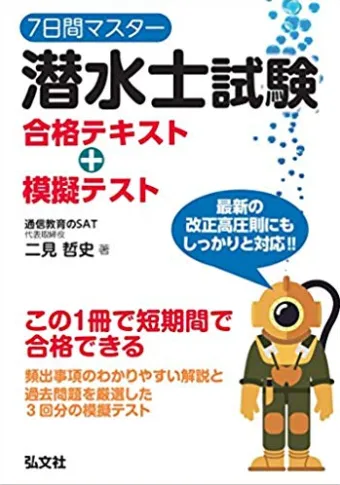
I basically powered through the entire book cover to cover, then drilled past exam questions obsessively.
At the bottom of this website you'll find past exam papers with explanations — finding this site felt like striking gold.
I studied by using Google Translate alongside the material.
After working through enough past papers, you'll start to notice that a huge number of questions are recycled from year to year.
One trick that made things a little easier: memorise some katakana. A lot of diving-related terminology in Japanese is simply borrowed directly from English. For example, "weight" (配重) is written as ウエート (u-e-to). Similarly, once you spot ない in a sentence, you know it's asking about a negative case or exception.
(Funny story: I didn't figure out that ない means "not" or "without" because someone explained it to me or because I looked it up — I picked it up purely from noticing the pattern across so many past exam questions. Ha!)
-
Study diligently for a week and the 潜水士 really isn't hard to pass. If you'd rather not buy a book (I didn't actually buy one — the shop happened to have a copy I could use), just hammer through the past exam questions until you can answer every single one on reflex. The questions really do repeat themselves year after year.
And hey, having a "Japan National Examination" certificate under your belt sounds pretty impressive, doesn't it? Ha!
Good luck to everyone preparing for the 潜水士!
Related links:
-
Blue Seas and Manta Magic in the Yaeyama Islands – Ishigaki Island Manta & Big Animal Diving
-
Caves, Sharks, and Stunning Coral Reefs: Uncovering Okinawa's Secret Dive Spots – Cape Manzamo
-
Step Outside Your Comfort Zone and Travel the World Through Diving!
-
There's More to Okinawa Diving Than the Blue Cave! 5 Okinawa Diving Secrets You Need to Know
-
The Most Complete Okinawa Diving Guide Ever! Stop Saying Diving in Japan Is Too Hard!
-
Author: Erica's Blog (Pixnet)
-
Author's page: 小島日常-islandvibes studio