![[Freediving] Someone Almost Died in the Ocean](/_images/a02ffce9a921-1440w.webp)
The Editor says: Freediving is a captivating sport, yet many people treat it as a casual leisure activity — renting a pair of long fins and a mask from a dive shop and heading into the water with a group of friends. In the midst of the fun, they overlook the enormous risks lurking beneath the surface. Instructor YIMIN shares a first-hand experience to help us understand how a near-fatal accident can unfold. Reproduced in full from the MISO Freediving Familia Facebook page.
If you found the headline alarming, perhaps it should be. But if you have the time, please read this all the way through and share it, so that more people can understand what happened and what we can learn from it. The language below may be blunt — please bear with me.
My name is YIMIN, and I am a freediving instructor. Today is August 20th. I was in the water with a student, conducting an open-water course. Around noon — 12:00 — I was about to send my student on one final dive before we packed up and headed to shore.
At that moment, a freediver from a neighboring float surfaced right next to my float (the connecting line between the two floats was roughly 5–6 metres). This told me he was not wearing a safety lanyard, and that he was 5 or 6 metres away from his dive buddy. Watching him from the side, I could just make out his neck — he appeared to take 1–2 recovery breaths, but they were incomplete, barely two rushed gulps of air. And then… he started sinking.
His body was completely relaxed, arms open, legs open — and during the sinking he exhaled a bubble of air.
At that moment I already sensed something was wrong. Yet strangely, my mind flashed to an image of @din_1shian — the judge at a pool competition — calling out to me: Go! (For context: during pool competitions, it is the judge who determines whether a competitor on the surface is conscious and whether a safety diver needs to intervene.)
Without hesitating, I jackknifed down and brought the sinking freediver back up. He had no wetsuit on — just a pair of board shorts. As I pulled him up, his upper body was convulsing from an LMC (loss of motor control). I removed his mask and called out 4–5 times: "Breathe! Blow! Come back!" — tapping his face.
He came around. But his first words were: Why are you holding me up? Whose legs keep pushing against me? — From what he said, it was clear he had blacked out (BO). In his mind, he thought he had already surfaced; he had no memory whatsoever of sinking, exhaling, or being rescued.
Afterwards, a student who had been watching the ocean training told me that while I was pulling him up, his dive buddy was heard saying loudly: What are those people doing?! — The terrifying part: you were unconscious in the water, being rescued by a stranger, and your own dive buddy had no idea anything had happened to you.
Friend — you are truly, incredibly lucky. I don't know whether you'll ever read this.
If I hadn't been planning to leave early, I would not have been positioned in front of your float, and there would have been no one at all in that spot.
"You would have been dead — sunk to the cold seafloor, and not necessarily ever found."
If I had happened to be facing the other way, and your dive buddy had no idea you were unconscious just five metres away beneath the surface:
"You would have been dead — sunk to the cold seafloor, and not necessarily ever found."
So please — cherish your own life.
Take the courses you need. Ask when you don't understand. Look up what you're missing.
Please stop assuming that instructors just love to nag, that we love to lecture, that we go on and on every single day about lanyards and buddy systems — and that when we urge you to take a class, we're somehow just trying to squeeze money out of you. When a human life is in your hands — or right beside you — and can vanish in an instant, nobody can afford to be casual about it.


Freediving Safety — Key Takeaways:
- If you've already taken a course, go back and thoroughly review and practise your safety protocols, rescue skills, and buddy system procedures.
- If you haven't taken a course yet, please — find an instructor somewhere near you, north, central, or south, and properly learn the safety concepts, rescue skills, and buddy system. If you truly can't make it to a class, remember: Google is free. Search those keywords yourself. If you're too lazy even for that, I'll post a link below to safety articles by @weirdo.freediving — read them in full. At the very minimum, have the basic common sense.
Finally, remember: the first line of defence in the buddy system is you.
You must be able to independently assess your own situation: Is the diving environment safe? Is your buddy capable enough? Are all your safety measures properly in place?
Only after you have made that self-assessment can you hand off the second line of defence to a buddy you trust and who is genuinely competent.
What's truly frightening is not ignorance — it's not knowing that you are ignorant. When you face the open natural environment, maintain a sense of crisis awareness at all times.
Without proper safety knowledge, a buddy system, and rescue preparedness:
Freediving is extremely dangerous — and the price is your life.
Freediving is extremely dangerous — and the price is your life.
Freediving is extremely dangerous — and the price is your life.
@weirdo.freediving freediving safety article: https://www.weirdofreediving.com/blog/5442238
As the freediving population continues to grow rapidly, I believe there are still a small number of people out there with no awareness of these risks. If sharing this has even a chance of helping one more person understand the hidden dangers and stay safe — why wouldn't we?
I am MISO YIMIN.
The MISO Freediving Familia instructor team cares about you!
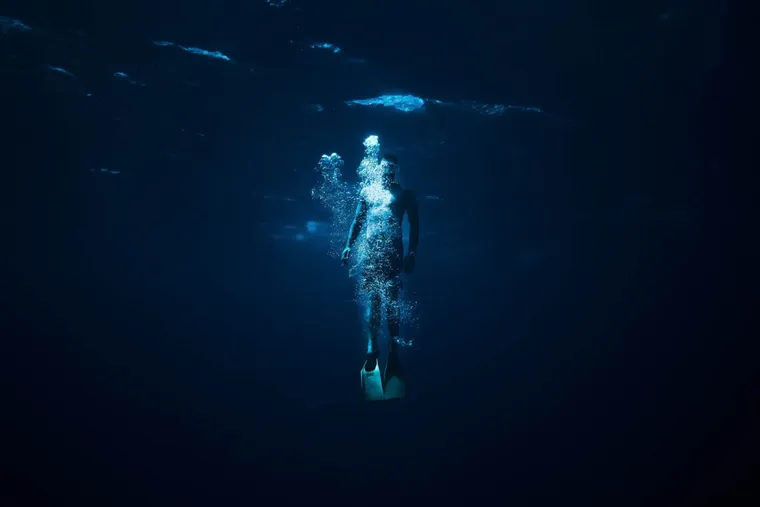
Cover photo: Photo by Naja Bertolt Jensen on Unsplash
Related links: