

Contents(9)
the Editor says: Freediving has become a hot topic in recent years, with young people and influencers sharing stunning underwater photos on social media — toned physiques, bikinis, sunshine, and brilliant blue water making for the perfect escape from everyday worries. But for any freediver who wants to look the part, the mask is arguably the most important piece of gear. Choosing the right mask is a real art form, so let's take a look at the tips shared by Liquid Vision 自由潛水合作社 on how to pick a freediving mask!


How Do You Choose a Freediving Mask?
The masks discussed here refer to the kind that covers both your eyes and nose — not other types such as liquid masks or Hektometers. Whether you're about to take your first plunge into the world of freediving or you're a seasoned diver looking to buy a new mask, the following should be a big help when making your purchase.
"Volume"
As you descend, water pressure causes the air inside the mask to compress, creating a squeeze. At this point you need to equalize the pressure in your mask. For freedivers, however, every bit of air is precious, so a lower-volume mask is generally more suitable for freediving.
Note that I said "lower volume," not "the smaller the better." With that in mind, let's talk about some things regarding mask volume that you may never have considered.
-
First of all, mask volume is not a fixed number — and many people will be shocked to hear that! Because everyone's face shape is different, the volume printed on a mask's spec sheet is not necessarily the actual volume once it's sitting on your face.
-
How do masks achieve a smaller volume? The most common approaches are reducing the size of the lens and skirt, and positioning the lens closer to the eyes. This means that whether your face shape is compatible with the mask's design becomes a crucial question.
So when it comes to finding a low-volume mask that actually works for you: much of it comes down to your individual face shape, rather than simply chasing the lowest volume number. If a mask doesn't conform to your face and lets water in, it's not the right mask for you. (Of course, there are many reasons a mask might leak — it's not always purely a fit issue.)
"Lenses"
Most lenses are made from tempered glass, while a small number are made from plastic (such as the very popular Aqualung Sphera). So what are the differences between tempered glass and plastic lenses?
-
Tempered glass lenses are generally marked on the lens itself, either with the word "tempered" written in full or just the abbreviation "T."
-
Prescription lenses will not display the tempered glass marking, but they are still made of glass — just like optical eyeglass lenses.
-
Plastic lenses offer greater flexibility and can be curved to follow the contour of your face.
-
Because they are plastic, they scratch very easily.
-
Curved plastic lenses can cause distortion at the edges of your field of vision; a small number of people experience dizziness when wearing them.
-
Regardless of material, lenses must be securely sealed within the frame to achieve a watertight fit.
-
Plastic lenses tend to seal less effectively within the frame and have a shorter lifespan.
[caption id="attachment_5290" align="aligncenter" width="720"]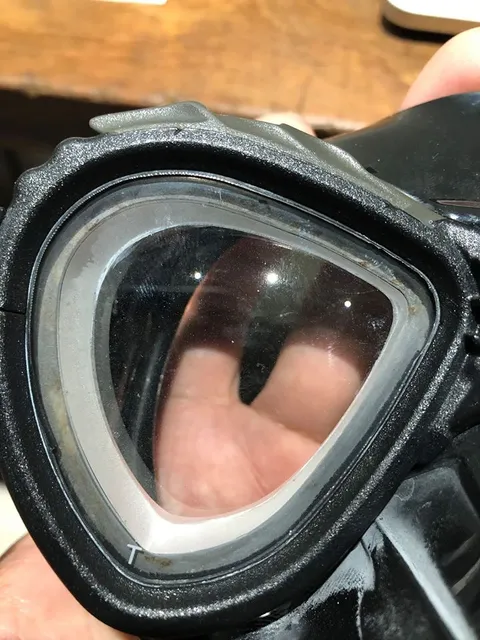 Prescription lenses with the "T" abbreviation visible at the top[/caption]
If your lens is marked with "tempered glass," be aware that during heat treatment the surface of tempered glass acquires a thin silicone film. This film makes it very easy for moisture to cling to the glass and cause fogging, so it must be removed before you start the de-fogging process.
[caption id="attachment_5288" align="aligncenter" width="720"]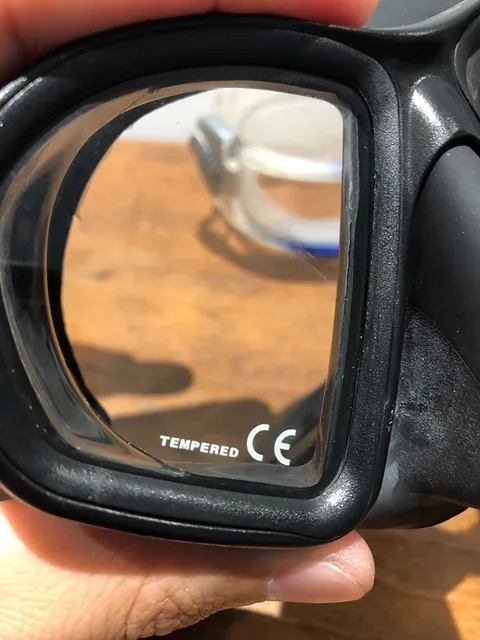 The "Tempered" marking[/caption]
Removing the film is simple: apply toothpaste to both the inner and outer surfaces of the tempered glass lens, scrubbing in circular motions as thoroughly as possible until the toothpaste dries, then wash it off with dish soap. Repeating this process a few times should be enough to remove the surface film. Some people burn the silicone film off with a lighter until it turns black, then wash the lens clean — but since I personally prefer not to use fire, I won't go into detail on that method here.
So how do you de-fog a mask? The most natural option is saliva (recommended), or a very small amount of toothpaste (do not use on plastic lenses, as it will scratch them), or a commercial de-fog solution. The one critical point to remember is the lens must be completely dry before applying any de-fogging agent — this is very easy to overlook. Water itself acts as a barrier, and a wet lens will prevent any de-fogging agent from adhering properly. (This is also why saliva is recommended: it's infinitely available and environmentally friendly.)
[caption id="attachment_5289" align="aligncenter" width="720"]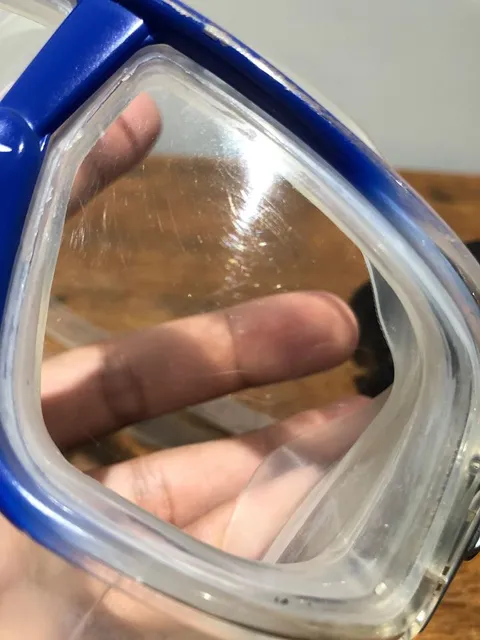 Plastic lens — scratch marks from use are clearly visible at the top[/caption]
Finally, one very important point: freediving lenses must be clear/transparent, so your dive buddy can clearly see your eyes and fulfil their role as a proper buddy.
"Frame Design"
Mask frames come in two designs: framed and frameless. A framed design, as the name suggests, has two lenses fixed to a rigid frame — similar to a pair of glasses. Frame materials vary widely, from the most common plastic through to aluminium alloy and even stainless steel.
As for frameless designs — technically speaking, the lens perimeter is still enclosed by some kind of frame. What is referred to as a "frameless" mask actually comes in two varieties:
- The nose bridge of the frame is slightly flexible, allowing it to bend slightly to follow your facial contours.
- Each lens has its own individual frame surround, but there is no rigid nose bridge connecting the two.
[caption id="attachment_5291" align="aligncenter" width="720"]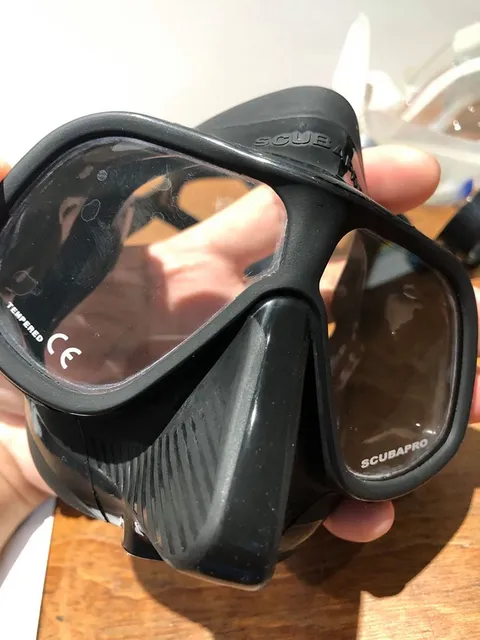 A mask with a flexible, bendable frame[/caption]
When trying on a mask, how can you tell whether the frame suits your face shape? First, gently place the mask against your face in its natural position, then slowly inhale through your nose, allowing the mask to compress against your face. At this point, check whether the frame makes contact with — or presses against — any part of your face.
If it does, this mask is not a good fit for your face shape. In practice, the most common pressure point tends to be between the eyebrows — definitely something to watch out for.
[caption id="attachment_5292" align="aligncenter" width="702"]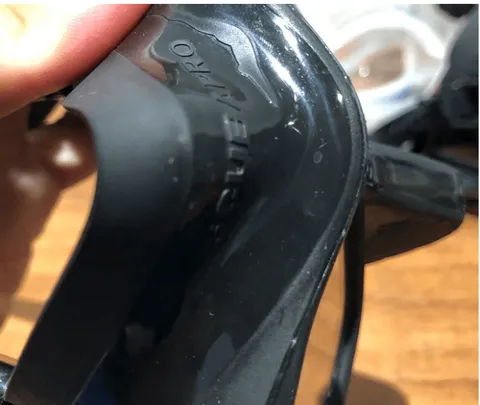 A top-down view clearly showing how the frame deforms[/caption]
"Skirt"
The skirt is another critically important component that tends to get overlooked. Most people say the softer the skirt, the better — better seal, better comfort. In reality, that's not always the case.
A skirt that is too soft lacks structural support and is more easily affected by water pressure, causing mask squeeze to set in earlier than it should. This can force you to equalize the mask sooner than necessary. As a general rule: when purchasing, how well the skirt conforms to your face shape matters more than how soft it is.
Another frequently overlooked part of the skirt is the lower edge of the nose pocket. The size, angle, and shape of this lower edge all have a direct bearing on whether water leaks in under the nose pocket — and of course, how you wear the mask also plays a role. This is especially relevant for Asian faces, which tend to be flatter in profile and can be at a slight disadvantage when fitting low-volume masks. Knowing how to spot these subtle details and adjust your fit accordingly becomes all the more important.
"Nose Pocket"
The nose pocket is probably the part most people pay the least attention to — beyond a passing mention that it should be easy to pinch. In most cases, however, how easy it is to pinch your nose actually has very little to do with the nose pocket itself; it mainly comes down to whether the mask's angle suits your face shape. The exception would be if your nose is unusually large or small.
In Taiwan, the most common complaints are a poorly angled mask or a nose that is simply too small to pinch easily for equalization. In those situations, most people turn to one of two "solutions":
- Pressing the nose pocket as hard as possible in hopes of reaching their nose.
- Wearing the mask higher, so the bottom edge of the nose pocket sits right against the nostrils, making it easier to block them.
Both of these are poor fixes. The first makes the nose pocket more prone to leaking, while the second can cause the soft palate to be inadvertently suctioned during descent as the mask compresses — making equalization even more difficult.
"Mask Strap"
A good mask strap must attach firmly to the frame. A small number of frameless masks connect the strap to the skirt instead — this can compromise the seal, so manufacturers tend to make the skirt much larger to compensate for the reduced structural integrity.
[caption id="attachment_5294" align="aligncenter" width="720"]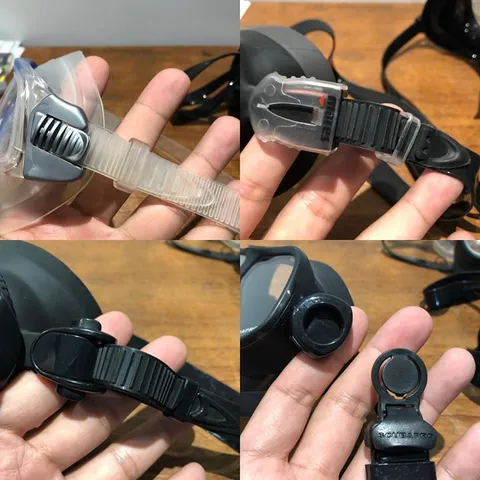 Various mask straps with different adjustment mechanisms — all connecting at the frame[/caption]
Additionally, when using a snorkel, a strap that is not attached to the frame can allow the skirt to be disrupted by the snorkel, causing leaks. Similarly, clipping a snorkel to the side of the mask without a keeper can also cause leaking. When not using a snorkel clip, it is recommended to position the snorkel at the back of the head; if you're worried about it falling off, you can secure it with a figure-eight ring or use a snorkel float sleeve.
[caption id="attachment_5293" align="aligncenter" width="720"]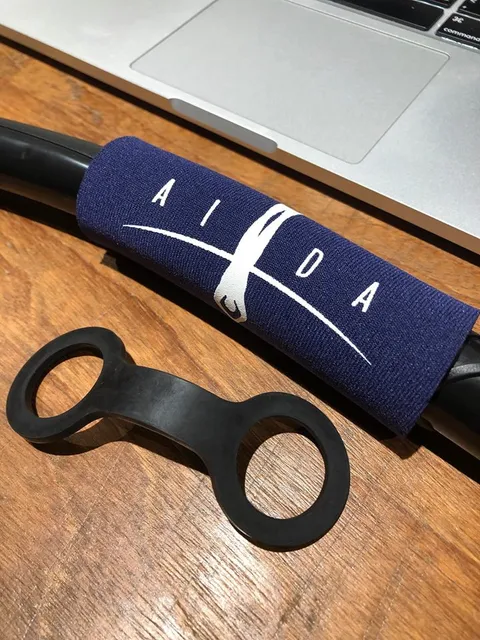 Float sleeve and figure-eight ring[/caption]
Remember: the side of the mask is not a good place to attach your snorkel.
"Summary — Key Points for Choosing a Mask"
-
Without wearing the mask strap, gently inhale through your nose and see whether the mask naturally suctions to your face.
-
Then slowly inhale more firmly through your nose until you feel pressure, and check whether the frame makes contact with or presses against any part of your face.
-
Check whether you can easily pinch your nose, and try equalizing a few times to see if any air leaks from your nostrils.
-
Make sure there is adequate space between your nose and the nose pocket.
-
Confirm that the mask strap functions properly — securely holding the mask to your face and maintaining an airtight seal.
-
Once conditions 1–5 above are all satisfied, choose the option with the smaller volume.
If you enjoyed this article, don't forget to like the Liquid Vision 自由潛水合作社 Facebook page and feel free to share this article!
Cover photo: Photo by Sebastian Pena Lambarri on Unsplash
Related links:

![[Kyotaro's Underwater Photography School] SONY RX100 or Olympus TG6? How to Choose?](/_astro/%E5%B7%A5%E4%BD%9C%E5%8D%80%E5%9F%9F-1-5_1b6de2.webp)