

![[Blu's Classroom] Marine Conservation Animals Get an Upgrade! Can You Identify These 3 Common Giant Clam Species in Taiwan?](/_images/7fb262ce4075-1440w.webp)


Known as the "rose of the sea," giant clams have become increasingly scarce due to overfishing and habitat destruction. In Taiwan, the three species most commonly encountered in the wild are the Elongated Giant Clam, Noah's Giant Clam, and the Scaly Giant Clam.
Giant clams are classified as members of the phylum Mollusca, class Bivalvia (Bivalve). They are filter feeders, drawing in seawater through their siphons and filtering out organic particles for food. In addition to being considerably larger than most other bivalves, another defining trait of giant clams is that — much like coral — they host colorful symbiotic algae (zooxanthellae), enabling them to contribute to reef-building in coral reef ecosystems and to help filter seawater. For these reasons, giant clams are regarded as indicator species in many environmental assessment reports.
Let's take a look at the distinguishing characteristics of the three giant clam species commonly found in Taiwan, and how to tell them apart.
Marine Conservation Animal — Elongated Giant Clam
Tridacna maxima
The Elongated Giant Clam is one of the most common giant clam species found in coral reefs, playing an important ecological role. Photo: Ye Chun-An
The most frequently encountered giant clam in coral reefs, this species uses its byssus threads to attach its shell to rocky substrate, gradually integrating with the reef structure as it grows. Its wavy mantle harbors symbiotic algae and is often spread open in sunlight to facilitate photosynthesis; it also draws in seawater to filter out organic particles. A small-to-medium-sized species, its shell can reach 20–30 cm in length. However, due to overharvesting, populations have declined in recent years and individuals are trending smaller in size.
Ocean Field Guide Vol. 2 — Nearshore Coral Reef Edition, p. 434
Noah's Giant Clam
Tridacna noae
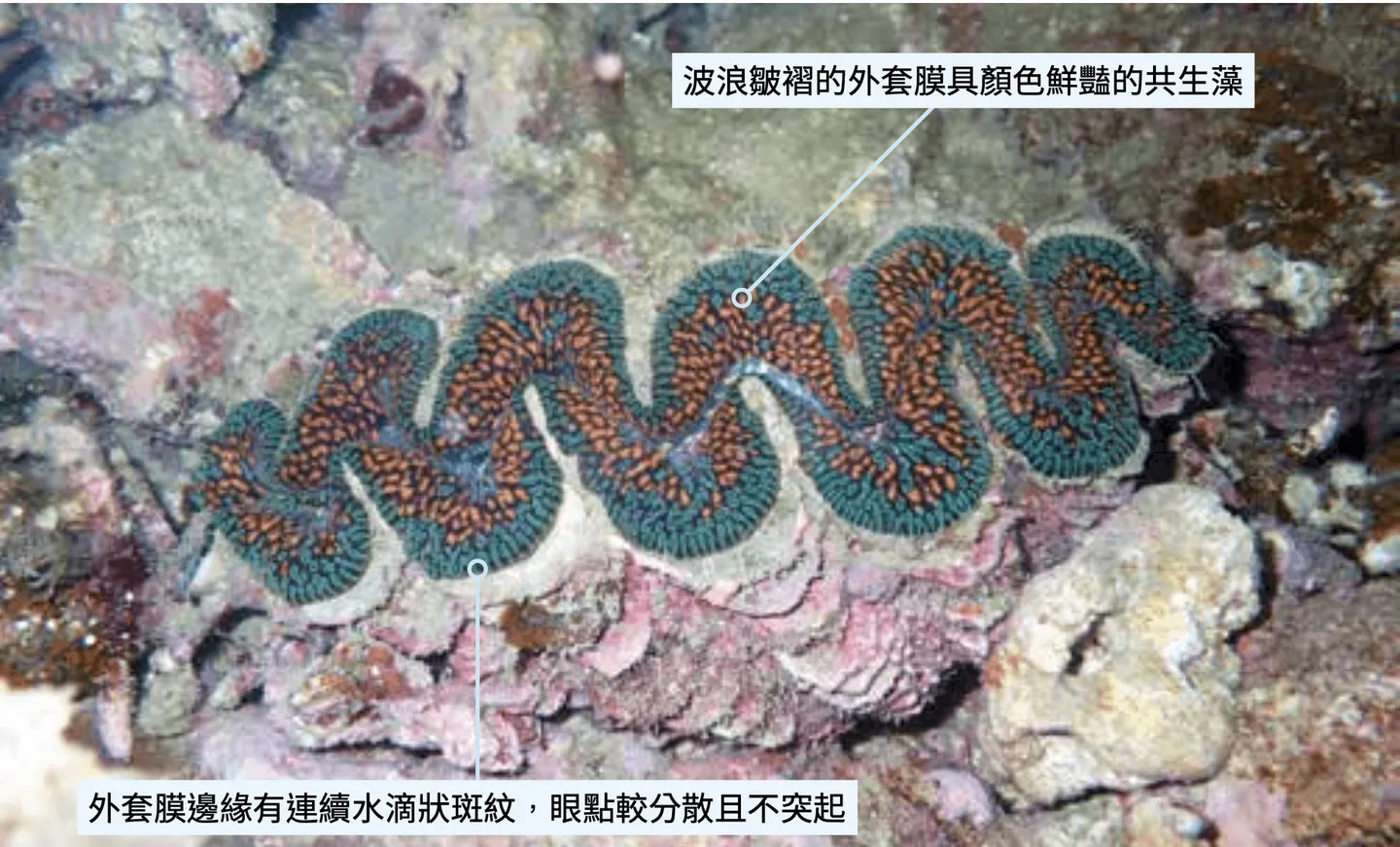
The vibrant colors on the mantle are imparted by the symbiotic algae living within it. Photo: Li Cheng-Lu
A commonly seen small-to-medium-sized giant clam, Noah's Giant Clam is most readily identified by the teardrop-shaped spots on its mantle. Its ecological habits are similar to those of the Elongated Giant Clam; it is often found growing alongside stony corals on rocky substrate. The mantle color varies — ranging from brown, blue-purple, and emerald green to reddish-brown — depending on the composition of its symbiotic algae. Because it contributes to both algal reef formation and water purification, it is, like other giant clams, an important indicator species in coral reef ecosystems.
Ocean Field Guide Vol. 2 — Nearshore Coral Reef Edition, p. 435
Scaly Giant Clam
Tridacna squamosa
This species can exceed 40 cm in shell length, making it one of the larger giant clam species. Photo: Lin Yu-Ping
The Scaly Giant Clam takes its name from the particularly well-developed scale-like lamellae projecting from its shell. These protruding ridges are often colonized by coral, sponges, sea squirts, and other encrusting organisms. Less common than the Elongated Giant Clam and Noah's Giant Clam, this species is typically found in deeper subtidal zones. Its mantle displays a wide range of colors and usually features wave-like patterning.
Ocean Field Guide Vol. 2 — Nearshore Coral Reef Edition, p. 436
On May 23 of the 111th year of the Republic of China, the Ocean Affairs Council announced a proposed amendment to Item 5 of the "List of Marine Conservation Wildlife," aiming to designate seven giant clam species — the Wedge Clam, Rounded Giant Clam, Fan Giant Clam, Giant Giant Clam (Tridacna gigas), Elongated Giant Clam, Noah's Giant Clam, and Scaly Giant Clam — as precious and rare marine conservation wildlife. The amendment has yet to be passed.
However, according to a survey conducted by the Ocean Conservation Administration in the 110th year of the Republic of China, giant clam populations in Taiwan's waters have been widely impacted by marine pollution, climate change, harvesting pressure, and human disturbance, with a generally low proportion of adults, low population density, and an overall declining trend.
Therefore, if giant clams are in the future officially listed as "Marine Conservation Wildlife," it will be possible under wildlife protection regulations to prohibit their capture, trade, display, exhibition, possession, import, export, captive breeding, and propagation — thereby strengthening their conservation through heightened management measures.
Related links:

![[BlueTrend Mini Classroom] Sea Lettuce Edition|Marine Habitat & Life Micro-Education Series Part 1 ft. Ocean Conservation Administration, Keelung City Government](/_astro/%E7%9F%B3%E8%93%B4%E7%AF%87%E5%B0%81%E9%9D%A2_1ALbXT.webp)
![[Blu's Little Classroom] Tide Pools | Marine Habitat & Life Micro-Education Series Part 2 ft. Ocean Conservation Administration, Keelung City Government](/_astro/%E6%BD%AE%E6%B1%A0%E7%AF%87_20dBwG.webp)