Contents(6)
- Recovering Marine Debris: Joining "Project ReCon" to Clear Fishing Nets
- The Negative Impacts of Ghost Nets, Fishing Gear, and Other Marine Debris
- The Ecological Conservation Crisis Caused by Discarded Fishing Nets
- Discarded Fishing Nets Will Lead to Reduced Commercial Fish Stocks
- Don't Let Discarded Nets Become Marine Debris! Kaohsiung Launches Recycling Incentives
- Clearing Fishing Nets Is No Easy Task! The Editor's Experience
Marine debris is a serious global problem, and ghost nets have become one of the greatest threats to the survival of marine life. According to estimates by World Animal Protection (WAP), each abandoned fishing net can trap 30 to 40 marine animals. At this year's APEC Marine Debris Regional Governance Workshop and International Forum, organised by the Ocean Affairs Council, Australian non-profit organisation Tangaroa Blue Foundation (TBF) shared their initiative, Project ReCon, which uses technology to track and retrieve ghost nets.
At the forum, Ye Zongxian, Section Chief of the Fishing Port Management Division of the Kaohsiung City Marine Bureau, also exchanged ideas with international partners on the topic of Kaohsiung's abandoned fishing net recycling and reuse programme. It's a global battle against stubborn fishing nets! At the end of the article, the Editor also shares personal experience of diving for ocean cleanup and clearing fishing nets — read on to find out more.
Recovering Marine Debris: Joining "Project ReCon" to Clear Fishing Nets
TBF is an Australian non-profit organisation dedicated to removing and preventing marine debris. Concerned about the damage ghost nets cause to the Great Barrier Reef's coral reefs and marine life, they launched Project ReCon — the world's first programme to use satellite technology to tag and track fishing nets. Notably, the equipment used is itself made from recovered discarded fishing gear.
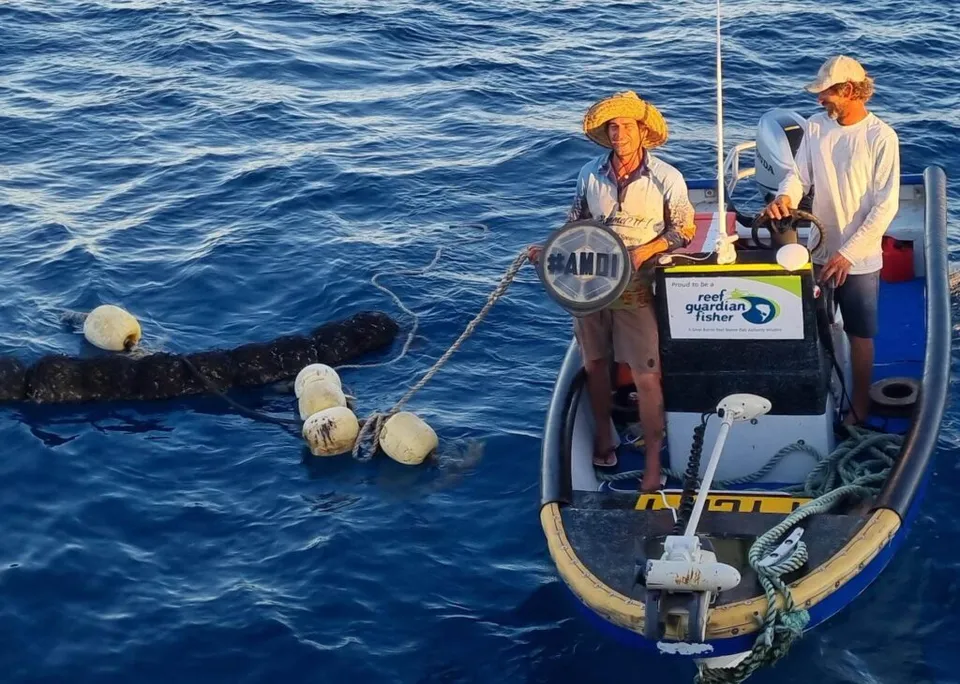
The Australian non-profit organisation uses satellite technology to track ghost nets. Image source: Project ReCon
Project ReCon repurposes decommissioned fishery buoys fitted with Echosounder Buoys — devices commonly used in purse-seine tuna fishing that can detect the volume of marine life within 115 m below the buoy. These are now deployed to report marine debris: when a ghost net is detected, the buoy continuously transmits signals via satellite, relaying the net's location and information.
Project ReCon works with more than 83 vessels and 21 tuna companies. When partner vessels are at sea and spot a fishing net, they can immediately attach a buoy, which transmits information via satellite. As soon as the retrieval team receives the signal, they can mobilise to clear the net. The retrieval team can track the buoy's movement via satellite and monitor the net's location in real time, meaning partner vessels can continue their work unaffected while waiting for the retrieval team to arrive.
In addition, this technology can also be used for prevention: virtual fences can be marked around ecologically sensitive coral reef areas of the Great Barrier Reef, so that if a ghost net drifts into the zone, an automatic alert is triggered, allowing the team to remove the net as quickly as possible and reduce the threat to the ecosystem at the earliest opportunity.


The Negative Impacts of Ghost Nets, Fishing Gear, and Other Marine Debris
Lurking beneath the ocean are all manner of ghost fishing gear — nets, fishing lines, lobster traps, and other man-made devices designed to catch marine life — whose negative impacts extend beyond ecological conservation crises to potential reductions in commercially viable fish stocks.
The Ecological Conservation Crisis Caused by Discarded Fishing Nets
Drawing on data provided by World Animal Protection, it is estimated that at least 136,000 seals, sea lions, and large whales are harmed each year. Every tonne of ghost nets and fishing gear is estimated to trap up to 125 tonnes of fish. Ocean Conservancy further notes that 45% of marine mammal species on the IUCN Red List of Threatened Species face threats from ghost gear, with knock-on effects for entire ecosystems.
Discarded Fishing Nets Will Lead to Reduced Commercial Fish Stocks
These pieces of marine debris — generated by human fishing activity and abandoned in the ocean — continue to trap fish even after they become unattended ghost nets. Ocean Conservancy estimates that 90% of the fish trapped globally have commercial value, and that these ghost fishing devices, which catch marine life with no one managing them, may cause the populations of some fish species to decline by 30%, also affecting fishery resources and food supplies.
Don't Let Discarded Nets Become Marine Debris! Kaohsiung Launches Recycling Incentives
To prevent discarded fishing nets from becoming marine debris, the Kaohsiung City Marine Bureau introduced a recycling incentive: every 10 kilograms of fishing net can be exchanged for NT$150 in convenience store gift vouchers. The incentive scheme has proven effective. Since the trial recycling and reuse programme for discarded fishing nets began in 2018, a total of 119 tonnes of discarded nets have been collected over five years.
Ye Zongxian, Section Chief of the Fishing Port Management Division of the Kaohsiung City Marine Bureau, shared that the key was "letting fishers know that discarded nets have value." Through active education, training, and outreach via seven fisheries associations, fishers have been willing to contribute to marine conservation with minimal effort. Ye Zongxian noted that the most time- and labour-intensive part of recycling the nets is the "pre-processing" stage, which requires manually removing floats, sinkers, and other components. After this painstaking pre-processing, discarded nets can be remanufactured into recyclable plastic pellets. Last year, the reuse rate reached 50%, and this year it is expected to rise as high as 60%.
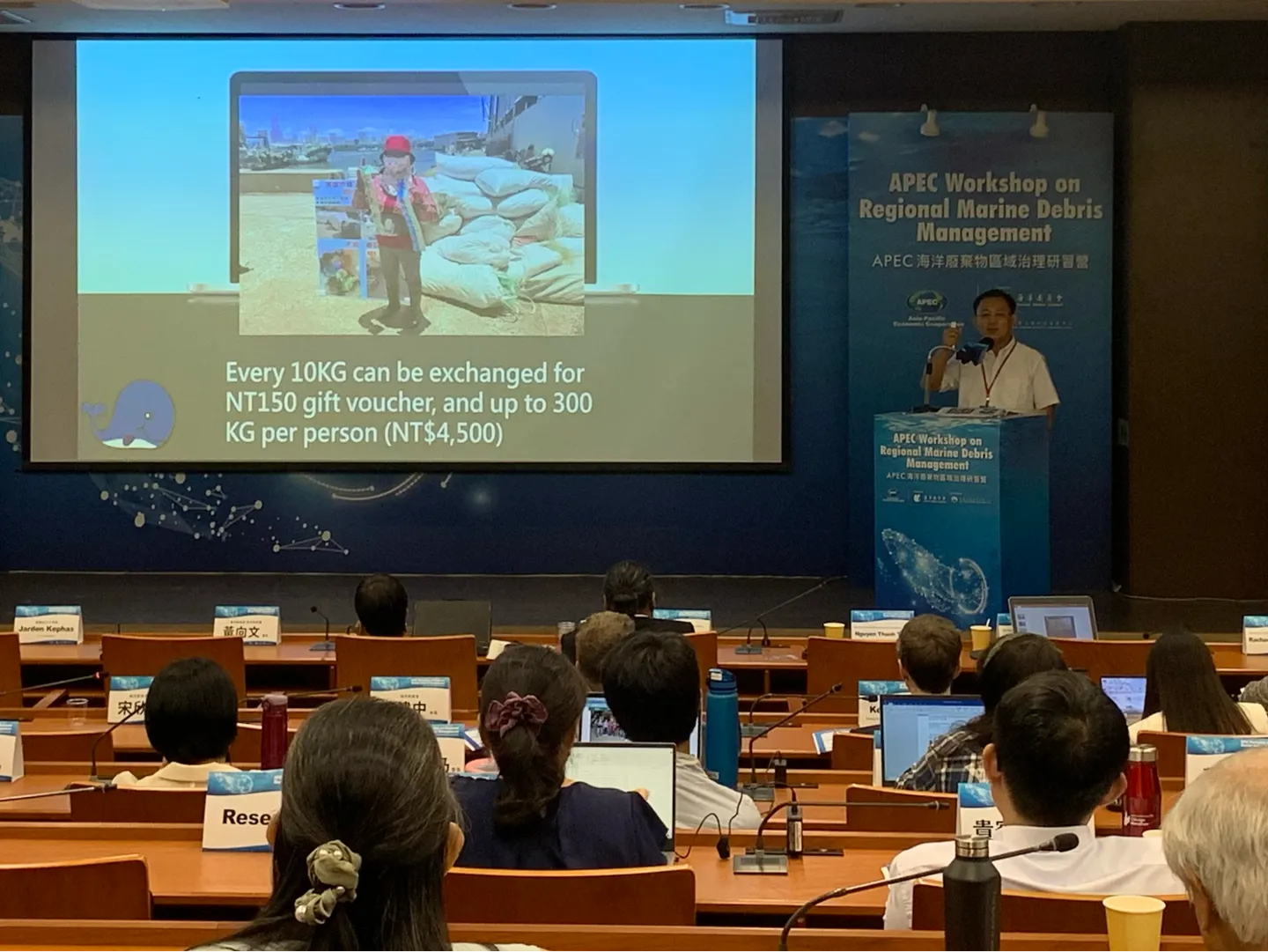
Ye Zongxian, Section Chief of the Fishing Port Management Division of the Kaohsiung City Marine Bureau, sharing the Kaohsiung discarded fishing net recycling and reuse trial programme.
Clearing Fishing Nets Is No Easy Task! The Editor's Experience
In the course of filming and documenting Taiwan's major dive sites, the Editor has witnessed discarded fishing nets damaging ecosystems on multiple occasions — for example, at "Turtle Egg," a dive site near Turtle Island, where fishing nets were seen blanketing a large area of coral reef. At the time, a fellow diver rallied 14 experienced divers who, battling the current, worked to cut through the nets before finally clearing a large portion, then used surface marker buoys (SMBs) to bring the nets up to the surface.
Every time we conduct an ocean cleanup or clear fishing nets, amid the nets piled high on the bow, we always find many trapped marine animals — crabs, pufferfish, and others. The heartbreaking reality is that it seems "impossible to ever truly finish the job." The nets spotted at Turtle Egg that day were likely several nets tangled together into a single massive clump, with the tangle extending even deeper below… To protect marine ecosystems, source management is actually far more important than ocean cleanup and net clearing alone!
This time, the Editor attended the APEC Marine Debris Regional Governance Workshop and International Forum, where experts from many countries shared marine debris collection technologies and circular reuse practices. We hope that through exchanges across all sectors, we can work together to make the ocean a better place. The Editor will continue to follow and share the latest ocean news from around the world — welcome to register as a member and subscribe to our newsletter for more of the blue pulse from the sea.
Editor in charge: Jenny Tsai
References:
Further Reading:

![[BlueTrend Mini Classroom] Stressed Out and Dropping Limbs? The Sea Star Is the Ocean's Most Dramatic Creature — and Its Biggest Enemy Might Surprise You!](/_astro/004_%E5%B8%83%E9%AD%AF%E5%B0%8F%E6%95%99%E5%AE%A4_vivipic_Z2g4jPr.webp)