Contents(5)
- Why Is a Healthy Coral Reef "Noisy"? Sound Is Actually the GPS Coral Larvae Use to Find Home
- The CORAL SONIC RESILIENCE Project: A Brand-New Reef Restoration Experiment Using Underwater Speakers
- New Evidence for Reef Restoration: WHOI's 2024 Paper Shows Sound Can Boost Larval Settlement Rates Up to 7 Times
- What This Means for Divers: Underwater Soundscapes Are the Overlooked Piece of the Reef Restoration Puzzle
- Closing Thoughts: Reef Restoration Isn't a One-Road Journey — Next Time You Dive, Use Your Ears Too
Can you imagine your next dive with a singing sculpture stationed beside the coral reef? The coral reefs along Jamaica's North Coast are testing a restoration idea that sounds straight out of a science-fiction film: Italian artist Marco Barotti has sunk a set of solar-powered underwater speakers into the sea, playing the sounds a healthy coral reef is supposed to make, in an effort to call fish and coral larvae back home. There's more than performance art behind this — a 2024 paper from the Woods Hole Oceanographic Institution (WHOI) in the United States has already demonstrated that this approach of "acoustic enrichment" can increase coral larval settlement rates by up to 7 times. In this piece, the Editor breaks down exactly how the CORAL SONIC RESILIENCE project works, why the science holds up, and why, as a diver, this is something worth keeping in mind.
Why Is a Healthy Coral Reef "Noisy"? Sound Is Actually the GPS Coral Larvae Use to Find Home
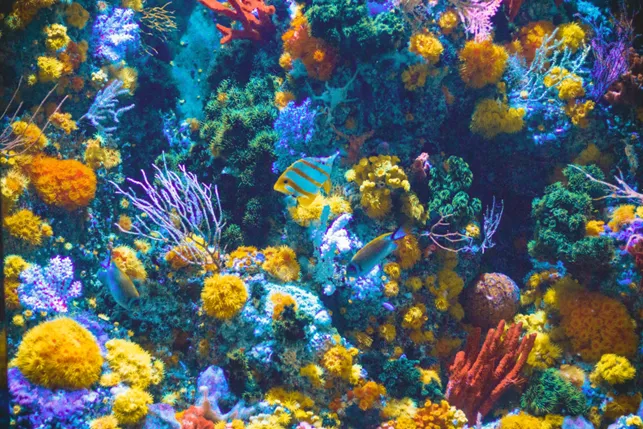
You might assume the underwater world is quiet — but the reality is quite the opposite. A healthy coral reef is essentially a round-the-clock wet market, its soundscape packed with the grunts and clicks of fish, along with tiny creatures called pistol shrimp, whose snapping claws fire off underwater explosions that sound like popcorn popping.
The Snapping of Pistol Shrimp and the Grunts of Fish Are Road Signs for Coral Larvae
After coral spawns, its larvae drift in the water for anywhere from a few days to a few weeks. During that time, a larva must find a suitable piece of reef to settle on before it can establish itself. The problem is that visibility underwater is limited — so how does a larva choose? The answer is by listening. Research shows that coral larvae interpret the lively soundscape of a busy reef as a signal that says "business is booming here, this is a good place to land," and conversely will avoid the silence of a dead reef.
The First Sign of a Reef in Decline Is That It "Goes Quiet"
This is why scientists have recently started treating underwater soundscapes as an indicator of coral reef health. When a reef suffers widespread coral bleaching and its ecosystem collapses, what disappears isn't just colour — the sound vanishes too. The pistol shrimp thin out, the fish leave, and all that remains at the surface is the sound of waves. For coral larvae still drifting in the water, that silence signals: "Nothing left here — don't stop." Once a reef goes quiet, it falls into a vicious cycle: the quieter it gets, the fewer new residents it attracts; the fewer new residents it attracts, the quieter it gets.


The CORAL SONIC RESILIENCE Project: A Brand-New Reef Restoration Experiment Using Underwater Speakers
This is the cycle Marco Barotti wants to break. The Berlin-based Italian media artist connects art with acoustic ecology. In December 2024, he deployed the first batch of prototypes around Feridhoo Island in the Maldives, and in April 2026 he brought upgraded underwater sculptures to Jamaica's North Coast.
Solar-Powered Underwater Speakers Paired with 3D-Printed Ceramic Sculptures Modelled on Bleached Coral
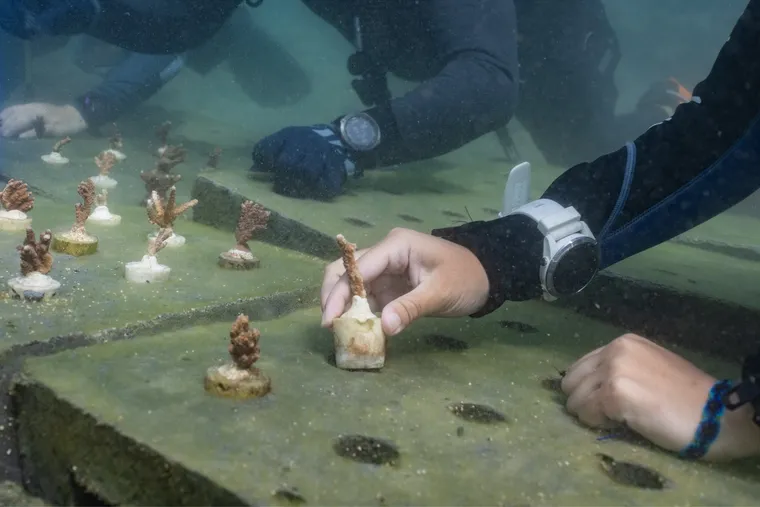
CORAL SONIC RESILIENCE is far more sophisticated than simply strapping a speaker to a rock and tossing it overboard. Marco Barotti used ceramic and calcium carbonate to 3D-print an entire set of underwater sculptures, their forms taken directly from 3D scans of bleached coral — essentially recreating the shapes of dead reef structures. Each sculpture functions simultaneously as a sound emitter and a physical habitat: solar panels on the surface provide power, while the speakers below play raw soundscapes recorded from healthy local reefs in the Maldives and Jamaica. The porous surfaces of the sculptures also allow fish to shelter inside and algae to colonise them — and in theory, coral larvae can settle on them too.
Why Jamaica's North Coast? The Real Crisis Behind the No Time to Die Filming Location
Jamaica's North Coast was where the 2021 film No Time to Die was shot around Port Antonio, and it has long been one of the most iconic coral reef environments in the Caribbean. Beginning in the 1980s, the reefs were battered in succession by Hurricane Allen, the mass die-off of long-spined sea urchins (Diadema antillarum), overfishing, and coastal nutrient pollution. Coral coverage collapsed from more than 50% to single digits — a breakdown comprehensively documented in Hughes's landmark 1994 paper in Science, and still considered one of the most challenging reef restoration contexts in the world. By choosing this site, Marco Barotti is essentially sitting his project's hardest exam. Whether it can reawaken an ecosystem on a reef this degraded is the ultimate test.
New Evidence for Reef Restoration: WHOI's 2024 Paper Shows Sound Can Boost Larval Settlement Rates Up to 7 Times
The artistic project sounds romantic, but Marco Barotti is confident enough to push ahead because there is solid data backing him up.
A Controlled Experiment Across Three Reef Sites off St. John, U.S. Virgin Islands
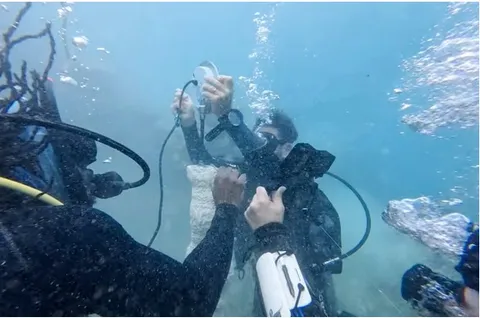
A research team led by WHOI doctoral candidate Nadège Aoki and marine biologist Aran Mooney published a paper in Royal Society Open Science in March 2024, conducted at three reef sites along the southern shore of St. John in the U.S. Virgin Islands: the relatively healthy Tektite Reef, and two severely degraded sites, Cocoloba and Salt Pond. The team placed underwater speakers at the degraded reef sites, played recordings of fish calls and pistol shrimp snaps captured from the healthy reef, and compared coral larval settlement rates between locations with and without acoustic playback.
Average Settlement Rates 1.7 Times Higher, Up to 7 Times at Peak Sites
The experiment used mustard hill coral (Porites astreoides). Sites receiving healthy reef soundscapes showed larval settlement rates averaging 1.7 times higher than control sites without playback, with certain locations reaching as much as 7 times higher. The paper also highlighted a key detail: settlement rates decreased with distance from the speakers, but even 30 metres away, rates remained higher than in the acoustically unenriched control group. This directly demonstrates that sound isn't merely a behavioural matter of "fish preferring a lively environment" — even pre-settlement planula larvae, which have yet to develop into coral, use hearing to choose where to settle, and the effect extends well beyond the immediate vicinity of the speakers. The paper concludes that acoustic enrichment has the potential to become a scalable new tool for coral restoration, filling a gap alongside existing strategies such as coral gardening and selective breeding for thermal tolerance.
A separate experiment by a British and Australian team at the Great Barrier Reef, published in Nature Communications in 2019, also found that degraded reef areas receiving healthy reef soundscapes saw fish numbers double within just a few weeks, with species diversity increasing by 50%. Coral recovery requires not only larval settlement but also fish populations to graze down the macroalgae that smother coral. Once that link in the chain is reconnected, the odds of successful coral restoration increase substantially.
What This Means for Divers: Underwater Soundscapes Are the Overlooked Piece of the Reef Restoration Puzzle
At this point, you might be wondering what any of this has to do with the Editor's next dive at Orchid Island or Kenting. It has everything to do with it.
The Soundscape Observation Method: Hold Your Breath for 30 Seconds and Listen
The next time you're in the water during a safety stop, the Editor suggests you do something most divers have never done: slow down your breathing rhythm, stop completely, hold your breath for 30 seconds, and really listen. If that reef is still alive, you'll hear a constant crackling in the background — a rapid, fine-grained popping — that's pistol shrimp at work. You might also catch lower, rumbling grunts; that's parrotfish or grouper talking. If a reef sounds thin and sparse, with nothing but the sound of water moving, that's not a problem with your ears — that reef is going quiet, and it's telling you things aren't looking good. Making "hold-and-listen" a personal habit is a free health check for any reef you dive.
Don't Let Boat Noise Become "Sound Pollution" for the Reef
On the flip side, the propellers, generators, and sudden accelerations of dive boats are all noise working in the opposite direction of reef recovery. Research has already shown that boat noise can interfere with coral larvae finding a place to settle, and can drive away the small fish that tend and protect the reef. The next time you're choosing a liveaboard or a day-trip dive site, ask one extra question: "Does the boat cut its main engine and switch to mooring lines when it reaches the dive site?" Whether that small detail is actually practised often marks the line between responsible dive operations and those cutting corners.
Closing Thoughts: Reef Restoration Isn't a One-Road Journey — Next Time You Dive, Use Your Ears Too
CORAL SONIC RESILIENCE isn't the only answer — reef restoration never has a single solution. Coral gardening, heat-resistant genetic strains, sea urchin restoration, and reducing land-based pollution all need to move forward simultaneously. But what makes Marco Barotti's experiment on Jamaica's North Coast so compelling is this: it brings "sound" — something divers have always treated as background — back to the centre of the conversation. The next time you stop underwater and hold your breath to listen, you're personally verifying whether that reef still has a future.
Where is the "noisiest" reef you've ever dived? Leave a comment on BlueTrend's social channels and let the Editor know — the next article will compile a reader-voted list of "the reefs that sing the loudest."
Sources:
- "Soundtrack of the sea: divers use underwater speakers to help dying coral reefs," The Guardian, 24 April 2026
- Aoki, N., Weiss, B., Jézéquel, Y., Zhang, W. G., Apprill, A. & Mooney, T. A. (2024) "Soundscape enrichment increases larval settlement rates for the brooding coral Porites astreoides," Royal Society Open Science, 11(3): 231514 (source of the average 1.7× and up to 7× larval settlement rate data)
- Gordon, T. A. C., Radford, A. N., Davidson, I. K. et al. (2019) "Acoustic enrichment can enhance fish community development on degraded coral reef habitat," Nature Communications, 10: 5414 (source of the Great Barrier Reef fish doubling and 50% species diversity increase data)
- Hughes, T. P. (1994) "Catastrophes, phase shifts, and large-scale degradation of a Caribbean coral reef," Science, 265(5178): 1547–1551 (landmark reference documenting Jamaica's coral coverage collapse from 50% to single digits, sea urchin die-off, and phase shift)
- Marco Barotti project page: Coral Sonic Resilience
- Popular science reference summaries: Sonic youth: Healthy reef sounds increase coral settlement (ScienceDaily, adapted from WHOI press release); Can Underwater Speakers Save the World's Dying Coral Reefs? (Katie Couric Media)