

Contents(3)
"What? You Don't Speak Japanese?"
That's usually the first thing people who care about me say when they find out I got a Japanese work visa in 2019 without being able to speak a single word of Japanese.
Yes — I've never even sat the JLPT N5 exam, I only recognize some hiragana, and the one Japanese sentence I can say is "I'm sorry, I don't understand Japanese."
And yet, here I am, working as a dive instructor in Okinawa, Japan. Being a dive instructor isn't anything extraordinary, and neither is my life. I am absolutely not the best or most elite person in this industry, and my story isn't the most remarkable either. But the road that led me to become a dive instructor — and the days I now spend facing the ocean — has been the blue fantastical journey of my life. It gave me the legitimate opportunity to live out my dream of traveling the world.
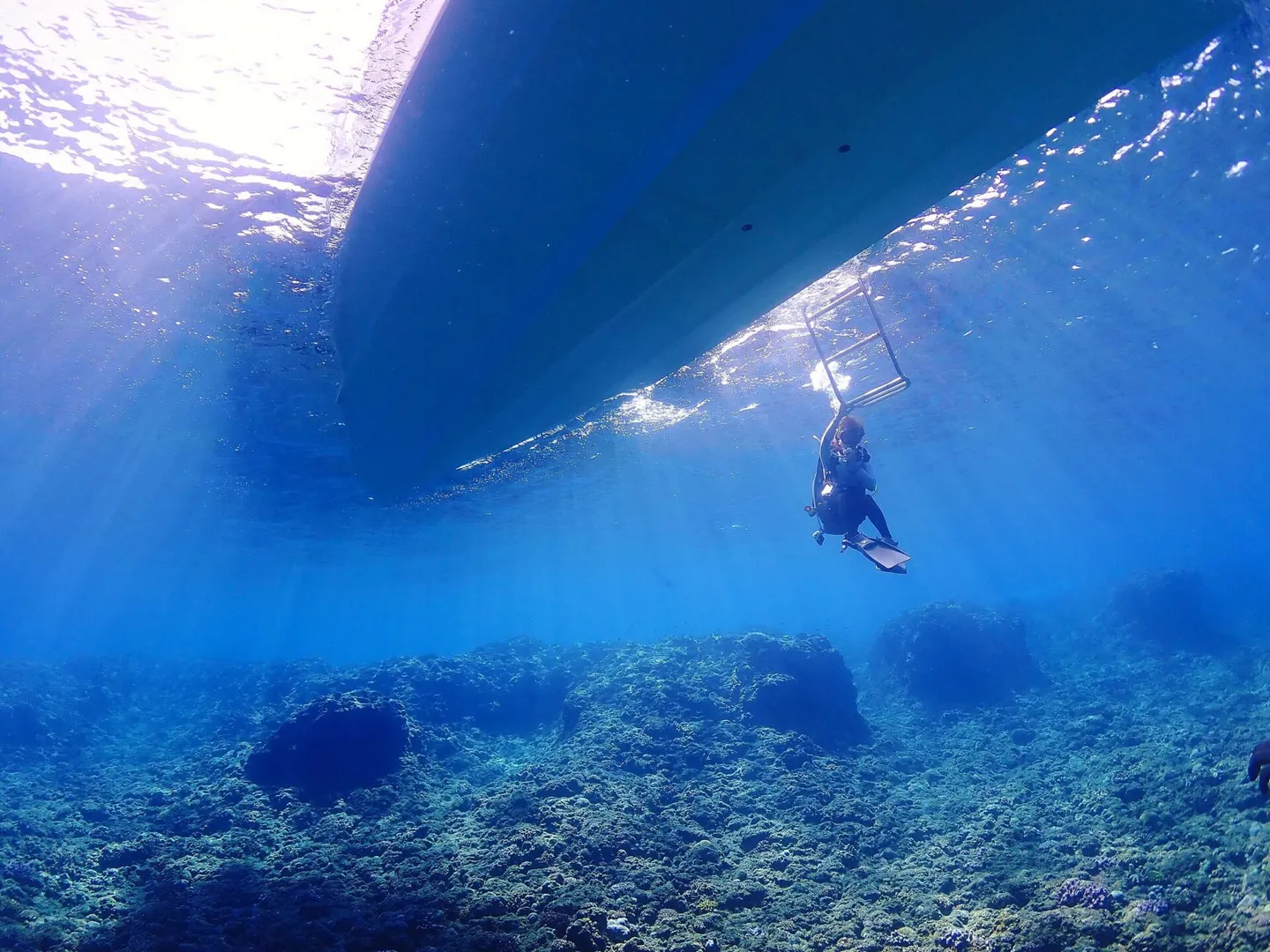
Boat diving at Zanpa Cape, Okinawa
The story I want to share isn't meant to explain how to work in Japan without speaking Japanese. Rather, it might offer a different kind of reference for people in a similar situation to mine — or for anyone who, like I once was, feels utterly lost about the future — a path that veers away from the cookie-cutter life.


I'm Someone Who's Fairly Smart but Incredibly Lazy.
I attended one of the top three girls' high schools in Taipei, but because I absolutely hated studying and had no real vision for my future, when it came time to fill out my university entrance exam preferences, I didn't choose based on interest. I just wanted to be in the same department as my best friend, so I casually put down the hospitality program at a private university in Taipei — and got in, naturally.
That's roughly when my life started going "off script."
The department required an internship in the food & beverage or hotel industry. Using that as my chance, I — having never been to Green Island — randomly Googled "Green Island work exchange," applied to the first guesthouse that came up, Chakra B&B, and got accepted without a hitch.
During those one and a half months on Green Island, every day was work, spacing out, laughing, swimming at the harbor... I began to fall in love with waking up to the ocean every morning. Up until then, my idea of water sports had only gone as far as snorkeling — and it was there that I discovered something called "scuba diving."
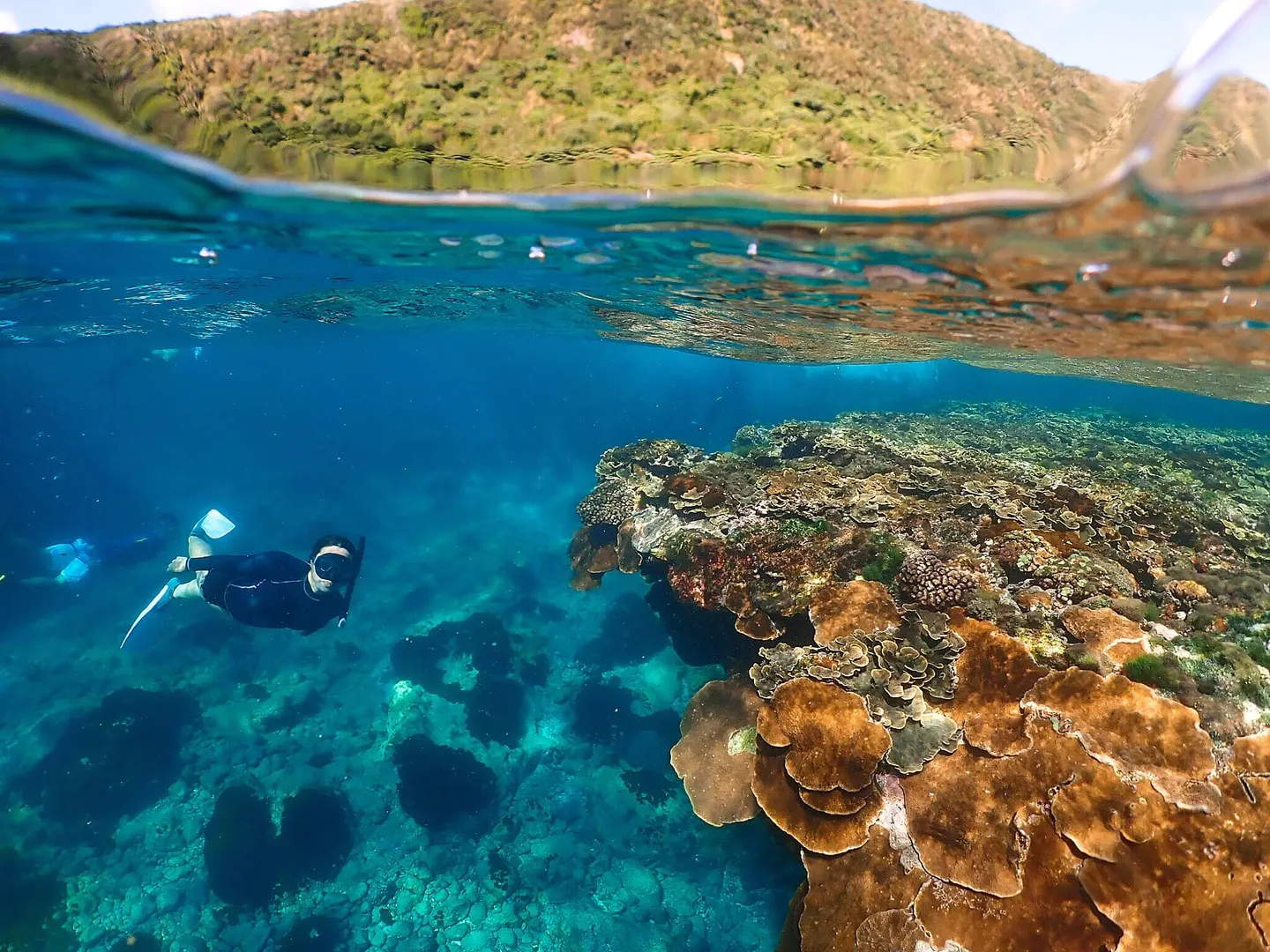
Everyday life on Green Island
Travel the World Through Diving!
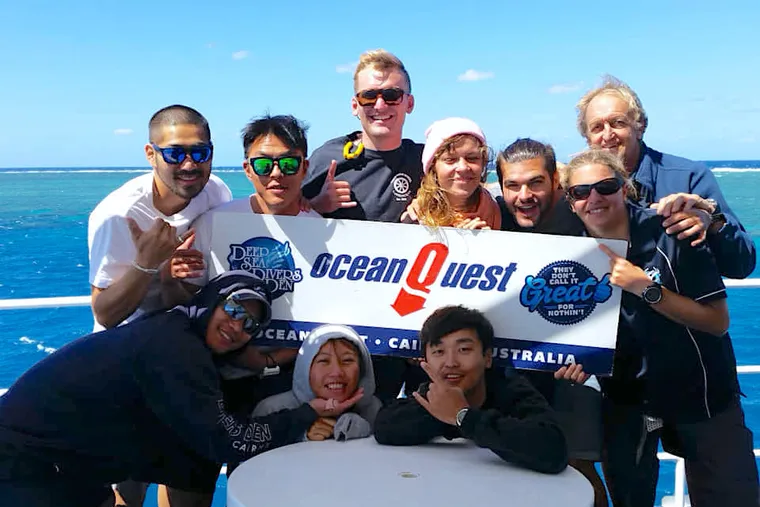
After graduation, I kept working at the hostel where I'd been doing my part-time job, living the same routine life as everyone else. Eventually, worn down by the daily soul-crushing dealings with difficult guests, I applied for an Australian Working Holiday Visa. During my first winter in Australia, I arranged to visit Cairns with a friend — but she unexpectedly couldn't make it over from New Zealand, leaving me alone in Cairns for seven days. Our carefully planned itinerary evaporated in an instant and took my enthusiasm with it, so I ended up wandering aimlessly around the hostel for seven days. It was precisely because I had nothing to do that I met, also doing nothing at the hostel, the owner of 沖潛 — the dive shop in Okinawa where I now work.
Although I had earned my first Open Water Diver certification back on Green Island before heading to Australia, and logged more than ten dives there, I still only half-understood what diving was really about. I kept thinking diving was exhausting, and that one Open Water cert was probably all I'd ever need in life. It wasn't until my second year in Australia, when I went on holiday to Bali with my then-boyfriend, that things shifted. To prepare for a shark dive in Fiji at the end of the year, I signed him up for an Open Water course — and since I wasn't planning to push further myself, I thought, "Well, I might as well take the Advanced course while I'm at it."
Getting my Advanced Open Water Diver certification took only two days, and it was from that moment that I realized diving doesn't have to be exhausting at all. When I first got my Open Water cert on Green Island, my entire impression of scuba diving was: everything is so heavy, my heels ache, my back is sore after every dive — and I always assumed being a dive instructor was a job for men, because of all the scuba tanks and gear to carry, when you could barely look after yourself let alone someone else.
Then, in Bali, I encountered so many female instructors. Their confidence and captivating presence left me genuinely in awe. The shore dives in Bali were also so relaxed — I had always assumed all diving required trudging across long stretches of rough, uneven terrain to reach the water, like on Green Island. And during a deep diving specialty at Nusa Penida, the sight of five or six manta rays circling and gliding above my head is something I still can't forget.
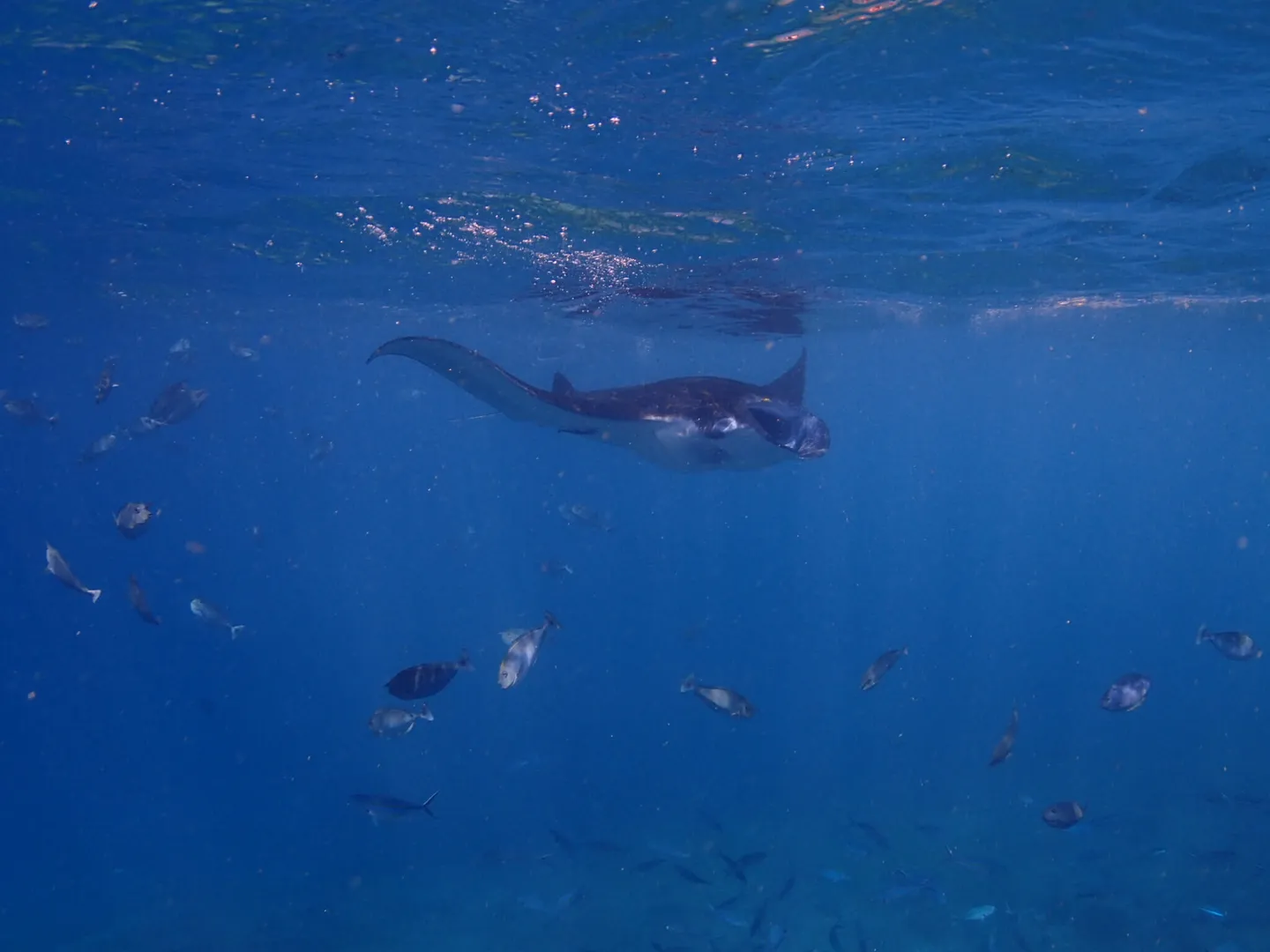
Manta rays at Manta Bay
The ocean moved me on a deeper level than ever before. It was that offhand "might as well" thought that first gave the idea of becoming a dive instructor a real shape in my mind. I had been agonizing every day over what I'd do when I returned to Taiwan, and for the first time I didn't feel completely directionless — it was as if I'd been walking through a pitch-black forest, and the clouds parted, letting moonlight show me the way. Later, the awe-inspiring shark dive in Fiji only cemented my resolve to become an instructor.
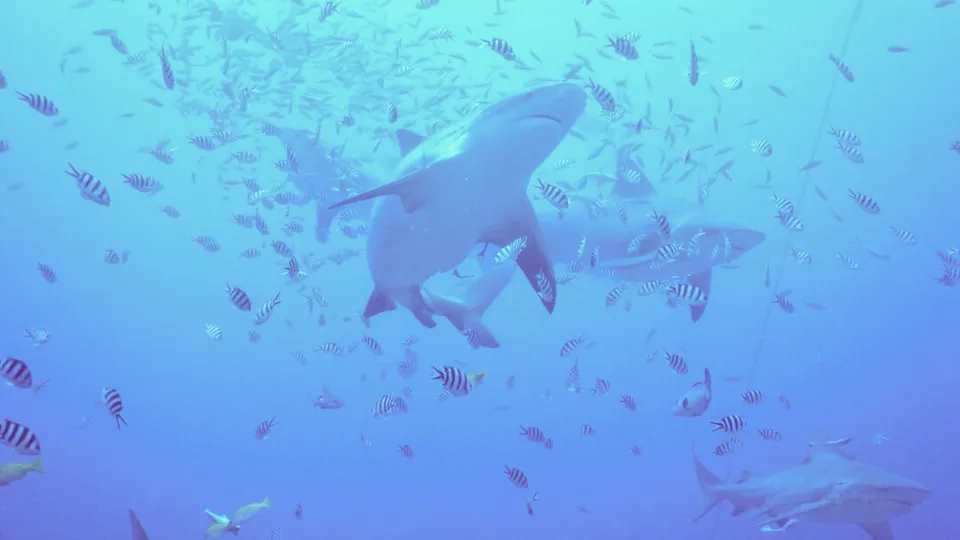
The sharks that came out very blue because I didn't know how to use a camera back then
My original plan was to return to Blue Season Bali — the dive shop in Bali where I'd done my Advanced course — to complete my Divemaster internship (the first professional level in diving). But I reconnected with the owner of 沖潛 and decided to do my internship in Okinawa instead, then head back to Bali in the same year to pass my instructor exam. From there, I went on to work in Thailand's Similan Islands and the U.S. territory of Saipan, before eventually circling back to where my diving career began — Okinawa — to keep pushing forward.
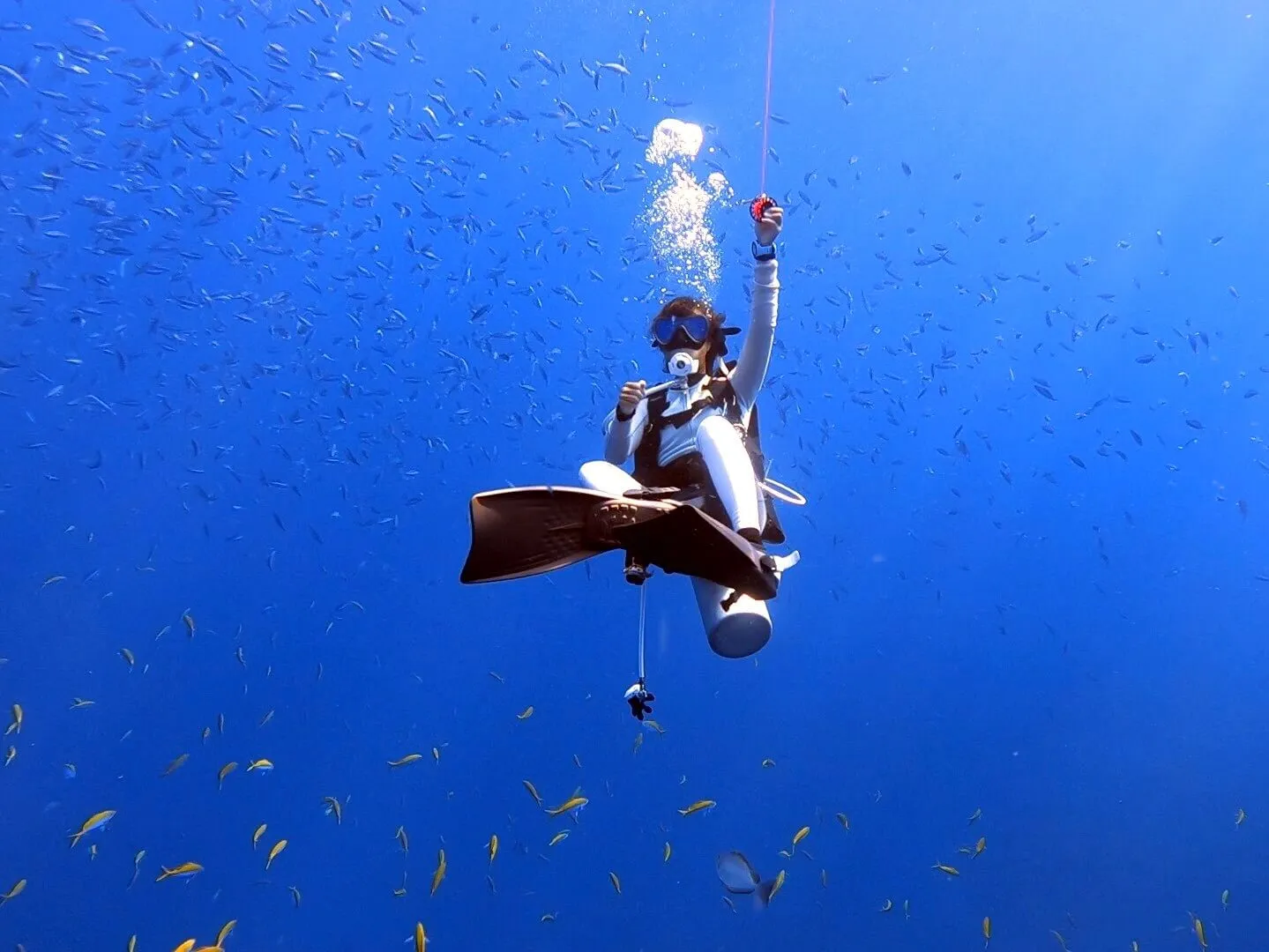
Safety stop surrounded by schools of fish in the Similan Islands
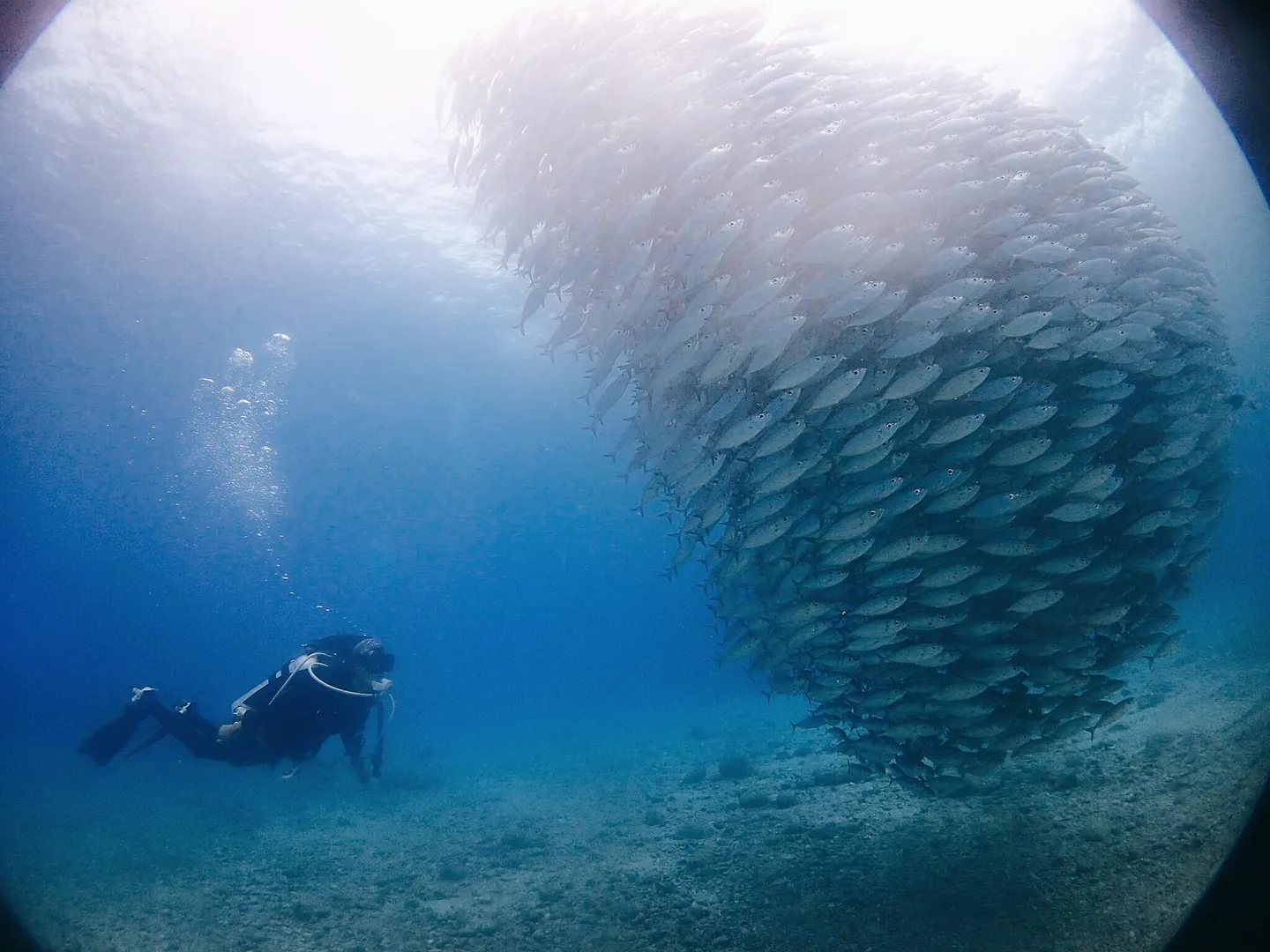
A baitball off Saipan
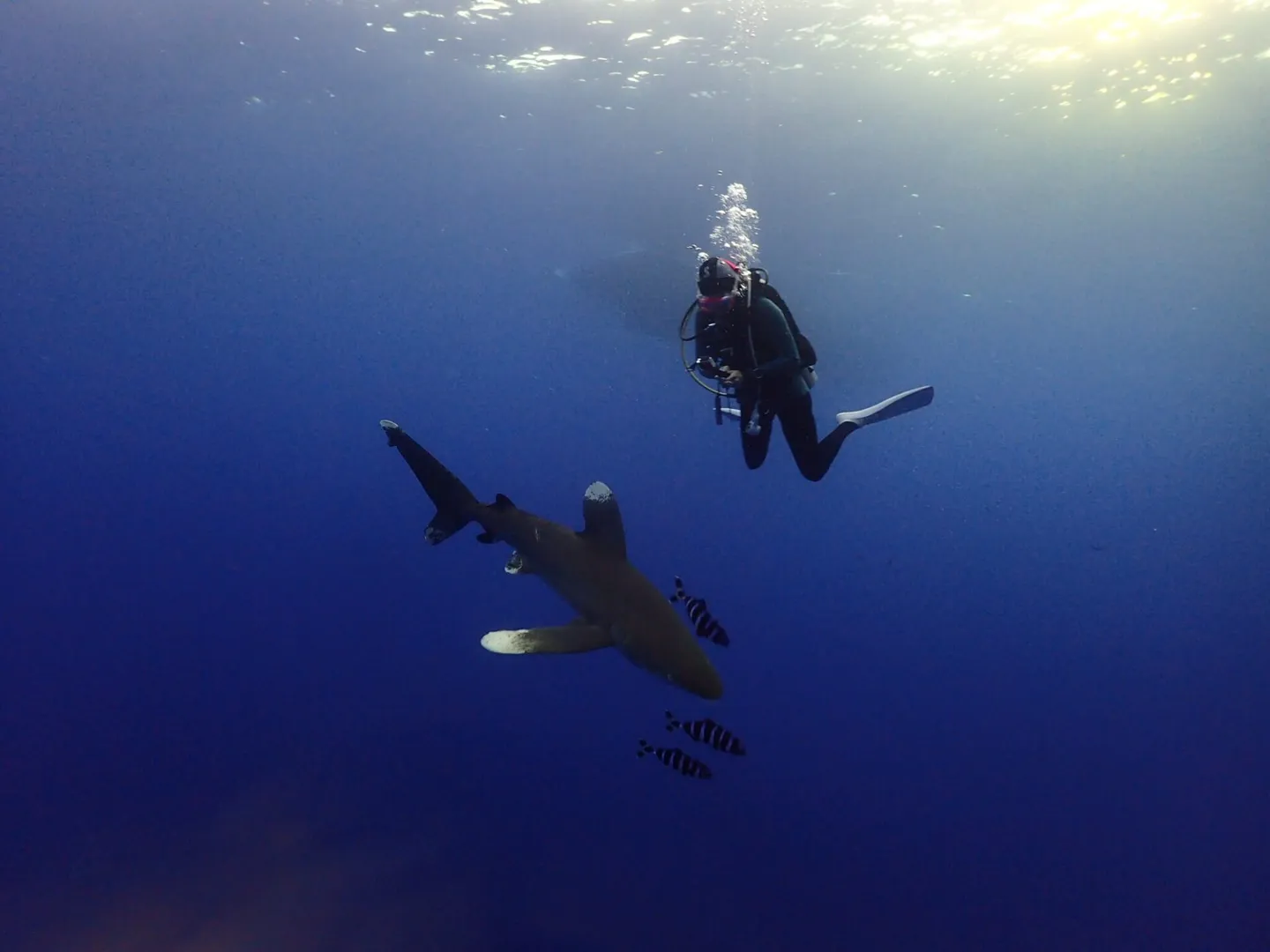
A close encounter with an oceanic whitetip shark in the Red Sea
Looking back over these past few years, I've realized that some of the moments in my life that seemed most casual — driven by nothing more than a pursuit of romance — were actually the ones that decided the road ahead.
I'm now heading into my third dive season working in Okinawa, and my second year as an instructor. I never imagined I'd have the chance to work in Japan without speaking Japanese. When I think about those decisions that quietly reshaped my future, it still feels surreal.
If I had listened to my mother and studied accounting, or chosen a national university in central or southern Taiwan, I probably would never have had the chance to intern on Green Island, never changed my outlook on life or my relationship with the ocean, and never gotten a dive certification. If I hadn't gone to Australia on a working holiday, I would never have gone to Bali to get certified, never dived in Fiji and thought about becoming a dive instructor (and never had the money to take the instructor course either). And if my friend hadn't been unable to make it to Cairns, I would never have spent those days stuck in the hostel — and never met the owner of my current dive shop in Okinawa.
So now I trust my instincts deeply, and I've learned not to regret the decisions I make. I still remember doubting myself during those three months of Divemaster internship, exhausted and feeling like I just wasn't cut out for it. Physically, I was at a disadvantage:
I'm under 160 cm tall, weigh under 50 kg, and my grip strength is under 20 kg (the average for adult women is 25–27 kg). To overcome these limitations, I forced myself to always carry one scuba tank in each hand at the same time (an aluminum tank weighs around 15 kg, a steel tank around 18 kg). During the internship, I almost never took a day off unless I was sick — if everyone else did three dives a day, I did four; if they did four, I did five.
Because I wanted to challenge myself and step outside my Mandarin-speaking comfort zone, I chose to go to Bali for my instructor exam. During that period, the fully English environment — from daily life to the classroom — combined with the financial pressure of needing to pass the instructor exam in one go, wore away at me day and night. On top of that, my beloved dog passed away during that time, which was a tremendous blow to my spirit.
But I never had a single moment of wanting to give up — simply because I didn't want to regret the decisions I had made. In this day and age, to live happily, there's no time left to regret the life you've chosen.
Hard work won't betray you. Once you've set out, keep moving forward with courage! Even after you achieve one dream, it doesn't mean your life's journey is over. It's okay if you haven't figured out what comes next — who knows what turning point might come along and change your life?
Related links:

![[Taiwan Diving – Dylan Chen Column] 3 Landmines to Avoid When Choosing a Dive Shop Before Enrolling in a PADI Divemaster Course](/_astro/sebastian-pena-lambarri-O1KSItQ1Uf4-unsplash-2-scaled_15YlmL.webp)