![[Taiwan · Keelung Chaojing] Dive Site Guide – North Taiwan's Ecologically Rich Secret Garden](/_images/92d7b7de6dd3-960w.webp)
Contents(4)
In May 2016, the government officially established the Wanghaixiang Chaojing Bay Resource Conservation Area. Through the concerted efforts of all parties, the restoration results have been outstanding — marine biomass is large and diverse — and the area has since been known as the underwater "Secret Garden."
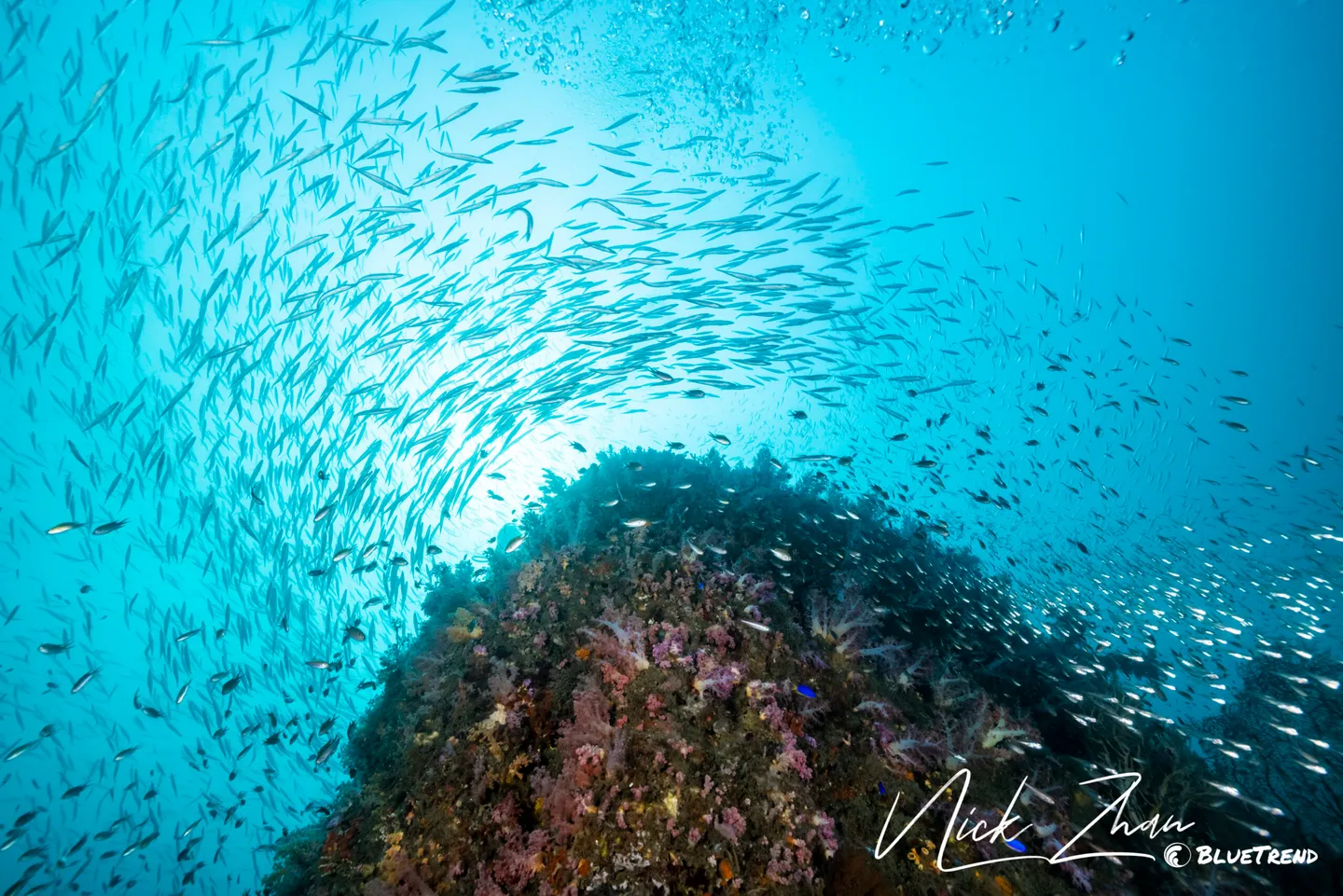
Fish everywhere, and an abundance of coral. photo credit:Nick Zhan
Pick Up Marine Debris — Let's Protect the Environment Together
Spark Chao, founder of the BlueTrend website and initiator of the Wanghaixiang Bay Dive Map Project, recalls that when he first learned to dive, he heard there was a lot of rubbish underwater and simply thought: why not help pick it up? He later learned that dive instructor Lin Yu-ping from Jiuqian regularly brought divers to Chaojing for ocean cleanup dives, and he joined their efforts. Coach Zhao laughs: "Picking up the rubbish really does make a difference — there's far less marine debris at Chaojing now than when I first came (in 2017)."
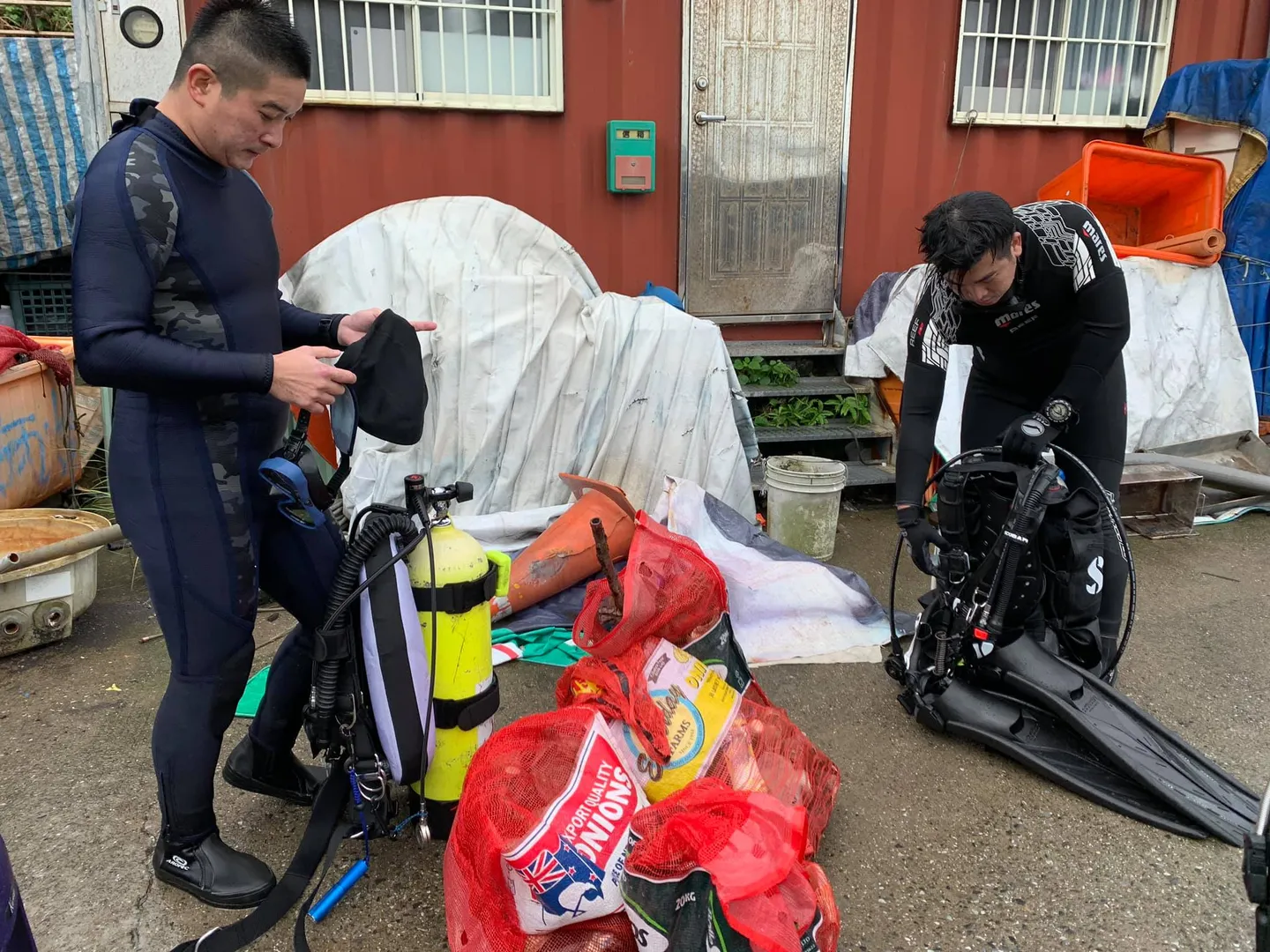
Diligently collecting marine debris — we're here to protect this environment. photo credit:Spark Chao
Compared with other dive sites, more people are willing to remove underwater rubbish here because Chaojing is a designated conservation area where you can actually see the fruits of everyone's labor improving the marine ecosystem year by year — rather than having it all swept away by a single trawl net. Today, Chaojing's conservation success has driven a boom in scuba diving activity, revitalizing the local industry and creating jobs, making both locals and divers more willing to invest in conservation efforts. This virtuous cycle has made Chaojing a model for marine and Northeast Coast dive-site conservation in Taiwan.


Chaojing's Star Attraction — the Sea Apple
The most beloved sight at Chaojing is the sea apple. The most popular route begins at Entry Point 2, descending and heading out at a compass bearing of 120°, where you encounter an 8 m trench, then continuing down to 16 m, turning 90° and following the slope until you reach a second trench. Keep your depth between 16 m and 18 m — stray shallower than 12 m or deeper than 25 m and you'll easily miss the isolated pinnacle that lies ahead, which is the celebrated Secret Garden.
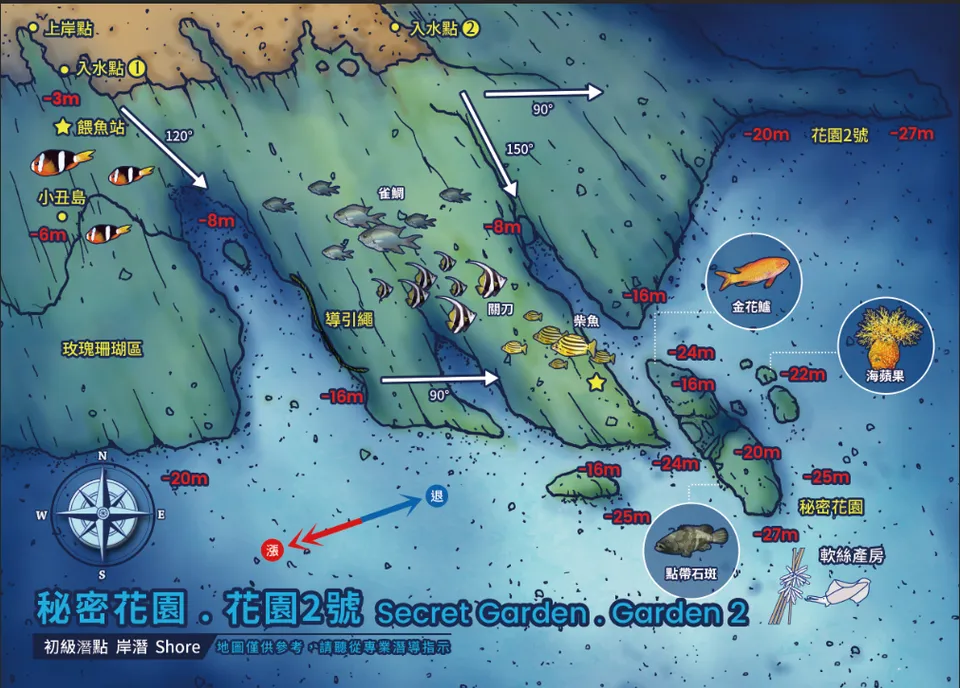
Entry Point 2 is the most popular entry point at Chaojing. photo credit:Spark Chao
Among the three small reef formations near the 22 m mark of the isolated pinnacle, you can spot the famous sea apple — a filter-feeding sea cucumber that, as the current flows past, spreads open the tentacles around its mouth to capture plankton, looking just like a golden flower in full bloom. Near the sea apple, you can also search the rock walls for all manner of creatures; if you're lucky, you might spot a Frogfish camouflaged as a sponge, a Lissoporcellana sp. (a porcelain crab often mistaken for a spider crab due to its delicate movements), and Periclimenes masudai shrimp whose coloring mimics a leopard-spotted sea anemone.
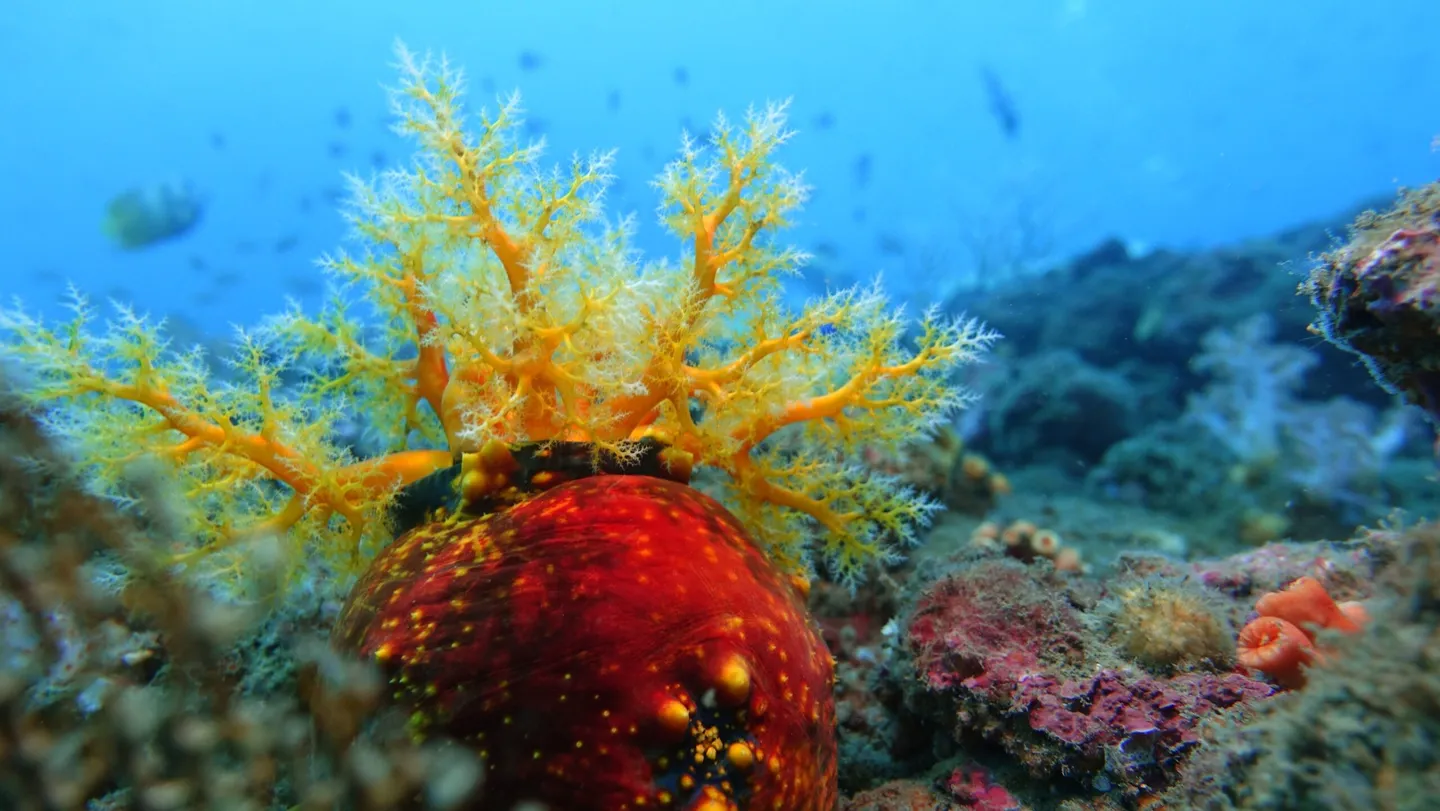
The sea apple is an absolute must-see highlight of any Chaojing dive. photo credit:野生鳳
The Rich Marine Ecology of Chaojing
Beyond the ultimate goal of finding the sea apple, along this route there is a very high chance of witnessing spectacular schools of butterflyfish, surgeonfish, fusiliers, and skipjack, which are essentially permanent residents of this area, almost always swimming in this zone. Coach Zhao says he once watched hundreds of Zanclus cornutus (Moorish idols) glide past him — a magnificent sight he has never forgotten. You can also search for large fish such as Grouper, moray eel, sweetlips, and snappers. In particular, several dragon moray eels and leopard moray eels that make their home on the isolated pinnacle are not only impressively large but also frequently interact with divers. While moray eels are found everywhere, it is genuinely rare to encounter individuals nearly one metre long that are comfortable around people at any other dive site.
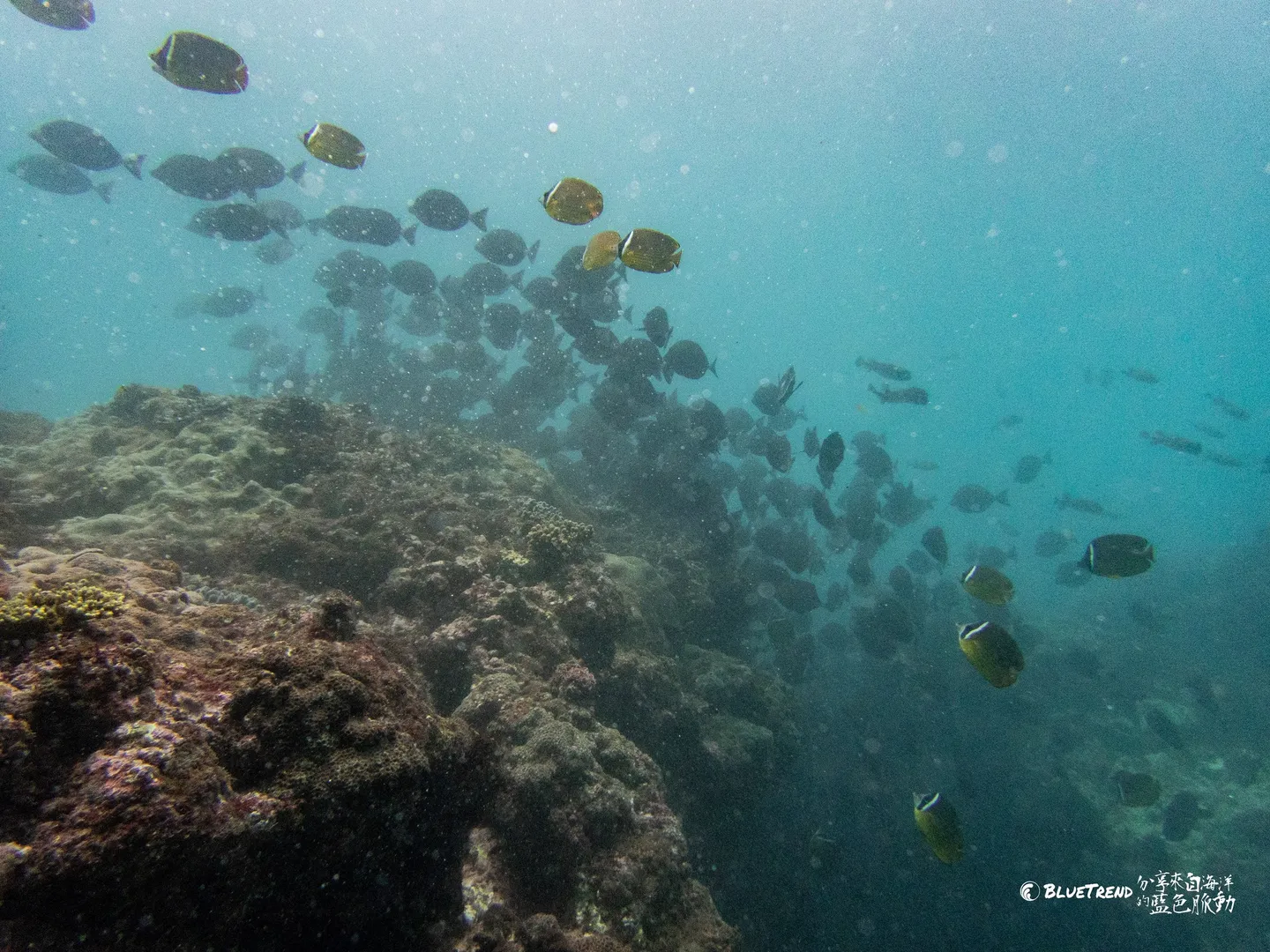
Sawtail surgeonfish Prionurus scalprum, locally nicknamed "black pig." photo credit:Spark Chao
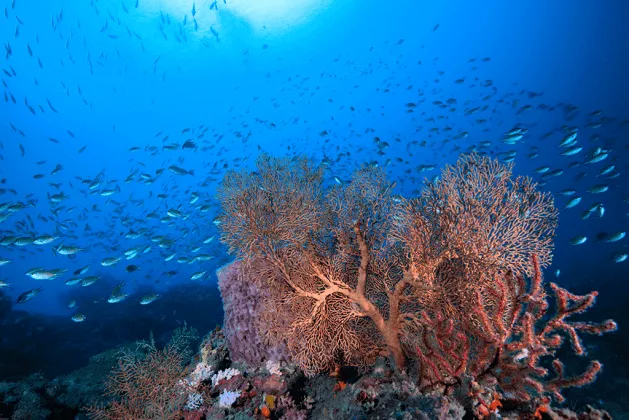
At Chaojing, from March to May you can observe tiger-patterned cuttlefish spawning; from May onward, Catriona sp. nudibranch begin to appear; around June, you can start anticipating spectacular schools of fusiliers and amberjack. In terms of restoration achievements, Coach Zhao particularly recommends visiting the bigfin reef squid spawning grounds. At other dive sites along the Northeast Coast, bamboo-branch structures are typically used as artificial spawning habitat for bigfin reef squid, but things are different here. After a group of dedicated divers carefully cleaned the gorgonians / sea fans, the squid began spawning directly on them. When you look out and see an entire expanse of gorgonians / sea fans draped with squid eggs, it is a truly breathtaking sight.
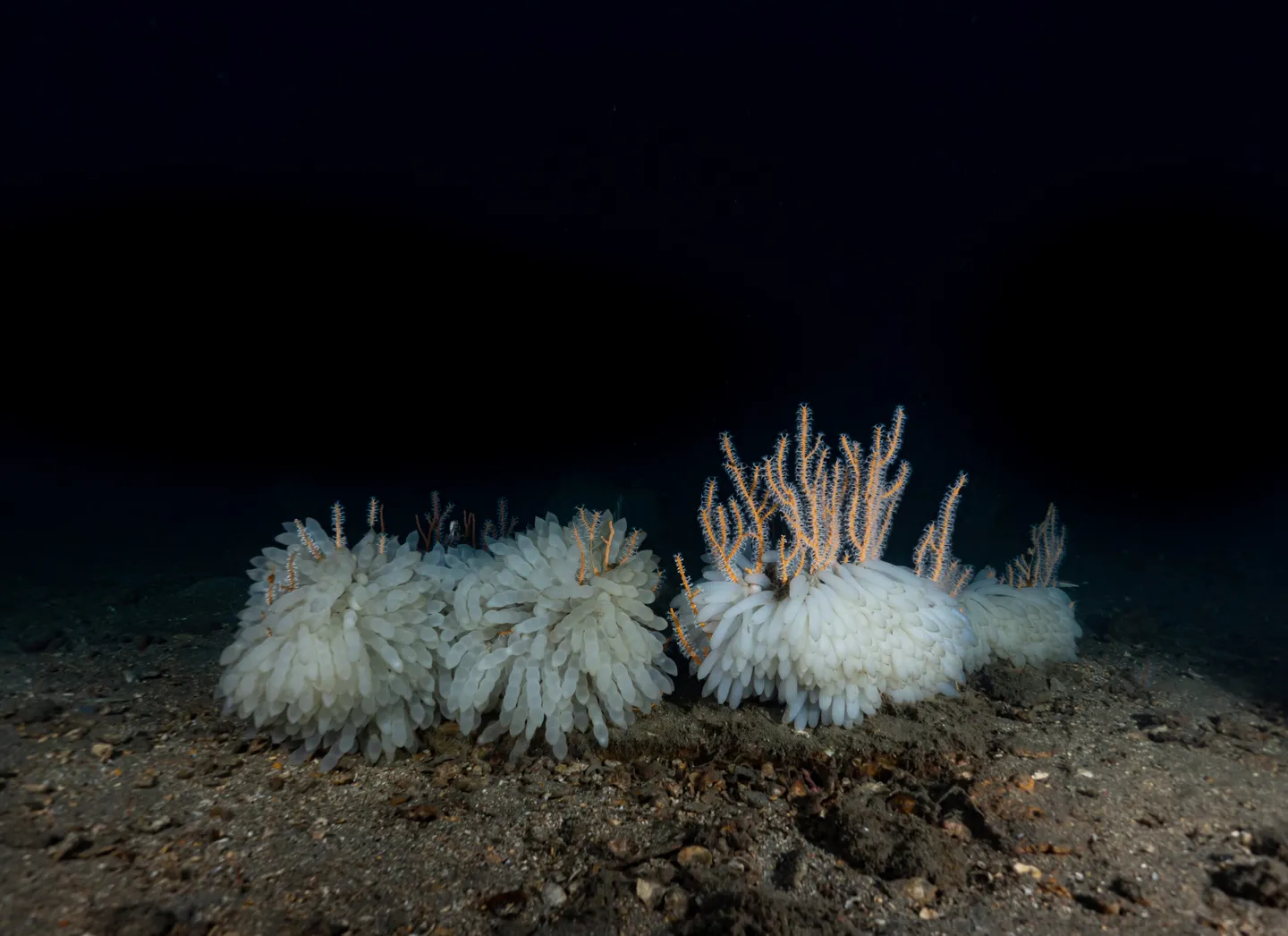
Bigfin reef squid eggs — plump and white, incredibly adorable. photo credit:簡晨宇
While enjoying Chaojing's rich marine ecology, dive safety must not be overlooked. Coach Zhao notes that Chaojing sits at the mouth of a bay, and with a predominantly silty bottom, the tidal flow can stir up underwater "sandstorms" during incoming or outgoing tides — visible from a distance as a hazy, fog-like cloud. If you see one, turn back immediately; once engulfed, visibility drops to zero. This is something divers need to be especially mindful of. He also reminds everyone to stay well clear of vessel traffic lanes when in the water.
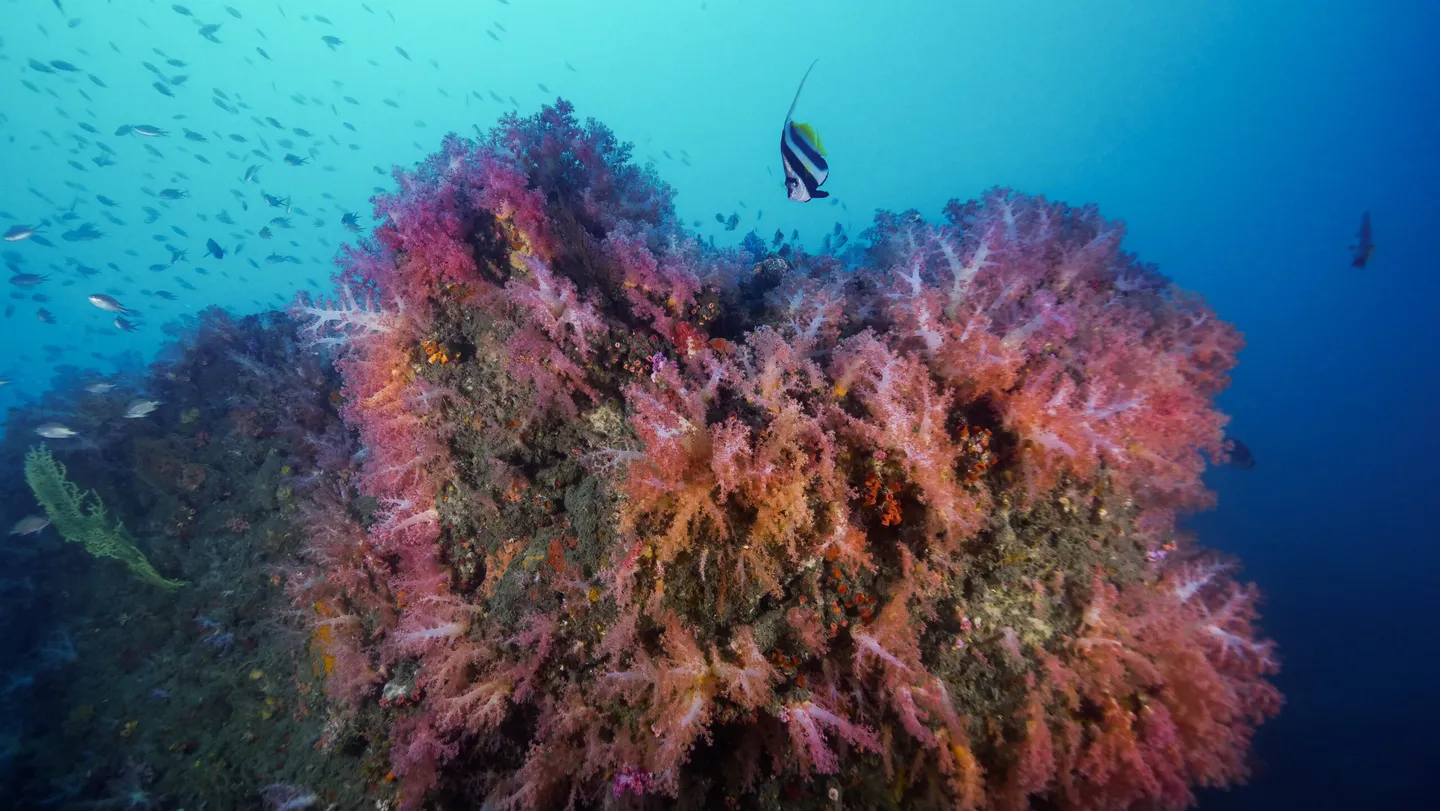
Chaojing's vibrant and beautiful underwater scenery is the main reason its reputation has spread far and wide. photo credit:Spark Chao
Of course, diving at Chaojing also requires maintaining good neutral buoyancy to avoid damaging the coral below, and care must be taken not to kick coral with your fins. Coach Zhao once witnessed a diver wearing long fins (freediving) push off the bottom — the diver shot gracefully upward, but a basketball-sized coral colony below was smashed in the process. A truly heartbreaking sight.
Chaojing's beauty is born of everyone's wholehearted commitment to conservation. Its future depends on you and me protecting it together — only then can we ensure a thriving, enduring ecosystem!
Wox's Recommended Species to Look For
- Sea apple: Extremely rare; Chaojing has a stable population. Only when feeding does it open its branching tentacles into the current, resembling a flower in bloom.
- Moray eel: Widespread along the Northeast Coast in great variety, but largely hunted out in most areas. Chaojing has a stable population; despite their fearsome appearance, they are not particularly aggressive and can be approached at close range.
- Periclimenes masudai: A small shrimp that lives on Calliactis sea anemones, its spots closely matching the background, making it very easy to miss.
Special thanks to biological consultant for this article: Wox Lee
References:
- Marine Natural History of Northern Taiwan (Li Cheng-lu & Spark Chao, 2020)
- Taiwan Reef Coast Atlas (Chao Shih-min, 2003)
- Tourism Administration, Ministry of Transportation official website
- Northeast Coast and Yilan Coast National Scenic Area official website
- National Museum of Marine Science and Technology official website
Further Reading:
- A Survey of Marine Protected Areas — Chaojing Outperforms Shen-ao! Unveiling the Differences in Management Measures and Intensity
- Keelung Chaojing Wanghaixiang — The Perfect Combination of Marine Protected Area and Citizen Science
- Chaojing Underwater Photography Competition Award Ceremony — Behind the Lens Stories Revealed
Frequently Asked Questions
How is a BlueTrend dive trip different from an unknown, no-name dive group?
Choosing us means full peace-of-mind protection and a smooth experience from start to finish. Every trip we run holds to three things.
First, full legal protection and a professional dive leader: we strictly follow Taiwan's travel regulations and provide complete travel-agency liability insurance, travel insurance, trip-inconvenience insurance and dive insurance. Every group is accompanied by a certified, foreign-language dive leader who joins you on both the dives and the land itinerary, liaising seamlessly with local dive shops and operators on your behalf to keep things running smoothly — the person our travellers trust most.
Second, fully licensed with secure payments: every payment goes into a licensed travel agency's account, with multiple safe payment channels (bank transfer, credit card and more) and a legal collect-and-remit receipt, so every transaction is open, transparent and protected, avoiding the fraud and dispute risks of transferring money privately to an individual.
Third, hand-picked quality we vet in person: every trip, dive site and partner shop is scouted on the ground by our own team, from the guides' professionalism and safety standards to the food, lodging, environment and service details on land, all vetted by us so you don't get caught out.
I want to sign up for a dive trip. Are there certification-level or logged-dive requirements?
Each dive site is different, so the entry bar varies. 'Bali Tulamben', for instance, is relatively beginner-friendly. 'Malapascua in the Philippines' is also beginner-friendly, but since thresher sharks tend to cruise between 20 and 30 metres, we recommend AOW certification with 20+ logged dives to enjoy this trip comfortably. For 'the Maldives' or 'Palau', we suggest AOW with 50+ logged dives for a more relaxed experience. If you're not sure whether your experience fits the trip you want, message us and our dive editors will assess it and help you find the trip you'll feel safest on.
Can I join if I'm signing up alone? How are rooms arranged?
Plenty of our travellers sign up solo! For rooms and beds, we prioritise pairing you with a same-gender traveller, and if you'd rather have your own space you can pay the difference to upgrade to a single room. For the diving, our professional leader will pair you with a suitable buddy, and with the happy vibe on our trips you'll quickly make a great group of dive friends. Many people sign up alone, make new friends, and end up organising the next trip together!
Does the trip fee include dive insurance, gear rental, taxes and instructor tips?
It depends on the trip, the destination's regulations and the local operators. Every BlueTrend dive trip has a detailed web page with a clear 'included / not included' list, transparent and with no hidden charges. All payments are collected by a licensed travel agency, with a standard-form contract for your protection.
I'm a new diver / haven't dived in a long time — will I fall behind the group?
Before you complete your booking, our team assesses a suitable trip based on your certification level and experience. Before departure, we strongly recommend taking time to refresh in Taiwan with an instructor, or a fun dive to get your feel back. On the trip itself, our professional dive leader groups and pairs everyone by experience, keeps a close eye underwater on travellers who need extra care, and steps in to help right away.
Will the photos and videos taken during the trip be shared with us?
During the dives, 'safety' is always the leader's top priority, so whenever it's suitable and safe the leader will capture great shots and record the best moments. During or after the trip, we compile a cloud album for all travellers to download, so you go home loaded with memories!
Besides your scheduled trips, can you arrange a private group charter or independent travel for me and my friends?
Absolutely! Besides group trips, we also arrange private group charters and independent travel. We can communicate, enquire and coordinate services with local operators based on your needs, saving you time and effort and taking the language barrier off your plate, to tailor the smoothest, most reassuring dive trip just for you. Contact our LINE support and our editors will arrange it for you!