Contents(12)
- The 3 Basic Concepts of Species Identification Every Marine Citizen Scientist Should Know
- Identification Concept 1: Colour
- Identification Concept 2: Morphology
- Identification Concept 3: Behaviour & Habitat
- Advanced Level: Marine Citizen Scientist — Let's Take on Species Identification Challenges!
- Species Type 1: General Fish
- Species Type 2: Seahorses
- Species Type 3: Scorpionfish (commonly called stonefish)
- Species Type 4: Lizardfish
- Species Type 5: Frogfish
- Species Type 6: Gastropods and Bivalves (Shells)
- Species Type 7: Nudibranchs
The Editor says: In recent years, as the topic of marine citizen science has gained increasing attention, many intertidal observers and underwater photographers have been sharing their wildlife photos across various platforms. While photography is one of the more accessible entry points into marine citizen science, the long-standing pursuit of high artistic quality in underwater photography can sometimes result in images that lack the key features needed to identify a species — a real missed opportunity for scientific value. Over the years that we have been promoting marine citizen science programmes, we have often encountered the situations described below, which are both amusing and telling. This article aims to give every underwater photographer and ecological observer some guidance on how to photograph specific types of organisms in ways that capture the identifying characteristics needed for species recognition.


The 3 Basic Concepts of Species Identification Every Marine Citizen Scientist Should Know
Coach, I just saw a blue fish — what kind of fish was it?
The question above is one we often hear from people at the shore, but when learning to identify marine life, there are a few key concepts we should keep in mind:


Identification Concept 1: Colour
Vision is the primary sense through which humans observe the world, and colour carries the strongest signal of all. As a result, colour is one of the most common bases for description and judgement during ecological observation — phrases like "a fluorescent blue fish," "a red-spotted nudibranch," or "a white eel with black spots" are typical examples. However, colour can also cause a great deal of confusion, especially when observing marine life.
First, because seawater absorbs light, the colours we see underwater are often not the organism's true colours. We therefore need to use a strobe or video light to restore the subject's natural hues. With artificial lighting, the vivid colouration of reef creatures — nudibranchs, shrimp and crabs, and all manner of tropical fish — becomes visible, and we can use their colours to narrow down the likely species. That said, species that live outside the coral reef environment, such as open-ocean sardines or yellowtail amberjack, or sand-dwelling lizardfish and flatfish, may not display particularly vivid colours at all.
Furthermore, many marine animals are adept at changing colour for purposes of communication, camouflage, and courtship. Octopuses, scorpionfish, and flatfish are especially skilled colour-changers — in these cases, colour alone is simply not enough to identify them.
Identification Concept 2: Morphology
When colour alone cannot help us identify an organism, we begin to pay attention to physical features. Describing body shape is an introductory lesson in getting to know an organism's characteristics. Rather than resorting to hand gestures, it is far more useful to describe an animal's appearance using precise morphological terms. Here are some commonly used descriptions for fish:
-
"Elongated" — for eels, sea cucumbers
-
"Round and plump" — for pufferfish, cowrie shells
-
"Flat" — for stingrays, flatfish
From a photography standpoint, it is best to capture the organism's full body shape clearly. If you can shoot from the side, from above, and from the front, so much the better.
When faced with an organism that is hard to identify from appearance alone, we need to dig deeper and look for more subtle clues — features that do not change, such as the shells of crustaceans, the mantles of molluscs, and the scales and spines of fish. Size also matters enormously. Take moray eels: the yellowmargin moray and the leopard moray can reach 2 m in length, while the ribbon eel grows to only a few tens of centimetres.
Identification Concept 3: Behaviour & Habitat
Finally, a few additional clues can help us narrow down the species: At what depth did you see it? Was the bottom sandy or a coral reef? Did it appear alone or in a group?
From all of the above, you can see that next time you want to ask your dive guide what animal you just saw, you can try reframing the question like this:
Coach, I just saw a group of oval-shaped, fluorescent blue fish about 5 cm long, on the coral reef at 5 m depth — what were they?
Most readers will quickly guess that this description points to the neon damselfish Pomacentrus coelestis, commonly seen in shallow water. Why only "points to"? Because at this stage we can probably narrow it down to a family or even a genus, but pinning it down to species level requires even more information.
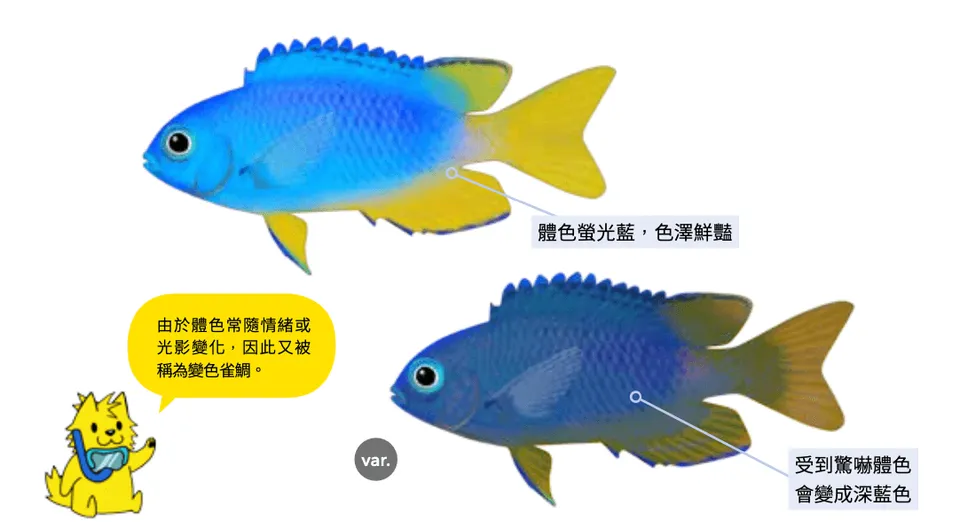
Even if it is likely to be the neon damselfish, its colour can change depending on the environment. Ocean Field Guide — Northern Taiwan, P:705
Advanced Level: Marine Citizen Scientist — Let's Take on Species Identification Challenges!
Congratulations — if you've read this far, you've completed the beginner level of species identification. Ready to level up with us into the advanced class? Some marine animals change not only their colour but even their overall appearance in response to different environments. Algae or debris attached to their bodies can also make identification difficult. In these cases, we need to focus on hard skeletal structures, which are key identifying features that do not change with the environment.
Species Type 1: General Fish
Because fish are so diverse and the identifying features vary so greatly between groups, let us start with the general principles for fish identification. The main identifying features of fish are the dorsal fin in lateral view and the colours and markings on the body — which is precisely why the hand-drawn fish illustrations in the Ocean Field Guide are almost all shown in large lateral view, making identification much easier.
Here we use two common carangid fish from the Northeast Coast as examples: the amberjack on the left in the image below, Seriola dumerili, and the frequently confused longfin yellowtail, Seriola rivoliana, on the right. We can distinguish them by examining the second dorsal fin and the caudal fin: the second dorsal fin is rounded in one and sickle-shaped in the other, and the lower lobe of S. dumerili's tail fin is white, while that of S. rivoliana is not. So a qualifying identification photo of a general fish must capture the full lateral view!
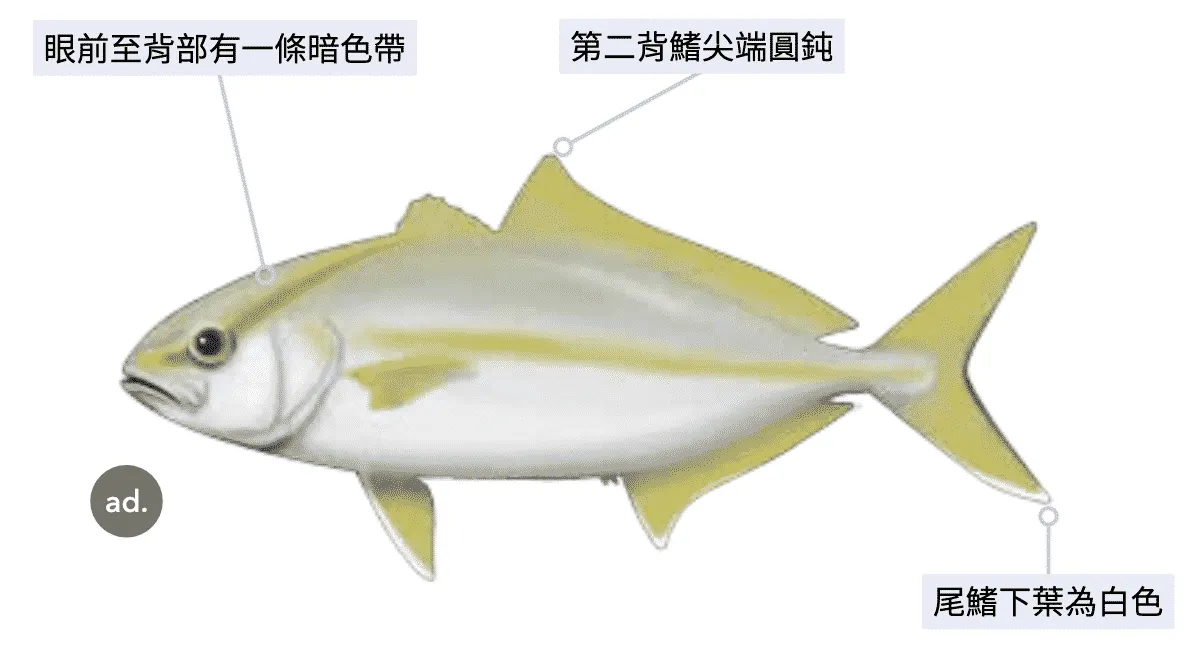
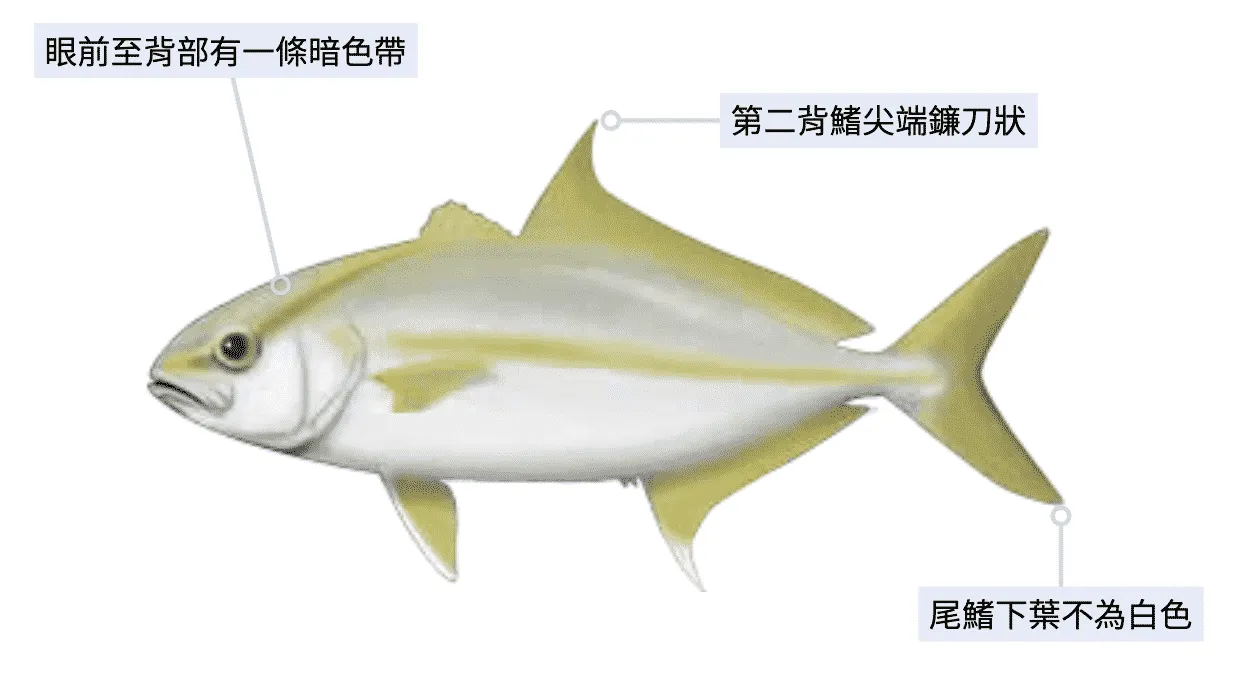
Left: Seriola dumerili (P:569); Right: Seriola rivoliana (P:571)
Species Type 2: Seahorses
One of the true stars of the underwater world is undoubtedly the seahorse! Setting aside the impossibly tiny pygmy seahorse, the type most people encounter is the larger, more commonly seen seahorse species. Every time a seahorse is spotted, divers confidently declare: "I saw a yellow seahorse!" or "A yellow seahorse must be such-and-such species!" Unfortunately, seahorses are precisely the kind of animal that changes colour with its surroundings, which means external colour is completely useless as an identification criterion.
A more reliable way to identify seahorses is to count the tail rings. As shown below, the Kellogg's seahorse on the left has 40–41 tail rings, while the Kuda seahorse on the right has 34–38 rings. If the tail rings cannot be clearly photographed, you can also observe the degree to which the body rings protrude along the side: Kellogg's seahorse body rings tend to be more angular and ridged, while those of the Kuda seahorse are generally smoother. So a qualifying seahorse identification photo must capture the tail rings or the lateral profile of the body-ring protrusion!
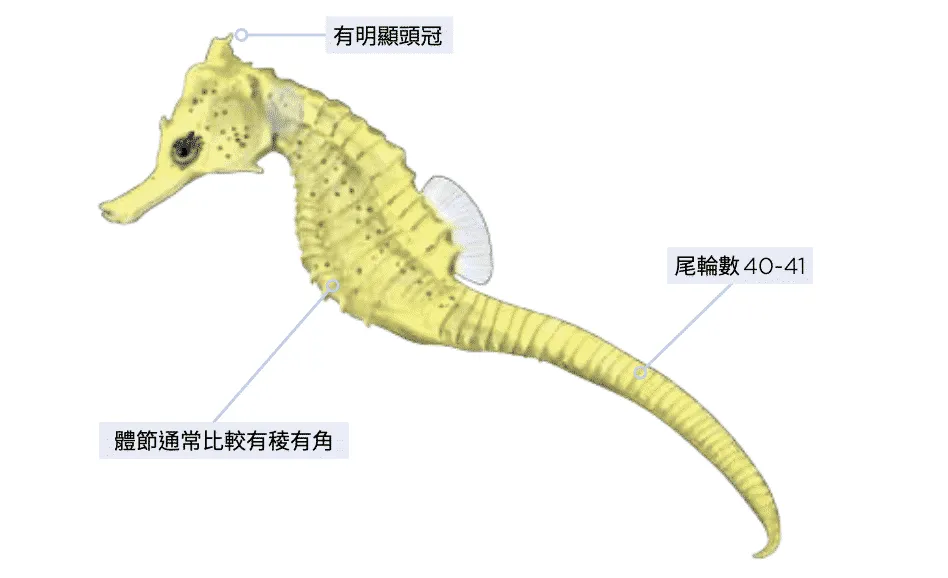
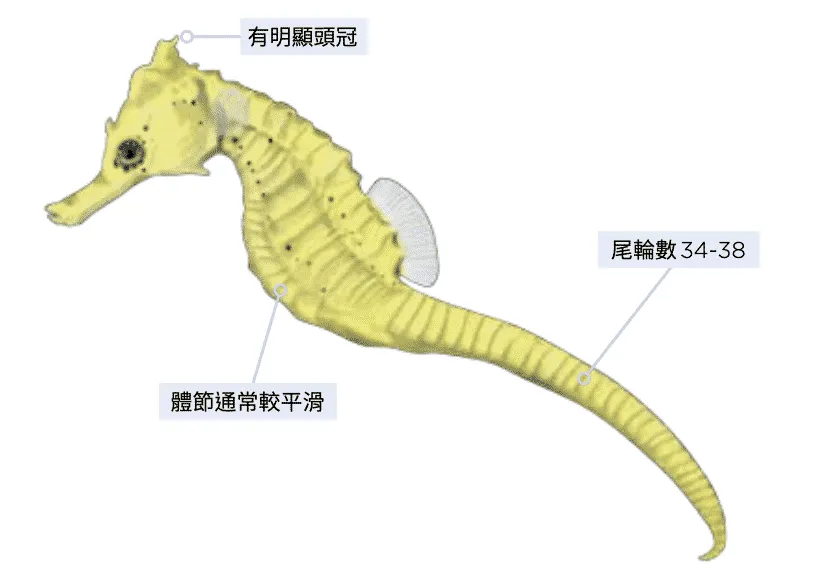
Left: Kellogg's seahorse (P:501), with body rings that tend to be more angular. Right: Kuda seahorse (P:503)
Species Type 3: Scorpionfish (commonly called stonefish)
Scorpionfish often lie motionless on the bottom waiting for prey to pass, making them relatively easy for divers to photograph. However, a wide lateral shot of a scorpionfish is not particularly useful for species identification, because their body colours are highly variable and the skin flaps that mimic algae can look completely different from one individual to the next. For identification, we need to zoom in and look at the many bony spines on their faces — these innate structural features do not change with the environment and are therefore crucial for identification. To identify them properly, it is best to photograph a close-up of the head from both the side and from above. So a qualifying scorpionfish identification photo must include a close-up of the face!
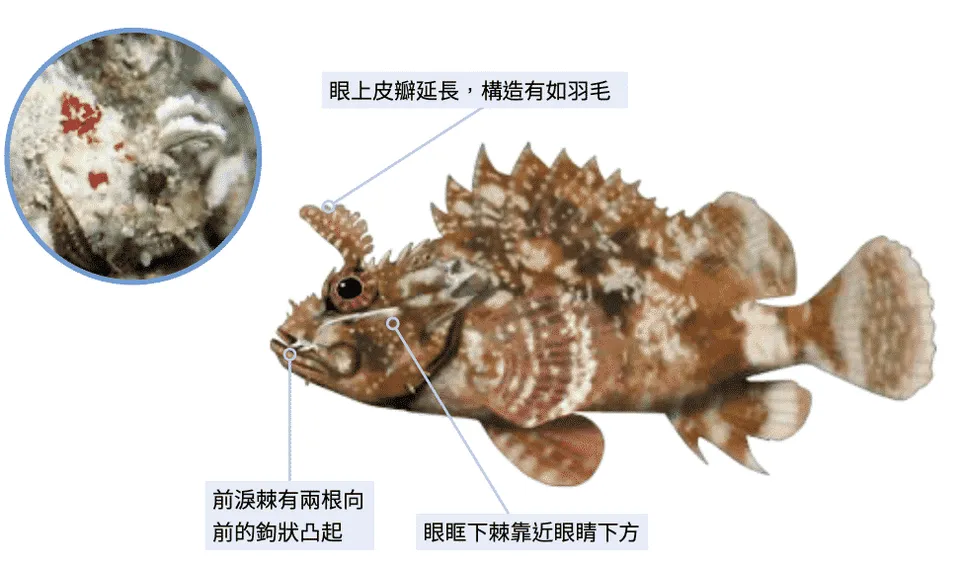
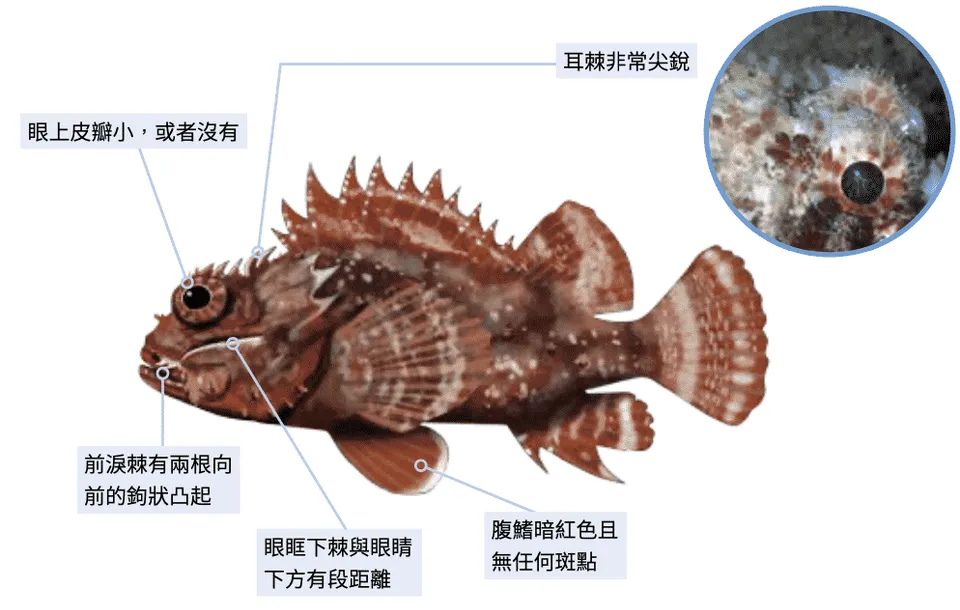
Left: Mozambique scorpionfish (P:526), with elongated supraorbital tentacles resembling feathers. Right: Golden scorpionfish (P:527), with small or even absent supraorbital tentacles
Species Type 4: Lizardfish
Lizardfish are among the more difficult fish to identify, as the distinguishing features between species are not obvious. Remarkably, the key diagnostic feature turns out to be the nasal flap at the tip of their snout. As ambush predators, they lie quietly on the reef floor and use their specialised nasal flaps to amplify their detection of waterborne scents, sensing the position of prey or predators. Different lizardfish species have evolved different nasal flap shapes. So a qualifying lizardfish identification photo must capture the nasal flap at the snout!
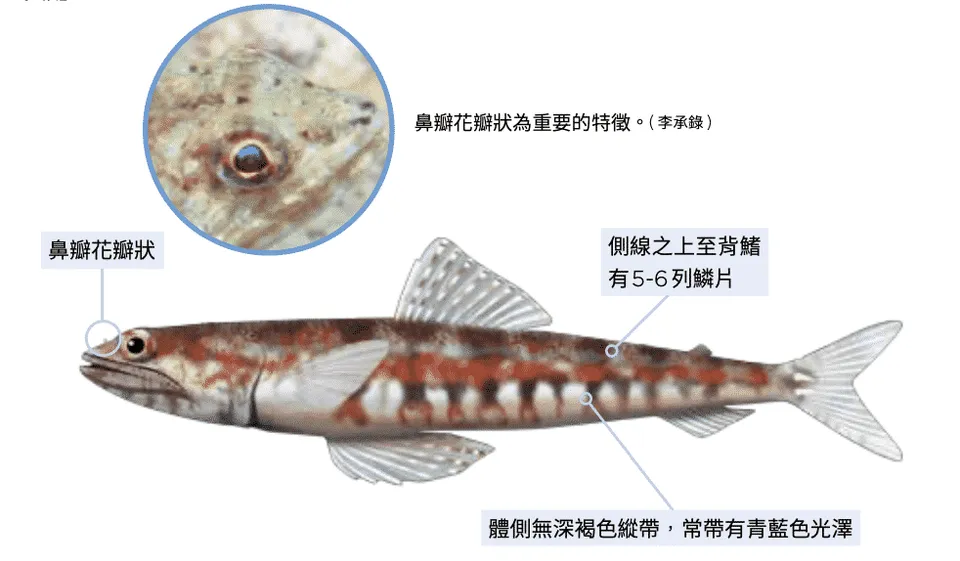
Lizardfish of the family Synodontidae are notoriously difficult to identify; the image above shows the variegated lizardfish. Ocean Field Guide — Northern Taiwan, P:461
Species Type 5: Frogfish
Frogfish are also masters of colour change underwater — not only do juveniles and adults look completely different, but changing colour to match their surroundings at any given moment is one of their signature tricks. As a result, body colour is a poor basis for direct species identification. The "easiest" way to identify a frogfish is by its fishing rod (the illicium and esca). Different frogfish species have evolved different lure shapes to suit their hunting style: some mimic a shrimp swimming through the water to attract fish, while others mimic a worm drifting in the current, occasionally twitching the lure to draw prey within striking range.
Although the lure is the "easiest" feature to use, it is unfortunately not often displayed. In those cases, you can carefully examine the second and third dorsal spines: in some species they are swollen like a drumstick, in others they are paper-thin, and in still others they resemble slender dry twigs. For the best results, photograph the frogfish's face clearly, and if you can capture the lure as well, even better! So a qualifying frogfish identification photo must capture the lure and the second and third dorsal spines.
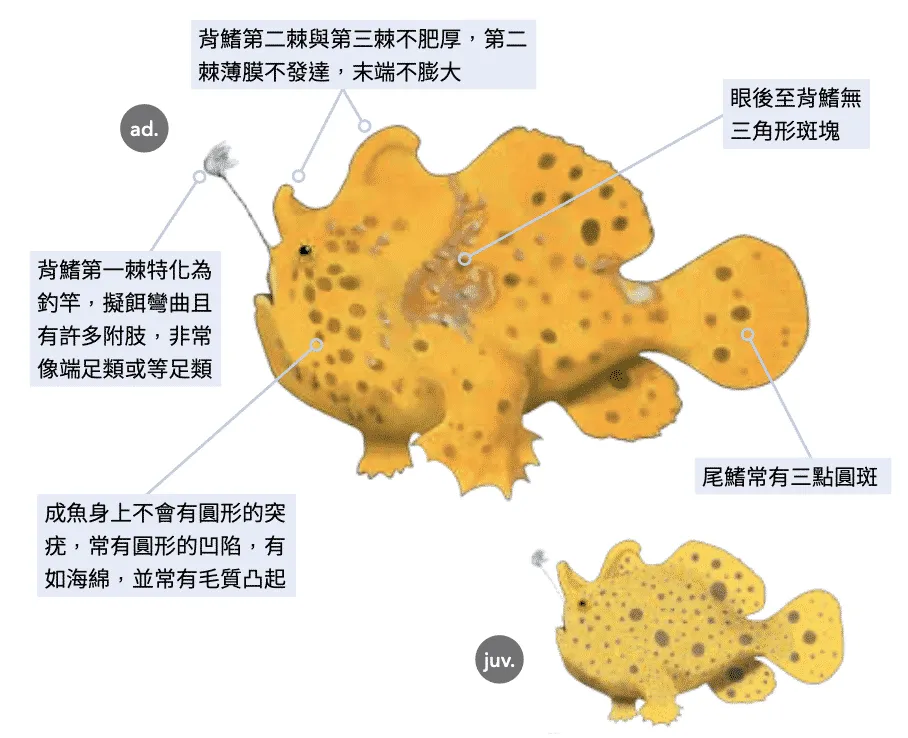
The painted frogfish is a celebrity species, but it is frequently confused with other species. Ocean Field Guide — Northern Taiwan, P:471
Species Type 6: Gastropods and Bivalves (Shells)
Molluscs play an important role in the marine ecosystem, but most people only photograph them from above, which often makes species identification impossible. The shells of many gastropods and bivalves are frequently encrusted with algae and other debris as a means of blending into the background, making it nearly impossible to discern the shell's pattern or shape from the outside.
The best way to identify a shelled mollusc is to turn it over and photograph the aperture (the shell opening). Because the mantle and foot pass in and out of the aperture every day, it tends to remain smooth and clean, making it the single most useful identifying feature. A word of caution, however: some gastropods such as cone snails are highly venomous, so be extremely careful when turning them over. After you have finished photographing, always turn them back and return them to where you found them, minimising disturbance to the animals. So a qualifying shell identification photo must capture the aperture on the underside!
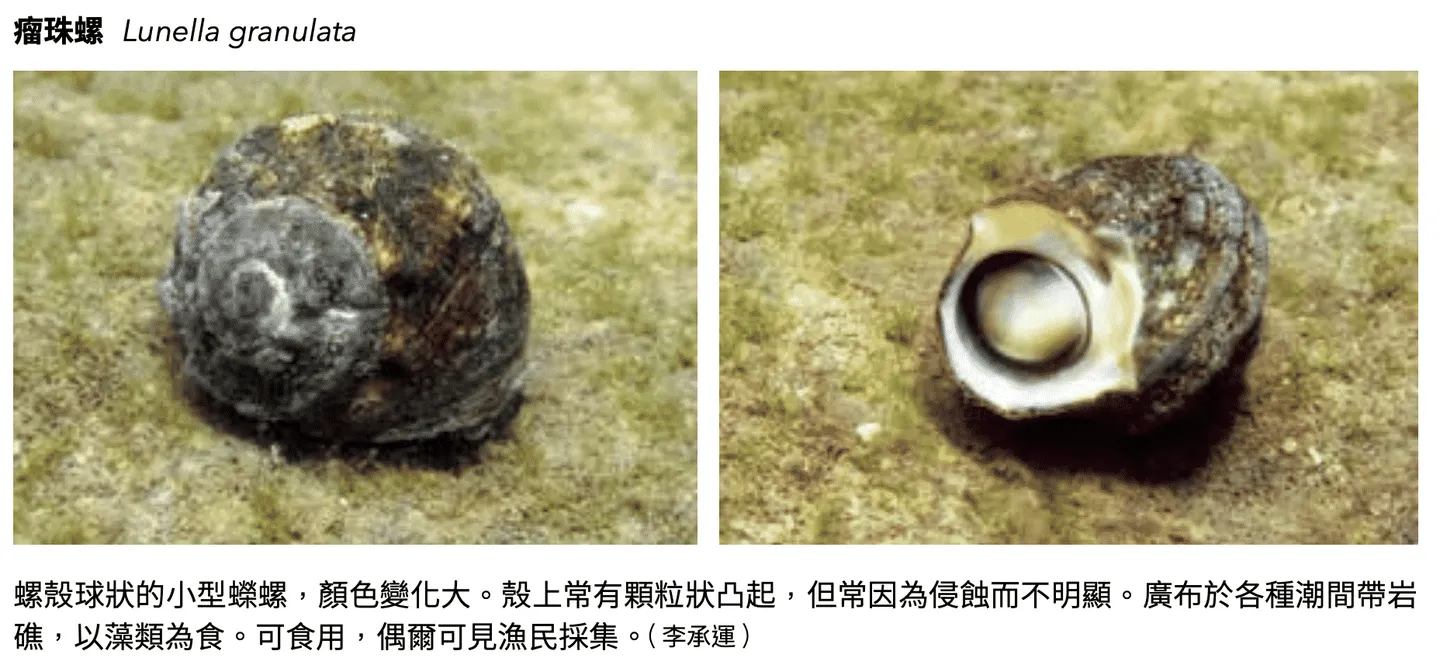
Shell photos need to show the aperture in order to be useful for identification. Ocean Field Guide — Northern Taiwan, P:184
Species Type 7: Nudibranchs
Thanks to the widespread love of macro photography, nudibranch photos are far more plentiful and diverse in marine databases than records of many other groups. Although many nudibranch species have yet to be formally named, as long as you can photograph their gills and rhinophores (the sensory tentacles on their heads), species identification becomes feasible. So a qualifying nudibranch identification photo must capture the rhinophores and gills.
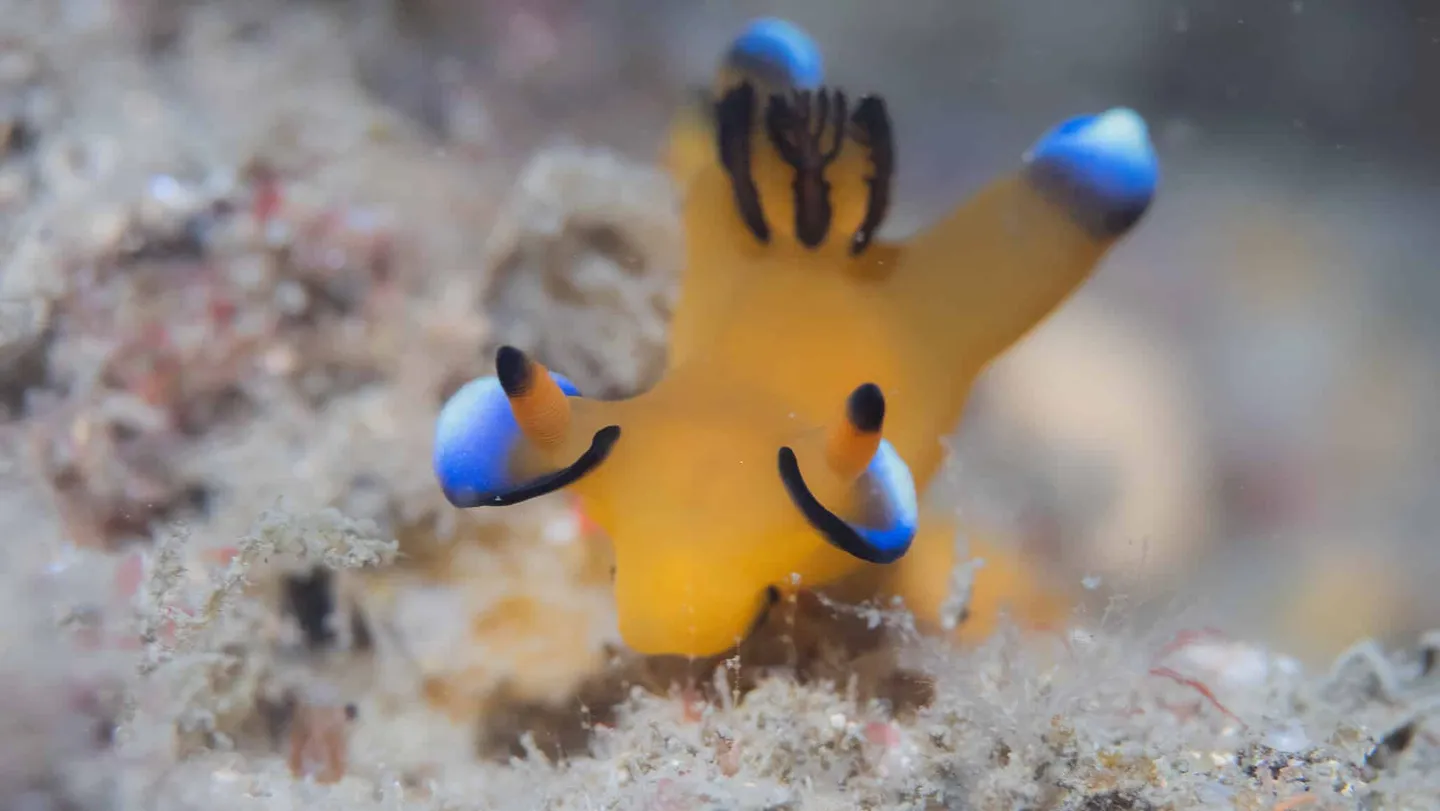
The Pacific thecacera nudibranch, popularly known as the "Pikachu nudibranch." Ocean Field Guide, P:225
Further reading: