Contents(4)
The Editor says: Did you know that the seemingly unremarkable sea urchin is actually a crucial herbivore on coral reefs? In certain ecosystems, it plays an enormous role in maintaining the balance between coral and algae. A research team from National Sun Yat-sen University spent a year surveying Xiaoliuqiu and discovered that Taiwan's very first "sea urchin barren" has appeared there. How did this happen? Read on with the Editor to find out. Full article republished from: "Sea Urchin Barren": Urgent Planning and Management Needed for Xiaoliuqiu's Duzaiping Intertidal Zone — Conservation Management and Research Recommendations Jointly Submitted by National Sun Yat-sen University and Local Operators, authors: Zhang Shuikai, Qiu Xunwen, Chen Yingzhu, Liu Lilian.
In August 2020, media outlets reported: "Sea urchins invade Xiaoliuqiu — the seabed is so packed with sea urchins there is barely room to stand" (UDN, 2020; China Times, 2020). Photographs showing sea urchins crammed together in dense masses drew widespread public attention. Separately, a research team from National Sun Yat-sen University completed a year-long survey and found that, in addition to a dramatic decline in the density of organisms in the Duzaiping intertidal zone compared with the past, Taiwan's first "sea urchin barren" [1,2] may already have emerged there — looking across the reef flat, one sees nothing but sea urchins and pitted, gnawed-away rock riddled with holes.
Because of its rich marine life and unique coral-reef landscape, the Duzaiping intertidal zone was designated a Liuqiu Fishery Resource Conservation Area in 2000 and a Natural and Cultural Ecological Scenic Area in 2015. It is an important conservation site for marine benthic organisms and a popular interpretive destination where intertidal-zone guides lead visitors to learn about intertidal life. In 2019, the zone was considered for designation as a conservation demonstration area — a year-round no-entry seed-source reserve [3] — but this was put on hold pending research data to support management decisions. Pingtung County Government therefore used subsidies from the Ocean Affairs Council to commission a National Sun Yat-sen University research team in 2020 to survey the major intertidal-zone benthic organisms of Xiaoliuqiu and facilitate planning discussions on management measures, while also inviting Dr. Zhao Shimin of the National Museum of Natural Science to serve as consultant on sea urchin issues.
Habitat Degradation of the Xiaoliuqiu Duzaiping Intertidal Zone
Based on early photographs taken by local guides and accounts from island residents, the reef platform at Duzaiping once had healthy substrate and extensive seagrass beds of Thalassia hemprichii, teeming with life. Comparing photographs from July 2003 with those from January 2021, however, the intertidal reef-flat environment has clearly changed over those 17 years: Thalassia hemprichii patches are now only sporadic, replaced by exposed, jagged, uneven bare rock and vast numbers of sea urchins that ceaselessly gnaw at the reef — the overall ecological and environmental quality has obviously deteriorated.
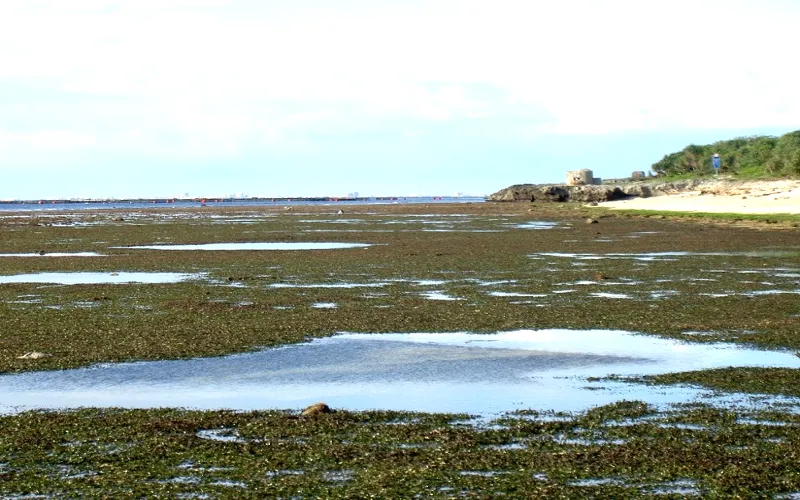
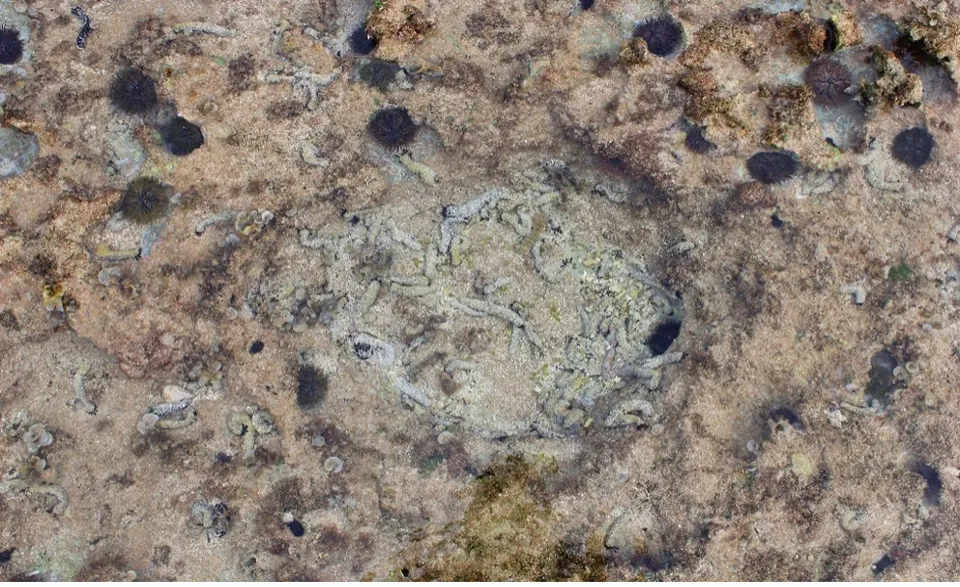
The ecological environment at Duzaiping has changed: the Thalassia hemprichii seagrass bed has been replaced by reef rock riddled with holes. July 2003, courtesy of Wang Tianzheng.
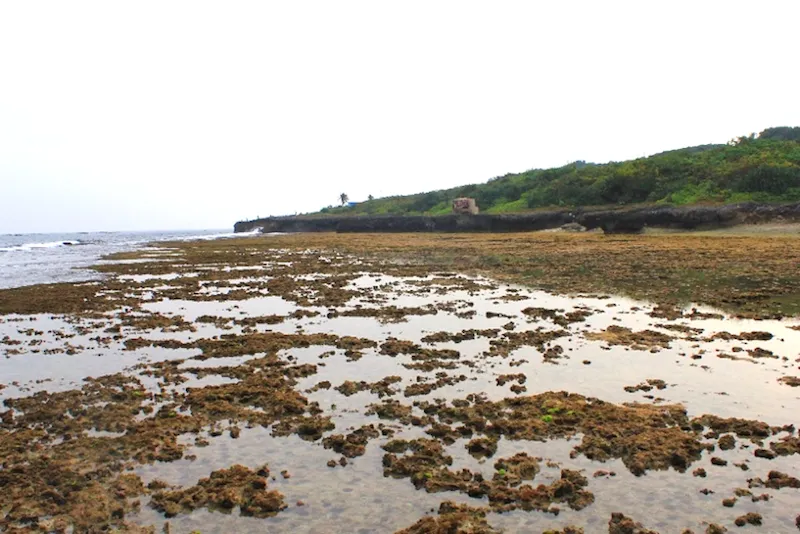
The ecological environment at Duzaiping has changed: the Thalassia hemprichii seagrass bed has been replaced by reef rock riddled with holes. January 2021, courtesy of the Sun Yat-sen University research team.
Furthermore, comparing benthic organism density with survey results from the same area five years prior, the density (individuals per square metre) of benthic invertebrates of comparable body size (>2 cm) fell from 95.5 (n=9, 2013 and 2014) to 19.4 (n=4, 2020) — a reduction of nearly 80% — while species richness also declined by 89%. In terms of species composition, compared with research conducted ten years earlier, the dominant species in 2011 was the large brittle star Ophiocoma scolopendrina (accounting for 68%), which sheltered in crevices and recesses; today, the dominant form is the small (< 2 cm) brittle star Ophiocoma brevipes. Meanwhile, sea urchins, which previously accounted for 21%, now make up 52%, with Echinometra mathaei being the most numerous, followed by Stomopneustes variolaris. There is also a notably high proportion of various sea cucumbers (39%), likely because the increase in sea urchins generates more biodetritus, providing an abundant food supply that has allowed sea cucumber numbers to grow.
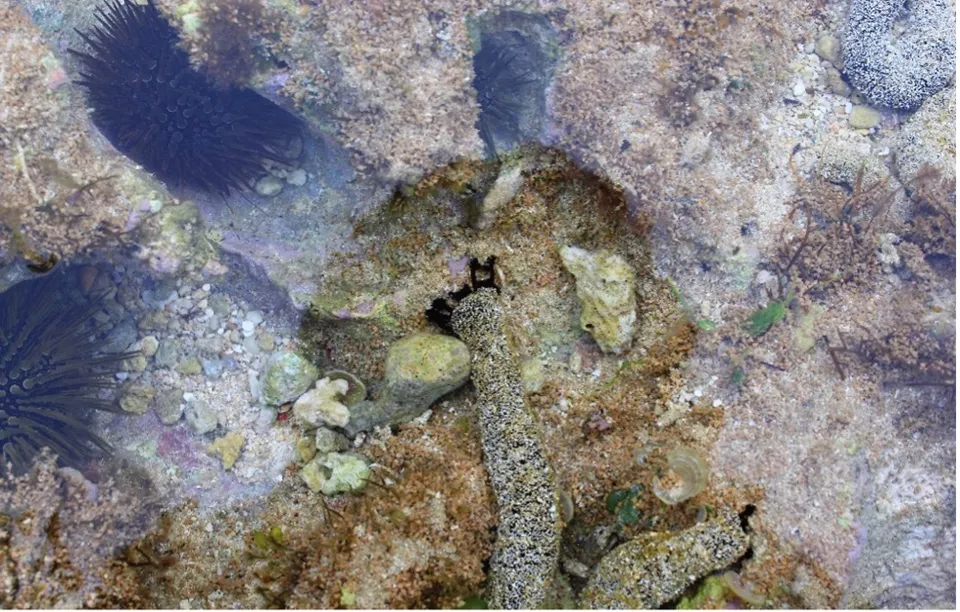
The sandy excrement left behind after sea urchins feed still contains abundant organic matter and is an important food source for sea cucumbers. The black sea cucumber pictured here is using its tentacles to collect organic particles from the substrate. Courtesy of the Sun Yat-sen University research team, photographed January 2021.
The sandy excrement left behind after sea urchins feed still contains abundant organic matter and is an important food source for sea cucumbers. The black sea cucumber pictured here is using its tentacles to collect organic particles from the substrate. Courtesy of the Sun Yat-sen University research team, photographed January 2021.


The Sea Urchin Barren Overrun by Sea Urchins
Just how many sea urchins are there at Duzaiping? Using on-site surveys combined with sea urchin distribution information provided by local guide operators, the research team first calculated the area of the mid-intertidal zone densely occupied by sea urchins, then used drone imagery to analyse and calculate sea urchin numbers per unit area. Based on this, the initial estimate for the number of sea urchins in the mid-intertidal zone is between 800,000 and 1,000,000 — or possibly even more.
In coral reef ecosystems, algae and coral populations compete for habitat space, and sea urchins play the role of herbivore: by grazing on algae, they free up growing space for coral. A moderate sea urchin population therefore benefits the development of coral reef ecosystems. However, once sea urchin populations expand out of control, seagrass and macro-algae habitats disappear under the pressure of high-density grazing. Seagrass and macro-algae are important primary producers in tropical and temperate waters; they also provide essential habitat for many marine fish and invertebrates to nurse, forage, and seek refuge from predators. When both the primary producers and the habitat of an ecosystem are gone, the marine organisms that depend on them disappear as well — until nothing remains but reef rock and sea urchins. This condition is known in the scientific community as a "sea urchin barren" [4,5]. If not remedied in time, the habitat will continue to degrade under constant sea urchin grazing until only bare rock remains.
Duzaiping today has already reached the state of a sea urchin barren, with vast numbers of sea urchins in the mid- and low-intertidal zones. The most abundant species, Echinometra mathaei, uses its mouthparts and spines to burrow into the reef rock, hiding inside these holes to escape predation and feeding on algal fragments and organic detritus washed in by waves, as well as scraping at the encrusting algae on burrow walls. This ongoing process of boring and scraping is the primary cause of the uneven, jagged, pitted reef-rock surface. Although the pits and holes do provide shelter for some small animals, reef rock that has been excessively eroded by sea urchins becomes brittle and increasingly susceptible to cracking from wave action and human trampling — which in turn leaves the sea urchins with nowhere to hide and results in the spectacle of large numbers of sea urchins exposed on the bare reef surface.
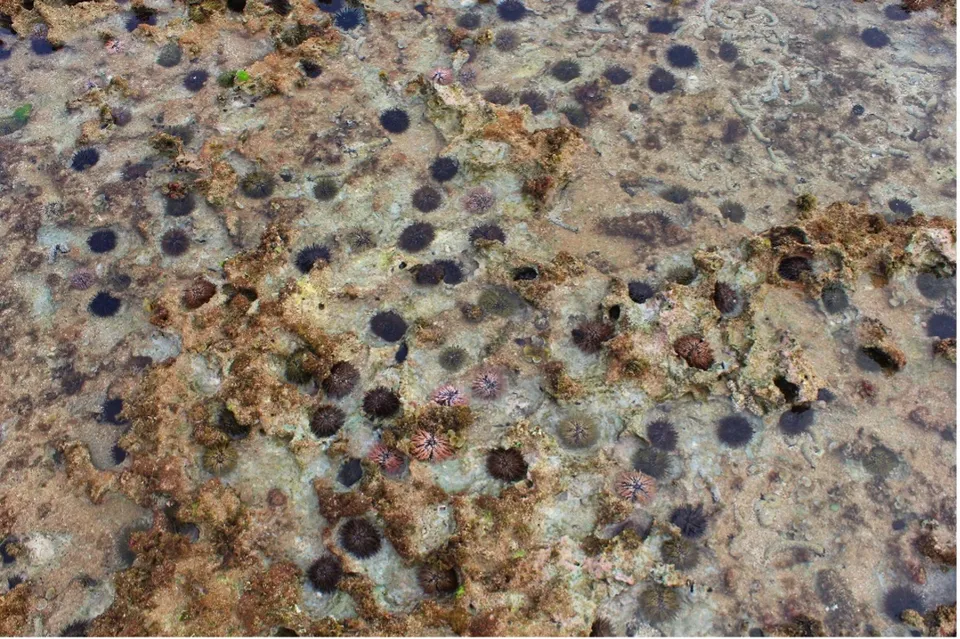
Today's Duzaiping intertidal zone: vast numbers of Echinometra mathaei can be observed in the mid- and low-intertidal zones. Courtesy of the Sun Yat-sen University research team, photographed January 2021.
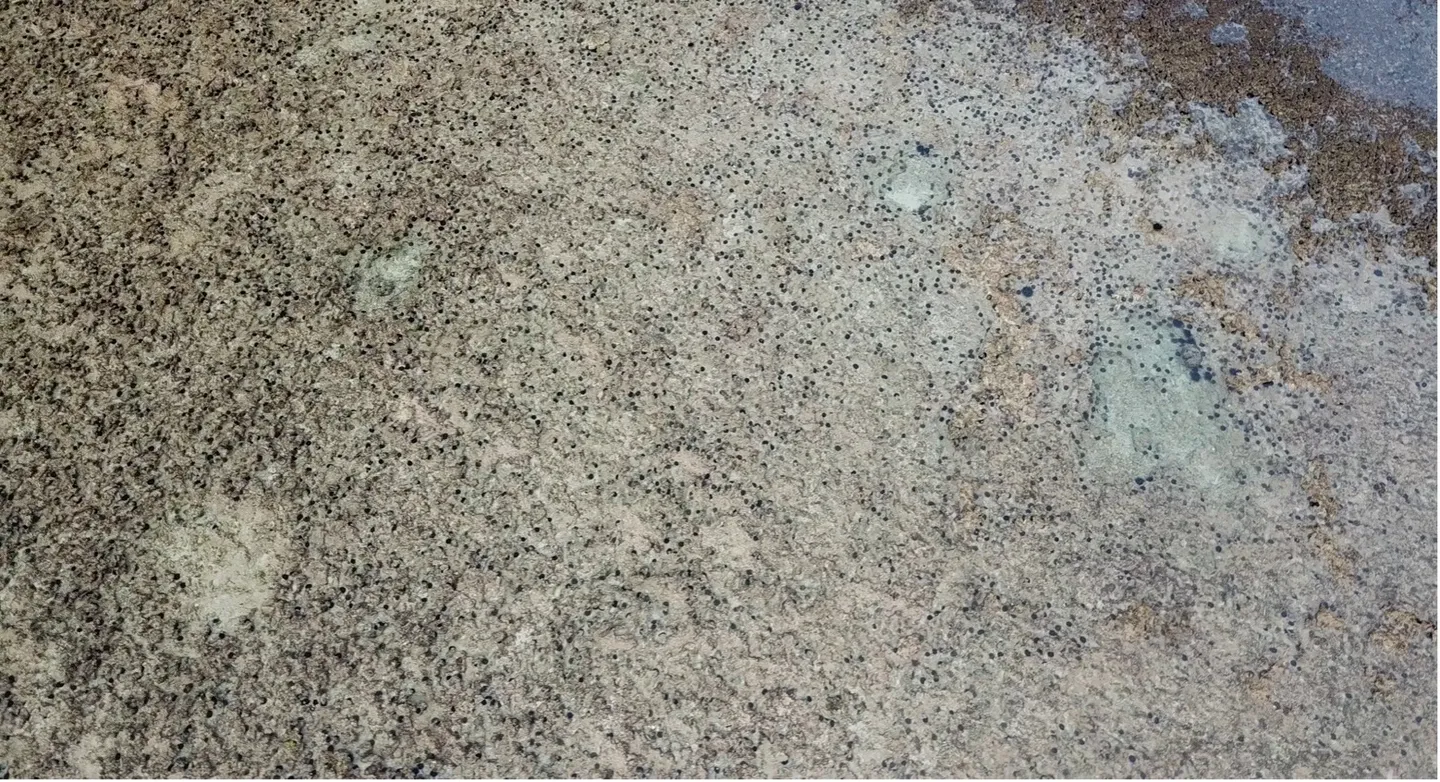
A sea urchin barren covered in sea urchins. The dark spots in the photograph are all sea urchins; others are hidden inside reef rock cavities. Photo credit: Cai Zhengnan (drone photograph taken November 2020).
Possible Causes of the Sea Urchin Barren
Because past ecological survey data for Duzaiping is scarce and incomplete, it is difficult to pinpoint the precise causes of the current situation. After reviewing international literature and consulting with sea urchin specialists and local operators, the research team concluded that both natural factors — such as typhoons and climate change — and the following human-induced factors may be responsible.
Sea urchin population explosions have been documented in many locations around the world. Scientists consider the primary drivers of sea urchin barrens to be overfishing, which eliminates sea urchin predators, and excess organic nutrients, which promote the growth of sea urchin food sources. Sea urchins have a number of natural predators, including certain species of lobster, crab, fish (such as some pufferfishes, triggerfishes, and wrasses), and gastropods (such as helmet shells and frog shells). The residents of Xiaoliuqiu, who historically relied on fishing for their livelihoods, largely continue that way of life today: some residents still harvest molluscs in the intertidal zone at low tide, fish from the shore, or catch fish nearby. These activities have gradually depleted marine biodiversity around Xiaoliuqiu and eliminated sea urchin predators, allowing Echinometra mathaei — which has no commercial value — to proliferate unchecked and damage the reef flat.
Before the tourism boom, prior to 2008, passenger ferry trips to Xiaoliuqiu from Donggang numbered fewer than 500,000 per year. In recent years, however, tourism has surged: approximately 1,500,000 ferry trips were made to Xiaoliuqiu in 2019 (Tourism Bureau website), suggesting a tourist count of roughly 1,000,000. The volume of domestic wastewater generated by this influx of visitors is not insignificant. Although wastewater treatment facilities exist, they cannot keep pace with the rapid proliferation of guesthouses, and large quantities of domestic wastewater are still discharged directly into the sea or the intertidal zone, causing eutrophication, excessive algal growth, and ocean acidification. This alters the biological composition of surrounding waters and accelerates the rate at which sea urchins erode the coral reef. Additionally, approximately 152,000 tourists entered the Shanfu, Yuchengwei, and Duzaiping intertidal zones of Xiaoliuqiu throughout 2019 (Pingtung County Government statistics), and the trampling and handling of organisms by excessive numbers of visitors has further accelerated the disappearance of marine life and the degradation of the fragile reef flat.
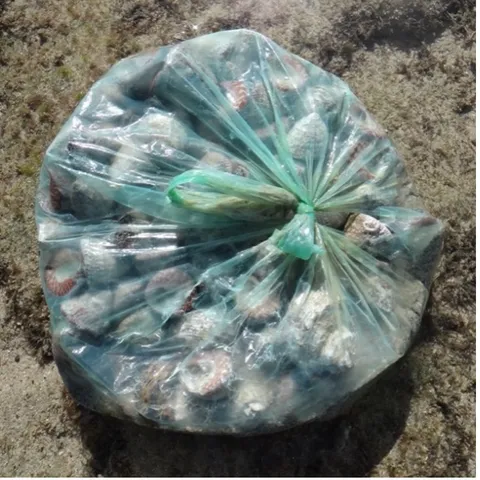
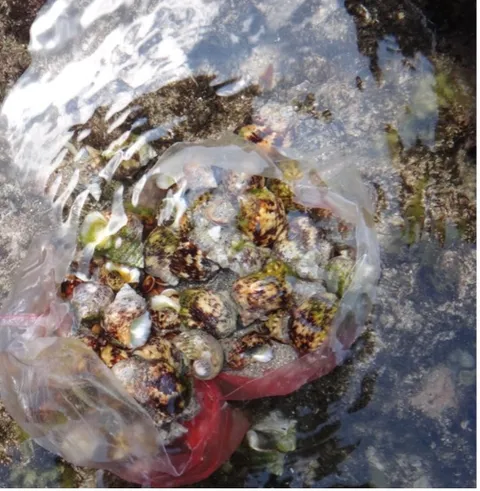
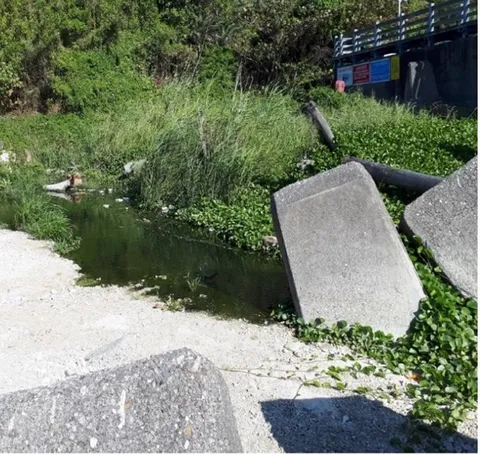
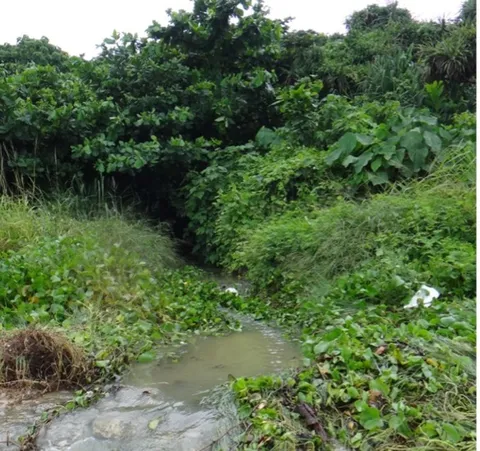
Tourist numbers to Xiaoliuqiu have climbed year after year, placing the marine environment under excessive carrying capacity. Top: a bag of top shells and turban shells consumed and discarded by visitors in the intertidal zone in 2020; bottom: wastewater pools near the Shanfu and Duzaiping intertidal zones. Courtesy of Liu Lilian.
Industry, Government, and Academia Join Forces to Reverse the "Sea Urchin Barren"
Based on current survey findings, it is clear that the coral reef ecosystem of the Duzaiping intertidal zone has progressively lost its function and can no longer fulfil the original conservation goals of the "Fishery Resource Conservation Area" and "Natural and Cultural Ecological Scenic Area" designations — namely, the protection of natural scenery and the conservation of biodiversity. Because the sea urchin surplus is not purely the result of natural ecosystem fluctuations — much of it is attributable to excessive human disturbance, including overharvesting of sea urchin predators, eutrophication from wastewater discharge, and trampling by excessive numbers of tourists — action must be taken if the situation is to change.
The research team and local guide operators discussed together how to reverse the "sea urchin barren." The following management recommendations are offered for consideration by the relevant authorities:
-
Decline of sea urchin predators: It is recommended that local residents and anglers be educated and that the harvesting of sea urchins' primary predators be restricted. Consideration should also be given to designating these species as legally protected animals subject to a no-take rule.
-
Wastewater discharge: It is recommended that the sewage system or wastewater treatment facilities be reviewed to ensure that all wastewater is properly treated before being discharged into the ocean.
-
Human trampling: It is recommended that the number of visitors allowed into the intertidal zone at any one time be limited (for example, to a maximum of 300 people), and that a "core conservation zone" be designated within the Duzaiping intertidal zone to protect organisms in that area from disturbance and facilitate restoration. Eco-tour routes should also be established within this zone to restrict the area that visitors may tread.
-
Sea urchin overabundance: It is recommended that sea urchins be removed by human intervention, following international precedents. As no related domestic research exists, the scale and method of removal needed to effectively reverse the sea urchin barren phenomenon are not yet understood. It is therefore recommended that a literature review and small-scale removal trials be conducted first, with monitoring of biodiversity and ecosystem recovery rates within the removal area to evaluate effectiveness — providing an evidence base for action to reverse the "sea urchin barren." Pingtung County Government has agreed to take these recommendations into account in promoting ecological restoration of the Duzaiping intertidal zone.
References:
-
[1] K. Filbee-Dexter, R.E. Scheibling, Sea urchin barrens as alternative stable states of collapsed kelp ecosystems, Mar. Ecol. Prog. Ser. 495 (2014) 1–25. https://doi.org/10.3354/meps10573.
-
[2] D.R. Bellwood, T.P. Hughes, C. Folke, M. Nyström, Confronting the coral reef crisis, Nature. 429 (2004) 827–833. https://doi.org/10.1038/nature02691.
-
[3] Zhang Shuikai, Chen Yingzhu, Xiaoliuqiu's Intertidal Zone "Trampled" by Tourism — Conservation Area Management Regime Needs Strengthening, Taiwan Environmental Information Association – Environmental Information Center. (2020). https://e-info.org.tw/node/223328 (accessed March 29, 2020).
-
[4] J. Pearse, C. M.E., D. Leighton, M. C.T., N. W.J., Marine waste disposal and sea urchin ecology, in: W.J. North (Ed.), Kelp Habitat Improvement Project, California Annual Report, 1969 to 1970., California Institute of Technology, Pasadena, CA, 1970: pp. 1–93.
-
[5] C. Birkeland, The influence of echinoderms on coral-reef communities, Echinoderm Studies. 3 (1989) 1–79.
-
Zhang Shuikai, Qiu Xunwen, Chen Yingzhu, Liu Lilian. 2021. Xiaoliuqiu's Duzaiping Intertidal Zone Has Become Taiwan's First "Sea Urchin Barren". Environmental Information Center, 2021/2/18.
Further Reading
Editor-in-charge: Jenny Tsai