

Don't forget to watch the video above!
High-Pressure Hose or Low-Pressure Hose — Which Blowout Poses a Greater Risk?
Unlucky divers do occasionally experience a hose blowout underwater.
That got us wondering:
which actually poses a greater risk — a high-pressure (HP) hose blowout or a low-pressure (LP) hose blowout?
In this episode of 【What's This Gear?】we're setting aside the usual equipment spotlight.
Instead, let's talk about hoses — something critically important in scuba diving, yet all too often overlooked.
00:00 What's This Gear?
01:00 Pre-test preparation
03:09 The answer revealed
03:30 Breaking down the correct answer
03:58 What to do if you experience a hose blowout
04:38 How to maintain your hoses
What to do if you experience a hose blowout underwater
If you're unlucky enough to have an intermediate-pressure hose blow, you may not even have time to perform a Controlled Emergency Swimming Ascent (CESA).
On top of that, when a blowout occurs, there's a very good chance you won't be monitoring your ascent rate —
which introduces the added risk of decompression sickness (DCS).
The best course of action is to find your dive buddy immediately and share air as you slowly make your way back to the surface.
This naturally leads to two safety reminders we'd like to share with everyone.
First: please — in recreational scuba diving (assuming a no-decompression dive), if you encounter an emergency, skip the non-essential 5-metre safety stop!
Believe it or not, the Editor has personally witnessed a diver with a second stage free-flowing massively still insisting on completing the 5-metre safety stop.
Second: please — you never know when a blowout might happen, so avoid solo diving to reduce risk. If you do dive solo, always carry an emergency backup air source so you have enough gas to reach the surface!
Why Does an HP Hose Leak Less Air Than an LP Hose?
Although the pressure inside an HP hose is far higher than the working pressure of an LP hose, the HP port features a pinhole-sized orifice that restricts the rate at which gas can escape. In other words, the passage is so narrow that even with enormous pressure behind it, the outflow is limited — much like a garden hose with a very fine nozzle.
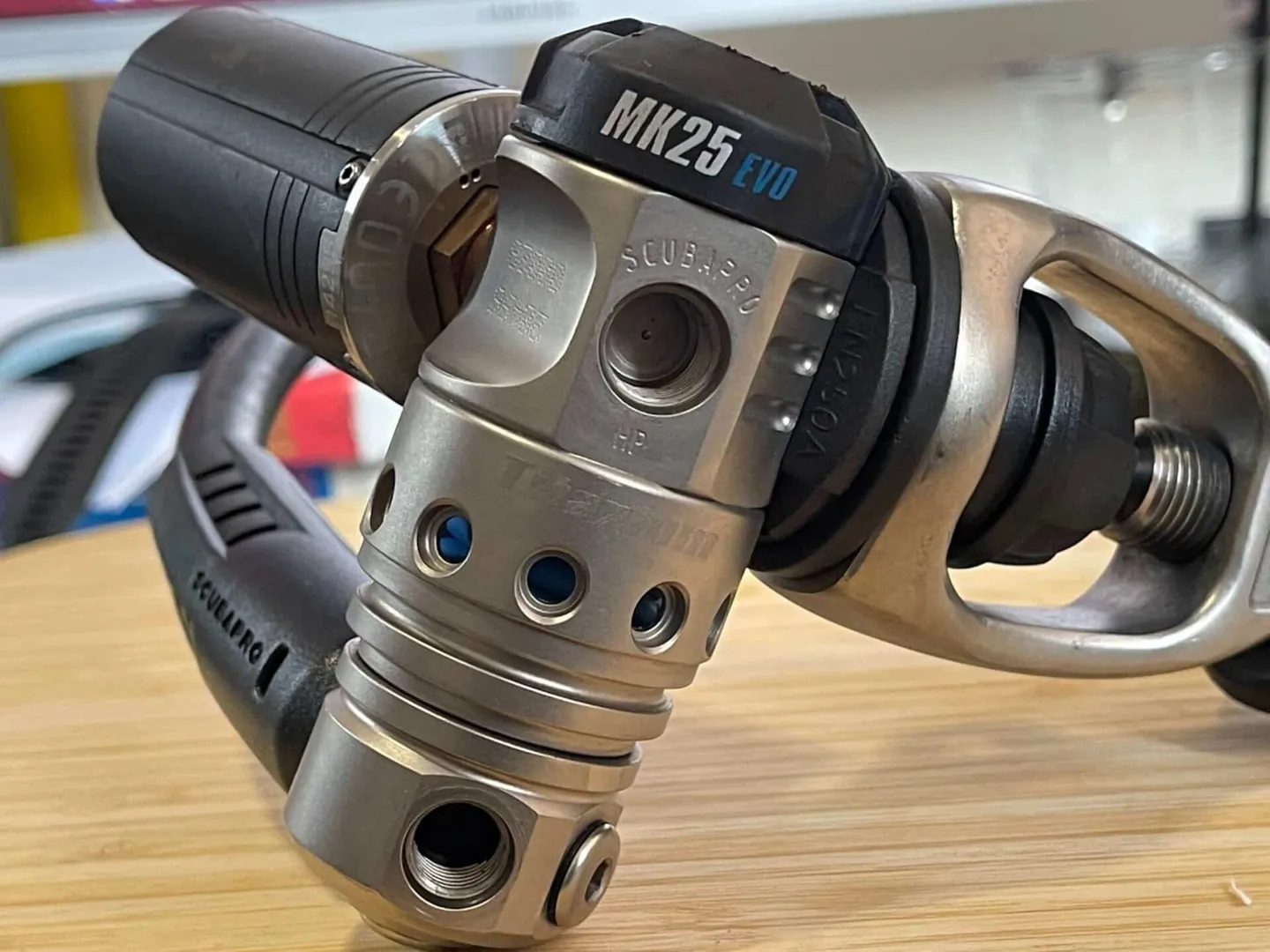
The upper port is the HP port, which contains an extremely small pinhole opening. The lower port is the LP port.
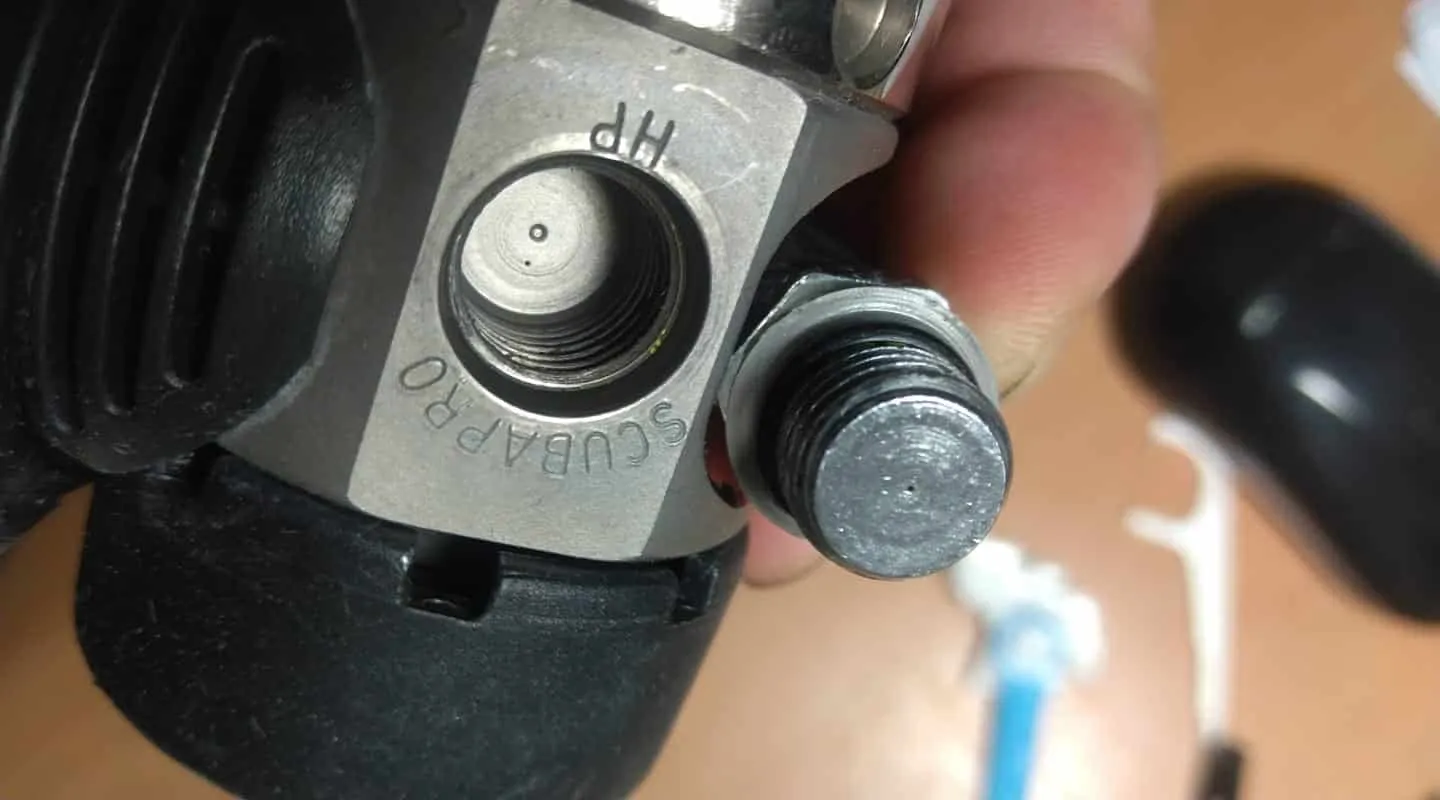
The junction between the HP port and the HP hose — only that pinhole-sized opening allows airflow through, which is why the gas leakage is relatively small.
How to Reduce the Risk of a Hose Blowout
This is a great question — and the answer might come down to whether you've been living right. If you're truly unlucky (and the Editor has been there), you could end up on a three-day dive trip to Green Island where two people in the same group blow a hose — on separate occasions, of course. A blowout means that dive is over, and it can easily lead to unnecessary risks.
That's why the video highlights the importance of proper daily storage (lay hoses flat whenever possible, avoid hanging them, minimise direct sun exposure), along with annual visual and tactile inspections. The most foolproof approach is to replace your hoses on a regular schedule — after all, hoses are consumables. This applies, of course, to those who own their own gear.
But what if you're using rental equipment? In that case, all you can do is thoroughly inspect the hoses yourself once you receive the gear — check for any abnormal bulging or deformation.
The key takeaway: build good diving habits and never stray too far from your dive buddy!!
In Episode 1 we covered SCUBAPRO's full regulator lineup.
Check it out here: https://youtu.be/PD8hzOMQ-uc
In Episode 2 we covered ATOMIC's full regulator lineup.
Check it out here: https://youtu.be/GMxpiQedDms
In Episode 3 we covered APEKS, a brand highly regarded in the technical diving world.
Check it out here: https://youtu.be/2T1DjYFkQJU
In Episode 4 we covered a buying guide and material overview for back-inflate BCDs (Back Float BCD).
Check it out here: https://youtu.be/pL3ko0Levb0
Next time, we'll be revisiting the back-inflate BCD (Back Float BCD) buying guide and materials overview,
along with propulsion systems and wetsuit purchasing tips!
If you enjoy our content, don't forget to like our fan page, subscribe to our YouTube channel, and hit the notification bell!
Subscribe to our YouTube channel here: https://bit.ly/3ryd1T3
Of course, purchasing our ocean journal is the most direct way to support us!
Buy the ocean journal on Books.com.tw: https://bit.ly/3iIrDdT
BlueTrend: [https://bluetrend.media/ BlueTrend](https://bluetrend.media/ BlueTrend)
BlueTrend Facebook fan page: https://www.facebook.com/BlueTrend.Media