Contents(8)
As digital technology and artificial intelligence (AI) advance at a rapid pace, data has become a critical resource for modern scientific research and environmental conservation. Yet data in itself carries no inherent value — only when it is properly processed and analyzed can it be transformed into meaningful information, knowledge, and ultimately wisdom. Nowhere is this more evident than in the field of marine conservation, where the combination of citizen science and AI is revealing enormous potential. Citizen scientists gather ocean data, while AI harnesses its powerful analytical capabilities to convert that data into actionable insights, deepening our understanding of the marine environment and driving efforts to protect it.
The DIKW Framework: From Data to Wisdom
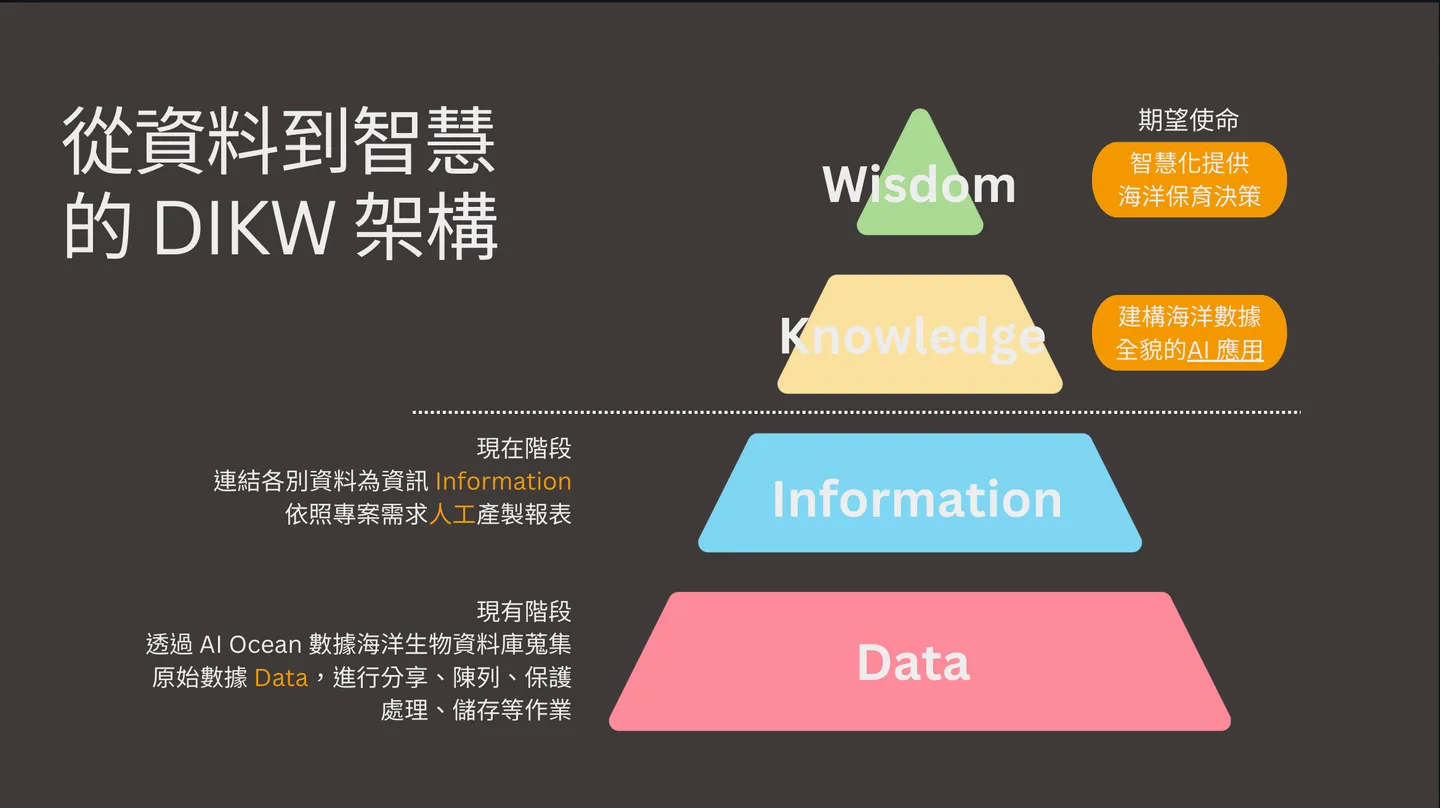
To understand how data is transformed into valuable outcomes, we can refer to the DIKW framework (Data, Information, Knowledge, Wisdom) — a model that describes the hierarchical relationships between data, information, knowledge, and wisdom. According to this framework, data is the most fundamental element and carries no direct meaning on its own; only through organization and processing does it become useful information. When information is further structured and applied with understanding, it rises to the level of knowledge. Finally, when knowledge is deployed at the right moment and in the right context, it produces wisdom.
This framework not only provides the theoretical foundation for understanding data processing, but also helps us appreciate the roles that citizen science and AI play in applying ocean data. Data collection is the starting point, while the generation of information, knowledge, and wisdom is what matters in downstream applications.


Citizen Science and Data Collection: The Starting Point from Data to Information
BlueTrend began developing its Marine Citizen Science Database in 2021 and launched the MCS (Marine Citizen Scientist) Program, an initiative designed to collect marine biodiversity data through public participation. The data primarily consists of marine life photographs uploaded by citizens, accompanied by detailed metadata such as GPS coordinates, timestamps, water temperature, and depth. This process of data collection and curation not only provides the academic community with much-needed foundational ocean data, but also gives more people the opportunity to participate in marine science exploration.
At this stage, BlueTrend's core work focused on data collection and storage. The team established a systematic database to classify, tag, and archive all submitted data, ensuring that nothing would be lost over time. Although the data had yet to be fully analyzed or utilized, it laid the necessary groundwork for deeper analysis and ensured the reliability and integrity of the dataset.
Citizen Data 2.0: AI Makes Data Meaningful
With the rapid advancement of AI technology — particularly from 2023 onward — the BlueTrend team secured support from the Taiwan Mobile Foundation's Tech The Dreamers program and progressively integrated AI image recognition and generative AI Chatbot capabilities into its platform. This enabled the AI Ocean platform to undergo a major upgrade, making it the first application in the Traditional Chinese-speaking world to integrate a comprehensive marine life database. The platform consolidates vast amounts of data from diverse sources, including the team's own publication Marine Natural History, citizen-uploaded species photos on AI Ocean, government-released survey reports, and millions of dive log entries from ATMOS dive computers — providing robust data support for marine biodiversity conservation and sustainable development.
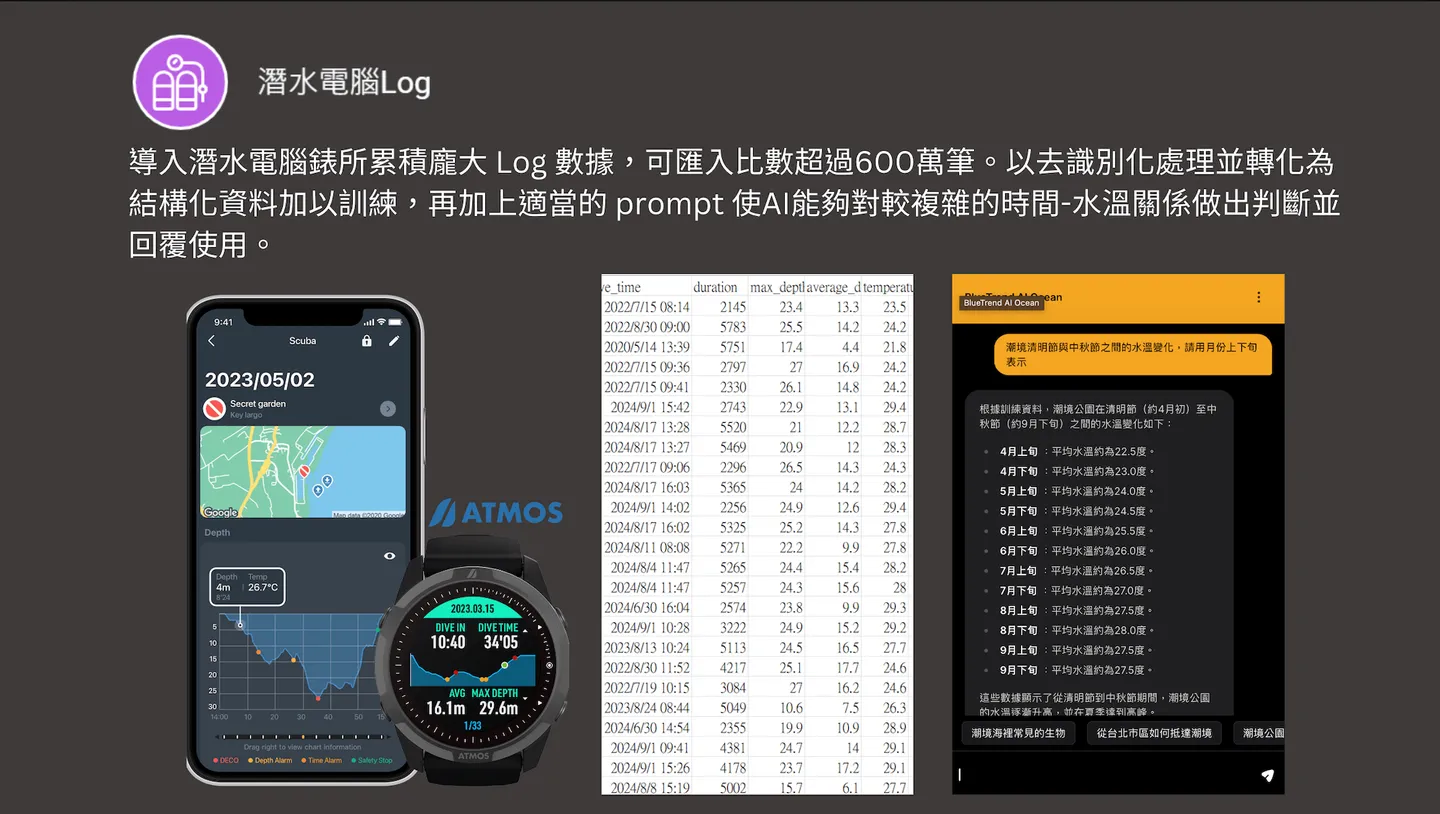
AI Ocean can now answer location-specific questions such as: What was the water temperature at a particular site at a given time? What species can be observed in that area? What are the identifying features of these marine organisms? It can even recommend suitable sustainable tourism operators. This kind of information is invaluable to researchers and visitors alike, helping them better understand the distribution of marine life and how it is changing over time.
At this stage, AI technology not only organically connects large volumes of data but also uncovers hidden patterns and relationships within it, elevating the results to the information level and thereby supporting decision-making. AI not only accelerates data processing but also adds greater depth and precision to data analysis.
AI Ocean's goal is to build a comprehensive database that integrates resources across marine biology, dive data, ocean education, and sustainable tourism, enabling people not only to learn about the ocean but also to fall in love with it and protect it from a more holistic perspective — truly embodying the spirit of "Falling in love with the ocean starts with understanding it."
Knowledge and Action: Applying Information to Knowledge
Once data has been transformed into information and AI has established multiple layers of connections within it, the next challenge is how to translate that information into real-world action. At the knowledge level, we must not only understand the information but also know how to effect change based on that understanding. The AI Ocean platform is designed and developed with knowledge as its guiding principle, committed to translating knowledge into concrete action plans.
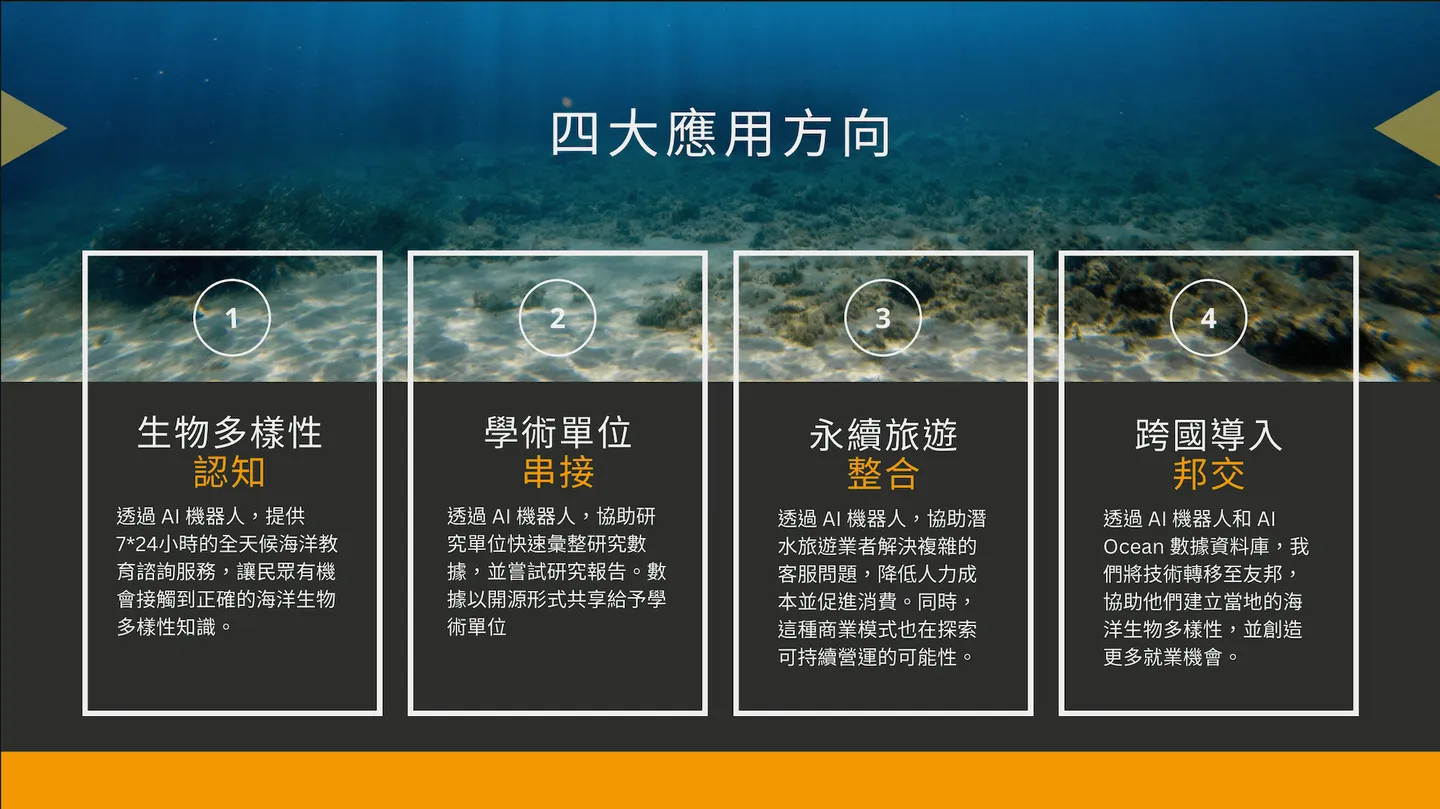
For example, the platform can help users understand how marine organisms behave under different environmental conditions, thereby encouraging individuals, communities, and businesses to change their behavior — improving diving practices, reducing pollution, and adopting ocean-protective measures. These actions will help mitigate the negative impact of human activity on marine ecosystems, providing tangible support for ocean conservation.
Wisdom: Transforming Global Behavior
The wisdom level represents a deep understanding and application of information and knowledge — it calls on us to make sound choices at the right time and in the right place. As the world grapples with increasingly severe environmental challenges such as ocean pollution and climate change, the application of wisdom becomes ever more critical. At this level, citizen science and AI technology offer us something profound: a shift in collective consciousness, and the power to drive transformation in global behavior.
This change extends beyond the individual — it is a form of collective action. When the AI Ocean platform can provide data analysis on a global scale and harness the power of citizen science to engage more people in ocean conservation efforts, it will ultimately cultivate a stronger societal awareness of marine environmental issues and inspire active participation.
Conclusion
From data to information, from information to knowledge, and from knowledge to wisdom — the DIKW framework offers a clear lens through which to understand the process of data transformation. BlueTrend's AI Ocean platform puts this philosophy into practice, fully leveraging the power of citizen science and AI technology to convert vast quantities of ocean data into meaningful information and knowledge, ultimately driving marine conservation and sustainable development on a global scale. Throughout this process, AI technology not only improves the efficiency of data processing, but also enables us to rethink the impact of human behavior on ecological environments from the perspective of marine life — laying the foundation for a more sustainable future.
Behind all of this lies the power of "data-driven action."
Related Links
Further Reading