Contents(4)
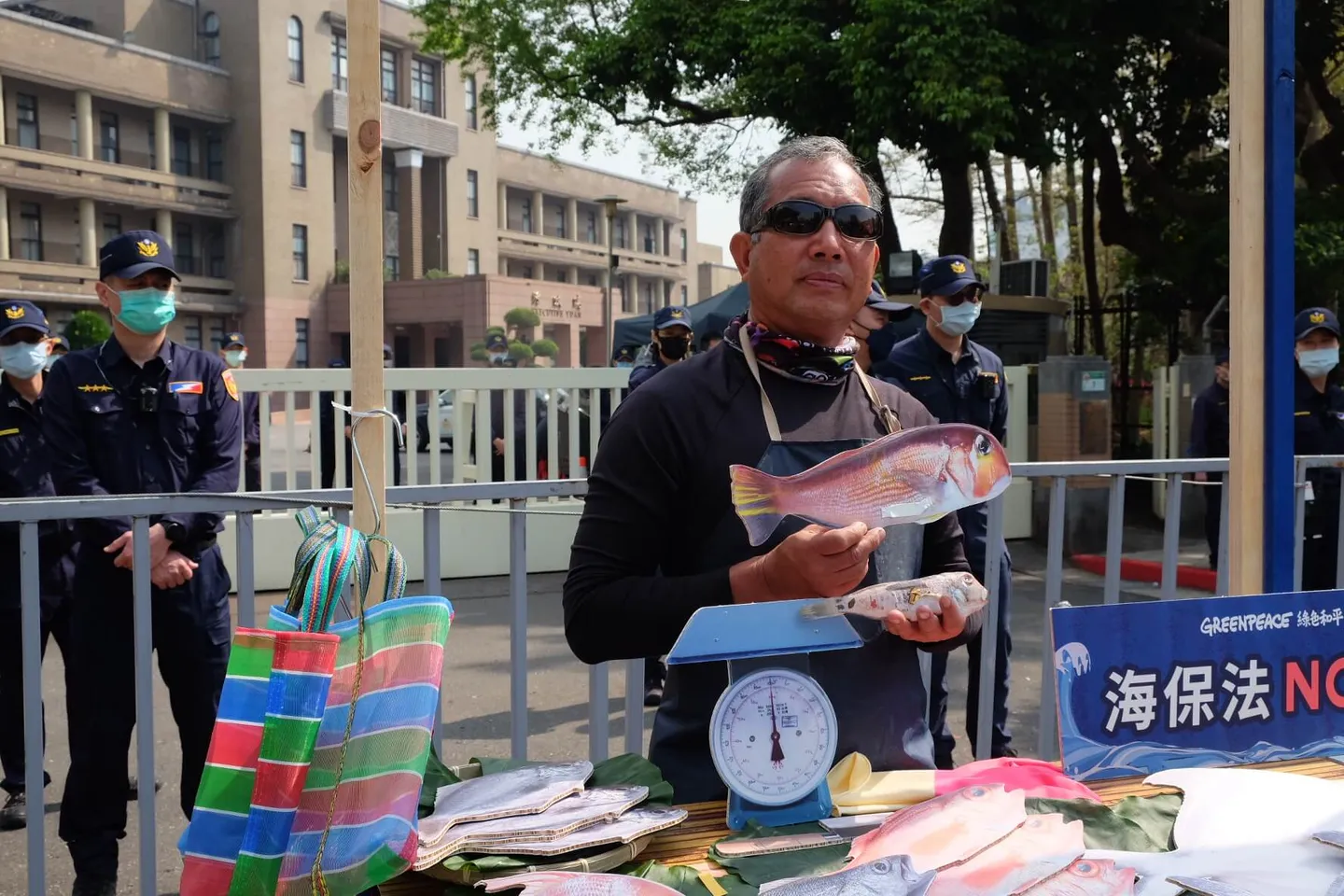
How big do you remember the mackerel and horse mackerel at the market being? The answer may differ depending on your age. Greenpeace set up a fish stall in front of the Executive Yuan, and the fish purchased from the market on the right were noticeably smaller compared to those from the 1990s on the left.
The environmental group partnered with the National Museum of Marine Biology and Aquarium to conduct a survey, visiting fish markets in Keelung, Yilan, Kaohsiung, and Pingtung. They collected 1,716 valid data points and found that over 97% of chub mackerel, Japanese horse mackerel, and blackthroat seaperch were caught and sold before reaching their "maturity length*." Among the pomfret sampled in Qianzhen, Kaohsiung, the smallest measured just 6.85 cm — only half of the species' maturity length.
*Maturity length, also known as the 50% maturity length (Lm50): the body length at which 50% of individuals in a population have reached sexual maturity. It serves as a reference baseline for assessing population health and establishing fisheries management standards.
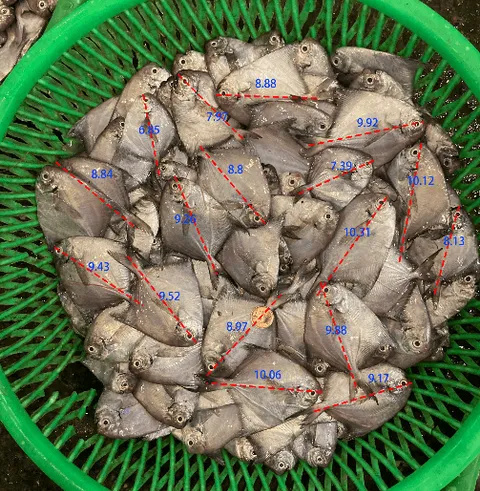
The smallest pomfret sampled in Qianzhen, Kaohsiung measured just 6.85 cm. (Photo provided by Greenpeace)
Survey: 100% of Chub Mackerel Below Maturity Length
"We are not giving these fish the chance to reproduce."
If juvenile fish are caught before reaching sexual maturity and reproductive capacity, fish populations will decline over time. Take the chub mackerel surveyed in this study: of the 84 fish sampled from markets, 100% had not reached the maturity length of 32.3 cm, with the smallest measuring just 17.97 cm.
"We are not giving these fish the chance to reproduce," said Ho Hsuan-Ching, a researcher at the National Museum of Marine Biology and Aquarium who participated in the survey. He cited a U.S. National Marine Fisheries Service survey in Alaskan waters as an example: "They conduct annual surveys of species populations, calculate reproduction rates, and use that data to regulate how much can be caught in the market the following year."
In Taiwan, by contrast, there is currently no legal basis for imposing such restrictions, nor is there systematic research data to reference — highlighting the importance of strengthening marine scientific monitoring as called for in the Marine Conservation Act.

Ho Hsuan-Ching, a researcher at the National Museum of Marine Biology and Aquarium who participated in the survey, lamented that we are not giving these fish the chance to reproduce.


Which Fish Can Be Caught? Fishers Hope the Marine Conservation Act Will Provide Guidance
Wang Ming-Hsiang, a Piston diving instructor who grew up in Keelung, is also a recreational boat skipper with over 20 years in the fishing industry. He has felt the depletion of fishery resources acutely — it was partly concern for both his livelihood and the sustainable development of the ocean that led him to transition to working as a dive instructor. Speaking from the perspective of fishers, he shared: "Which fish can be caught and which cannot — for fishers, it comes down to following the rules. There needs to be a legal foundation to tell fishers what to do. I hope the Marine Conservation Act passes quickly, so that future generations will have more fish, and bigger fish, to catch."
Chung Meng-Hsun, Ocean Project Director at Greenpeace, added that the significance of the Marine Conservation Act lies in its ability to promote the expansion and effective management of marine protected areas (MPAs). "When an MPA is ecologically healthy, fish will naturally congregate there, and eventually spill over," he said — creating a positive cycle that also benefits fishers.
Wang Ming-Hsiang, a Piston instructor with over 20 years in the fishing industry, hopes the Marine Conservation Act will pass as soon as possible.
Progress on the Marine Conservation Act: "To Be Sent to the Legislature This Session"
Even with the Ocean Affairs Council now established and many conservation initiatives and policies underway, the situation with marine protected areas (MPAs) — designated and managed by different competent authorities — illustrates the problem well. The Ocean Conservation Administration is nominally the competent authority, yet it has no legal basis to formally designate MPAs, making it a tiger without teeth.
In fact, at last year's "Our Ocean Conference (OOC)" hosted by Palau, Taiwan explicitly committed to passing the Marine Conservation Act. Yet the relevant legislation remains stalled at the Executive Yuan. With various stakeholders pressing for updates on the Act's progress, Chen Ying-Jung, Director of the Executive Yuan's Department of Transportation, Environment and Resources, stepped forward to respond on behalf of the government. She stated that the relevant ministries and agencies have largely completed their coordination, and that efforts will be made to submit the Marine Conservation Act to the Legislative Yuan during the current legislative session.

Chen Ying-Jung, Director of the Executive Yuan's Department of Transportation, Environment and Resources, indicated that the Marine Conservation Act will in principle be submitted to the Legislative Yuan during the current session.
Full Breakdown: Survey of Common Fish Body Lengths in Taiwan
| Species | Sample Size | Proportion Below Maturity Length |
|---|---|---|
| Chub Mackerel | 84 | 100% below maturity length |
| Blackthroat Seaperch | 685 | 99% below maturity length |
| Japanese Horse Mackerel | 144 | 97.9% below maturity length |
| Japanese Tilefish | 61 | 85.3% below maturity length |
| Disc Pomfret | 568 | 82.2% below maturity length |
| Silver Pomfret | 174 | 77% below maturity length |
Source: Survey of Body Lengths of Six Common Fish Species in Taiwanese Fishing Ports
Further reading:
- Body lengths of six common fish species in Taiwan's fish markets have all shrunk! Fish-eating culture is in jeopardy — Greenpeace demands the Marine Conservation Act be submitted for review in March
- Last year, the Taiwanese government made an explicit commitment to pass the Marine Conservation Act at the 7th "Our Ocean Conference (OOC)" hosted in Palau, yet the promise has yet to be fulfilled. The government's commitment can be found on p. 23 (fourth item from the bottom) of this document.
- While the Marine Conservation Act Remains Stalled, Marine Life Is Dying — When Will the Government Honor Its Legislative Promise?
- Are Marine Protected Areas the Best Answer for Ocean Sustainability? Ocean Encyclopedia Takes You Inside MPAs — Part 1
- Taiwan People's Party Legislative Caucus Draft of the Marine Conservation Act