Contents(6)
On April 15, 2024, Taiwan's Ministry of Foreign Affairs raised the travel advisory for Mauritius to an "Orange Alert," recommending that citizens avoid non-essential travel. The first point of the advisory states: "Mauritius law expressly prohibits anyone from entering the water to swim with whales. The Ministry of Foreign Affairs reminds travelers visiting Mauritius to respect local regulations and refrain from breaking the law."
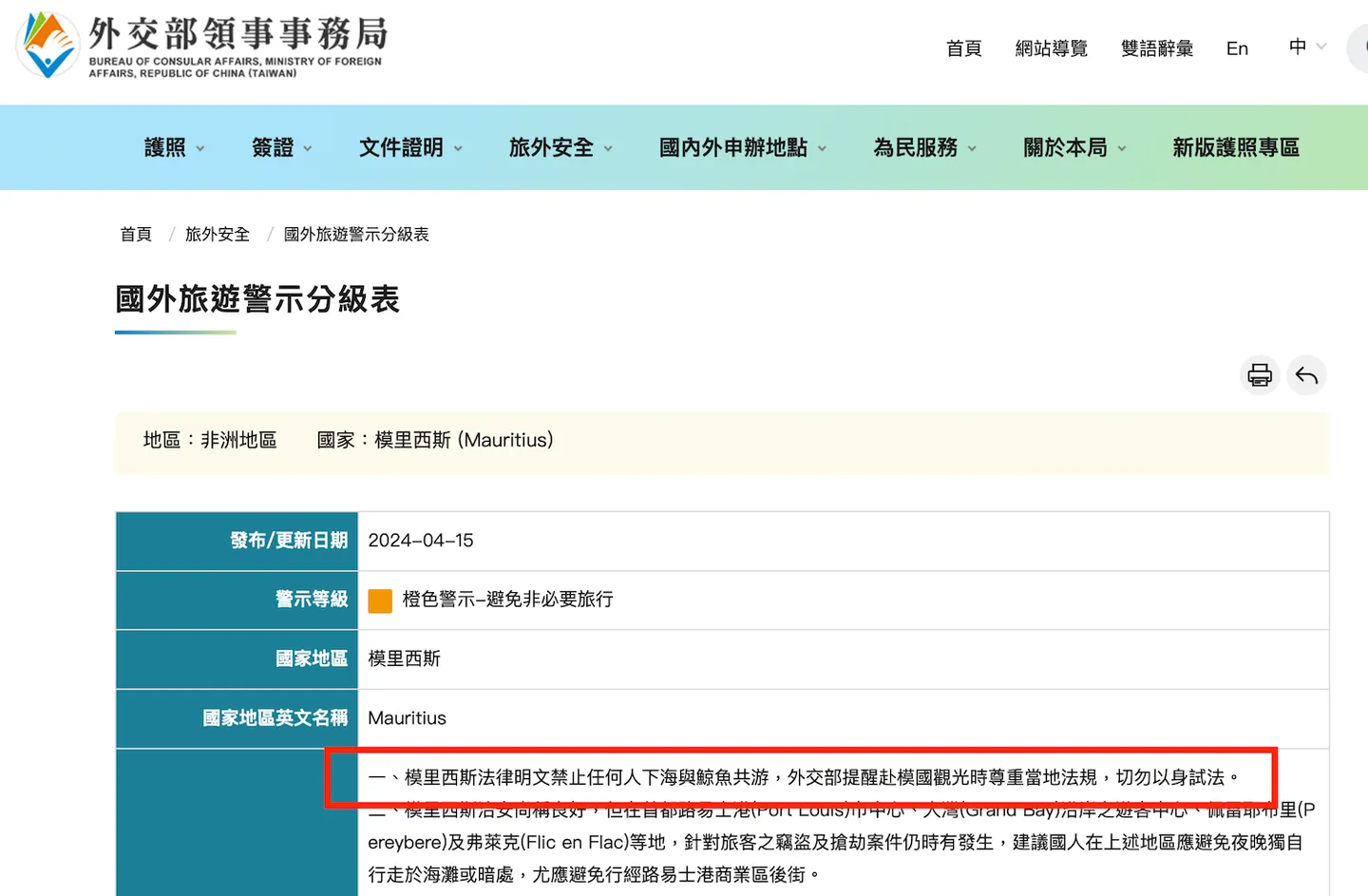
Taiwan's Ministry of Foreign Affairs has officially announced that Mauritius prohibits swimming with whales.
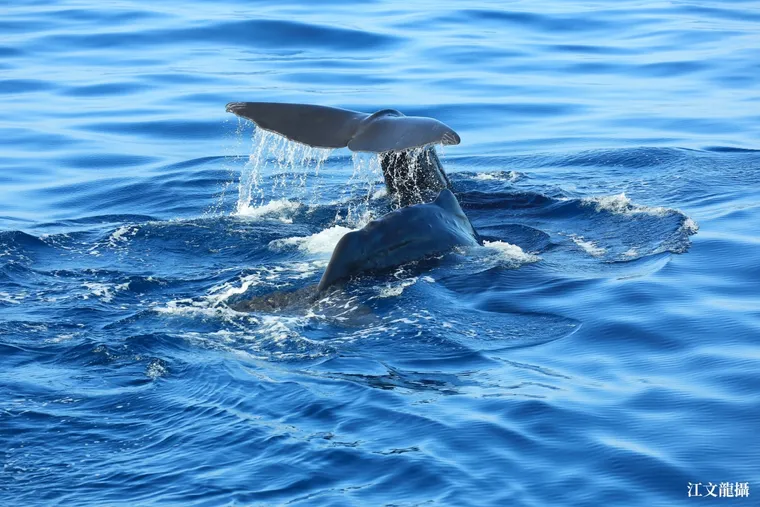
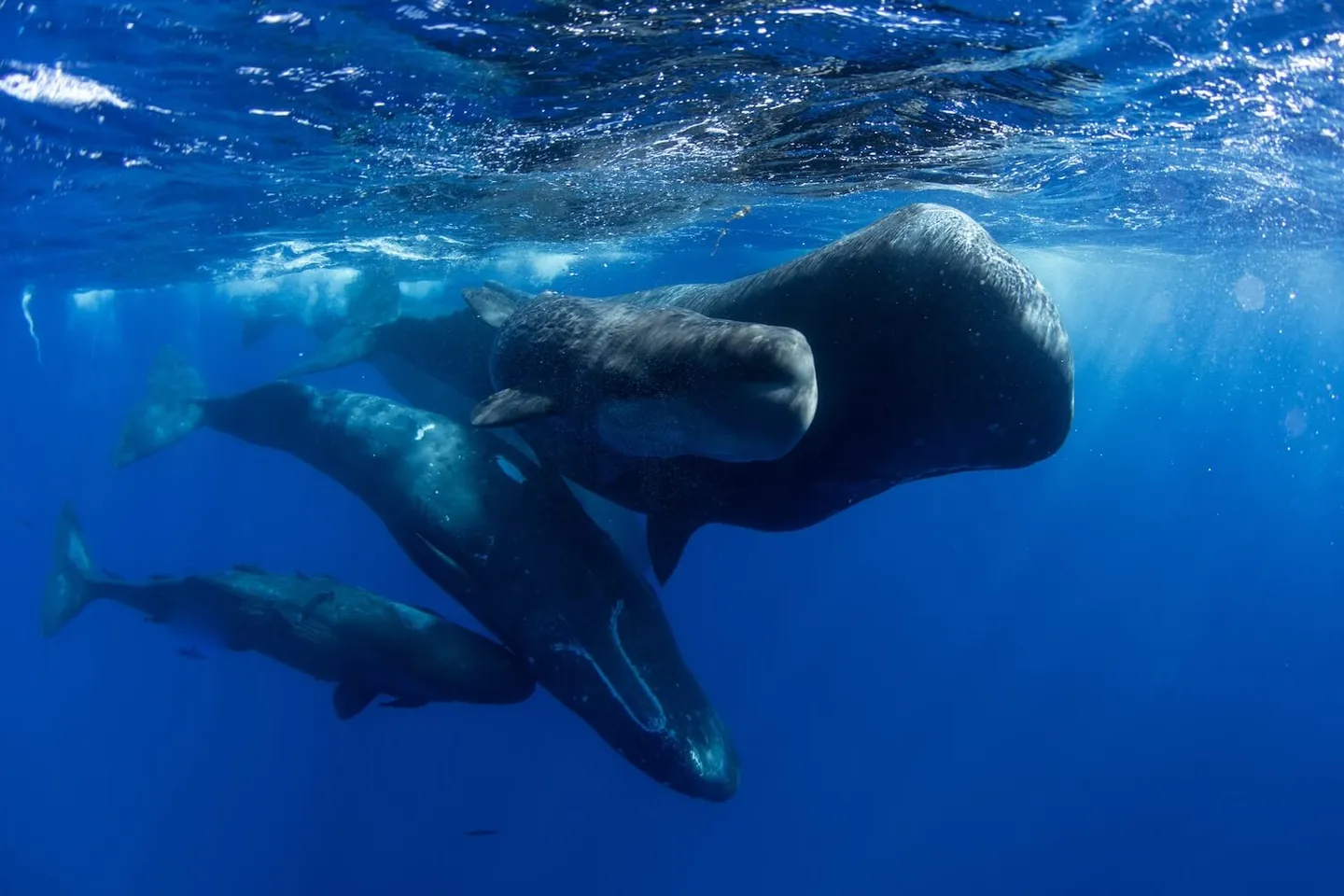
At the same time, footage of people swimming with sperm whales in Mauritius remains one of the hottest topics in the ocean community. Photos show divers slipping beneath the surface and gazing up at clusters of sperm whales, or gliding alongside them in mermaid tails. Mauritius has been dubbed a "guaranteed sperm whale destination," and many divers join photo-tour groups, flying halfway around the world just to capture a stunning shot — or to check "swimming with whales" off their bucket list.
Yet behind those group tours lie many unknowns. Once on the ground, travelers discover that it isn't only Taiwanese — visitors from all over the world take part in whale-watching and whale-swimming trips. Some tourists have even mentioned hearing that "there are no restrictions locally," leaving the information landscape thoroughly confused.
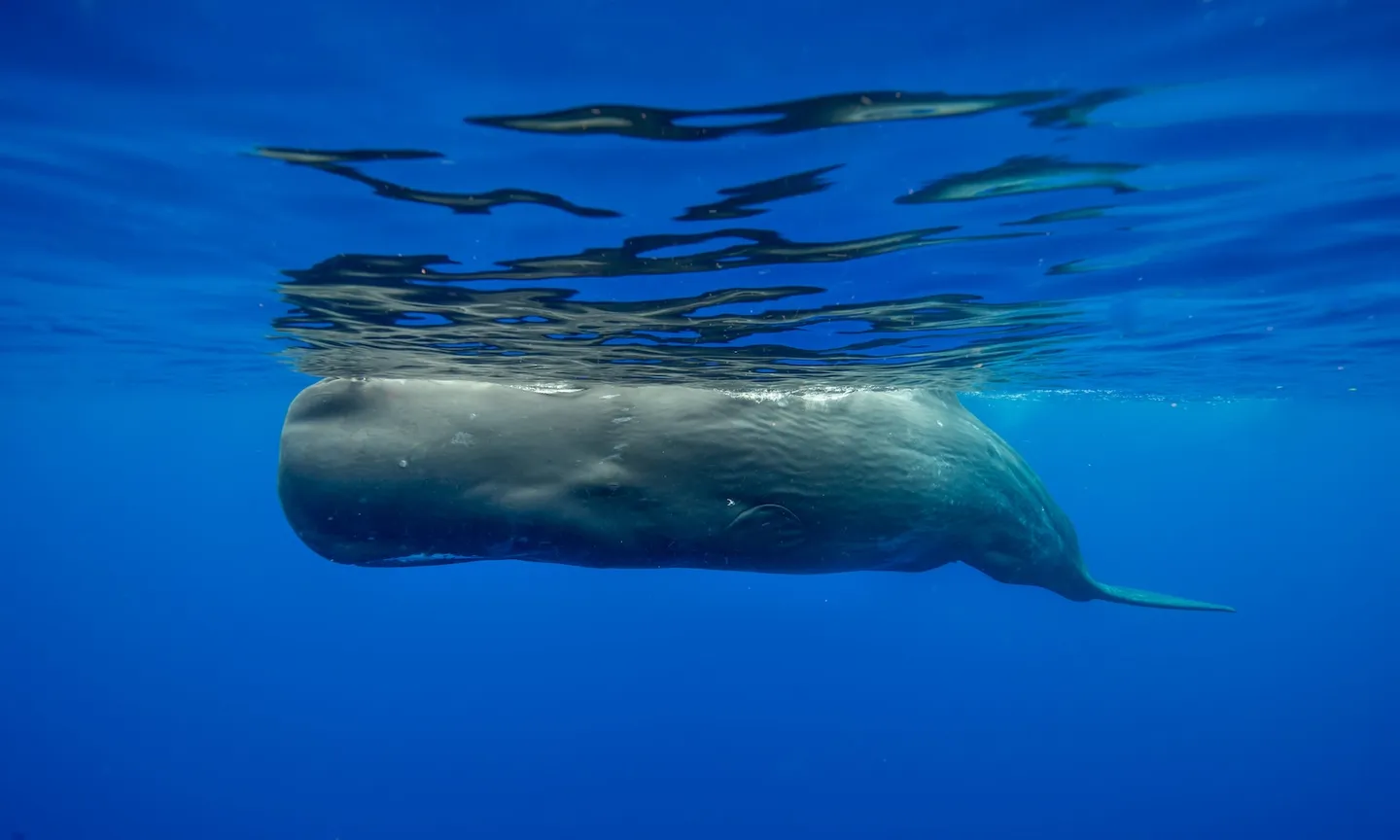
So can you actually swim with whales in Mauritius? the Editor spoke with cetacean photographer Zola — who has gone through the official permit process to photograph sperm whales in Mauritius — to share her firsthand experience and her observations from chasing whales around the world. The Editor also consulted Jin Lei, Taiwan's first cetacean photographer, to compile a broader overview of whale and dolphin photography regulations in other countries.
Where Is Mauritius?
Mauritius is located in the Indian Ocean, southeast of Africa and east of the Republic of Madagascar. Like the Maldives, it is counted among the "Three Jewels of the Indian Ocean," and its land area is roughly comparable to New Taipei City.
Other Facts About Mauritius
- Taiwanese passport holders enjoy a free visa-on-arrival valid for up to 60 days.
- Mauritius has won the "World's Best Beach" award at the World Travel Awards.
- Famous attractions include the underwater waterfall illusion and the Seven Coloured Earths.


Why Has Mauritius Become a Dream Destination for Ocean Lovers?
Are you a fan of "big animals"? The sperm whale — the largest toothed whale on the planet — is many divers' ultimate dream encounter. The sperm whales in the waters surrounding Mauritius are "resident" populations, meaning they can be spotted virtually year-round, and observers have the chance to watch them living and interacting as a group. During March and April, for instance, sperm whales are in their calf-rearing season, and the group moves at a pace suited to the slower-swimming calves.
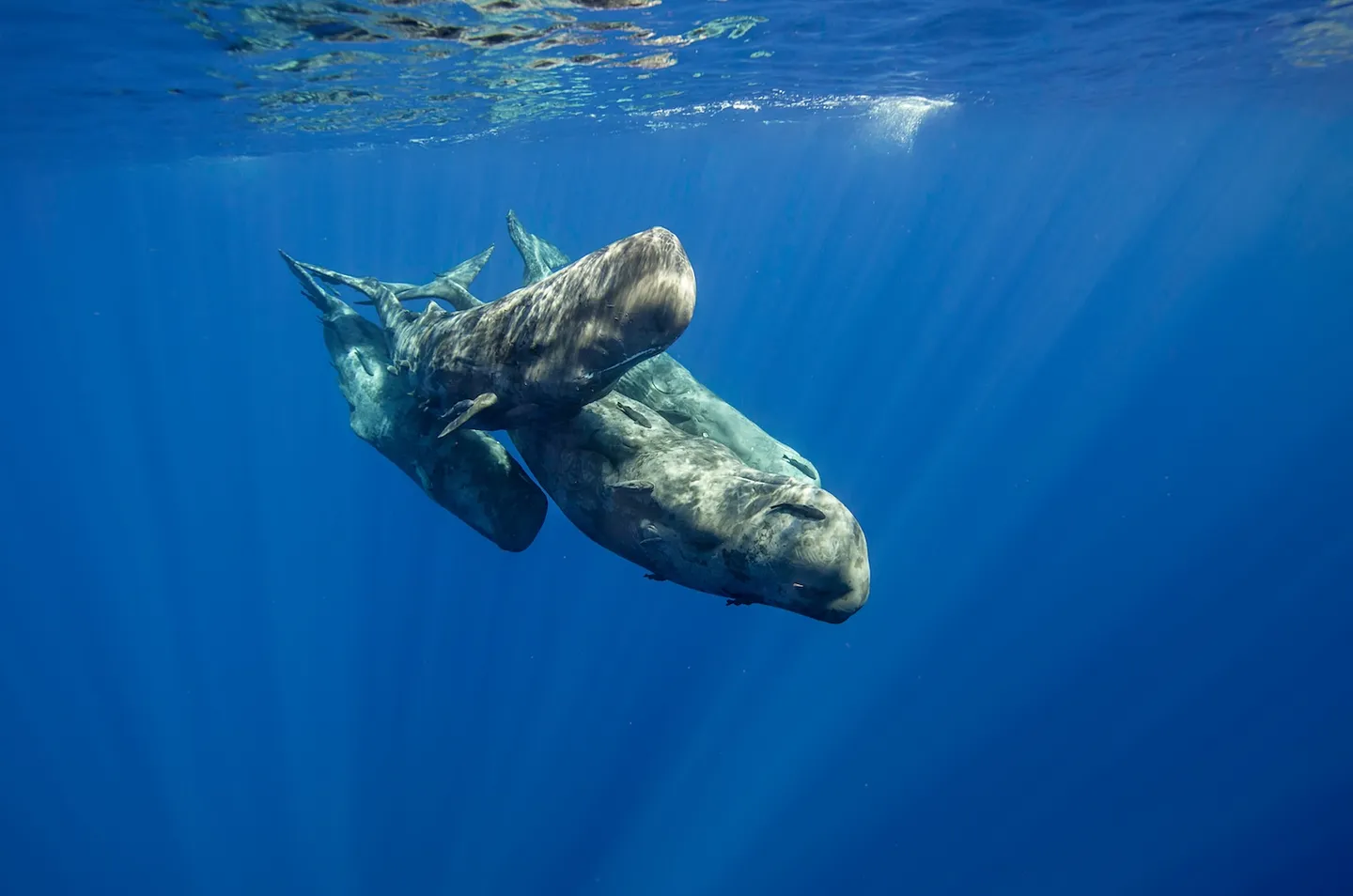
The sperm whale's body is long and cylindrical, with a head that accounts for roughly one-third of its total length. Adult males measure approximately 15–18 m in length; adult females measure approximately 9–12 m. Listed as Vulnerable (VU) on the IUCN Red List, sperm whales are long-lived and slow to reproduce. Combined with the heavy hunting they endured during the whaling era, their numbers remain low — making every sighting a treasured event for ocean enthusiasts.
Mauritius also offers a wide range of water activities, including the popular "swim with dolphins" excursion, though given space constraints this article will not focus on that topic.
Is It Legal to Swim with Whales in Mauritius?
As noted at the opening of this article, the Ministry of Foreign Affairs advisory states that "Mauritius law expressly prohibits anyone from entering the water to swim with whales." We also located the original regulation, which clearly stipulates: "no person shall swim, dive or snorkel with a whale."
How Can You Legally Swim with Whales in Mauritius?
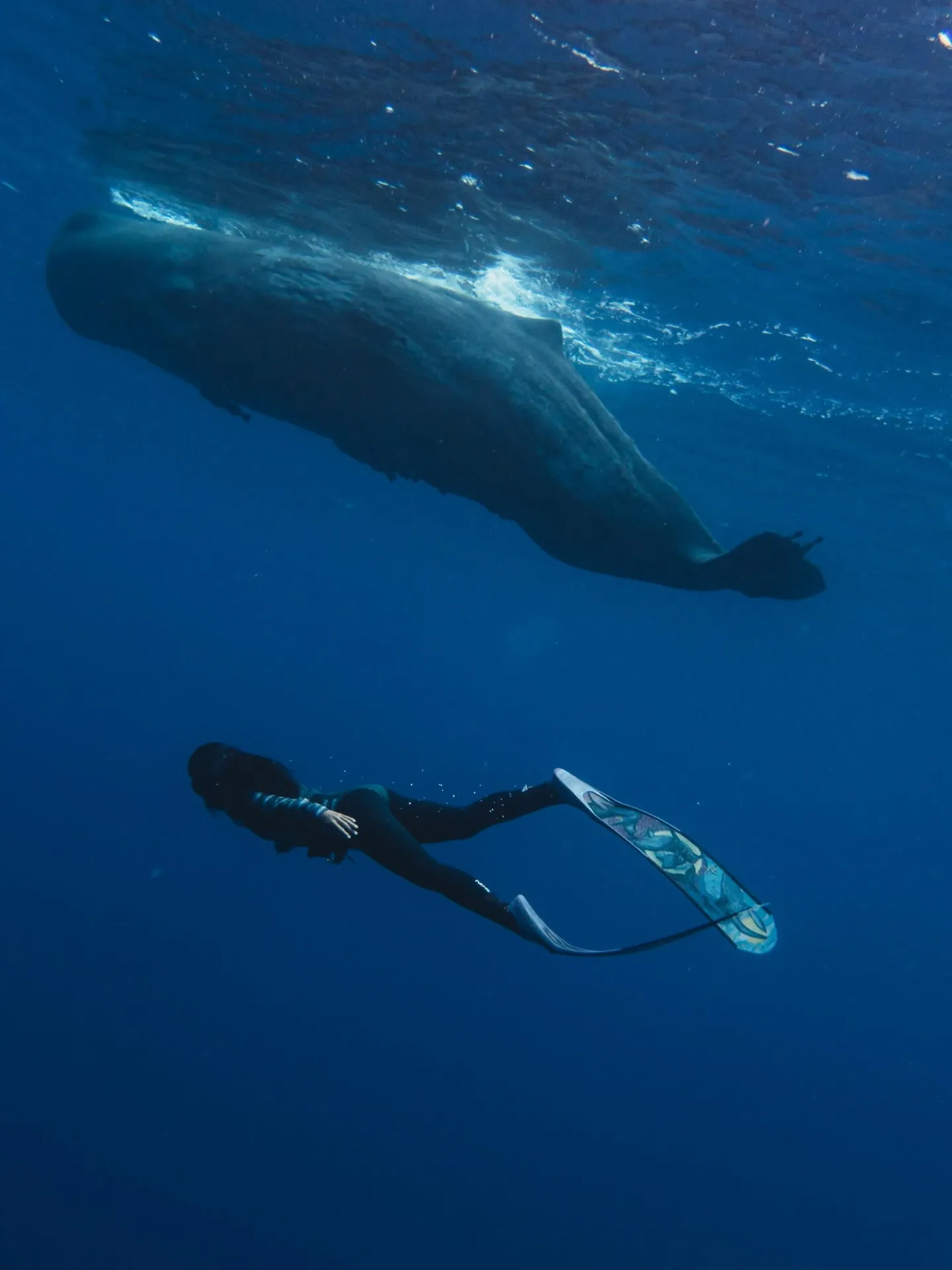
Photo by Chinh Le Duc on Unsplash
To swim with or photograph sperm whales in Mauritius, a formal application must be submitted. The Editor interviewed Taiwanese cetacean photographer Zola about her real-world experience with the process. It took Zola a full year to obtain the permit documentation, after which she still had to contact individual Mauritian government departments — such as the Tourism Authority and the Fisheries Division — one by one, declaring her intention to comply with all regulations and receiving their endorsement before she was truly considered legally qualified.
Even after approval, strict conditions apply. The Editor reviewed the permit Zola received, which ran to nearly 30 clauses. One of them reads: "The filming activity shall not include any ecotourism or commercial activity." What other rules govern the photography of cetaceans? The Editor has selected three to highlight:
- Every vessel operator and every person going out to sea must pass a vetting process. (Changes are not permitted arbitrarily — any change requires a fresh application, which is fundamentally different from the casual substitution of participants that is common in commercial group tours.)
- Before each filming session, participants must check in at the nearest fisheries station and submit GPS coordinates.
- No more than six divers or swimmers may be in the water at any one time.
Mauritius Law Is Clear — But What Is the Reality on the Ground?
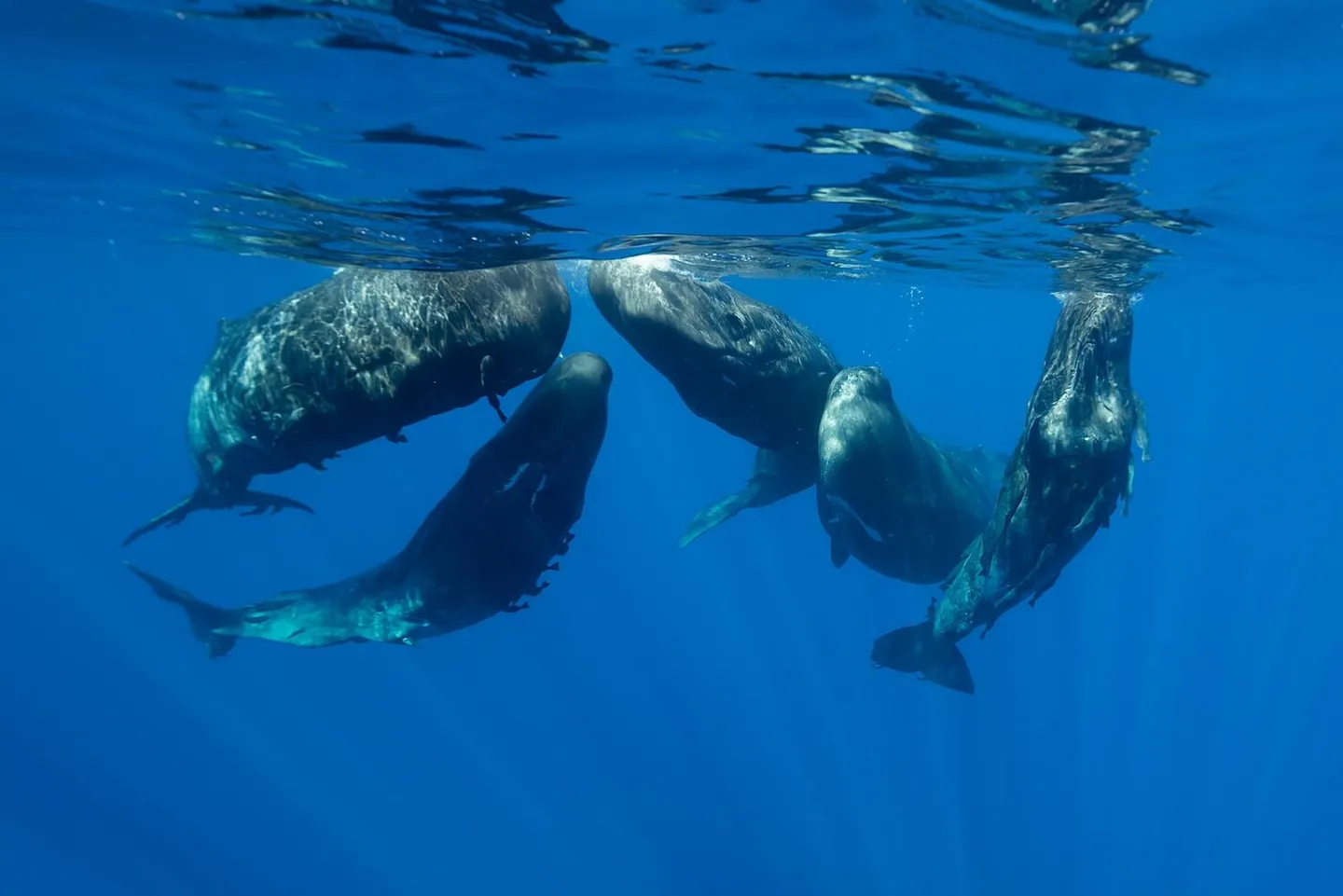
You have probably seen plenty of stunning photos of people swimming with sperm whales in Mauritius on social media — but do you think every single group of tourists went through a year-long permit application? We don't have the answer.
When laws are on the books but enforcement is lax, their deterrent effect is diminished. Local tourism and dive operators ignore the regulations and recruit paying customers, and even Taiwan-based dive trip groups — without any permits — can readily find local travel operators willing to run the trips.
Some operators do show a greater awareness of animal welfare: they provide thorough pre-trip briefings and approach the whales in a cetacean-friendly manner — keeping the boat parallel and at a distance from the sperm whales for a period of observation before quietly asking divers to enter the water and swim toward the whales at their own pace. Nevertheless, Zola noted that on one occasion, once the marine police appeared on the scene, every boat backed off to the outer perimeter and dared not approach the whales — let alone enter the water to swim alongside them. This alone suggests that the numerous "swimming tours" and "photo tours" that operate on normal days remain of questionable legality.
Beyond the issues of illegal whale swimming and photography, whale-watching vessels themselves pose a major problem through harassment of the animals. Zola witnessed two boats sandwiching a sperm whale and speeding alongside it, and scenes of dozens of vessels surrounding sperm whales — chaos that appears to be par for the course locally.
Even if local enforcement is inconsistent and you are never fined, that does not mean what you are doing is legal.
For tourists, this may feel like a dilemma. Besides Taiwanese visitors, many Western travelers also purchase ocean excursions advertised as legal and permitting in-water encounters — happily joining group trips to approach sperm whales without ever realising there may be a legal issue.
Truly protecting sperm whales will require the Mauritian government to enforce its laws consistently, impose meaningful penalties, and communicate the prohibition against swimming with whales clearly and visibly — eliminating the grey area — rather than simply hoping that visitors will self-regulate based on their own conscience.
The Mauritius Photo-Tour Controversy Travels Home
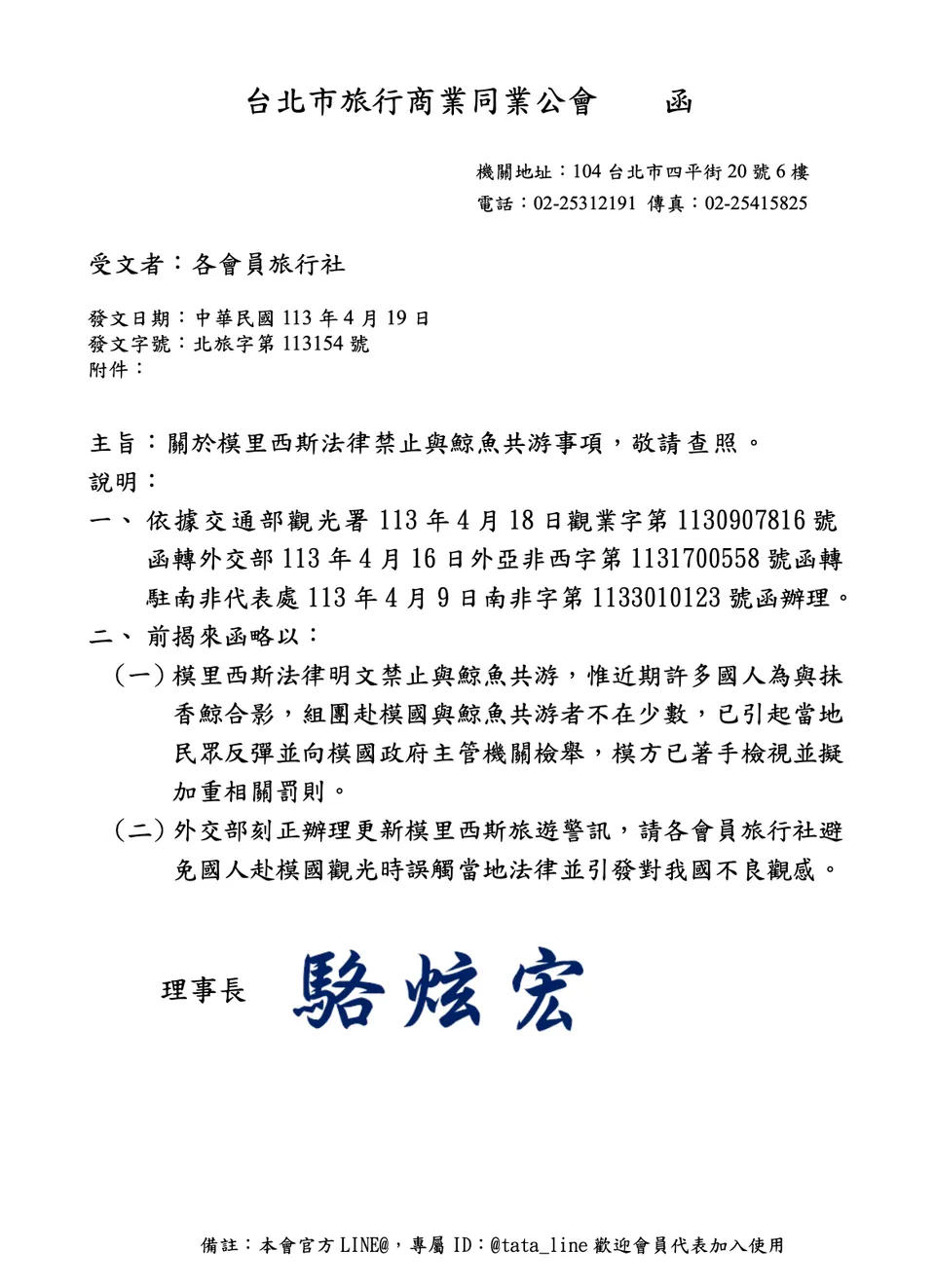
The chaotic flouting of Mauritius's local laws drew a backlash from local residents, who filed complaints with the relevant Mauritian authorities. In response, Taiwan's Ministry of Foreign Affairs issued its travel advisory, and the Tourism Administration under the Ministry of Transport and Communications sent a notice to travel industry associations, asking them to pass the information on to their member agencies and urging them to "avoid breaking the law and creating a negative impression of Taiwan."
Beyond Mauritius: How Do Other Countries Regulate Whale Encounters?
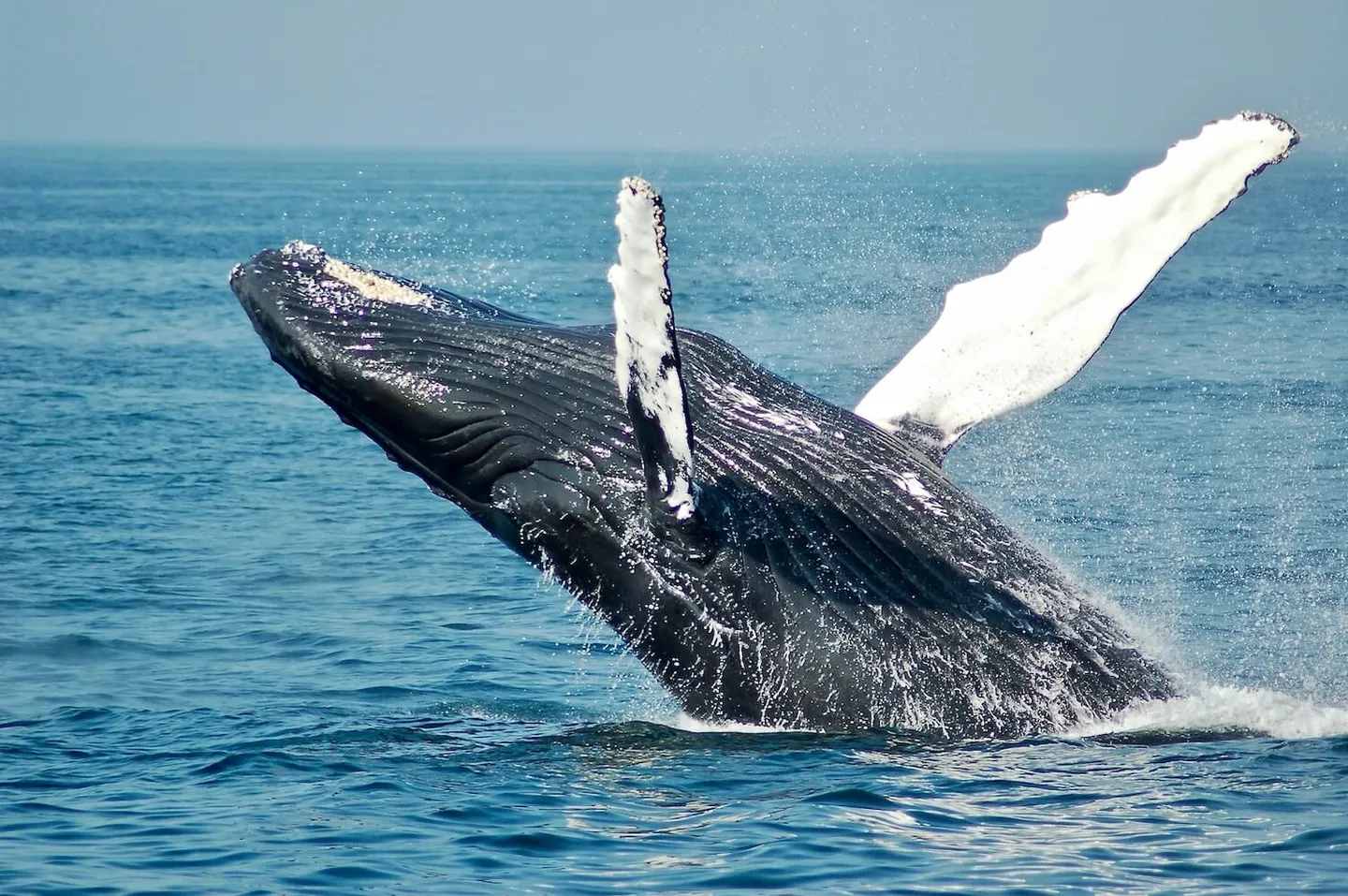
Photo by Todd Cravens on Unsplash
If you too dream of chasing big animals and are willing to travel the world in pursuit of cetaceans, here is what the Editor has compiled from Jin Lei's whale-chasing experience regarding regulations in the Kingdom of Tonga and Japan — two destinations generating the most discussion recently.
Kingdom of Tonga
Tonga has strict legislative provisions in place. At the most basic level, sighting a mother-and-calf pair triggers an absolute rule: no diving is permitted. In other circumstances, decisions are largely left to the captain and dive guide.
Furthermore, regardless of whether a single humpback whale or an entire group is sighted, only one boat may approach at a time, and a maximum of four people may be in the water simultaneously. If other boats also wish to approach the same group, they must queue. Most boat operators, upon spotting a vessel near animals, will proactively take a different route — a sign that respect for the animals is deeply internalised among local operators.
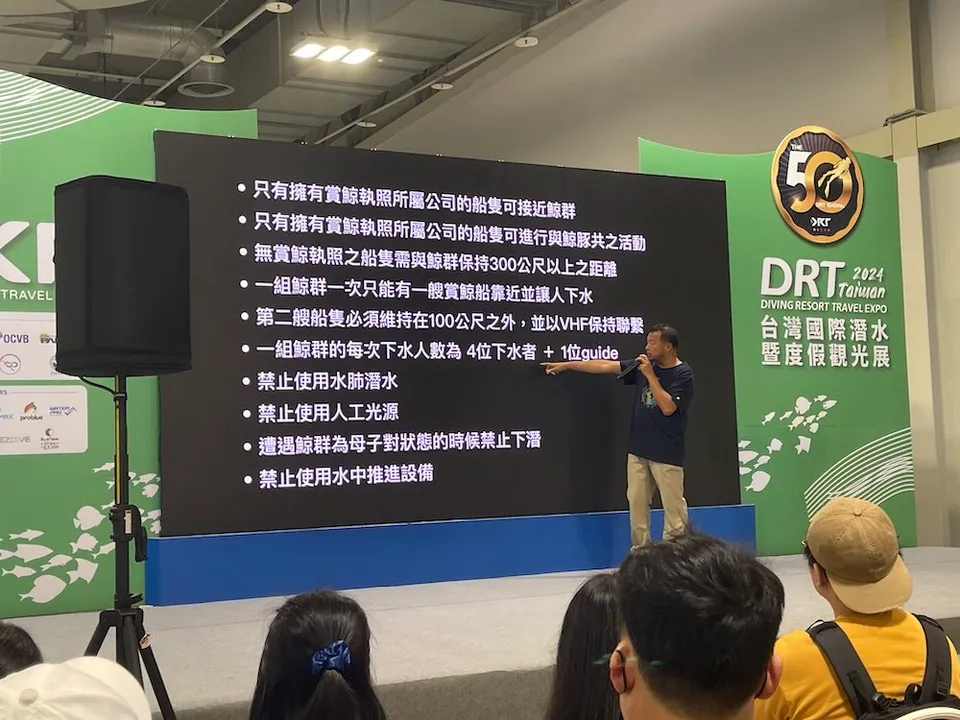
Jin Lei sharing whale-watching regulations from around the world at the DRT Show
Jin Lei also relayed a message from local whale-watching operator and boat captain Aunofo Havea: "Humpback whales aren't just cherished — like every Tongan, they are a part of Tonga. This is a breeding ground, a place for new life to be born and to rest in safety."
"The most important thing about people's interactions with humpback whales isn't photography — it's respecting all of the Tongan government's regulations and approaching humpback whales in the most appropriate and respectful way possible."
Amami Ōshima, Japan
There is currently no national-level legislation in place. Regulations are governed primarily by the self-imposed code of conduct of the local Amami Whale and Dolphin Association. Examples of these guidelines include:
- Approaching a mother-and-calf group by swimming is limited to three times per encounter.
- No more than eight people may enter the water at the same time.
- Snorkeling is permitted; scuba diving and freediving are prohibited.
- Long fins (freediving) and selfie sticks are prohibited.
- Approach cetaceans slowly from behind without impeding their natural movement.
- Do not surround cetaceans with multiple vessels.
- If cetaceans begin avoiding the vessel, cease observation immediately.
- Do not produce artificial sounds in the water that imitate cetaceans.
- Do not drive whales into inner bays, reef areas, or other spaces that restrict their freedom of movement.
Okinawa, Japan
There is currently no national-level legislation in place. Regulations are governed primarily by the self-imposed code of conduct of the Zamami Village Whale Watching Association, covering the waters within 10 nautical miles of Zamami Village and its various islands, and applying to baleen whales and sperm whales. Examples of these guidelines include:
- Within 300 m of a target whale is a reduced-speed zone. Approach slowly and do not obstruct the whale.
- Within 100 m of a target whale is a restricted zone. Sharp turns are prohibited; if a whale approaches, the vessel must stop until it has left the restricted zone.
- Observation of a single whale or whale group is limited to two hours.
- Observation of a mother-and-calf pair is limited to one hour in the morning and one hour in the afternoon.
- Entering the water is prohibited throughout the regulated waters; producing artificial sounds that imitate cetaceans is also prohibited.
- If a non-commercial purpose such as education or research requires contact with whales and compliance with the above guidelines is not possible, prior approval from the Association must be obtained.
Controversy surrounding Mauritius sperm whale photo tours is far from the only issue. Recently, incidents of Taiwanese divers diving down to chase whales in Okinawa, Japan, have drawn the attention of local associations and created a negative impression of Taiwanese groups. One Japanese operator who witnessed the whale-chasing behaviour wrote: "It looked as though the whale was fleeing from people pursuing it. Is watching a whale run away like that truly a moving experience?" Those who love the ocean and love cetaceans should also be responsible, nature-respecting ocean-goers.
Note: All images in this article are sourced from stock photo libraries and do not depict any of the individuals mentioned in the text.
Related Links
- 【Exploring Taiwan】Let's Go Whale Watching! A Friendly Whale-Watching Guide - Kindom Living
- Friendly Whale Watching - Ocean Conservation Administration, Ocean Affairs Council
- Ministry of Foreign Affairs Orange Alert (Issued: 2024/4/15)
- Interview subject: Jin Lei
- Interview subject: photo credit Zola Studio 左拉影像工作室
Further Reading