Contents(4)
The Editor says: Cave diving has always been one of the biggest temptations pulling recreational divers down the rabbit hole into technical diving. The complex, seemingly bottomless cave systems of Cancún, Mexico — threaded with cold underground rivers and governed by a completely different set of technical diving principles — never fail to draw cave diving enthusiasts from every corner of the globe. Yet the common assumption is that travelling all the way from East Asia to Central and South America for diving must cost a fortune. This article is adapted from the personal Facebook page of Coach Ryan Chan, a member of the technical diving group 百鬼夜行 TEK Dive Team, in the hope that it gives everyone the courage to take on the secrets hidden beneath the earth!
What Does a Cave Diving Course in Cancún, Mexico Cost?
A cost breakdown for a 2019 self-organised, three-person group taking TDI Cavern / Intro to Cave / Full Cave courses in Playa del Carmen or Tulum, Mexico — three courses, three people, worked to the bone. Long read ahead, but please feel free to share and circulate widely to recruit your own group; no need to notify me first.
Let me get straight to the number everyone cares about most. Return flights from Taiwan to Cancún, Mexico, local transportation, three meals a day, accommodation, and tuition (course materials, theory, practical sessions, gas fills, and cave entry fees) all add up to just over NT$90,000 — call it NT$100,000 flat. That's roughly RMB 22,000 or HK$25,000. I'll include a full breakdown with screenshots at the end of the article.
I'm aware that plenty of people out there are trying to organise group tours to make a tidy profit, but honestly, going DIY is still your best option. So where does that extra money beyond NT$100,000 actually go? Most likely some combination of the following:
- The tour organiser's accommodation and meals
- The tour organiser's diving costs
- The tour organiser's local transport and even airfare
- The tour organiser's coordination or translation fees
- The tour organiser's profit margin
I imagine each operator charges differently, but in my opinion, for Mexican cave diving you simply don't need to pay for any of these extras.
Sure, I know that service has a price — but based on my own experience in Mexico (having taken the same courses three times), as long as one person in your group speaks English, a Taiwanese tour organiser adds essentially zero value. A DIY cave diving trip to Mexico is not difficult at all. Choose the right accommodation and everything you need is within easy reach: supermarkets, the beach, restaurants, and a laundromat are all at most a 15-minute walk away. Rooms typically come with an electric stovetop and a toaster so you can cook simple meals yourself. Day-to-day life really doesn't require someone to hold your hand. There are also plenty of restaurants at various price points within walking distance of the hotel (everything except Chinese food, sadly).


During the Training
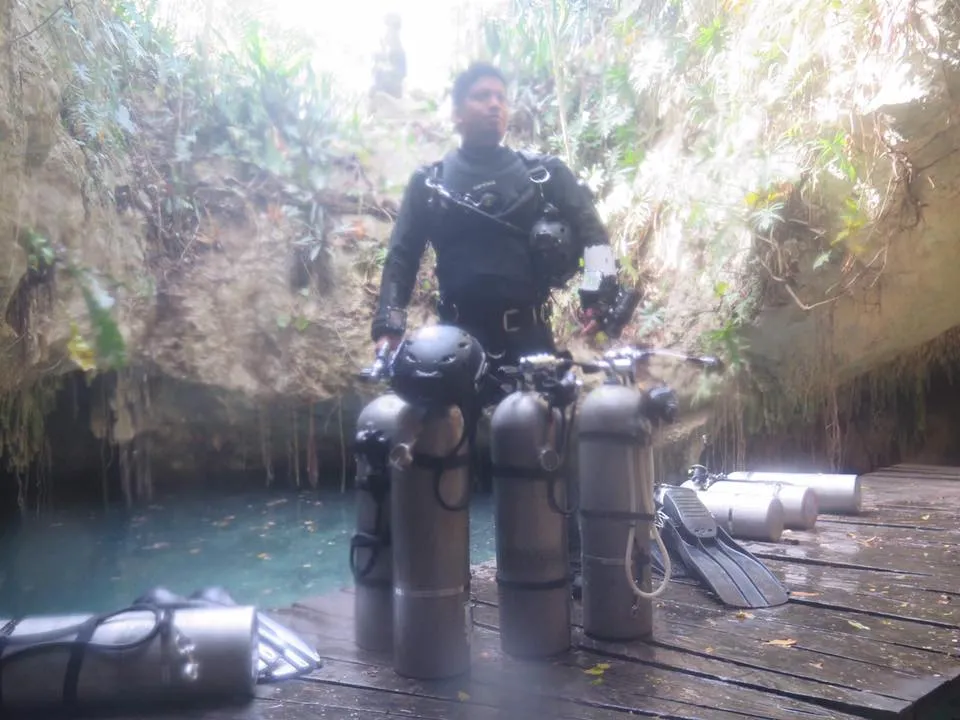
Don't assume that the guide who brings you along is there to keep you safe — the person who actually keeps you safe is the local instructor training you. Even if your group leader holds a cave instructor rating, you still cannot enter the cave without a locally recognised instructor leading you. And frankly, a cave instructor who logs fewer than five dives a year — I genuinely cannot think of what value they add in terms of experience or safety.
The only people permitted to enter the caves and lead others inside are locally recognised instructors. What's more, many group-tour leaders aren't even cave instructors themselves. If the person leading your group is also an inexperienced cave diver, you have the added risk of someone else potentially getting into trouble in the cave, forcing your actual instructor to divert attention to them. All that talk of "helping you get great photos" and "translating for you" is honestly nonsense (a way to take your money) — it's not worth the extra fees they charge. So for a well-documented destination like Mexican caves, rather than paying a Taiwanese organiser to come along for a free diving holiday, you'd be far better off giving that money to your local dive guide or instructor as a tip. Of course, if you're wealthy and enjoy treating people to meals, diving, and hotel stays, that's an entirely different matter. When I took friends to do courses, we split everything equally (AA system), and I served as the translator.
A three-person private group for a cave course is just about perfect, but you just need one person who speaks English and everything falls into place. Even for a group of 15, one translator is enough — don't worry about whether there are enough instructors; they'll call on each other for backup.
Local Accommodation and Food
When choosing where to stay, there are really just a few key criteria: a convenient location, a reasonable price, and decent facilities. Get those right and you'll save a lot, because if everything you need is within walking distance, you can completely eliminate local transport costs. A room with a stovetop, a toaster, and a water dispenser means breakfast and the first few dinners can be incredibly cheap. This isn't about being stingy — trust me: in the first few days, when jet lag is brutal and your instructor has been running you ragged for 10–12 hours starting at 8:00 AM, all you'll want to do when you get back to the hotel is pass out. Finishing a shower before you collapse into bed will feel like a superpower. On those first few nights, the three of us could barely finish the instant noodles we'd cooked in the room — typically one of us would already be snoring before the water had even come to a boil. For breakfast, walk to the nearby supermarket and stock up on bread, ham, eggs, and instant noodles for several days. And yes — Mexican supermarkets do carry Asian instant noodles.
Every morning at 7:45 AM your instructor will pick you up and take you to the cave for intensive practice and lessons. The standard rate is calculated on a full group of three: US$200–350 per person per day, depending on the instructor's pricing. That said, cheaper doesn't mean less skilled, and I wouldn't recommend going straight to the highest-tier (most expensive) instructor either — without a foundation in cave diving knowledge and technique, even the most expensive instructor can't transmit the essence of the discipline to you all at once, and you won't necessarily be able to execute or absorb it anyway. You don't need an Ivy League PhD professor to teach a middle-school class, if you know what I mean.
Choosing the right instructor still matters enormously. My instructor sits in the US$200–300 mid-range bracket — with a full group of three, that works out to US$210 per person per day. More importantly, they are well-known in the global cave diving community, and that matters. If your instructor isn't recognised in the community, when you later approach another instructor for a course or a fun dive, even with your certification you may end up spending your entire first day on a boring check dive. Cave diving instructors who don't know you will almost always ask in their first few exchanges who trained you — and that one answer shapes how you're treated from then on. I was asked exactly this question when consulting with a prominent European instructor about an advanced confined-space course. Fortunately, they knew my instructor. (My instructor is also very good-looking, for what it's worth.)
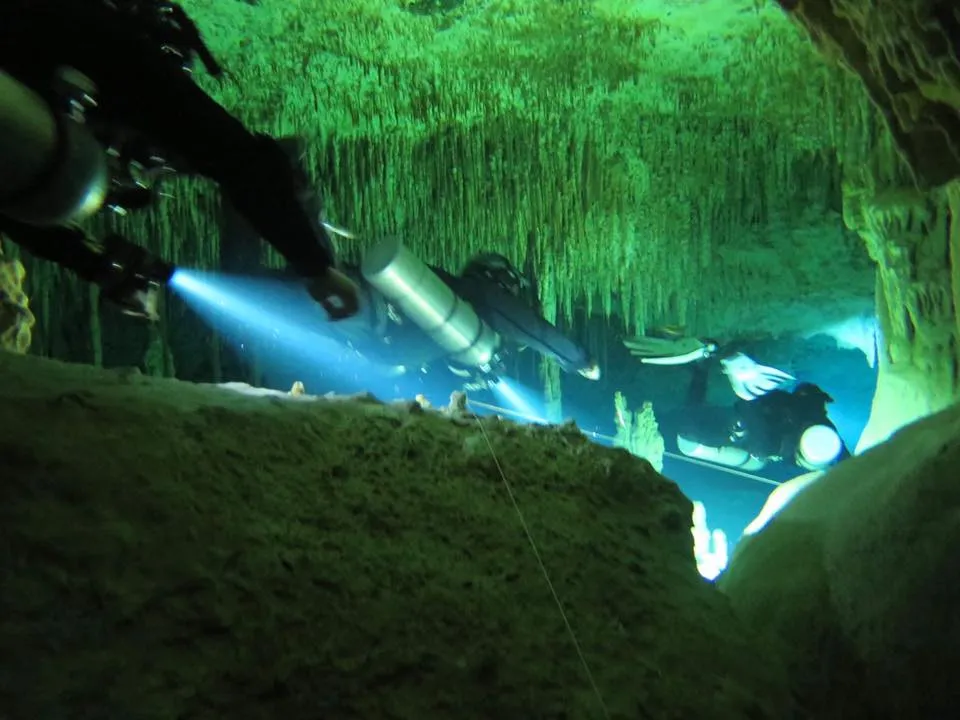
Now Let's Crunch the Numbers
The total trip expenses break down into the following categories:
- Return airfare
- Return transfers between Cancún airport and Playa del Carmen
- Cave diving course fees
- Three meals a day for eight days
- Seven nights of accommodation
- Cave entry fees
- Local transportation
Here's the itemised breakdown:
- Searching online now, return flights to Cancún in early November run approximately NT$32,500. See screenshot.
- One-way transfer: US$60; two ways: US$120 + US$10 tip each way / 3 people = NT$1,450
- Course fee at a full group of three: US$210 per person per day × 7 days = US$1,470 ≈ NT$45,400
- Budgeting roughly 200 pesos per meal, 600 pesos per day × 8 days = 4,800 pesos ≈ NT$7,800 (conservative estimate — remember breakfast is from the supermarket, and on the first few evenings you probably won't have the energy to eat dinner; lunch is typically a sandwich eaten in the cave site car park during the theory session)
- The hotel I stayed at last time: 8 days / 7 nights came to approximately NT$16,7xx; one room with three beds = NT$16,7xx / 3 people ≈ NT$5,570. See screenshot.
- Cave entry is roughly 200–250 pesos per person per practice session; instructors enter free. Calculating at 250 pesos × 8 days = 2,000 pesos ≈ NT$3,300
- If you pick the right hotel location, local urban transport costs zero — everything you need is within a 15-minute walk. Like the place I stayed.
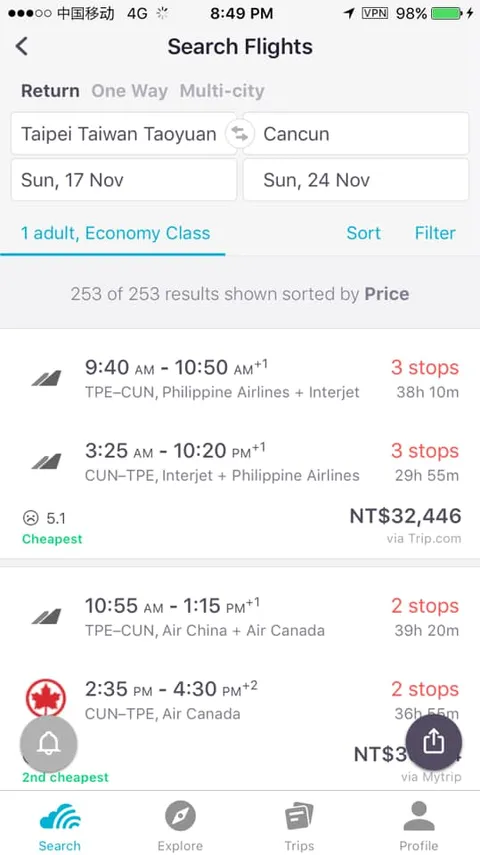
Airfare estimate
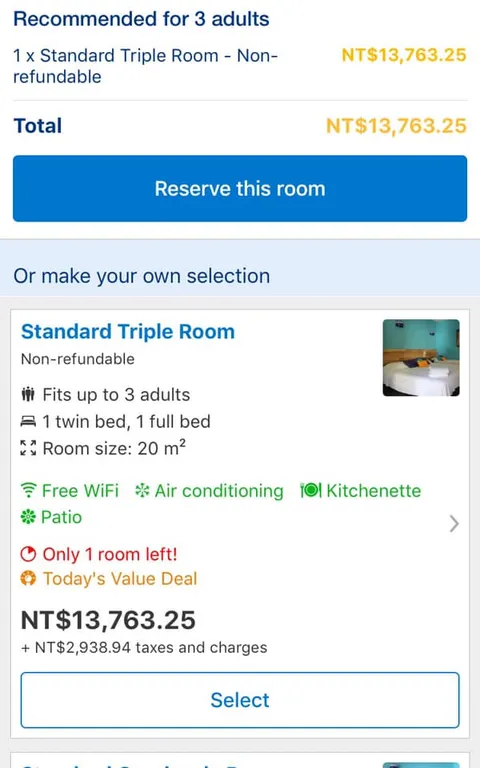
Accommodation estimate
Time for the maths: NT$32,500 + NT$1,450 + NT$45,400 + NT$7,800 + NT$5,570 + NT$3,300 = NT$96,020 = RMB 21,100 = HK$24,400.
One more thing worth mentioning: make the most of your cave instructor. For onshore excursions — visiting Maya ruins, for instance — your cave instructor will know local operators and can make referrals, and prices arranged through them will be more reasonable than anything a Taiwanese tour organiser quotes you. On the diving side, beyond cave diving, the Playa del Carmen / Cancún area offers other great dive options: the underwater museum, Bull Shark dive trips, Cozumel, and more. Your instructor can usually arrange these too — the only thing they probably can't book is a tee time at a golf course. Ha!
All of this planning and preparation takes about an hour and a half of focused effort, can save you a meaningful amount of money, and leaves you in complete control. Why wouldn't you?
If you'd like details on accommodation and food, want me to recommend an instructor (I know plenty), or have questions about nearby dive sites, land tours, private transfers, what to buy, where to go after class, or anything else about the Cancún – Playa del Carmen – Tulum area in Mexico, feel free to ask — don't be shy.
Wishing everyone a fantastic trip — and don't let yourself get ripped off!
Cover photo credit: Photo by Bruno van der Kraan on Unsplash
Related links:
Frequently Asked Questions
How is a BlueTrend dive trip different from an unknown, no-name dive group?
Choosing us means full peace-of-mind protection and a smooth experience from start to finish. Every trip we run holds to three things.
First, full legal protection and a professional dive leader: we strictly follow Taiwan's travel regulations and provide complete travel-agency liability insurance, travel insurance, trip-inconvenience insurance and dive insurance. Every group is accompanied by a certified, foreign-language dive leader who joins you on both the dives and the land itinerary, liaising seamlessly with local dive shops and operators on your behalf to keep things running smoothly — the person our travellers trust most.
Second, fully licensed with secure payments: every payment goes into a licensed travel agency's account, with multiple safe payment channels (bank transfer, credit card and more) and a legal collect-and-remit receipt, so every transaction is open, transparent and protected, avoiding the fraud and dispute risks of transferring money privately to an individual.
Third, hand-picked quality we vet in person: every trip, dive site and partner shop is scouted on the ground by our own team, from the guides' professionalism and safety standards to the food, lodging, environment and service details on land, all vetted by us so you don't get caught out.
I want to sign up for a dive trip. Are there certification-level or logged-dive requirements?
Each dive site is different, so the entry bar varies. 'Bali Tulamben', for instance, is relatively beginner-friendly. 'Malapascua in the Philippines' is also beginner-friendly, but since thresher sharks tend to cruise between 20 and 30 metres, we recommend AOW certification with 20+ logged dives to enjoy this trip comfortably. For 'the Maldives' or 'Palau', we suggest AOW with 50+ logged dives for a more relaxed experience. If you're not sure whether your experience fits the trip you want, message us and our dive editors will assess it and help you find the trip you'll feel safest on.
Can I join if I'm signing up alone? How are rooms arranged?
Plenty of our travellers sign up solo! For rooms and beds, we prioritise pairing you with a same-gender traveller, and if you'd rather have your own space you can pay the difference to upgrade to a single room. For the diving, our professional leader will pair you with a suitable buddy, and with the happy vibe on our trips you'll quickly make a great group of dive friends. Many people sign up alone, make new friends, and end up organising the next trip together!
Does the trip fee include dive insurance, gear rental, taxes and instructor tips?
It depends on the trip, the destination's regulations and the local operators. Every BlueTrend dive trip has a detailed web page with a clear 'included / not included' list, transparent and with no hidden charges. All payments are collected by a licensed travel agency, with a standard-form contract for your protection.
I'm a new diver / haven't dived in a long time — will I fall behind the group?
Before you complete your booking, our team assesses a suitable trip based on your certification level and experience. Before departure, we strongly recommend taking time to refresh in Taiwan with an instructor, or a fun dive to get your feel back. On the trip itself, our professional dive leader groups and pairs everyone by experience, keeps a close eye underwater on travellers who need extra care, and steps in to help right away.
Will the photos and videos taken during the trip be shared with us?
During the dives, 'safety' is always the leader's top priority, so whenever it's suitable and safe the leader will capture great shots and record the best moments. During or after the trip, we compile a cloud album for all travellers to download, so you go home loaded with memories!
Besides your scheduled trips, can you arrange a private group charter or independent travel for me and my friends?
Absolutely! Besides group trips, we also arrange private group charters and independent travel. We can communicate, enquire and coordinate services with local operators based on your needs, saving you time and effort and taking the language barrier off your plate, to tailor the smoothest, most reassuring dive trip just for you. Contact our LINE support and our editors will arrange it for you!