

Contents(4)
With extensive media coverage in recent years, the issue of microplastics has appeared frequently before the public eye. Below are several reports on microplastics for readers who are new to the topic, providing a general overview to get you started.
This major ocean issue affecting all of humanity has prompted countries around the world to take steps to reduce the sources of marine microplastics. In Taiwan, perhaps the most tangible measure for the general public was the 2018 ban on microbeads in personal care products, since the vast majority of microbeads in Taiwan are made of polyethylene (polyethylene). These tiny beads, marketed by manufacturers as aids for facial and dental cleansing, have been proven to be a direct source of microplastics in the ocean. Of course, another major source of microplastics is the everyday plastic products we all use — including plastic bags, PET bottles, and cigarette butts. These items end up in the ocean for various reasons and, battered by waves and exposed to sunlight, gradually break apart into the protagonists of this article: microplastics.
In this article, we are delighted to have interviewed Yu Xing-Pei from the Institute of Ecology and Evolutionary Biology at National Taiwan University (supervised by Dr. Kuo-Chin Chen, a researcher at the Biodiversity Research Center of Academia Sinica). In a recent research paper, she used the rigorous tools of scientific inquiry to help us understand what unexpected effects there might be on us when the filter-feeding species at the very bottom of the marine food chain are filled with microplastics.
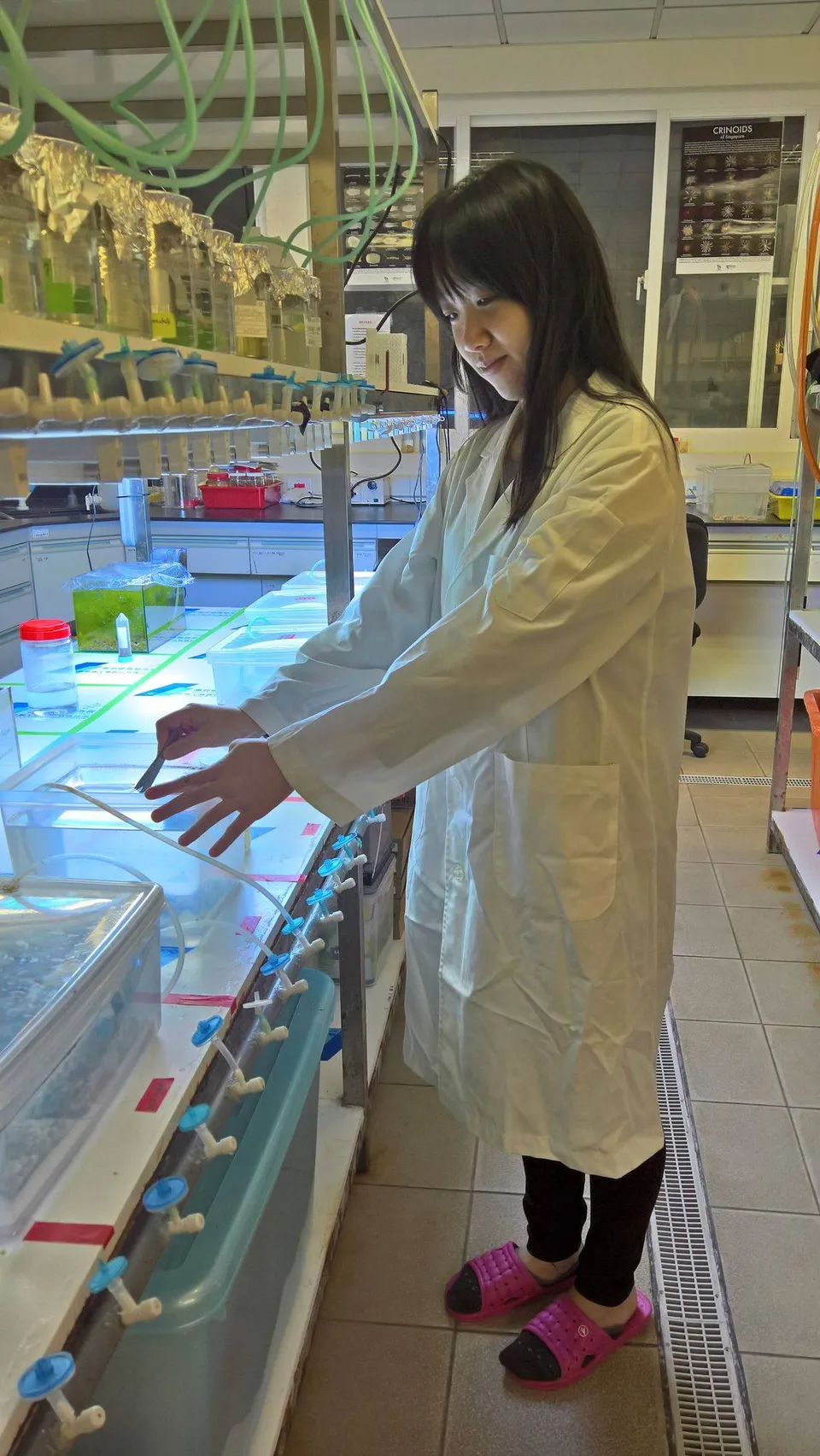
Yu Xing-Pei has published multiple papers on microplastics
Yu Xing-Pei has loved marine life since childhood. She happened to have the opportunity to visit Hokkaido, Japan, where a local research institution was studying microplastics — and so she decided to make microplastics the subject of her graduate thesis. At the time, most other research papers focused on the impact of microplastics from facial cleanser microbeads, but studies specifically examining the concrete effects of these microplastics on marine organisms were relatively scarce. It just so happened that her thesis supervisor specialized in barnacle research, so she zeroed in on barnacles — bottom-dwelling filter feeders — to investigate how microplastics affected them.
The Star of the Microplastics Study: The Barnacle
Barnacles (Superorder Thoracica) are often called "Buddha's hands" (佛手) in Taiwanese, and many people assume they are shellfish — but they are in fact crustaceans through and through. Some cling tightly to intertidal reef flats, while others attach themselves to driftwood floating on the ocean surface. As adults, they have no ability to move, and they feed by using their feathery appendages (cirri) to sweep plankton from the passing water. Common barnacle species in Taiwan include Capitulum mitella, Pollicipes, Chthamalus, and others. Barnacles occupy the bottom tier of the ecosystem, and certain species have evolved specialized biological structures specifically adapted to prey on them.
For this study, Yu Xing-Pei used the striped barnacle (Amphibalanus amphitrite) — sometimes called the "lab mouse" of the barnacle world — as her experimental subject. Conventional experiments feeding microplastics to organisms typically involve administering high concentrations of microplastics over just one or two days, which fails to accurately reflect real-world conditions in the ocean. Yu Xing-Pei therefore extended her experimental timeframe across two generations: she collected adult barnacles, allowed them to release larvae, and then continuously fed those larvae microplastics at concentrations matching those found in actual marine environments, all the way through to adulthood and into the production of their offspring.
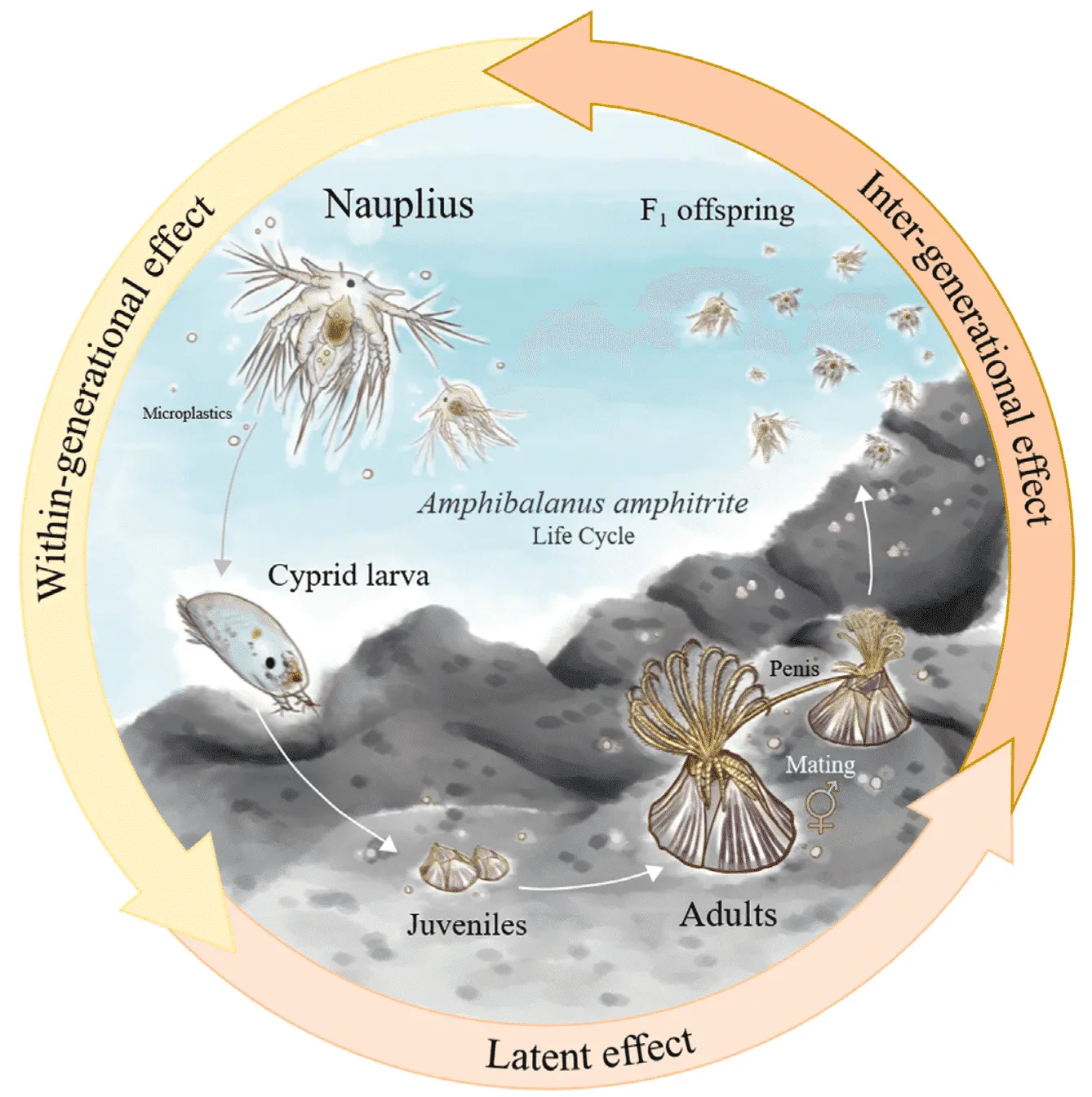
For this barnacle study, Yu Xing-Pei extended the timeframe across two generations
In order to faithfully replicate microplastic concentrations found in real-world environments, she fed barnacles four different sizes of microplastics and observed how these accumulated within their bodies over time. Once the research was underway, Yu Xing-Pei admitted to feeling a little disappointed at first. She had originally assumed that larval individuals would be more vulnerable and show some kind of response to the microplastics — but the baby barnacles grew up perfectly healthy, with absolutely no discernible effects! She also shared an interesting fact: barnacle larvae actually drift through the water in a planktonic state, and only after growing to a certain size do they settle on a reef flat, gradually developing a shell and anchoring themselves there for the rest of their lives.
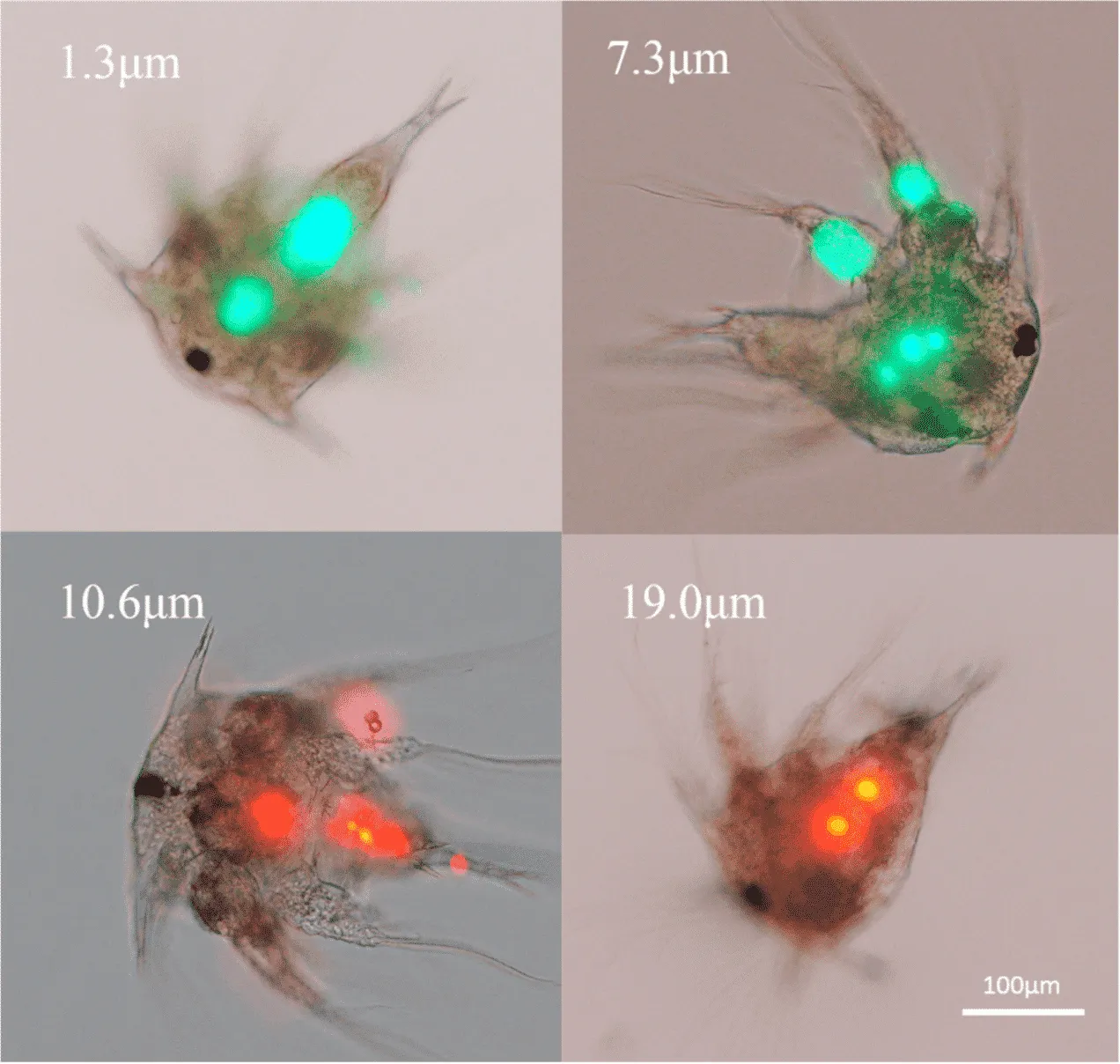
Microplastics of different sizes inside barnacle larvae
The conclusion drawn from this part of the research — without accounting for toxic substances adsorbed onto the microplastics — was that microplastics at current environmental concentrations may not cause observable harm to individual organisms.
Just as the results were leaving the team feeling somewhat deflated, however, the story took a dramatic turn. Yu Xing-Pei discovered that the offspring of barnacles fed microplastics had higher mortality rates — and the smaller the microplastics the parent had consumed, the higher the offspring mortality, in some cases more than 3 times that of the control group that had not been fed microplastics. To account for this striking phenomenon, Yu Xing-Pei reviewed relevant domestic and international literature and hypothesized that after ingesting microplastics, the body may engage in a natural trade-off, diverting precious energy toward expelling the microplastics or generating inflammatory molecular responses — thereby reducing the quality of offspring produced and causing elevated offspring mortality rates. As mentioned above, barnacles occupy the bottom tier of their ecosystem, so if barnacle populations in a given area were to decline sharply due to microplastics, the ripple effects through the interconnected food chain would inevitably cause the entire local ecosystem to collapse.


The Harm Caused by Microplastics After Adsorbing Seawater Contaminants
Numerous experiments have already demonstrated that microplastics adsorb a wide variety of human-made carcinogens from seawater, including bisphenol A (BPA) and polychlorinated biphenyls (PCBs) — environmental toxins that everyone goes out of their way to avoid, as they are linked to chronic diseases, infertility, hormone disruption, and even cancer. If bottom-dwelling filter feeders like barnacles ingest microplastics that have adsorbed these environmental toxins, the toxins may then diffuse into their bodies through concentration gradients (since internal toxin levels are lower, the toxins gradually permeate inward) — directly affecting the parent organism, or being passed on to offspring through reproduction. These accumulated toxins are also transferred up the food chain: barnacles are eaten by small fish, small fish are eaten by larger fish, larger fish are eaten by humans — and in the end, the toxins circle back into our own bodies (where they accumulate in the greatest concentrations). We who pride ourselves as the crown of creation sit atop the pyramid, yet we are the ultimate victims of the microplastic backlash. What an unfortunate irony.
The implications of this research apply equally to oysters, clams, freshwater clams, short-necked clams, and scallops — all beloved by humans. The next time you dig in at the dinner table, it might be worth pausing to think: are the microplastics we generate in our daily lives being eaten back by us, one by one?
Every Time You Do Laundry, You Are Creating Microplastics!
24% comes from everyday plastic products
28% comes from tire wear on roads
35% comes from washing synthetic fiber clothing in washing machines
Data analyzed by Dr. Kuo-Chin Chen, Biodiversity Research Center, Academia Sinica
Looking at the breakdown of microplastic sources above, it is surprising to learn that tire wear from daily commuting and the shedding of synthetic fibers during regular laundry together produce more microplastics than all the marine debris we see on the ocean floor. Modern civilization cannot simply ban travel, nor can it ban doing laundry — so does that mean we simply surrender to microplastics? Before scientists succeed in developing effective methods for removing microplastics from the ocean, the only change we can make in our daily lives to reduce microplastic quantities is to use fewer single-use plastics — starting with ourselves. Our oceans change because we dive!
Reducing Plastic in Daily Life Is Simple — Here's Where You Can Start
-
Use fewer single-use plastics; carry a reusable bag and your own utensils wherever you go
-
PET bottles are not as eco-friendly as you might think — the plastic labels on the bottles and the bottle caps cannot be recycled, and the dioxins released when they are incinerated harm us all; bringing your own water bottle is the only real solution
-
Love bubble tea? A plastic bottle, a plastic straw, and a plastic carry bag create three kinds of plastic waste in one go — after reading the above, perhaps next time you can make a different choice
-
Don't flick cigarette butts into drains — and quitting smoking altogether is even better for your health
Cover photo credit: Photo by mauRÍCIO SANTOS on Unsplash
Research papers:
-
Effects of polystyrene microplastics on larval development, settlement, and metamorphosis of the intertidal barnacle Amphibalanus amphitrite Sing-Pei Yua,b, Benny Kwok Kan Chana,∗(2020)
-
Intergenerational microplastics impact the intertidal barnacle Amphibalanus amphitrite during the planktonic larval and benthic adult stages* Sing-Pei Yu a, b, Benny K.K. Chan a, *(2020)
Further reading:

![[More Protected Zones Mean Nothing Without Enforcement!] Ocean Encyclopaedia: A Fresh Look at Marine Protected Areas — Part 2](/_astro/%E6%BD%AE%E4%B8%8B%E5%B8%B6%E5%AE%8C%E7%A8%BF_Z1IciwA.webp)
![[Are Marine Protected Areas the Best Answer for Ocean Sustainability?] Ocean Almanac Takes You Back to Basics on Marine Protected Areas — Part 1](/_astro/%E4%BA%9E%E6%BD%AE%E5%B8%B62-scaled_28wA0p.webp)