![[New Zealand] A Diver's Dream Itinerary: Swimming with Dolphins in Kaikoura, New Zealand](/_images/afcf74678108-480w.webp)


Even though we're in the thick of the COVID-19 pandemic in 2020, once things ease up and borders reopen, New Zealand should be a relatively safe destination, right? Yes! Yes! Yes! I highly recommend coming here to see dolphins!!
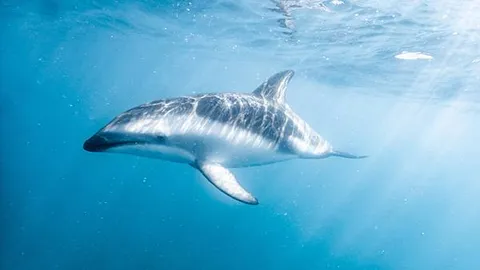
This is Kaikoura, on New Zealand's South Island. The rate of cetacean encounters here is remarkably high. The most common sightings include sperm whales, the dusky dolphins I'll introduce in a moment, New Zealand fur seals, royal albatrosses (the world's largest seabirds), and occasional encounters with orca, the world's smallest dolphin — the Hector's dolphin — as well as humpback whales and blue whales.
Time of Year
We joined the activity in early December 2020. The weather was slowly warming up, but the water temperature was still freezing cold! (Around 14°C.) That said, once you're in the water, the excitement takes over and you forget how cold it is! The recommended window for swimming with dolphins is December through April — this covers summer to early autumn, making the water a bit more bearable. Also, the breeding season for Dusky dolphins typically runs from September to November each year. Regulations here are strict: when a boat encounters a mother with a calf, guests are not permitted to enter the water to swim with them.
The Operator
The only operator in Kaikoura offering dolphin swimming experiences is Dolphin Encounter.
This company also runs an Albatross Encounter tour. From online booking and check-in to the start of the activity itself, the well-trained staff and knowledgeable guides left me — someone who hadn't participated in a water activity as a guest in a long time — thoroughly impressed. We booked directly through the official website. There are four pricing options (all in NZD):
- Adult Dolphin Swim & Watch: 210/person
- Child (8–14) Dolphin Swim & Watch: 195/person
- Adult Dolphin Watch Only: 105/person
- Child (3–14) Dolphin Watch Only: 65/person
Another great booking option is New Zealand's popular activity discount site, Book Me: Dolphin Encounter Book Me. Discounts pop up there frequently — for example, we booked a separate Hector's dolphin swim in Akaroa through Book Me at half price! As for our Kaikoura booking, we went through the official website because we spotted a promo code at the time of booking that brought the price down to the same level as the lowest available rate on Book Me. We ended up securing our tour at NZD 168 per person through the official site. During the pandemic, even though New Zealand had little to no local transmission, closed borders had taken a serious toll on the tourism industry in a country that already has a small population (around 4.4 million at the time). Nearly every operator was running promotions to attract business, so snagging a discounted deal wasn't difficult at all.
The Activity
- Total duration: 3–3.5 hours (in practice, around 4 hours)
- What to bring yourself: personal drinking water, sunscreen (please use reef-safe mineral/physical sunscreen — chemical sunscreens can damage marine ecosystems), a towel, dry clothes to change into, and an underwater camera or GoPro (optional)
- Gear provided by the operator: mask and snorkel, 5mm wetsuit and hood, short fins (long fins can easily injure dolphins, whose skin is very delicate — even a minor scrape can lead to serious infection). You may bring your own gear. On board, hot cocoa and ginger snap cookies are also provided.
We booked the 08:30 morning session. While researching beforehand, I discovered there used to be an even earlier 05:30 departure (in New Zealand's summer, sunrise is before 6 a.m. and sunset is around 9 p.m.). That slot has likely been cut due to the current slowdown in business. There's also a 12:30 session available, but both online resources and staff on the day consistently noted that dolphins are more energetic on the earlier tours.
At check-in, the front desk gives you a risk acknowledgement form that also asks about your swimming ability. Because the dolphins may be found in fully open water 100–200 metres deep, and staff do NOT enter the water with guests — they remain on the boat to assist — anyone who isn't confident swimming in open water should opt for the watch-only experience. After completing the paperwork, staff gathered all participants in the changing room for a brief rundown, then distributed gear. Once changed, everyone was ushered into a small screening room where the company played a video covering what to do (and not do) in the water with dolphins — prohibited behaviours, how to attract dolphins' curiosity, and so on.
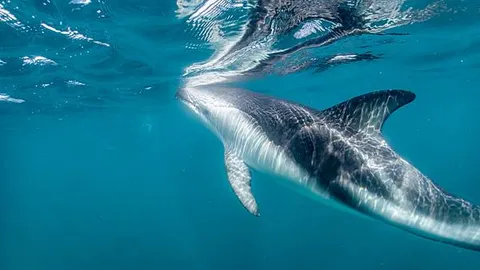
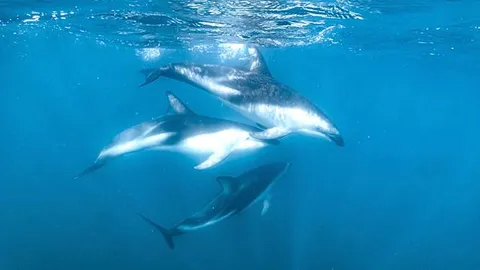
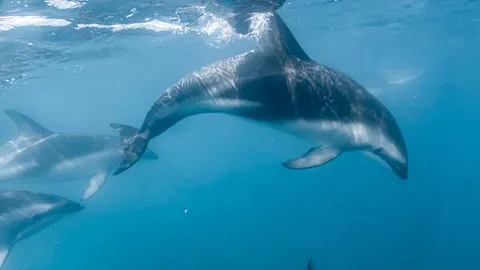
After leaving the harbour, intern Nicole introduced the layout of the vessel, and naturalist guide Tracy launched into a non-stop commentary on Dusky dolphin behaviour and biology. Before finding the dolphins, we spotted numerous seabirds — albatrosses, shearwaters, and more — each of which Tracy carefully identified and explained. We headed south for about 30 minutes before encountering an enormous pod of dolphins. At a rough visual estimate, there were well over a hundred individuals! Dusky dolphins are found only in the Southern Hemisphere; in the wild they can live up to 30 years, and adults typically reach 165–190 cm in length. Dolphins are highly social animals. Dusky dolphin pods can range in size from 2 to over 1,000 individuals. I later asked Tracy about this, and she explained that a pod's membership is fluid — today's pod isn't necessarily a single family unit. It's a bit like booking a fun dive at a dive shop with your partner: the dive guide and two other divers join you, and together you form a pod for that dive — but once the dive is done, you all go your separate ways.
Once dolphins were encountered, the captain strictly adhered to New Zealand's local regulations:
- Approach the dolphin pod carefully from the side or from behind.
- Operate the vessel slowly and quietly at "no wake" speed within 300 metres.
- Do not approach a pod if three or more vessels are already within 300 m.
- Do not obstruct the dolphins' path of travel, cross through the pod, or separate a mother from her calf.
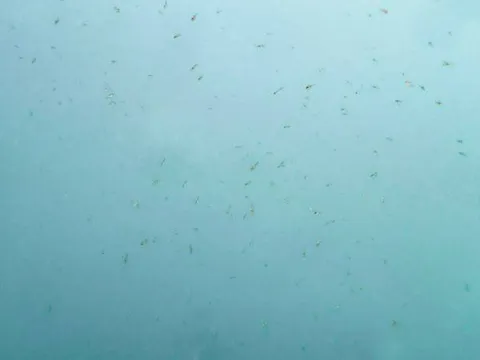
Staff then reminded everyone to zip up their wetsuits and fit their masks. All guests were required to wear their hoods, which the staff marked with a green dye so that the crew on board could easily identify swimmers in the water. Once ready, everyone excitedly lined up along the stern — and when the bell rang, it was time to leap in! The water in the Southern Hemisphere is genuinely cold 🥶, so unlike diving at Mikurajima where you can dress nicely for photos, visibility here wasn't great either. But! Dusky dolphins are intensely curious animals, so you really don't need to chase them — they simply swim right up alongside you, practically close enough to touch (though of course, feeding, touching, harassing, or harming dolphins is absolutely prohibited). In the water, I also spotted lots of small creatures — I was probably the only one not photographing dolphins 😅. These little creatures are called squat lobsters. Despite the name, they actually belong to the crab family; juveniles live near the ocean's surface, while adults sink deeper to live on the seafloor.
Compared to freediving, this activity is essentially just snorkelling alongside dolphins — however, if you're comfortable duck-diving in a 5mm wetsuit (the operator doesn't provide weights), the company won't stop you. In fact, diving down is one of the best ways to pique a dolphin's curiosity! During this session, we were sent into the water three times in total. After the final entry, Nicole had everyone remove their wetsuits and change into dry clothes, then we gathered at the bow to watch the dolphins leaping and playing around us.
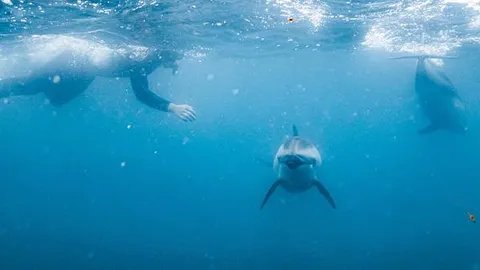
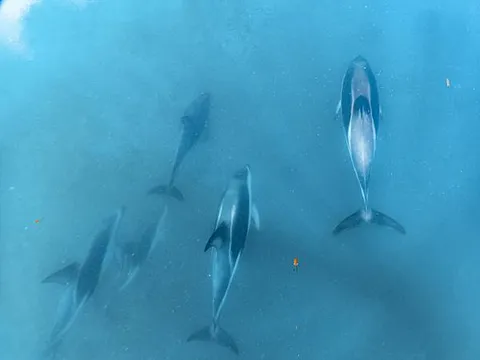
On the way back, guide Tracy came over to chat with Wenhao and me. We learned that she had previously worked for WWF's Hong Kong office. Between her expert narration throughout the tour and the unmistakable spark in her eyes as we talked, I could feel in every moment that she does this work out of a genuine love for wildlife. Tracy is everything I aspired to be when I first became a dive instructor — and everything I still hope to grow into.
Conservation
In New Zealand, any business wishing to conduct activities involving marine mammals must obtain a special permit from the Department of Conservation (DoC). Operators must strictly observe and enforce all conditions that apply when encountering cetaceans — conditions built on years of research and grounded in the principle that animal welfare always comes first. For example:
- There is a limit on the number of swimmers any single vessel may put in the water at any one time.
- Any single vessel may run no more than three sessions per day.
- Within any single session, a vessel may send guests into the water a maximum of five times.
- Throughout the day, the same pod of dolphins must be given at least 2 hours of uninterrupted "rest time" to prevent vessels from disturbing the animals too frequently.
Dolphin Encounter also established a foundation in 2009. A portion of their operating revenue flows into the foundation to support initiatives including marine mammal and seabird conservation research, community education programmes, and environmental campaigns. The company states clearly to its customers:
As a business relying on a healthy ocean habitat, we want to ensure that we are doing as much as we can to educate all customers that we meet about the precious marine life of Kaikoura.
It's a simple principle, but a deeply thought-provoking statement. Like New Zealand, Taiwan is surrounded by ocean on all sides. Our geographic isolation has given rise to unique endemic species; the Kuroshio Current brings us an abundance of marine resources; and every summer, Taiwan's offshore islands are packed with people both above and below the water. But in Taiwan, how many businesses that "depend on the sea" truly fulfil their social responsibility? How many operators of water activities actually take the time to educate their customers with the right values?
When you, as a dive instructor, take first-time divers on an introductory experience, have you ever let them grab onto coral for a photo just to save yourself some effort?
When you, as a freediving instructor, have you ever carelessly dropped a bottom weight without regard for the coral beneath?
When you, as a snorkelling instructor, guide group after group into the water, have you ever looked the other way — out of sheer inconvenience — when guests kick recklessly or harass marine life?
When you, as the captain of a vessel, spot cetaceans, do you follow the regulations and slow down without giving chase? Or do you charge right into the pod to thrill your passengers?
And when you, living by the sea and making your living from it, go and buy salt-and-pepper chicken in a single-use paper bag, carry it home in a plastic bag, eat it off bamboo skewers alongside a plastic bottle of cola — and then post online about protecting the environment?
If you, as an instructor, cannot lead by example, how can we ever expect to educate the general public to love and protect the ocean?
A Call to Action
If you call yourself a lover of the sea — a true ocean devotee — yet choose to visit marine parks, ocean theme parks, or aquariums to watch beluga shows and dolphin performances, ask yourself honestly: do you truly love the ocean?
Perhaps you don't have the money or the time to travel to Mikurajima or New Zealand to chase dolphins, let alone fly to Iceland or Russia to see beluga whales. But you can choose not to spend your money on those industries. Just as I know I may never see an orca in the wild in my lifetime, I would never buy a ticket to SeaWorld to watch an orca show. The internet today is more powerful than ever — how much have we really absorbed from National Geographic or Animal Planet? There is no shortage of knowledge available to us.
No demand, no harm — we all know that.
It wasn't until I personally experienced swimming alongside truly wild dolphins that I deeply understood the kind of profound emotion a "free soul" can stir within you. If the only point is to look, captive animals will only ever display abnormal behaviours. You might see them, think "how cute," and then what?
The "Cove" plays out every single day in Taiji, Wakayama Prefecture, Japan. Today, consuming whale and dolphin meat is no longer mainstream in Japan — yet the whaling and dolphin hunting industry persists under the banner of preserving tradition, fuelled precisely by the enormous profits of the aquarium and live animal performance industry. A single dolphin can fetch millions of yen. The marine parks that claim to be conserving animals are, in reality, a vehicle for businesspeople to profit at the cost of their conscience.
Dolphins are animals of remarkable intelligence and complex social behaviour. During a drive hunt, only a handful are selected; the rest are slaughtered by the hunters. Those left behind are the ones who suffer most. After enduring the panic and violence of the round-up, witnessing their companions killed right before them, they are then traded and shipped to aquariums and marine parks around the world, to live out their days cut off from nature. For an animal capable of swimming at least 12 knots (approximately 20–30 km, the distance from Beitou to Xindian) every hour, how unbearably cruel must that existence be?
This post ends on a somewhat heavy note — but the truth is often hard, and it's something we need to know.
I hope that one day, everyone will be able to say they've stopped spending money at marine parks — and that the magical experience of encountering wild cetaceans in the open ocean is one you get to have for yourself.
Frequently Asked Questions
How is a BlueTrend dive trip different from an unknown, no-name dive group?
Choosing us means full peace-of-mind protection and a smooth experience from start to finish. Every trip we run holds to three things.
First, full legal protection and a professional dive leader: we strictly follow Taiwan's travel regulations and provide complete travel-agency liability insurance, travel insurance, trip-inconvenience insurance and dive insurance. Every group is accompanied by a certified, foreign-language dive leader who joins you on both the dives and the land itinerary, liaising seamlessly with local dive shops and operators on your behalf to keep things running smoothly — the person our travellers trust most.
Second, fully licensed with secure payments: every payment goes into a licensed travel agency's account, with multiple safe payment channels (bank transfer, credit card and more) and a legal collect-and-remit receipt, so every transaction is open, transparent and protected, avoiding the fraud and dispute risks of transferring money privately to an individual.
Third, hand-picked quality we vet in person: every trip, dive site and partner shop is scouted on the ground by our own team, from the guides' professionalism and safety standards to the food, lodging, environment and service details on land, all vetted by us so you don't get caught out.
I want to sign up for a dive trip. Are there certification-level or logged-dive requirements?
Each dive site is different, so the entry bar varies. 'Bali Tulamben', for instance, is relatively beginner-friendly. 'Malapascua in the Philippines' is also beginner-friendly, but since thresher sharks tend to cruise between 20 and 30 metres, we recommend AOW certification with 20+ logged dives to enjoy this trip comfortably. For 'the Maldives' or 'Palau', we suggest AOW with 50+ logged dives for a more relaxed experience. If you're not sure whether your experience fits the trip you want, message us and our dive editors will assess it and help you find the trip you'll feel safest on.
Can I join if I'm signing up alone? How are rooms arranged?
Plenty of our travellers sign up solo! For rooms and beds, we prioritise pairing you with a same-gender traveller, and if you'd rather have your own space you can pay the difference to upgrade to a single room. For the diving, our professional leader will pair you with a suitable buddy, and with the happy vibe on our trips you'll quickly make a great group of dive friends. Many people sign up alone, make new friends, and end up organising the next trip together!
Does the trip fee include dive insurance, gear rental, taxes and instructor tips?
It depends on the trip, the destination's regulations and the local operators. Every BlueTrend dive trip has a detailed web page with a clear 'included / not included' list, transparent and with no hidden charges. All payments are collected by a licensed travel agency, with a standard-form contract for your protection.
I'm a new diver / haven't dived in a long time — will I fall behind the group?
Before you complete your booking, our team assesses a suitable trip based on your certification level and experience. Before departure, we strongly recommend taking time to refresh in Taiwan with an instructor, or a fun dive to get your feel back. On the trip itself, our professional dive leader groups and pairs everyone by experience, keeps a close eye underwater on travellers who need extra care, and steps in to help right away.
Will the photos and videos taken during the trip be shared with us?
During the dives, 'safety' is always the leader's top priority, so whenever it's suitable and safe the leader will capture great shots and record the best moments. During or after the trip, we compile a cloud album for all travellers to download, so you go home loaded with memories!
Besides your scheduled trips, can you arrange a private group charter or independent travel for me and my friends?
Absolutely! Besides group trips, we also arrange private group charters and independent travel. We can communicate, enquire and coordinate services with local operators based on your needs, saving you time and effort and taking the language barrier off your plate, to tailor the smoothest, most reassuring dive trip just for you. Contact our LINE support and our editors will arrange it for you!