Contents(8)
- Older Than Dinosaurs! A 290-Million-Year-Old Helicoprion Fossil Takes the Stage
- Three Things You Didn't Know About Sharks
- Shark Fun Fact 1. Sharks Aren't Always Big! The Smallest Shark Is Just 14 cm
- Shark Fun Fact 2. Sharks Can Replace Their Teeth Endlessly
- Shark Fun Fact 3. Sharks Have a Sixth Sense — Electroreception
- Sharks and Land Animals Have More in Common Than You Think
- Being Bitten by a Shark, Winning the Lottery, Getting Struck by Lightning — Which Is Most Likely?
- "Who Is More Dangerous Than the Shark?" Shark Conservation Is Underway
"Swimming with sharks" is on the bucket list of many divers — whether it's heading to Yonaguni, Okinawa to witness a Hammerhead Shark tornado, or flying to the Maldives for a face-to-face encounter with a Tiger Shark. Does your own wishlist of big marine encounters come to mind as you read this? That said, there are many shark species you might not yet know, and plenty of mysteries surrounding their habits and way of life that are well worth exploring.
This time, the Editor headed to the American Museum of Natural History in New York to walk you through the limited-run shark special exhibition "Discover the World of Sharks." Here are five handpicked highlights to share with you — let's dive in!
Older Than Dinosaurs! A 290-Million-Year-Old Helicoprion Fossil Takes the Stage
The American Museum of Natural History — also famous as the filming location for Night at the Museum — draws visitors from around the world with its extraordinary dinosaur fossil collections. But did you know that sharks have roamed the Earth far longer than dinosaurs? One of the centerpiece exhibits of "Discover the World of Sharks" is a prehistoric giant from 290 million years ago: the fossil of the now-extinct Helicoprion.
[caption id="" align="alignnone" width="960"]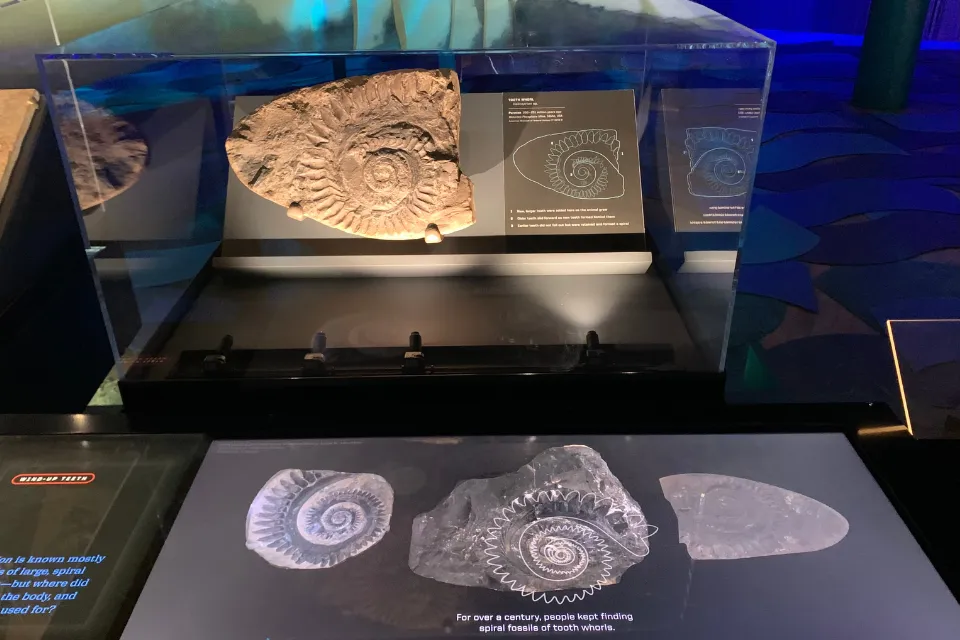 A Helicoprion fossil from the collections of the American Museum of Natural History.[/caption]
The fossil resembles a wheel — look closely and you'll see spiraling rows of serrated teeth. How exactly did these spiral "whorl teeth" arrange themselves inside the shark's mouth to function as a deadly hunting tool? It turns out that as new teeth continuously grew in, the older ones were pushed inward toward the center. It's easy to imagine this spiral-toothed predator hunting across the ocean floor hundreds of millions of years ago — yet the Helicoprion is now extinct, and its true full form remains a mystery, leaving the rest to our imagination.
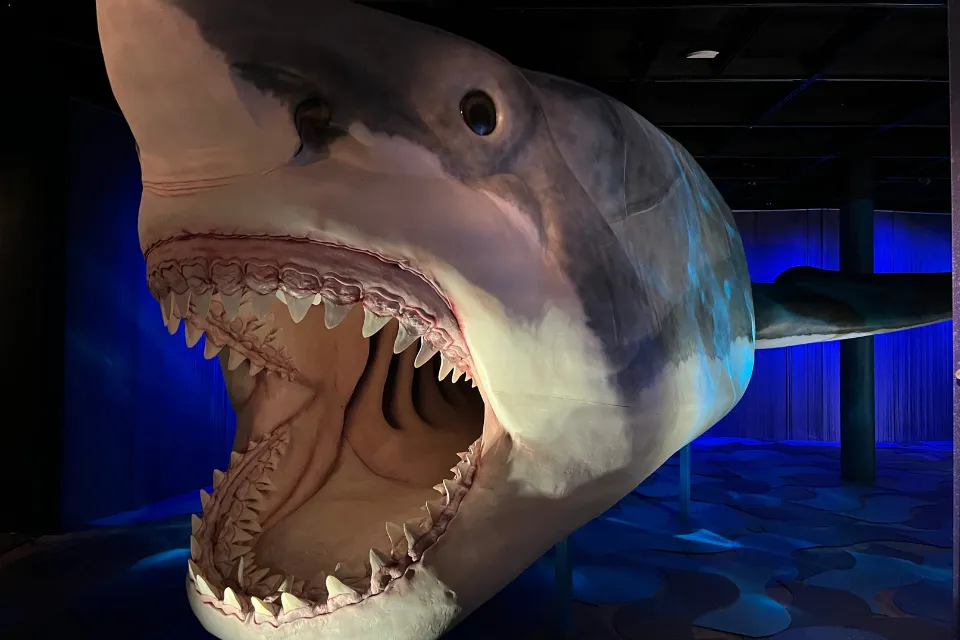
In addition to the 290-million-year-old Helicoprion fossil, if you'd like to see what sharks look like in full, the exhibition also displays dozens of lifelike shark models, with the largest reaching ten metres in length — and naturally, it's become one of the most popular exhibits for queuing up and snapping photos. After your photo op, be sure to take in the rich shark information panels. We've picked out three fun facts to share with you — keep reading!


Three Things You Didn't Know About Sharks
Shark Fun Fact 1. Sharks Aren't Always Big! The Smallest Shark Is Just 14 cm
When most people think of sharks, they picture a hulking creature — but the world's smallest shark, the American Pocket Shark, is only 14 cm long, smaller than an adult's palm. Scientists first discovered this species in 2019; it's known for secreting a bioluminescent fluid from pouch-like glands and is an exceptionally rare species in the ocean. Take a look at the lifelike models side by side, and it's clear just how tiny this one is!
[caption id="" align="alignnone" width="960"]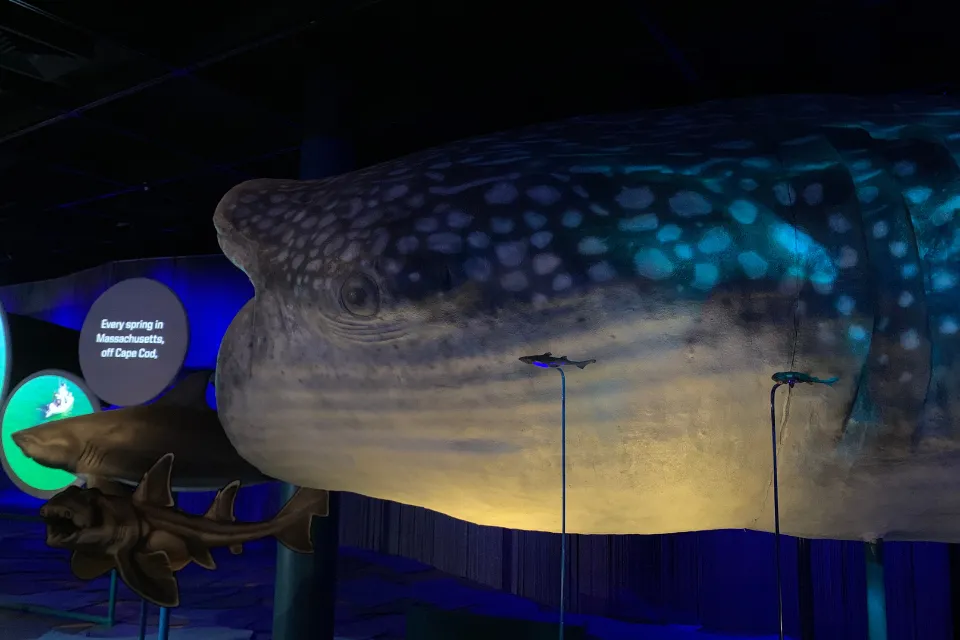 Spotted the super-tiny shark? On the right side of the image is the American Pocket Shark — the world's smallest shark at just 14 cm long.[/caption]
A quick note: in front of the Pocket Shark in the photo above, there's another small shark — the dwarf lantern shark — which measures only 20 cm. Its belly and fins are covered with photophores (light-emitting organs), and its large eyes help it see more clearly in dark environments.
Shark Fun Fact 2. Sharks Can Replace Their Teeth Endlessly
Humans only get one set of replacement teeth in a lifetime, but sharks replace their teeth throughout their entire lives! Anyone who has ever struggled with cavities or dental problems would surely envy the shark — it can grow a brand-new set of teeth every few weeks.
A shark's teeth aren't anchored to its skull; instead, they're attached to a membrane that works like a conveyor belt. As new teeth grow outward, the outermost teeth are retired and replaced, ensuring the shark always has a sharp set ready to go. Take the Bull Shark as an example: it can have seven rows of teeth with 50 teeth per row — and all 350 of those teeth are constantly being renewed, so the shark always has a perfect bite!
[caption id="" align="alignnone" width="960"]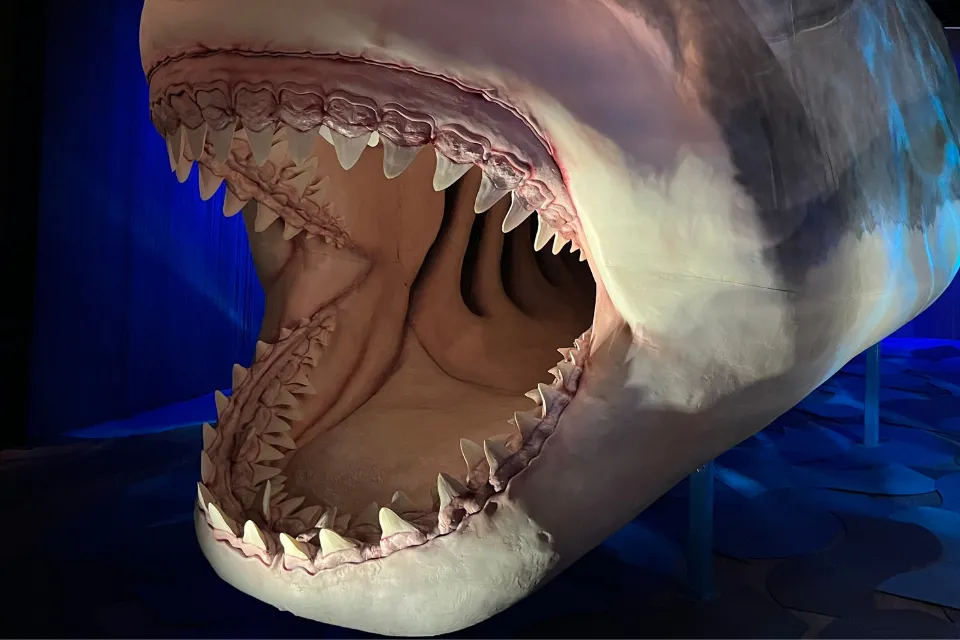 Take a look at the shark's tooth structure through this lifelike model! Pretty enviable that they can keep replacing their teeth, right?[/caption]
Shark Fun Fact 3. Sharks Have a Sixth Sense — Electroreception
Do sharks have a sixth sense? Indeed they do — it's called electroreception, the ability to detect electromagnetic fields. All living creatures emit faint electrical fields, and sharks rely on this sixth sense to hunt prey even when visibility is poor or scent is insufficient. Prey hiding beneath the sandy seabed, for instance, can hardly escape a shark's detection.
This is thanks to a unique structure found on sharks called the ampullae of Lorenzini — a sensory organ capable of detecting minute changes in electrical fields and transmitting nerve signals to the brain.
Sharks and Land Animals Have More in Common Than You Think
To bring sharks closer to our everyday understanding, the exhibition features interactive installations that invite visitors to guess which land animals share surprising behavioral similarities with certain sharks. Through these connections, you can more easily picture how sharks live their lives. See if you can figure them out!
- Stingrays —— Bees
- Angel sharks —— Frogs
- Baby lemon sharks —— Mice
Stingrays and bees both use venomous stingers to fend off enemies — that one's not too hard! But what do sharks have in common with frogs and mice? It all comes down to self-protection. Angel sharks and frogs both use camouflage to blend almost seamlessly into sand or leaves; baby lemon sharks and mice are both adept at using their surrounding environment to build a safe refuge — baby lemon sharks hide among the roots of mangrove plants until they grow strong enough, while mice construct shelters from grass and leaves.
Being Bitten by a Shark, Winning the Lottery, Getting Struck by Lightning — Which Is Most Likely?
After learning more about sharks, do you feel a little closer to them? Most divers who leap into the deep blue actually love and look forward to encountering sharks — yet there are still many people in the world who misunderstand and fear them. That fear stems from a lack of knowledge, compounded by various mysterious stories that have labelled sharks as villains. The 1975 classic film Jaws — the first movie in history to gross over a hundred million dollars at the box office — deeply embedded a fear of sharks into the public consciousness.
[caption id="" align="alignnone" width="960"]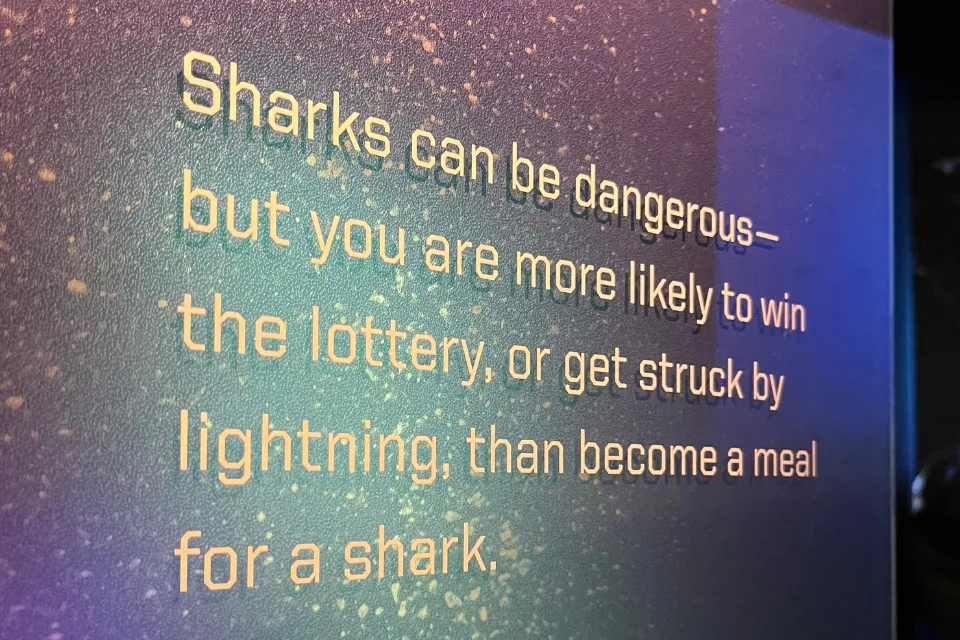 "Sharks can be dangerous — but you're more likely to win the lottery or be struck by lightning than end up on a shark's menu." A humorous sign that made us chuckle (we'd love to win the lottery though!)[/caption]
The exhibition uses interactive installations to visualize data: simply press a button on the device and you can see the number of people killed by shark bites compared to deaths caused by flea and insect bites. Topping the fatality count are insect bites — hundreds of thousands of people worldwide die from them each year. Deaths caused by flea bites number in the hundreds; deaths caused by shark bites total around ten. The exhibition goes even further, noting that "the drowning fatality rate is 23,600 times higher than the shark bite fatality rate."
"Who Is More Dangerous Than the Shark?" Shark Conservation Is Underway
Sharks cause around ten human deaths per year — but how many sharks are killed by humans each year? According to information provided by the exhibition, approximately 100 million sharks die at human hands annually. Among the roughly 1,200 species of sharks and related marine animals, at least 391 species are classified as threatened with extinction due to overfishing. While the number of sharks killed by humans has been declining year on year, a significant part of that trend is simply because shark populations themselves have dwindled…
The exhibition also presents important information on shark conservation, sharing international efforts to protect sharks:
-
- Fiji: Of the approximately 63,000 divers who visit Fiji each year, 78% come specifically to see sharks, generating NT$842 million in annual tourism revenue. Local dive operators have partnered with the Wildlife Conservation Society to rally thousands of divers to participate in documenting shark populations (The Great Fiji Shark Count), providing vital data for marine protected areas.
-
- Palau: In 2009, Palau declared all surrounding waters a shark sanctuary — the world's first shark fishing ban — and introduced associated penalties. This landmark move became a key milestone in global shark conservation, and over the following decade, 16 countries followed Palau's lead in banning shark fishing.
[caption id="" align="alignnone" width="960"]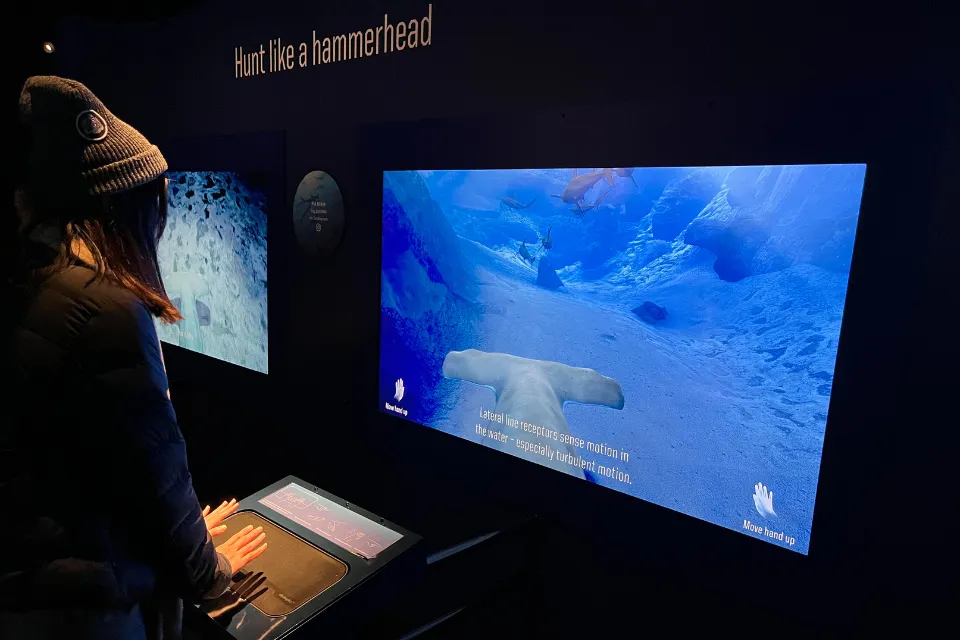 Simulate a Hammerhead Shark hunting — this is the most popular mini-game in the exhibition. You'll need to queue up for a turn, so make sure you give it a try.[/caption]
Of course, a shark exhibition wouldn't be complete without some lighthearted fun! Visitors can use an interactive installation to simulate being a Hammerhead Shark on the hunt in the ocean — using both hands in mid-air to control direction and diving depth, dodging underwater reef formations along the way, before finally swimming toward the sandy seabed to search for Stingrays and timing your strike just right (it's actually not that easy!). To finish things off, you can even transform into different species of sharks and take a photo to remember the experience.
Having toured the limited-run NYC shark exhibition with the Editor, is there anywhere else you'd like the Editor to visit and bring back firsthand coverage? Come join the BlueTrend official LINE account and leave us a message to let us know!
Join the BlueTrend Official LINE
References:
Further Reading:

![[Must-Read for Divers] Always Getting Turned Away When Joining Group Dives? How to Become a Self-Sufficient Diver](/_astro/71723046_2280349618943723_525180423337148416_o_aJHG.webp)