the Editor says: Blue carbon sinks are a critical component in mitigating climate change. Although Taiwan has already met its 2030 target of 340,000 tonnes, expanding carbon sinks remains difficult, and related programs are still in the experimental phase. The focus going forward will be on maintaining existing carbon sink capacity. <Full article reprinted from the Environmental Information Center, reported by reporter 劉庭莉2023.09.08>
The Ocean Affairs Council held an APEC Business/Private Sector Roundtable on Marine Environmental Sustainability on the 6th and 7th, with one of the key topics being the current state of and challenges in blue carbon economic development. Domestic scholars noted that Taiwan's marine carbon sink is preliminarily estimated at approximately 350,000 tonnes of CO₂ equivalent per year, already surpassing the 2030 target of 340,000 tonnes. The Director-General of the Marine Conservation Administration (MCA), Huang Hsiang-wen, stated that related programs are still being piloted, that increasing carbon sinks is no easy task, and that the priority going forward will be to maintain existing carbon sink levels.
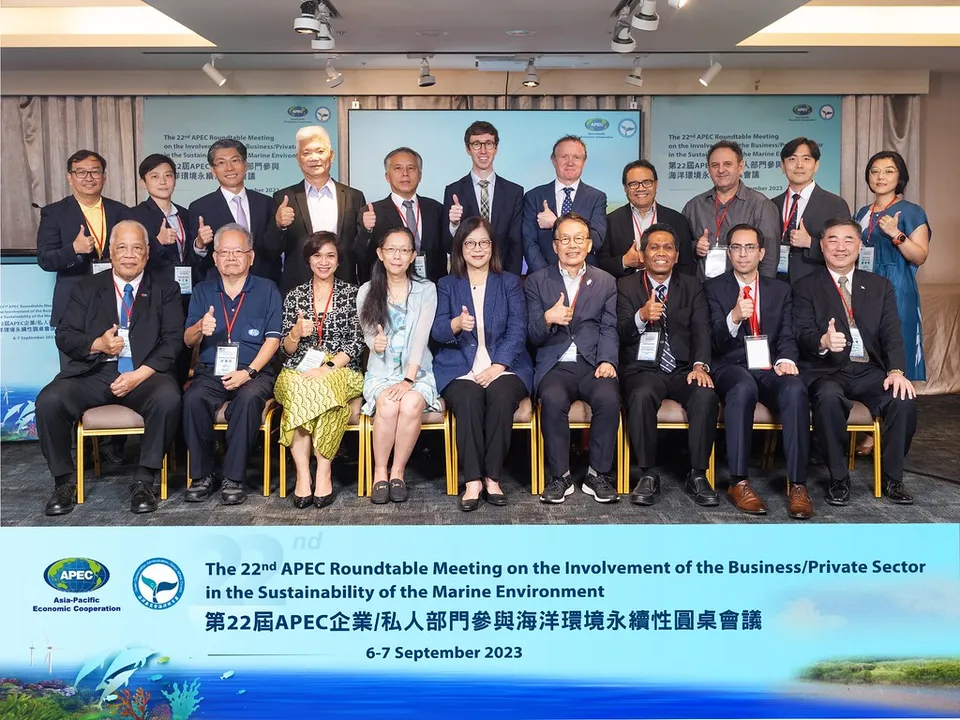
The Ocean Affairs Council held an APEC Business/Private Sector Roundtable on Marine Environmental Sustainability on the 6th and 7th. Image source: Marine Conservation Administration
Blue Carbon Sink Targets
Blue carbon sinks play a vital role in mitigating climate change. Professor Lin Hsing-Juh, a lifetime distinguished professor in the Department of Life Sciences at National Chung Hsing University, explained that Taiwan's blue carbon area covers approximately 6,350 hectares, with seagrass beds accounting for the largest share at roughly 5,470 hectares. He also revealed that Taiwan's marine carbon sink is preliminarily estimated at approximately 350,000 tonnes of CO₂ equivalent per year — already meeting the 2030 target of 340,000 tonnes.
MCA Director-General Huang Hsiang-wen said in an interview that Taiwan's blue carbon figures have only become relatively precise this year, and calculations are still ongoing. Programs aimed at increasing carbon sinks are also being piloted, but boosting carbon sinks is no easy task, and the focus going forward will be on maintaining current carbon sink levels.
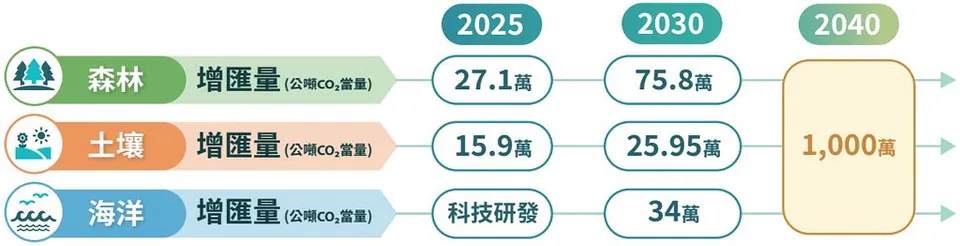
Natural carbon sink targets outlined in the 2050 Net-Zero Transition Key Strategies. Image source: National Development Council presentation
Climate change and biodiversity are deeply intertwined. Beyond their contribution as carbon sinks, blue carbon ecosystems provide additional value by enhancing biodiversity. In terms of carbon sequestration capacity, mangroves absorb carbon five times more effectively than seagrass beds and 26 times more than terrestrial forests. They also help expand land area and protect coastal communities from flooding, making them a highly cost-effective blue carbon investment.


Mangrove Restoration Programs Around the World
The roundtable invited scholars from Japan, South Korea, Australia, Indonesia, Thailand, and other nations to share their experiences. Benjamin Brown, a postdoctoral researcher at the Australian Institute of Marine Science and the Research Institute for the Environment and Livelihoods (RIEL) at Charles Darwin University (CDU) who has long studied mangroves in Indonesia, pointed out that the direct financial value of mangroves is low. Local communities, driven by livelihood needs, have largely replaced them with aquaculture, oil palm, or coconut cultivation, resulting in a loss of more than 5,000 hectares of mangrove forest over the past decade or more.
In an effort to restore coastal environments, Indonesia has set a target of rehabilitating 600,000 hectares of mangroves by 2024. However, Brown noted that mangrove restoration is an extremely challenging undertaking — more than 95% of attempts end in failure. Comprehensive planning and assessment are essential. In addition to identifying suitable natural environments, socioeconomic and political dimensions must be considered, and public participation must be fostered through workshops to improve the chances of success.
Multiple coastal regions in Thailand are also undergoing mangrove restoration programs. Sakanan Plathong, a lecturer at the Marine Science Learning Center, Department of Biology, Prince of Songkla University, shared experiences of failure, pointing out that planting in areas with unsuitable socioeconomic conditions often fails because residents lack conservation awareness or alternative livelihoods. Planting mangroves in areas where they did not historically exist can also impede water flow or sediment movement, causing habitat damage. Planting a single species further diminishes the overall benefits.
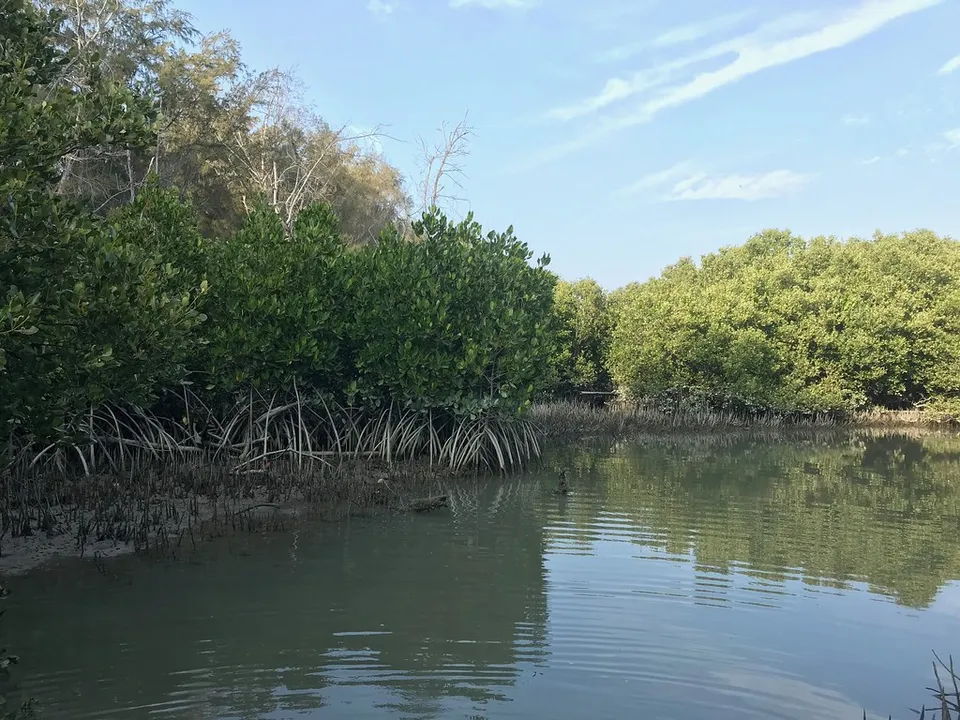
Professor Lin Hsing-Juh, a lifetime distinguished professor in the Department of Life Sciences at National Chung Hsing University, noted that while Taiwan's environment is well-suited for mangrove growth, appropriate thinning and management are still necessary to maximize biodiversity benefits. Pictured: the Haomeiliao mangrove forest in Chiayi County. Image source: Marine Conservation Administration
Overly dense mangrove growth and the expansion of land area can also cause problems. Yeh Tsai-fu, Director of the Environmental Conservation Division at Guandu Nature Park, explained that because human intervention is prohibited in the Guandu Nature Reserve in Taipei, the mangrove area expanded from 0.32 hectares in 2000 to 23.31 hectares in 2020. This has led to a reduction in the waterway area of the Keelung River and Tamsui River and has affected waterbird habitat. In 2021, the reserve became the first nature reserve in Taiwan to be decommissioned, transitioning into a nationally important wetland, and approximately 8 hectares of mangroves have since been thinned.
Editor in charge: Jenny Tsai
-
Ending 35 Years of Prohibition on Human Management: Guandu Important Wetland Replaces Nature Reserve
Full article reprinted with permission from the Environmental Information Center. Original title: Ocean Affairs Council APEC Roundtable Discusses Blue Carbon — Scholar: Marine Carbon Sink Has Already Met 2030 Target Ahead of Schedule