Contents(3)
Starting in 2019, the Editor gradually shifted toward underwater videography, upgrading from an OLYMPUS OM-D E-M5 Mark II to a Panasonic LUMIX DC-GH5. This meant not only replacing the entire underwater housing setup, but also retiring the strobe lights previously purchased for stills photography — they simply couldn't meet the demands of video. A search for a suitable continuous-output video light became essential.
Switching cameras is always a massive undertaking, and the Panasonic LUMIX DC-GH5 has no first-party underwater housing — only expensive metal housings are available. Add in the cost of lenses and lens ports, and the budget evaporated almost instantly.
Fortunately, while searching online, the Editor stumbled upon ORCATORCH — a brand not widely used in Taiwan at the time. After reviewing the specs on the official website, the D910V stood out as the model best suited to current needs. Here's a quick write-up sharing some impressions of this continuous-output light!
The current ORCATORCH video light lineup includes:
-
D900V: Official list price US$449.95. Maximum output 2,200 lumens; supports red light, UV light, 120° wide-angle natural light, and 8° spot beam.
-
D910V: Official list price US$409.95. Maximum output 5,000 lumens; 120° wide-angle; Color Rendering Index (CRI) Ra: 92.
-
D950V: Official list price US$999.95. Maximum output 10,500 lumens; 120° wide-angle; Color Rendering Index (CRI) Ra: 92.
After assessing that the Editor's technique wasn't yet refined enough to make full use of colored light options, the D900V was ruled out. And as tempting as the D950V's 10,500-lumen output was, the D910V ultimately won out — to avoid a future diet of instant noodles.
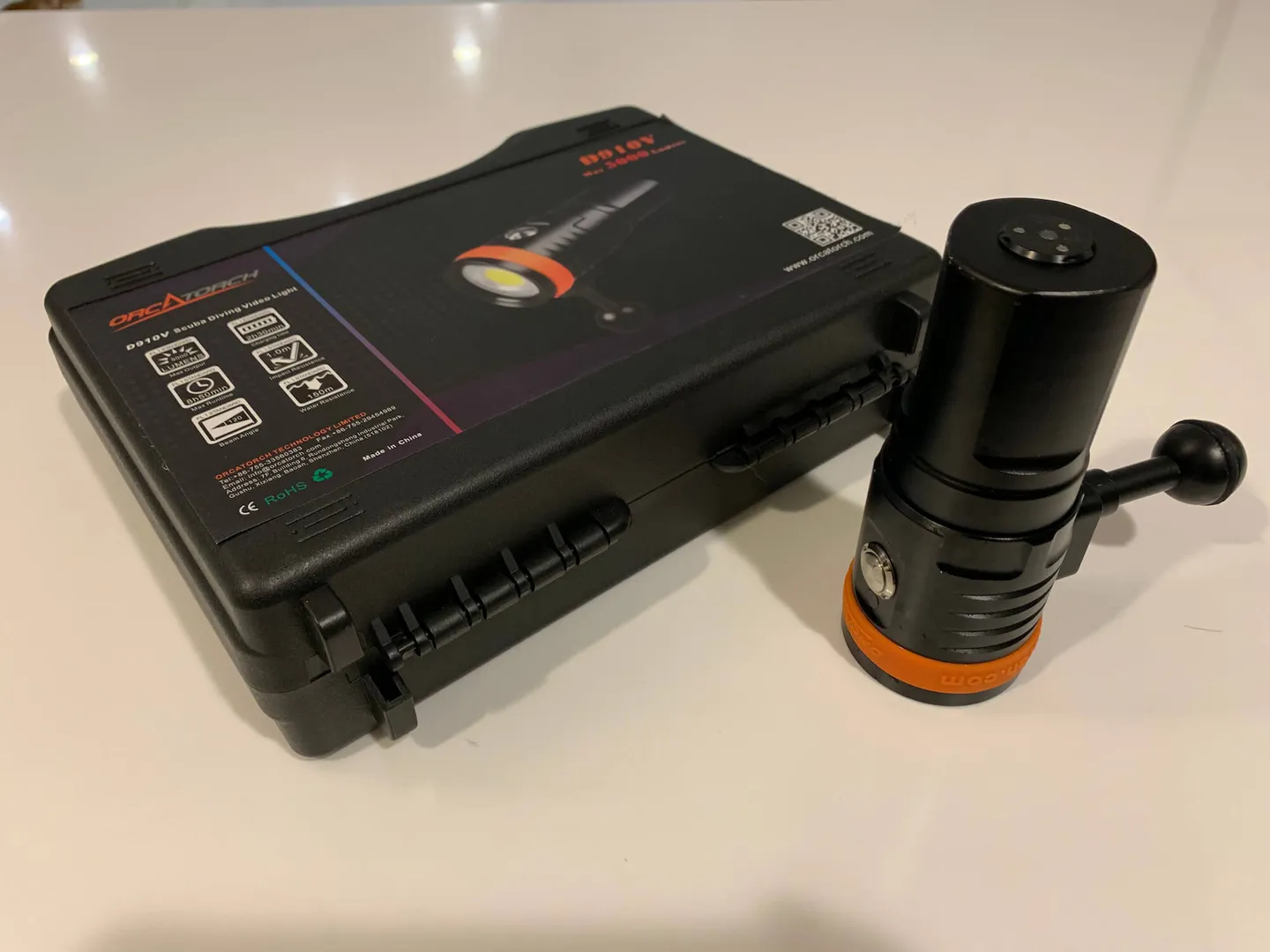
The D910V and its retail box


ORCATORCH D910V
The first thing that strikes you when you pick up the D910V is how compact it is. Its in-air weight is 430g (batteries included), with dimensions of 129.5mm × 45mm × 53mm. Those numbers might not mean much on their own, so the Editor placed it next to a previously used Bigblue 36VR for comparison.
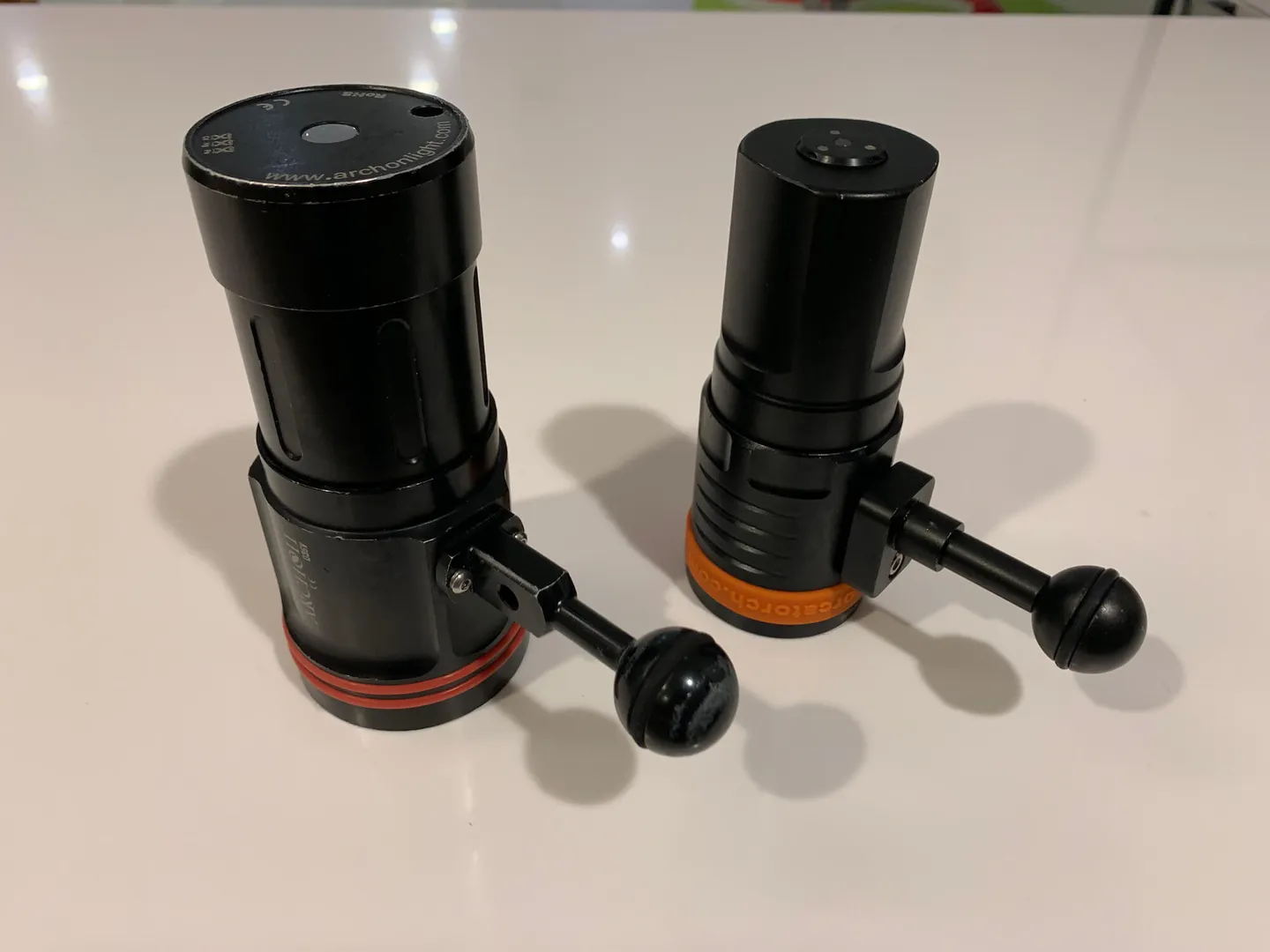
Ta-da! You can really see the size difference (the D910V is on the right)
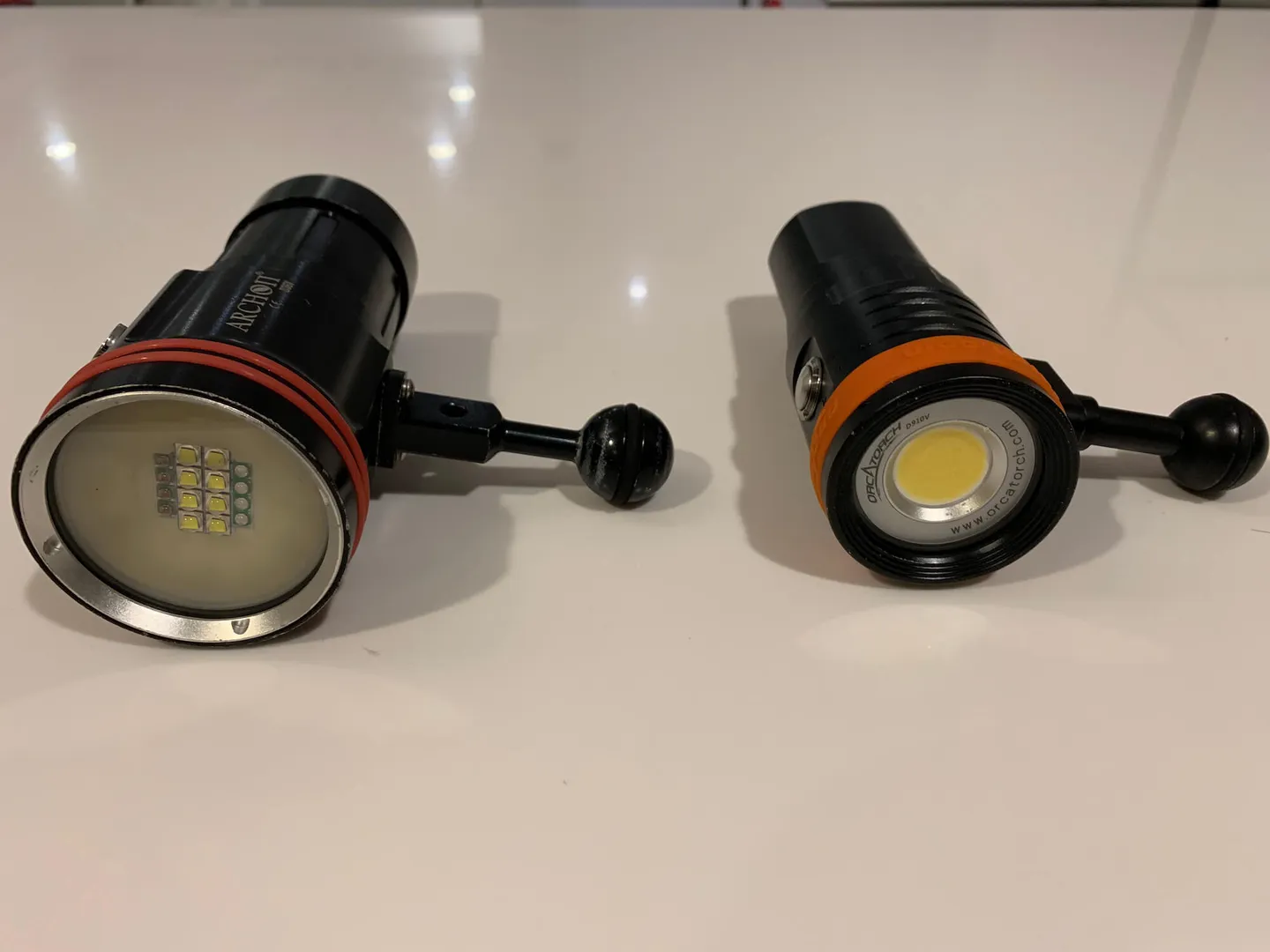
Laying them side by side to see the difference
Another genuinely useful design feature of the D910V is its magnetic charging dock. With the old Bigblue 36VR, which ran on four 18650 batteries, charging after a dive was a headache — two video lights alone meant eight batteries to manage, not to mention the Torch used for night diving and the dive computer also waiting to be charged. You might even have to get up in the middle of the night to swap batteries. Magnetic charging solves all of this in one go with a single plug!
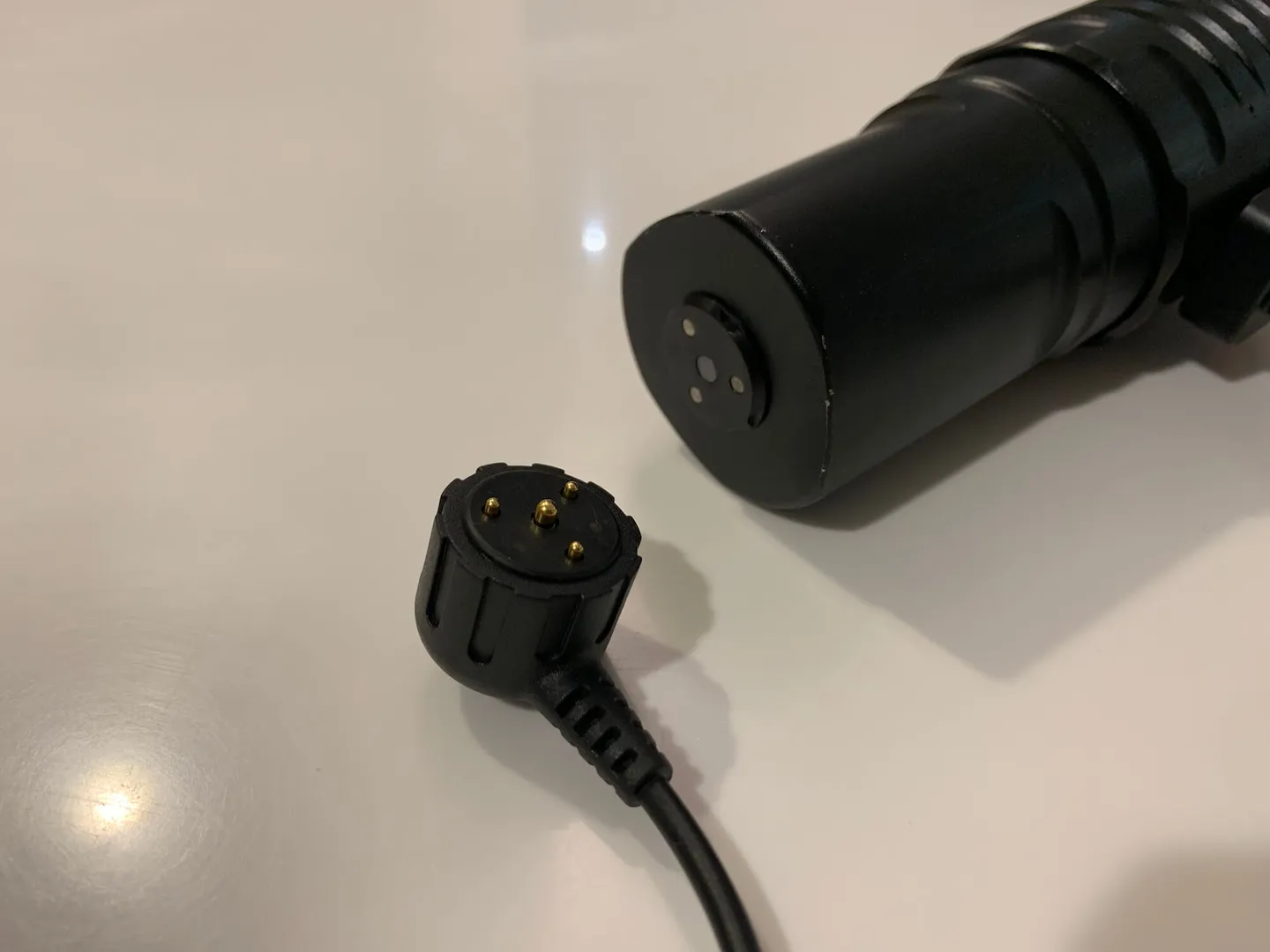
The magnetic charging dock on the rear of the D910V
According to official specifications, the D910V's runtime at full charge across its three brightness levels is as follows:
-
5,000 lumens: up to 50 minutes of continuous use
-
2,000 lumens: up to 2 hours 10 minutes of continuous use
-
500 lumens: up to 8 hours 50 minutes of continuous use
You can dial the output to match your camera settings — there's no need to run at 5,000 lumens for the entire dive. The light does include a battery indicator, but it's still good practice to charge it fully before every dive!
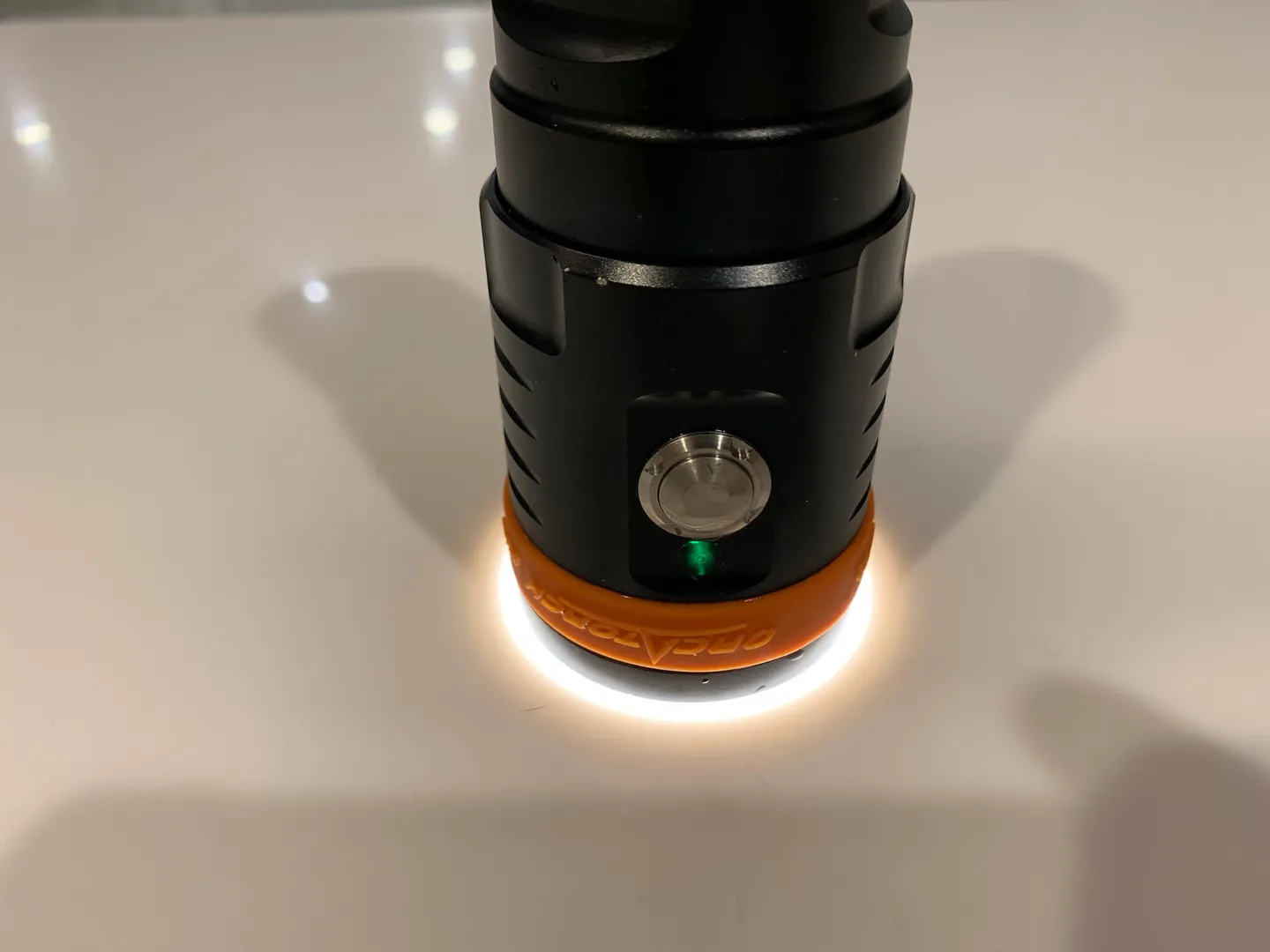
Battery level is indicated in sequence: green, yellow, red
The D910V weighs 430g in air (batteries included) and 215g underwater (batteries included). You can calculate the buoyancy of your camera and housing combination underwater, then pair the rig with buoyant float arms to offset the weight. The Editor's current setup uses one positively buoyant float arm of 280g on each side, which neatly cancels out the D910V's negative buoyancy of 215g per light — with a little positive buoyancy left over to help compensate for the camera and housing. The complete rig sits at a slight negative buoyancy underwater, making shooting relaxed and stress-free!
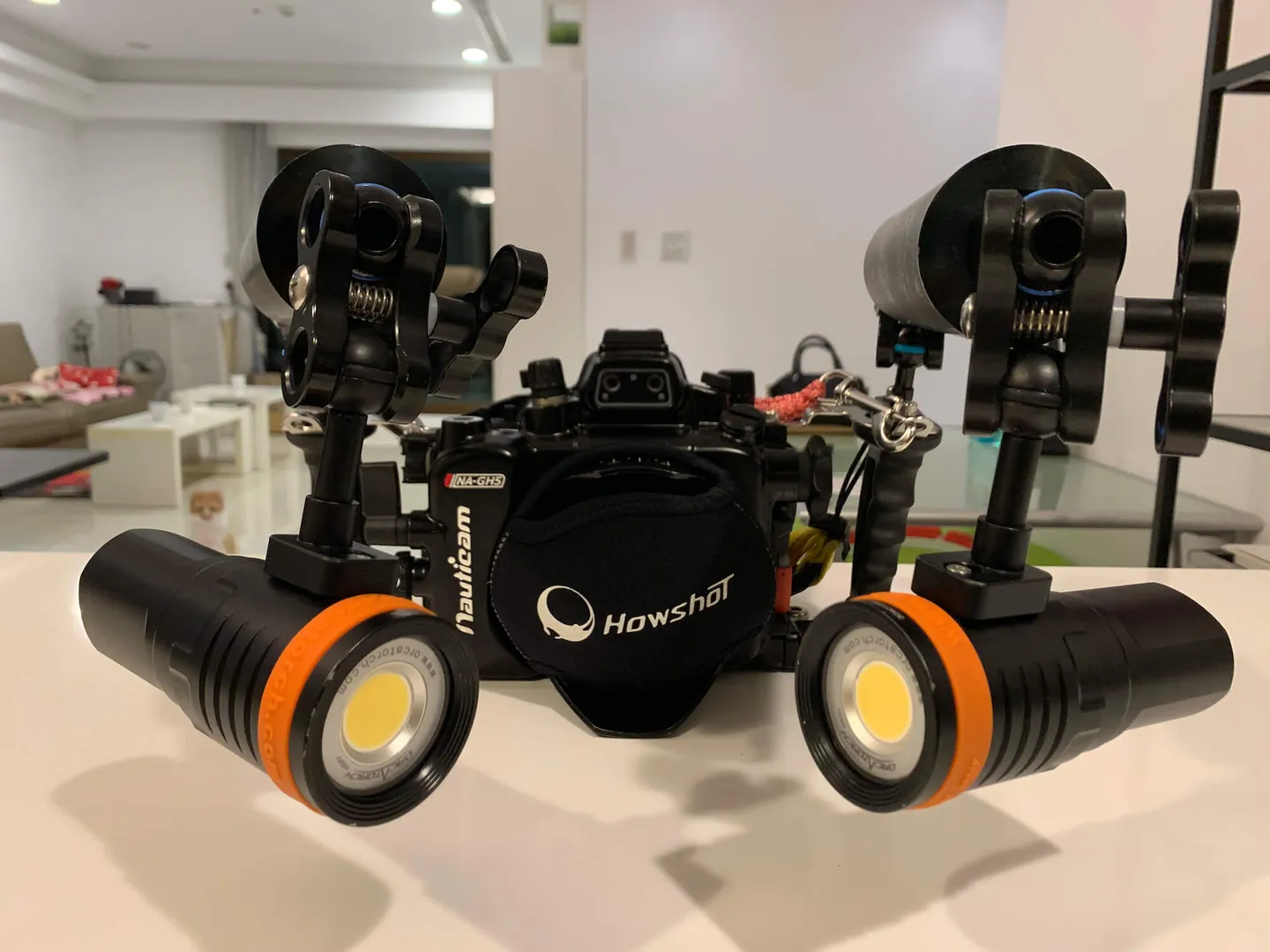
The full rig with camera attached
There are a few key specs worth considering when shopping for a video light. The first is beam angle. Unlike a dive Torch, which pursues a tight, long-throw spot beam, a video light needs to illuminate as wide an area as possible to avoid dark edges or exposure drop-off in the frame — which would severely limit usable footage. The D910V offers 120° wide-angle illumination; with one on each side, it can cover virtually any wide-angle lens.
The second key spec is Color Rendering Index (CRI). This value describes how accurately a light source reproduces the true colors of objects. The higher the CRI, the closer the color rendering is to that of an ideal reference light or natural sunlight. The D910V has an Ra value of 92 (with 100 representing a perfect match to natural light), so its color reproduction is impressively natural.
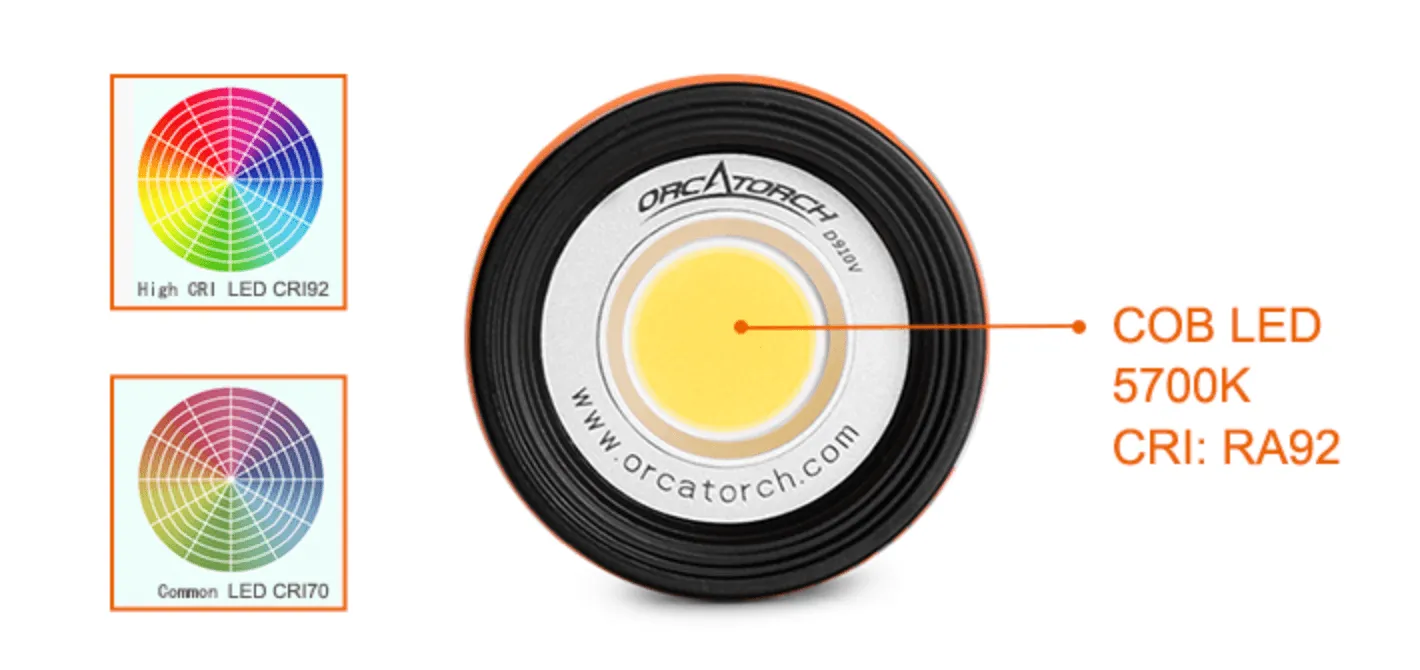
Official website screenshot illustrating the difference a high CRI makes
The D910V also uses a COB (chip-on-board) LED module. COB technology delivers high luminous flux density, spreading light more evenly across a surface and reducing hotspots and glare. It also allows the addition of red chips to further boost the CRI mentioned above — making it the mainstream design choice for video lights today.
Underwater test footage:
Here's how the D910V performs with both lights switched on:

With the lights off, the image is a flat, lifeless blue

Left D910V switched on — color is partially restored on the left side

Both lights on simultaneously — a magical moment is born
The three images above were shot straight out of camera with zero color grading or white balance adjustments — purely in the spirit of experimentation, to show the true color rendition. Now let's take a look at some actual video footage.
The video above has had a LUT applied in post-production, so the colors don't represent the raw footage, but you can still appreciate how the high CRI gives you more flexibility during color grading.
The video above also has a LUT applied in post, so again the colors aren't representative of the raw output — but you can clearly see the advantage of the light's 120° wide-angle coverage. As for the murky, particle-heavy footage, anyone who has dived at the Northeast Coast will immediately understand the reality of 3-metre visibility (laughs).
All of the underwater footage in the video above was shot using two D910V lights — and we're really happy with how the colors came out!
Throughout this year, BlueTrend will continue producing underwater photography and videography content, and the ORCATORCH D910V will be one of our most relied-upon pieces of kit. In the brief time we've spent shooting with it so far, we've pieced together a few tips to share:
-
No matter how powerful your video light, its effective range is still only a few metres. Natural light helps whenever it's available.
-
In poor visibility or at night, get as close to your subject as possible.
-
Higher lumens isn't always better — output should be matched to your camera settings.
-
If you're shooting video, learning post-production is a must. The Editor uses Final Cut Pro — expensive, but absolutely worth it.
-
Shooting in a log format is recommended; for Panasonic, that's V-Log. It gives you far more latitude to adjust and correct in post.
Further reading: