

The Editor says: Dive sites around the world that harbour underwater archaeological ruins tend to become extraordinary diving experiences — including Yonaguni, just off Taiwan's coast, and even Turtle Island off Yilan, which has recently been claimed to host an underwater pyramid. If Taiwan could dedicate more resources to underwater archaeology, perhaps one day we will make truly unexpected discoveries. Source: Xu Yuhe's Facebook
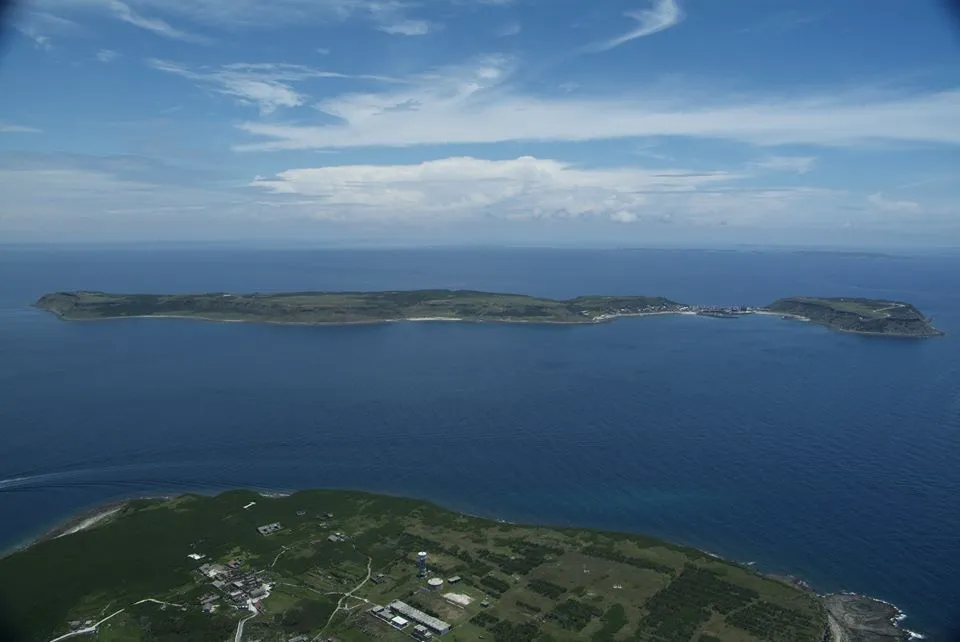
Hujing's Sunken Depths, Still and Silent
Hujing — known in 17th-century foreign maps as Groote Taeffel — appears in a chart titled Kaart van het Eyland Formosa en de Eylanden van Piscadore (Map of the Island of Formosa and the Pescadores Islands), drawn between 1642 and 1653, which already records the existence of Hujing Islet. References to Hujing appear repeatedly in the Dagregisters van het Kasteel Zeelandia; for example, the entry for 6 March 1631 reads: "…and so the Beverwijck bade us farewell and set sail that same night, whereupon we too weighed anchor. On the night of the 7th we arrived at Penghu and anchored beneath that large Table Island (Groote Taeffel)." In 1683, when Shi Lang led his fleet in the assault on Penghu, he also mentioned Hujing in his memorial Qing Jue Ji Jin Jiao Shu: "…On the fifth day, in the wei hour, we reached Penghu's Cat Islet. The ships were not yet ready to advance lightly, so we anchored at Hua Islet. At dawn on the sixth, I led the fleet past Hujing and around Shi Islet Head, where we sighted that Liu Guoxuan's rebel vessels were all moored at Magong…" By the early Qing dynasty, families surnamed Weng and Chen had already settled on Hujing to herd sheep and farm the land. Yet nothing has brought Hujing greater renown than the legend of the "Sunken City of Hujing."
The Penghu Xu Bian (Supplement to the Gazetteer of Penghu), compiled during the Daoguang reign of the Qing dynasty, had already enshrined Hujing澄淵 (Hujing's Clear Depths) among the Eight Scenic Wonders of Penghu. Poems written in contemplation of the sunken city beneath the waters of Hujing Islet are beyond counting:
How did a strong city come to stand on the river bed, Through how many turns of the sea into mulberry fields? Lonely mountains and rivers bear the grief of the past, A maritime fortress that stood guard in a once-clear age. Hard to find the battlements piled a thousand layers high, Yet one can still see a stretch of crumbling wall leaning to one side. I wish to burn a rhinoceros horn and let its light reveal, The brilliance hidden beneath the chin of the black dragon.
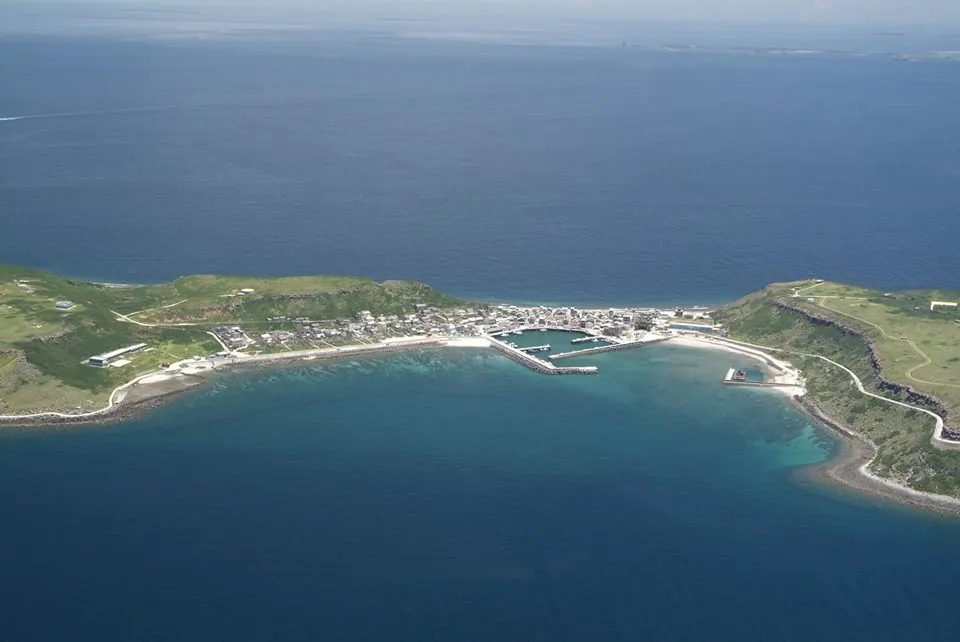


Yet the treacherous and unpredictable currents here have kept the Sunken City of Hujing well beyond the reach of ordinary visitors.
The mystique of the "Sunken City of Hujing" has nonetheless attracted international attention and spawned countless theories. In 1982, prominent figures in Taiwan's diving community, Xie Xinxi and Su Yuan, led two dive teams — sponsored by the United Daily News Group — on an underwater expedition, during which they discovered stone walls on the seabed running north to south, rising approximately 3 meters above the seafloor. In 1996, with government approval, a Japanese team invited Xie Xinxi to return to Hujing to dive the stone walls, and they discovered additional walls running east to west, perpendicular to the north–south walls, forming a cross-shaped castle-like structure, with a circular structure approximately 20 meters in diameter at the northern end.
The findings of these expeditions have been widely reported. Some researchers believe the structures are natural formations produced by Penghu's basalt geology, while the majority regard them as man-made constructions. Various theories have emerged: some hold that the Sunken City of Hujing dates to the Sui dynasty; others believe it was a red-brick fort built by the Dutch. Speculation has run wild in every direction.
Professor Huang Shiqiang of National Taiwan University, however, argued that Penghu's crust has undergone no major geological shifts over the past ten thousand years. The only significant change occurred before the Ice Age — roughly between 12,000 and 80,000 years ago — when sea levels were approximately 106 meters lower than today. The Taiwan Strait was then a continental shelf, and numerous ancient biological fossils and stone tools have been dredged from the Penghu Channel over the years; in recent years, the archaeological discovery of the Penghu Archaic — an ancient human specimen — has further confirmed that this area was once dry land, a fact now broadly accepted by the scholarly community. Professor Huang also concluded that the Sunken City of Hujing was most likely built on the continental shelf during the Ice Age.
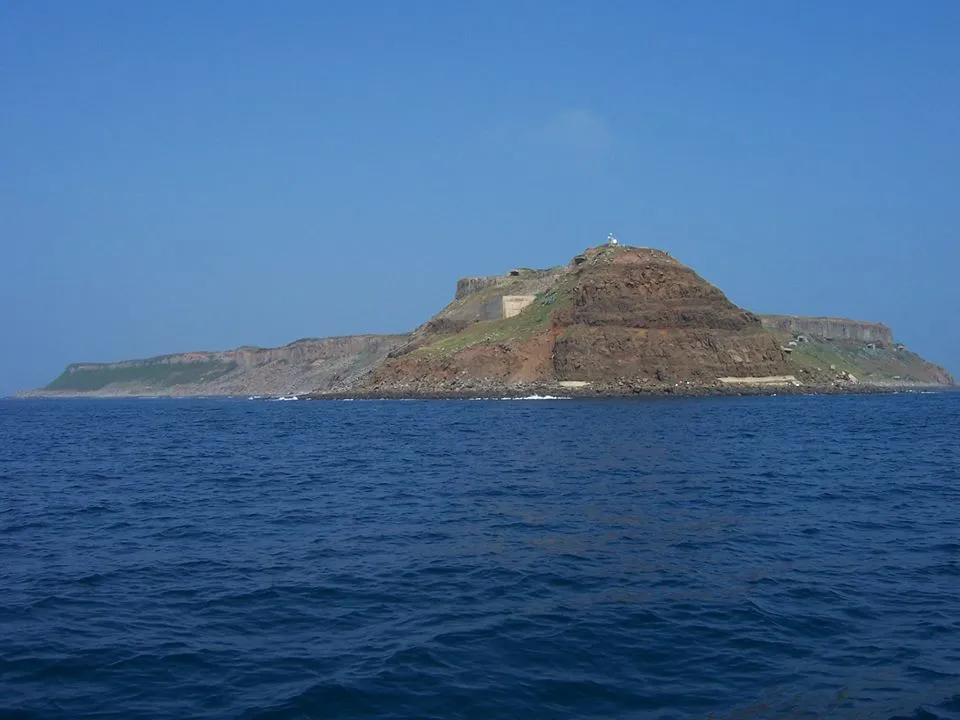
After nearly 200 years, the Sunken City of Hujing still has no definitive explanation. Is it that we have chosen not to unravel this mystery, or is it truly beyond our capability? Let me turn the clock back a hundred years to glimpse the courage of our Penghu ancestors who dared to explore, and the ingenuity with which they made use of the Sunken City of Hujing. The following is a report titled Hujing Sunken City, published in the Taiwan Daily News (臺灣日日新報) on 5 September 1905, the 38th year of the Meiji era:
To the east of Hujing Islet in the Penghu Islands, roughly one li or more offshore, there lies a sunken city on the seabed. It stands tall and imposing. Its battlements of grey brick remain entirely intact, not the slightest bit displaced. Recently, more than ten fishermen from Tongpan Village rowed a net boat into this sunken city and cast their nets to encircle blacktip fish, catching some seven or eight hundred catties in all. Those skilled at swimming and able to hold their breath walked a full circuit inside the city and reported that this sunken city is slightly smaller than Magong City. Gates were built to the east, west, and south, but there is no northern gate. The city towers are also not particularly grand. On clear, sunny days, the water is so transparent that the bottom is visible, and the fish swimming about the battlements can be counted one by one — leisurely and unafraid of people. As for when and in what dynasty this city was built, no one knows for certain. Some say that when the Dutch occupied Penghu, they had already built this city on the hill as a defensive fortification, and that at some unknown point in time it toppled into the sea, where it still stands upright to this day. This too is one of the wonders spoken of by seafarers who venture into the open ocean.
More than a hundred years ago, the ancestors of Penghu dove into the waters of the Sunken City of Hujing on a single breath, used its grey-brick battlements to encircle and catch fish, and gave a vivid, clear description of the scale and appearance of the sunken city: "This sunken city is slightly smaller than Magong City. Gates were built to the east, west, and south, but there is no northern gate. The city towers are also not particularly grand." What a remarkable account of the Sunken City of Hujing! More than a hundred years later, we possess the most advanced equipment and technology. If we carry within us a spirit of inquiry, how can we afford to turn a blind eye to what our ancestors achieved?
Frequently Asked Questions
How is a BlueTrend dive trip different from an unknown, no-name dive group?
Choosing us means full peace-of-mind protection and a smooth experience from start to finish. Every trip we run holds to three things.
First, full legal protection and a professional dive leader: we strictly follow Taiwan's travel regulations and provide complete travel-agency liability insurance, travel insurance, trip-inconvenience insurance and dive insurance. Every group is accompanied by a certified, foreign-language dive leader who joins you on both the dives and the land itinerary, liaising seamlessly with local dive shops and operators on your behalf to keep things running smoothly — the person our travellers trust most.
Second, fully licensed with secure payments: every payment goes into a licensed travel agency's account, with multiple safe payment channels (bank transfer, credit card and more) and a legal collect-and-remit receipt, so every transaction is open, transparent and protected, avoiding the fraud and dispute risks of transferring money privately to an individual.
Third, hand-picked quality we vet in person: every trip, dive site and partner shop is scouted on the ground by our own team, from the guides' professionalism and safety standards to the food, lodging, environment and service details on land, all vetted by us so you don't get caught out.
I want to sign up for a dive trip. Are there certification-level or logged-dive requirements?
Each dive site is different, so the entry bar varies. 'Bali Tulamben', for instance, is relatively beginner-friendly. 'Malapascua in the Philippines' is also beginner-friendly, but since thresher sharks tend to cruise between 20 and 30 metres, we recommend AOW certification with 20+ logged dives to enjoy this trip comfortably. For 'the Maldives' or 'Palau', we suggest AOW with 50+ logged dives for a more relaxed experience. If you're not sure whether your experience fits the trip you want, message us and our dive editors will assess it and help you find the trip you'll feel safest on.
Can I join if I'm signing up alone? How are rooms arranged?
Plenty of our travellers sign up solo! For rooms and beds, we prioritise pairing you with a same-gender traveller, and if you'd rather have your own space you can pay the difference to upgrade to a single room. For the diving, our professional leader will pair you with a suitable buddy, and with the happy vibe on our trips you'll quickly make a great group of dive friends. Many people sign up alone, make new friends, and end up organising the next trip together!
Does the trip fee include dive insurance, gear rental, taxes and instructor tips?
It depends on the trip, the destination's regulations and the local operators. Every BlueTrend dive trip has a detailed web page with a clear 'included / not included' list, transparent and with no hidden charges. All payments are collected by a licensed travel agency, with a standard-form contract for your protection.
I'm a new diver / haven't dived in a long time — will I fall behind the group?
Before you complete your booking, our team assesses a suitable trip based on your certification level and experience. Before departure, we strongly recommend taking time to refresh in Taiwan with an instructor, or a fun dive to get your feel back. On the trip itself, our professional dive leader groups and pairs everyone by experience, keeps a close eye underwater on travellers who need extra care, and steps in to help right away.
Will the photos and videos taken during the trip be shared with us?
During the dives, 'safety' is always the leader's top priority, so whenever it's suitable and safe the leader will capture great shots and record the best moments. During or after the trip, we compile a cloud album for all travellers to download, so you go home loaded with memories!
Besides your scheduled trips, can you arrange a private group charter or independent travel for me and my friends?
Absolutely! Besides group trips, we also arrange private group charters and independent travel. We can communicate, enquire and coordinate services with local operators based on your needs, saving you time and effort and taking the language barrier off your plate, to tailor the smoothest, most reassuring dive trip just for you. Contact our LINE support and our editors will arrange it for you!

![[Fall in Love with Sailing with a Young Captain] Offshore Living — Sailing to Penghu Southern Four Islands National Park: Dongyu Ping](/_astro/%E5%B0%81%E9%9D%A2-1_Z6ryfN.webp)