![[Philippines – Malapascua] Reunited with the Dreamlike Thresher Shark After 3 Years!](/_images/67d581fdcc51-1440w.webp)
After more than three years apart, Taiwan finally reopened its borders — and I was able to return to the Philippines, a country I had traveled to so frequently before the pandemic.
This trip brought me back to the little island I'd been longing for: Malapascua (Chinese transliteration: 媽拉帕絲瓜), known to some as Malapascua (Mama Island) or Sigua Island. Malapascua is a small island located off the northern tip of Cebu.
Think of it as a secondary offshore island. It's a bit remote and not exactly a famous tourist destination — yet it's an absolute paradise for diving enthusiasts! This is because Malapascua is one of the only places in the world where you can encounter Thresher Sharks almost every single day.
How Do You Get There?
We flew directly from Taiwan to Mactan–Cebu International Airport — a flight of just 3 hours. From the airport, it takes roughly 3.5 hours by car to reach Maya Pier, then another 30–40 minutes by boat to arrive on the island.
There are public ferry boats departing every 30 minutes, but trips are cancelled if fewer than 10 passengers are on board. You can also charter a private boat as a group. One important thing to note: ferries heading to Malapascua only run until around 5 p.m. and stop after dusk. If you want to reach the island on your arrival day, make sure to book a flight that lands in Cebu before noon.
Most divers fly into Cebu on the morning of the first day, hire a private car directly to the pier, grab lunch along the way or have the driver stop at a fast-food drive-through, arrive at the pier around 4 p.m., and reach the island by around 5 p.m.
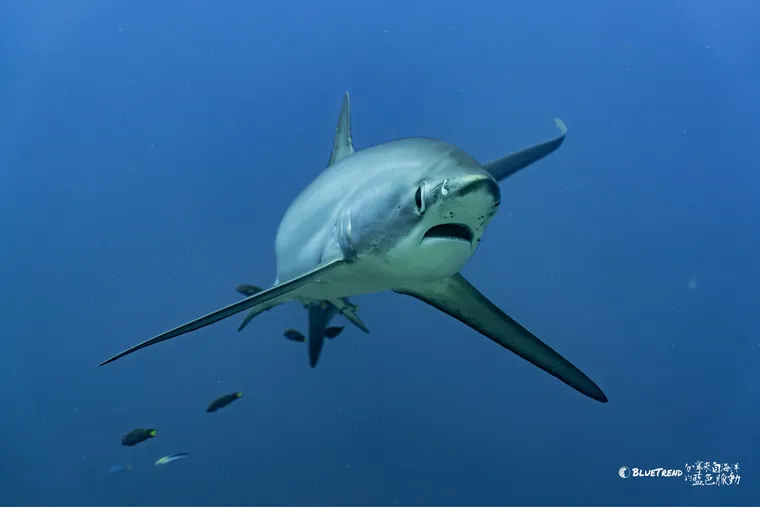
The Thresher Shark gets its name from its tail, which equals the length of its body. That elongated tail actually serves a purpose — it's used to stun prey. When a Thresher Shark swims, its tail sways with the elegance of a ribbon in the wind. And those eyes — big, round, and impossibly adorable. I'll never forget the moment, years ago, when one swam right up to me and we locked eyes. It moved me to tears.
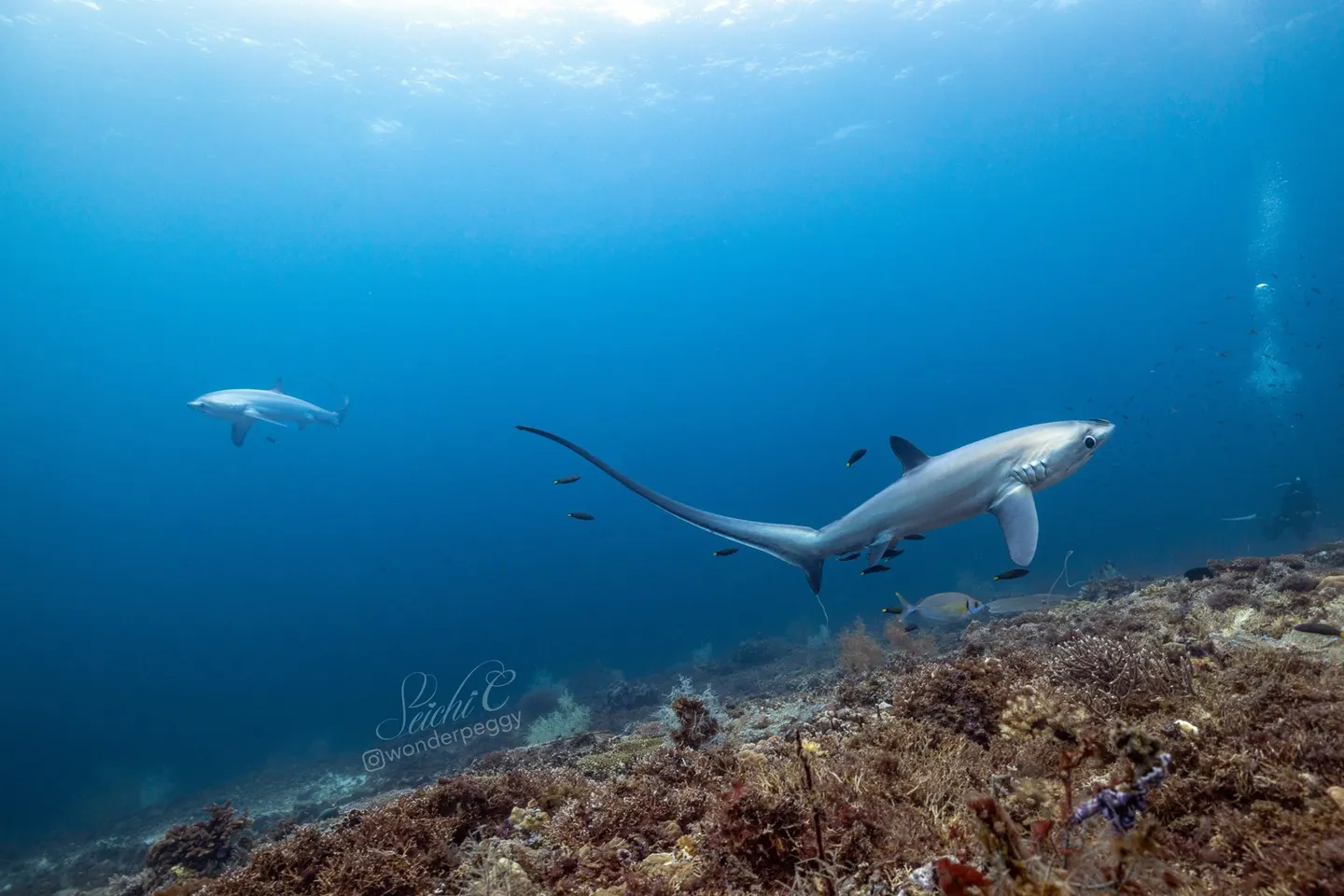
Thresher Sharks normally inhabit deep waters beyond the reach of recreational divers. Only in the early morning do they rise to shallower cleaning stations — once the sun climbs higher, they retreat to the depths.
To see the sharks, you'll gather at around 4:30 a.m. and take nearly an hour's boat ride to the dive site. Yes, it's that early! But waking up before dawn is absolutely worth it for the Thresher Shark.
Before the pandemic, I visited three times. Back then, the cleaning station sat at around 30 m depth — a platform at the edge of a cliff. A long rope was stretched in front of the cliff face to mark a boundary divers were not allowed to cross. The sharks would glide back and forth along the wall outside, letting the cleaner fish there give them a full spa treatment. The platform served as the viewing area for divers, and dive guides would lead everyone in spotting the Thresher Sharks while making sure no one strayed past the boundary rope. Everyone crowded along that rope, like an audience watching a 4DX film playing out right in front of them.
Most of the time the sharks kept a comfortable distance from the divers. But on a quieter day with fewer people around, I watched a Thresher Shark slowly glide straight toward me, then pass right over my head — close enough that I could have reached up and touched it. The awe and emotion of that moment are etched into my heart forever.
On this trip back, I found that the dive site had changed. Tiger Sharks had appeared at the original cleaning station, Monad Shoal, so Kimud Shoal has now become the Thresher Shark's preferred spa destination.
It's a beautiful spot. The platform sits at around 10 m, dotted with clusters of coral and a kaleidoscope of reef fish. Thresher Sharks frequently glide up onto the platform to receive their grooming services. I noticed there are more Thresher Sharks here now, and they seem far less shy. The dive guides ask divers to stay low on the platform, near the bottom, and not to swim higher than the sharks — lest they be startled away. Some Thresher Sharks even seem curious about the divers, making rounds between different dive groups like a diligent part-time worker doing the rounds. You look at them, they look at you — and the moment you meet those big, round eyes, you simply melt.
My theory for why they can get so close to divers:
- They've learned that these creatures pose no threat.
- They're genuinely curious about these bubble-blowing beings.
Everyone now has a much better chance of coming face-to-face with them up close.


The Thresher Shark Cleaning Station
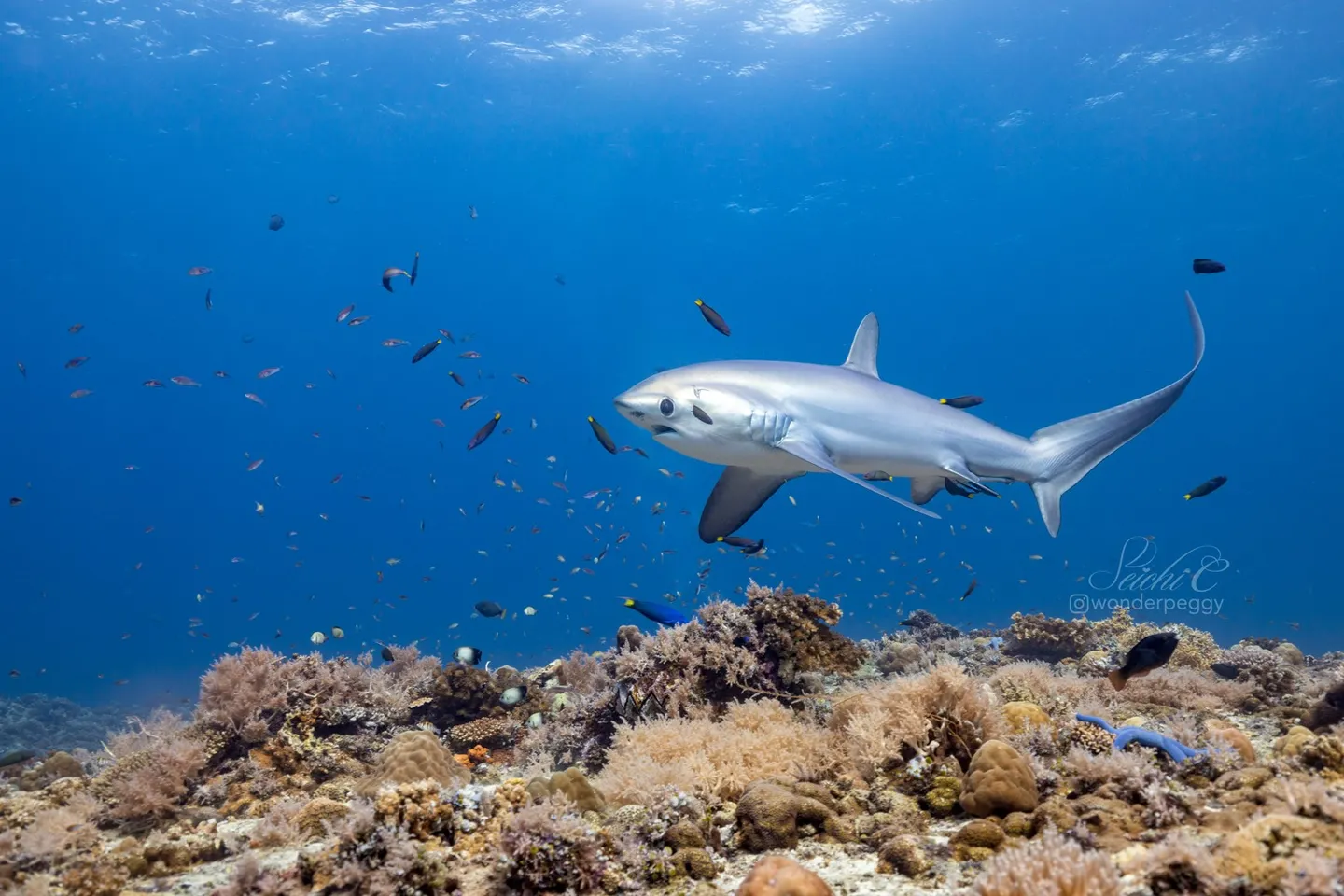
What's more, the Thresher Sharks now spend even longer at the cleaning station than before. On this visit, I surfaced after the first dive, had breakfast, and went back in for a second tank — and they were still there!
Being able to see Thresher Sharks every single day, across two full dives each day, is pure bliss. That said, the seafloor is carpeted with branching coral, so divers absolutely must maintain excellent neutral buoyancy or find a clear sandy patch to settle on. Please don't crush hard-won coral growth just to get a better shot of the sharks!
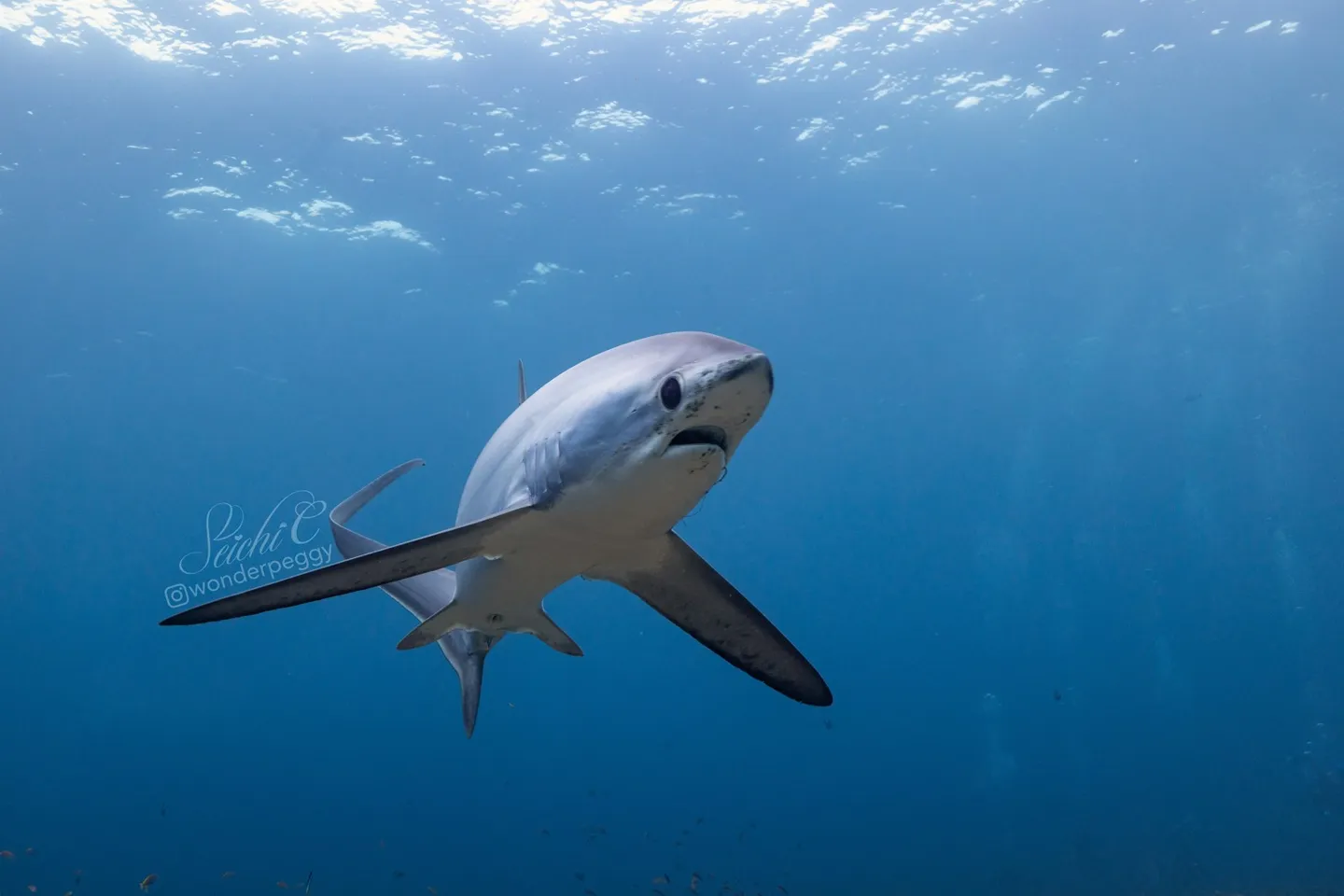
One day, we encountered a particularly bold Thresher Shark that circled around us for a very, very long time. Friends who were diving with a different group that same day independently sent us videos of the same shark — its world tour had everyone grinning from ear to ear!
The Approachable Thresher Shark
But looking closer, we spotted a fish hook caught at the corner of its mouth. This new dive site was actually discovered because local fishermen — who fish in these waters — told the dive guides they frequently saw Thresher Sharks leaping out of the water, which is how everyone learned the sharks had moved here.
Every day we saw many fishermen working these waters, each in their small outrigger boat. Their livelihoods likely depend entirely on whatever fish they can catch. If the fishermen had alternative work, perhaps they wouldn't need to spend each grueling day fishing — and fish hooks wouldn't end up snagged in marine life. But this is one of the great unsolvable dilemmas of our time: so difficult, so complicated.
Since the pandemic, a great deal of coral at this site has already been damaged by divers. I sincerely hope that anyone planning to visit holds at least an Advanced Open Water Diver certification and has around 50 logged dives, with confident command of neutral buoyancy, before heading out to see the Thresher Sharks.
We seek healing in the company of these wonderful Thresher Sharks. Let's honor that gift by protecting them — so they can go on living in this beautiful environment for years to come.
Further Reading:
Frequently Asked Questions
How is a BlueTrend dive trip different from an unknown, no-name dive group?
Choosing us means full peace-of-mind protection and a smooth experience from start to finish. Every trip we run holds to three things.
First, full legal protection and a professional dive leader: we strictly follow Taiwan's travel regulations and provide complete travel-agency liability insurance, travel insurance, trip-inconvenience insurance and dive insurance. Every group is accompanied by a certified, foreign-language dive leader who joins you on both the dives and the land itinerary, liaising seamlessly with local dive shops and operators on your behalf to keep things running smoothly — the person our travellers trust most.
Second, fully licensed with secure payments: every payment goes into a licensed travel agency's account, with multiple safe payment channels (bank transfer, credit card and more) and a legal collect-and-remit receipt, so every transaction is open, transparent and protected, avoiding the fraud and dispute risks of transferring money privately to an individual.
Third, hand-picked quality we vet in person: every trip, dive site and partner shop is scouted on the ground by our own team, from the guides' professionalism and safety standards to the food, lodging, environment and service details on land, all vetted by us so you don't get caught out.
I want to sign up for a dive trip. Are there certification-level or logged-dive requirements?
Each dive site is different, so the entry bar varies. 'Bali Tulamben', for instance, is relatively beginner-friendly. 'Malapascua in the Philippines' is also beginner-friendly, but since thresher sharks tend to cruise between 20 and 30 metres, we recommend AOW certification with 20+ logged dives to enjoy this trip comfortably. For 'the Maldives' or 'Palau', we suggest AOW with 50+ logged dives for a more relaxed experience. If you're not sure whether your experience fits the trip you want, message us and our dive editors will assess it and help you find the trip you'll feel safest on.
Can I join if I'm signing up alone? How are rooms arranged?
Plenty of our travellers sign up solo! For rooms and beds, we prioritise pairing you with a same-gender traveller, and if you'd rather have your own space you can pay the difference to upgrade to a single room. For the diving, our professional leader will pair you with a suitable buddy, and with the happy vibe on our trips you'll quickly make a great group of dive friends. Many people sign up alone, make new friends, and end up organising the next trip together!
Does the trip fee include dive insurance, gear rental, taxes and instructor tips?
It depends on the trip, the destination's regulations and the local operators. Every BlueTrend dive trip has a detailed web page with a clear 'included / not included' list, transparent and with no hidden charges. All payments are collected by a licensed travel agency, with a standard-form contract for your protection.
I'm a new diver / haven't dived in a long time — will I fall behind the group?
Before you complete your booking, our team assesses a suitable trip based on your certification level and experience. Before departure, we strongly recommend taking time to refresh in Taiwan with an instructor, or a fun dive to get your feel back. On the trip itself, our professional dive leader groups and pairs everyone by experience, keeps a close eye underwater on travellers who need extra care, and steps in to help right away.
Will the photos and videos taken during the trip be shared with us?
During the dives, 'safety' is always the leader's top priority, so whenever it's suitable and safe the leader will capture great shots and record the best moments. During or after the trip, we compile a cloud album for all travellers to download, so you go home loaded with memories!
Besides your scheduled trips, can you arrange a private group charter or independent travel for me and my friends?
Absolutely! Besides group trips, we also arrange private group charters and independent travel. We can communicate, enquire and coordinate services with local operators based on your needs, saving you time and effort and taking the language barrier off your plate, to tailor the smoothest, most reassuring dive trip just for you. Contact our LINE support and our editors will arrange it for you!