Contents(5)
The Editor says: Starting in 2019, the Ocean Conservation Administration (OCA) has rolled out a variety of "Marine Citizen Scientist Training Programs," encouraging the public to take part in citizen science activities — from observing dolphins and whales, sea turtles, and coral reefs to even seagrass meadows. These programs not only cultivate citizen scientists but also help collect and report ocean-related data for further research. Come join BlueTrend in becoming a marine citizen scientist! <Full article reprinted from the Environmental Information Center, by special correspondent Li Yu-chin, reporting from Tainan, 2024.05.07>
Citizen science is a popular and widely applied scientific survey method in recent years. Scientists gather members of the public who are interested in science, and after basic training, participants observe and record findings in their everyday lives — all it takes is a smartphone to contribute to scientific research. In Europe and North America, using citizen scientists to conduct surveys is already very common, especially in research on conservation, biodiversity, and climate change, allowing related research to advance rapidly.
Since 2019, the OCA has launched its "Marine Citizen Scientist Training Program," inviting the public to participate in citizen science activities covering dolphins and whales, sea turtles, fishing, coral reefs, and more, helping to collect and report ocean data. Combined with local community stewardship initiatives, the program has expanded into different thematic categories, and to date there are already 50 marine citizen science projects underway in Taiwan. This year, the OCA also organized one-day marine citizen scientist experience events, inviting the public to participate and become marine citizen scientists, further assisting ocean science research and influencing marine conservation policy.
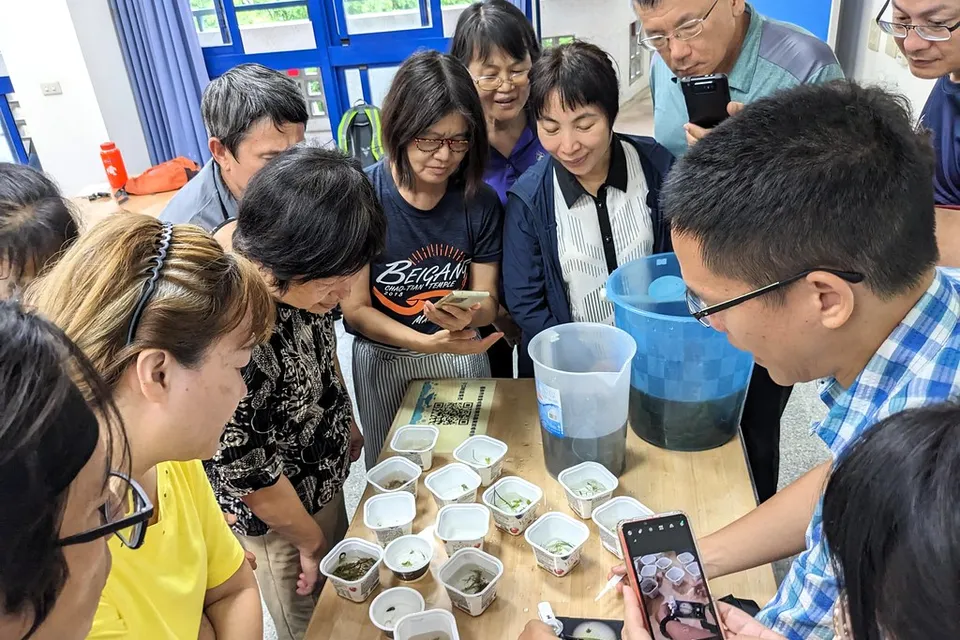
The OCA hosts a seagrass citizen scientist experience event, introducing participants to the seagrass of the Jiangjun Salt Fields. Photo: Li Yu-chin
Fun and Engaging Citizen Science Activities Draw Public Participation
This year's OCA one-day marine citizen scientist experience events targeted surveys including beach microplastics, seagrass, clams, and tri-spine horseshoe crabs, bringing participants into real marine environments to learn citizen science survey methods and gain a deeper understanding of marine conservation issues.
"The most important part of citizen science is the citizens," said Yen Ning, CEO of Cheng-Yang Environmental Consulting, the company contracted to run the OCA's citizen scientist experience events. Without everyone coming together to participate, scientists would have to conduct surveys on their own and would be unable to gather sufficient data in a short time. For this reason, the citizen science survey process must be fun and interesting, so that people are willing to join in.
The reasons people participate in citizen science are varied — some enjoy going out into nature, some come with friends for a shared activity, and some local community members want to care for the environment around their homes. Citizen science is like a game, allowing people to take part with a sense of joy. The survey data collected can be used by scientists to publish research papers, or communicated to the public through media coverage, raising awareness among more people and potentially driving changes in government policy.


How to Tell Seagrass from Seaweed? Citizen Scientists Monitor with a Single Smartphone
In late April, a group of citizen scientists arrived at the fan-shaped Jiangjun Qingkunshen Salt Fields in Tainan. Their survey target was seagrass — a species that appears in only a handful of locations in Taiwan and in very sparse numbers.
The seagrass meadows along Tainan's coast were fragmented in the past due to salt field development. After salt production ceased, the fields were transformed into tourist attractions, with the installation art piece "Tree of Life" standing tall among them, drawing visitors to enjoy and photograph the scenery. However, the citizen scientists who raised their smartphones were not there to capture beautiful views — they were looking down, searching for seagrass among the salt fields.
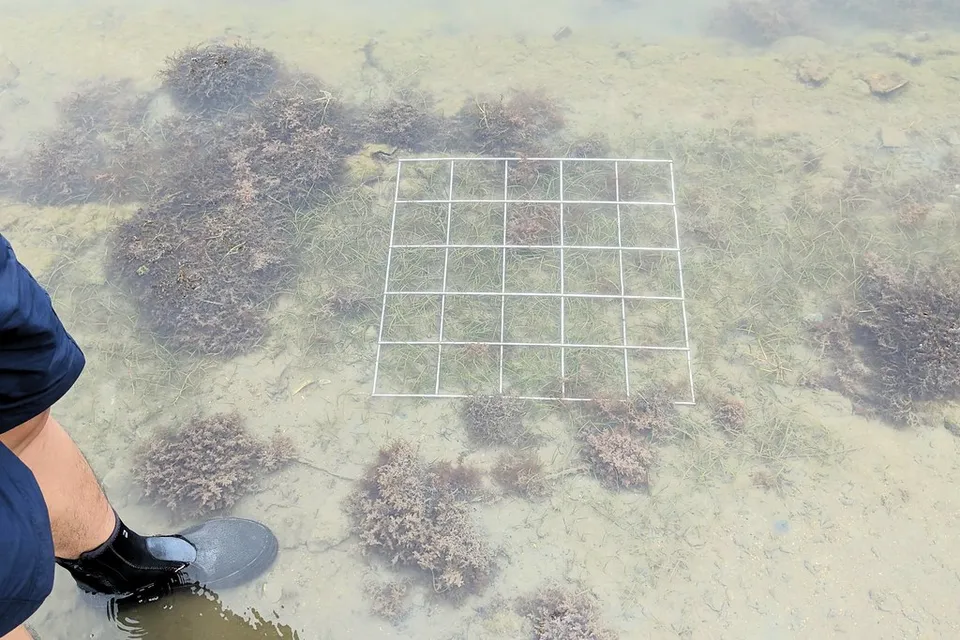
Using a grid tool to count and estimate the proportion of seagrass. Photo: Li Yu-chin
According to surveys, there are 12 species of seagrass along Taiwan's coast, found primarily in the waters of Hsinchu, Gaomei Wetlands in Taichung, Tainan, Chiayi, Pingtung, Penghu, Green Island, Kinmen, and Dongsha Atoll. With the exception of Dongsha Atoll, the vast majority of seagrass meadow areas are very small — less than 1 hectare.
Seagrass citizen science uses grid measurement tools and smartphones to survey seagrass discovered in wetlands, recording information including species, distribution proportion, and plant height, and using Google Maps to pinpoint locations where seagrass is found before reporting the data back to the survey group.
First, however, citizen scientists must be able to identify seagrass. Green plants growing in the saltwater of the salt fields may in fact be seaweed, not seagrass. Cheng-Yang Environmental Consulting Research Director Hu Jie-shen explains that seagrass is a submerged vascular plant that lives in shallow coastal waters; it has roots, stems, and leaves, and flowers and bears fruit. Seaweed, on the other hand, is not a plant — it has no fiber and is an alga made up of many single cells joined together. Before conducting surveys, participants can consult a field guide to familiarize themselves with the species and appearance of seagrass.
Seagrass Plays Vital Ecological Roles — More Monitoring and Attention Are Needed
Common seagrass species found in Tainan's salt fields include Halodule uninervis and Halophila ovalis. During the event, participants also learned about the ecology and environmental significance of seagrass, and used smartphone microscopes to examine collected seagrass samples and the organisms living within them.
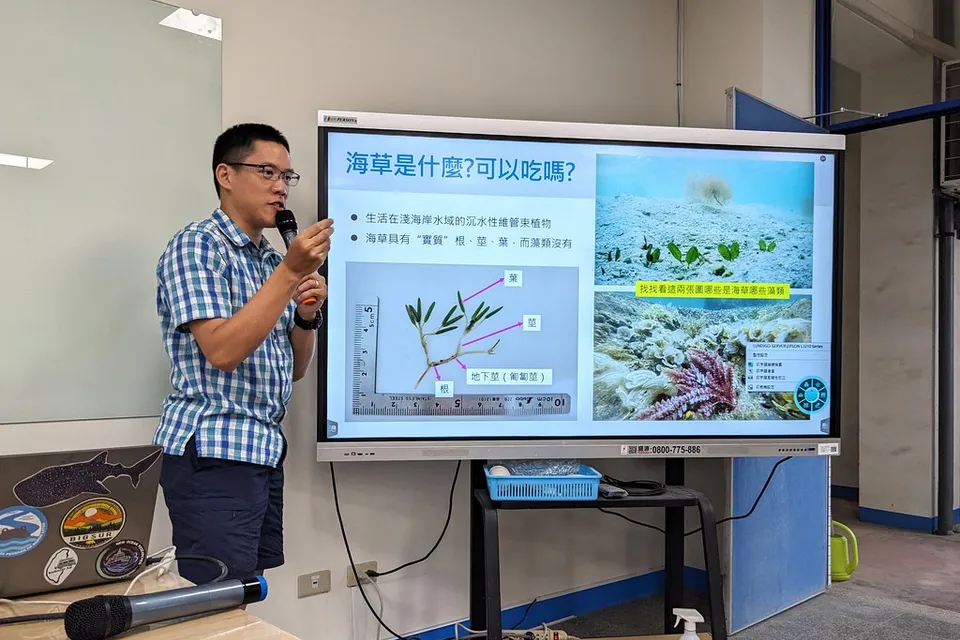
Before conducting a citizen science survey, the first step is learning what seagrass actually is. Photo: Li Yu-chin
Hu Jie-shen explains that seagrass meadows are like forests beneath the sea, housing a complete ecosystem with important ecological functions. Many algae, plankton, and small organisms live within them; seagrass serves as food for sea turtles, dugongs, and other creatures; and some large fish species spend their juvenile stages in seagrass meadows. Additionally, in the context of climate change adaptation, seagrass meadows help prevent coastal erosion and hold significant value for carbon sequestration.
Awareness of seagrass is not high in Taiwan, and public knowledge of it is limited. Internationally, however, seagrass citizen science has a long history. Yen Ning points out that "Seagrass Watch" has been conducting seagrass monitoring research through citizen science since 1998, and the UK's "Project Seagrass" invites the public to photograph seagrass wherever they spot it and log the data as an accessible entry-level form of citizen science. Through open use of this data, seagrass-related research has produced 80 published papers. Beyond monitoring, "Project Seagrass" also carries out seagrass seed collection, cultivation, and restoration efforts.
Due to the impact of coastal development and tourist foot traffic, Taiwan's seagrass populations are steadily declining and require more monitoring and attention. Yen Ning notes that the barrier to entry for seagrass citizen science surveys is low — no diving or offshore fishing is required, as surveys can be conducted by simply walking to the shoreline. She therefore encourages local communities and schools to participate together, helping to collect relevant data and ultimately generating greater impact for marine environmental science and seagrass ecosystem conservation.
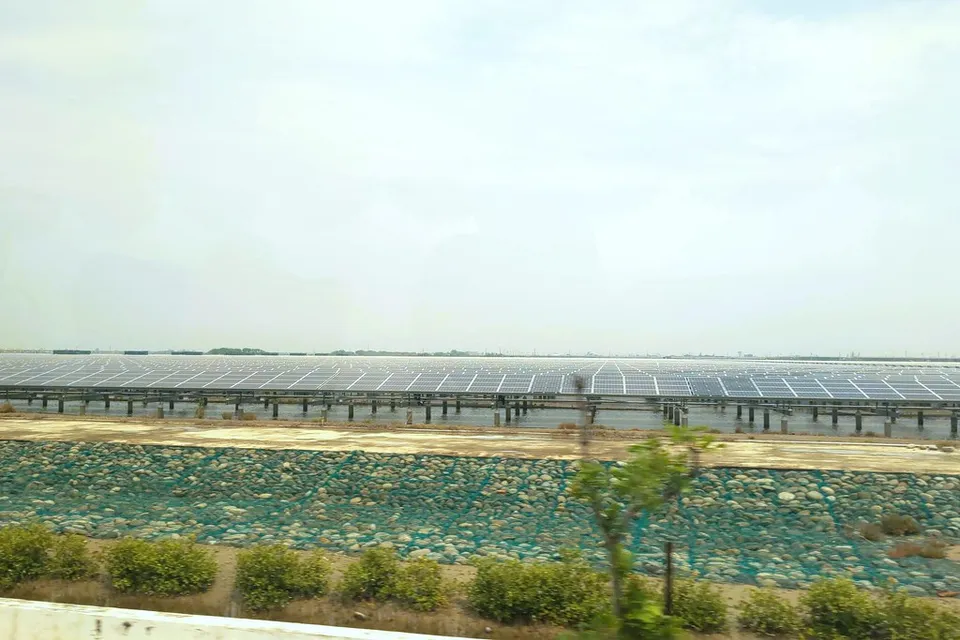
The landscape of old salt field wetlands in Tainan has changed dramatically in recent years due to solar power installations. Civil groups have adopted the wetlands from the National Property Administration to carry out monitoring and sustainable management. Photo: Li Yu-chin
The old salt field wetlands on both sides of Provincial Highway 61 along Tainan's coast have seen dramatic landscape changes in recent years, with the arrival of solar power plants impacting the intertidal zone ecosystem. To protect the wetland environment, civil groups formed the "Qigu-Jiangjun Salt Flat Wetland Restoration Alliance" and adopted 1,605 hectares of salt fields from the National Property Administration. The Taiwan Environmental Planning Association adopted the Qingkunshen Fan-Shaped Salt Fields, conducting ecological surveys and environmental maintenance there, while also organizing a series of citizen science activities to invite local residents and school groups to participate — all aimed at promoting locally collaborative, sustainable management of the salt field wetlands.
Related Links
- Environmental Information Center
- Original article: Protecting Seagrass Meadows: Step into the Salt Fields as a Citizen Scientist
- These People Aren't Catching Pokémon — The Golden Bat Hall Is Training the Next Generation of Citizen Scientists
- Birders, Assemble! Going Beyond Bird Surveys — Taiwan's Bird Distribution Map Is Being Drawn
- Marine Citizen Scientists Gather for the First Time — Being an "Underwater Paparazzo" Is No Longer Out of Reach
Further Reading