

Contents(3)
The Editor says: Green Island and Orchid Island have long been must-visit dive destinations for Taiwanese divers. Rising defiantly from the open ocean far from the mainland, they foster a marine ecosystem entirely unlike the nearshore reefs of Taiwan proper. Bathed year-round in the Kuroshio Current, these waters teem with extraordinary marine life — and their consistently crystal-clear visibility, frequently exceeding 50 m, has earned them worldwide renown. SDI/TDI/ERDI Taiwan dive instructor Yu Ming-Hong shares a comprehensive breakdown of Green Island's dive sites. Start planning your ultra-clear-visibility dive trip to Green Island today!
Green Island: Geography & Getting There
Green Island lies in the Pacific Ocean approximately 33 km east of Taitung County. The island forms an irregular quadrilateral, roughly 4 km north to south and 3 km east to west. You can reach Green Island by boarding a 19-seat propeller plane at Taitung Fengnan Airport and flying to Green Island Airport, or by taking a ferry from Taitung's Fugang Fishing Harbor to Green Island's Nanliao Fishing Harbor. The island offers a wide range of guesthouses and bed-and-breakfasts, and finding simple set meals, full banquet-style dishes, or local specialty restaurants is easy once you start exploring.
Green Island draws crowds in summer, but as long as you avoid periods dominated by cold fronts, winter is also an excellent time to visit. The island's Amei Mountain and Huoshao Mountain block the powerful northeast winds, so while the northeastern shores can be rough, the southwestern waters remain calm enough for water activities. Average seawater temperature is 26°C year-round. Visiting Green Island in winter also means avoiding the scorching summer heat — which can reach 38°C — and the night-market-like crowds of tourists and vehicles.
Itinerary notes:
-
Taipei → Taitung by train: approx. 3.5–4 hours (350 km, one-way NT$783)
-
Kaohsiung → Taitung by train: approx. 3 hours (165 km, one-way NT$362)
-
Taipei Songshan Airport → Taitung Fengnan Airport by plane: approx. 45 minutes (one-way NT$ early bird 1,460 – full fare 2,303)
-
Taitung Fugang Fishing Harbor → Green Island Nanliao Fishing Harbor by ferry: approx. 50 minutes (one-way NT$260)
-
Taitung Fengnan Airport → Green Island Airport by plane: approx. 12 minutes (one-way NT$1,070)
Green Island is a tropical island surrounded by the Kuroshio Current, its waters warm and clear, its climate warm and humid throughout the year. The combined forces of tectonic uplift, sea-level subsidence, and wave erosion have sculpted a coastline of sheer cliffs and dramatic rock formations, reef shelves that spread like the hem of a long skirt, and occasional small sandy beaches. Heat- and drought-tolerant plants such as beach morning glory, Thespesia populnea, and screw pine carpet the shoreline, while the coral reef waters nurture a dazzling array of colourful, striped, and spotted creatures. The island's sunshine, blue skies, and rich biodiversity make it a true gem of Taiwan's southeastern seas.
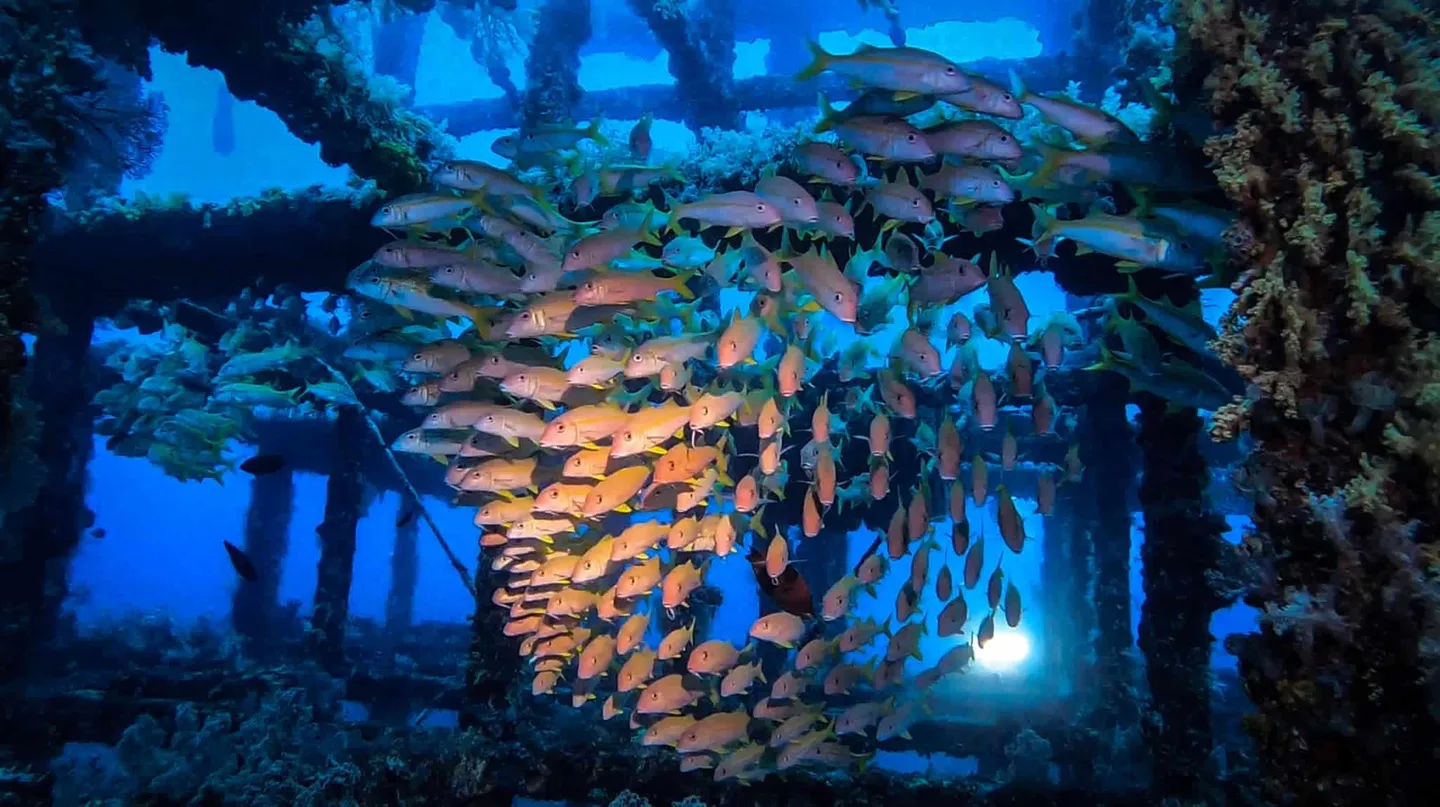
Green Island's remarkable underwater life is a natural treasure, especially within its protected zones, where the variety and abundance of species — and the close encounters visitors can enjoy — never fail to astonish. The most recent biological survey of Green Island's shallow nearshore waters recorded 168 species of molluscs across 56 families, 75 species of crustaceans across 28 families, 48 species of echinoderms across 24 families, and 665 species of fish across 76 families.


Beyond Diving: Green Island's Mysterious Human History
Green Island's rich marine resources have long supported a fishing-based livelihood for many residents. Fishermen here use longlines, pole-and-line fishing, shore fishing, gill nets, trawl nets, and spearfishing to catch fish. The island once exported ornamental coral reef fish to the aquarium trade. During the Japanese colonial era, the Japanese introduced skipjack tuna pole-and-line fishing, and the catch was processed on the island into dried bonito (katsuobushi) for export. Beyond fishing, Green Island was once home to a thriving deer-farming industry; though it has since declined, abandoned deer enclosures can still be found on the island. The island's prison, which held political prisoners and serious criminals, cloaked Green Island in an air of mystery that has captured the public imagination for decades.
Today, providing tourism and recreation services has become the islanders' primary source of income. Visitors can still witness the remnants of the dried bonito industry; sika deer are often tethered outside shops to attract customers; traditional fishing continues, and arriving boats bring in crates of longline-caught fish. Political victims of past injustices have gradually been vindicated through the efforts of many individuals, and a Human Rights Memorial Park now stands on the island. Former prison cells and facilities have been repurposed for commercial recreation.
Get to Know All 11 Green Island Dive Sites at Once
1. Green Island Dive Site — Da Xianggu (Big Mushroom)
This massive Porites coral colony, nicknamed "Big Mushroom," has stood in Green Island's waters since the year 1099 — over 919 years. Its base rests on a sandy seabed at 18 m depth; the sand layer averages 20–60 cm thick, beneath which lies andesite bedrock. The coral stands 10 m tall from base to crown, with the top sitting approximately 8 m below the surface. Bell-shaped Porites corals grow slowly, advancing toward the surface at roughly 1 cm per year, which means Big Mushroom is estimated to be around 1,000 years old.
Near this dive site are three tire reef structures that host a sizeable colony of reticulate damselfish, unique sea anemone species, and dazzling palette surgeonfish (blue tang). The limestone skeleton of Big Mushroom's columnar body is home to an abundance of life — beyond the soft and hard corals, a considerable number of nudibranchs have taken up residence. This site is a remarkably complete ecosystem where virtually every representative species can be found. As of 2018, a confirmed total of 174 fish species have been recorded here.
For divers with sufficient skill and fitness, two routes are accessible. The fastest starts at the tip of the breakwater, heading at a bearing of 270°, covering a straight-line distance of 165 m. If you enter the water from the Shilang Marine Protected Area trail, aim at a bearing of 315° for a straight-line distance of 214 m. How do we know these distances so precisely? Because someone actually measured them with a tape measure. Both routes involve currents to varying degrees — always remember to compensate for the angular drift caused by the current. (This shore dive approach is not suitable for beginners!) The safer option is a boat dive, which cuts out the long swim but means missing the highlights along the shore dive route.
Note: Big Mushroom was toppled by the massive swells of Typhoon Meranti in the summer of 2016 and now sits at a 45° tilt.
2. Green Island Dive Site — Steel Reef
Located in the Guiwan subzone, the Steel Reef has seen its batfish population grow from 12 individuals to 48 — as recorded in March of the 99th year of the Republic of China era — in the four years since the reef was re-deployed. This tells us something important: deploying reef structures requires careful assessment and thorough communication with local communities. Artificial reefs are not inherently unworkable — we have observed nearly 80% coral coverage on the structure. When rare species are discovered, prompt designation of the area as a protected zone by the relevant authorities can genuinely boost the value of both tourism and fishing.
The batfish found at Green Island should properly be called the "longfin batfish." It is one of three species in the genus Platax within the family Ephippidae, with the scientific name Platax teira (Forsskål, 1775). The Chinese name translates as "pointed-fin batfish." Juveniles prefer to inhabit lagoons and shallow reef flats, often mimicking dead leaves and swaying with the waves to evade predators. Juvenile longfin batfish can frequently be spotted in Green Island's Zhongliao and Gongguan harbours. Foreigners commonly call them batfish.
Male longfin batfish develop a pronounced forehead hump, and their cloaca is pointed and narrow; females have a more rounded head and a broad, rounded cloaca. Neither sex shows any difference in their attitude toward humans — both are equally fond of approaching people.
A fascinating behaviour has been observed both at Green Island and abroad: when an artificial rope is placed near a batfish habitat on the seabed, the batfish gather around it in a group and stop wandering from their home territory, forming loose queues near the rope. This phenomenon has only been observed, not yet fully explained, but a bold hypothesis is that the rope creates a prominent vertical landmark that makes the habitat more visible, giving the batfish a wider field of view for foraging.
Since a guide rope was attached to the Steel Reef, it has transformed from a dangerous dive site into an intermediate-level one. Currents here generally flow from northwest to southeast — a thorough dive plan is strongly recommended before diving this site. In addition to the longfin batfish, marine life includes yellowbanded goatfish, angelfish, wrasse, and various coral reef fish from the family Lethrinidae. Among corals, soft corals, staghorn corals (Acropora spp.), and small gorgonians are the most abundant.
3. Green Island Dive Site — Six-Metre Reef
Six-Metre Reef is a small underwater hill that rises from the seabed, approximately 170 m from shore in a straight line. Its top platform sits only 6 m below the surface and is densely populated with anthias and various wrasse species. Nearby is an open-form cave whose tiny inhabitants could keep you busy for two scuba tanks worth of air — you just need to search carefully and patiently.
The small ridge of Six-Metre Reef that rises near the surface runs approximately 50–60 m in horizontal length, and the vertical coral reef face is well worth exploring. Be aware, however, that the longshore current at Six-Metre Reef is quite strong, making a boat dive the recommended approach. Extending further offshore from the reef, at a depth of 33 m, you'll find an expansive forest of whip corals and curling black corals, as well as sea pens, and a spectacular school of roughly 200+ pennant bannerfish (Heniochus chrysostomus) cruising in formation. Three regular sea turtle resting stations are located here, but given the strong currents and depth, you must consult your dive guide for a proper dive briefing and plan.
4. Green Island Dive Site — Shilang Marine Protected Area
The Shilang Marine Protected Area is the finest model marine protected area in all of Taiwan, the result of sustained efforts by scholars and divers dedicated to its protection. This site is less than a one-minute drive from the boat landing pier. Within the protected area, surgeonfish, parrotfish, wrasse, butterflyfish, damselfish, and grouper are so abundant they seem to fill every corner. At high tide in particular, fish of all species congregate in just 1 m of water to feed (grazing on algae off the rocks) — a truly spectacular sight.
In the outer zone surrounding Shilang, four additional landmark dive sites can be found: Middle Mushroom (4.5 m tall), Dragon Head Rock, Back Garden, and Turtle Rock. These sites share a common characteristic with Shilang itself — thriving soft coral growth, which in turn harbours all manner of unusual and fascinating creatures well worth searching out together.
Note: Little Mushroom was knocked over by the typhoon in 2016 and the coral body is still recovering.
5. Green Island Dive Site — Utility Pole Reef
In 2004, the Council of Agriculture's Fisheries Agency deployed 150 decommissioned utility poles as artificial fish reefs along the outer boundary of the Shilang Marine Protected Area's left marker. Why is this a dive site worth visiting? Because you absolutely must come and see just how poorly conceived the policy was. The idea of restoring coral in a place already celebrated as a coral paradise sounds strikingly ill-considered. Today, these artificial reefs lie in haphazard tangles on the sandy seabed. According to international literature, concrete fish reefs have limited fish-aggregating effectiveness and support only slow coral growth; denser wood reefs or steel reef structures, on the other hand, have proven significantly more effective at aggregating fish.
More controversially, the utility poles were deployed directly in the habitat of Heteroconger hassi — the garden eel — whose habitat was severely damaged across a wide area. A population that once numbered around 800 individuals has now been reduced to approximately 400 recorded individuals.
The sea cucumbers found here — including Bohadschia marmorata, Bohadschia subrubra, and two species of pineapple sea cucumbers — are iconic indicator species for this site. Large schools of barracuda are also commonly encountered, making them another guaranteed sighting at this dive site.
6. Green Island Dive Site — Guiwan Point
Guiwan is a dive site where two longshore currents converge: one flowing from north to south past Shilang, and another flowing from east to west past Wugui Cave. The two currents meet at Guiwan and then merge into the main Kuroshio Current at a bearing of approximately 330°. Depths range from about 15 to 30 m. The defining feature of this site is a sweeping aggregation of Lobophyllia corals, accompanied by diverse and abundant coral species overall. Sea turtles and members of the mackerel family (Scombridae) are frequently encountered here.
7. Green Island Dive Site — Jizai Reef
Jizai Reef is formed by an enormous coral reef platform whose base sits at 31 m depth. A steep cliff face drops from the reef's crest at 18 m straight down into the depths beyond 30 m. The dramatic topography and powerful currents attract large numbers of pelagic fish to feed here. Documented characteristic species include yellowback fusilier, bluespine unicornfish, pennant bannerfish, banded trevally, and many-scaled coralfish.
Coral covers the entire reef platform, with staghorn corals (Acropora spp.), encrusting corals (Montipora spp.), and gorgonians being the most prevalent; soft corals are comparatively rare here. The dominant current direction runs from southeast to northwest.
On the southern side of Jizai Reef lies a massive open-mouthed reef formation that has been nicknamed "Crocodile Mouth" for its unmistakable resemblance to a crocodile's gaping jaws. The base of Crocodile Mouth is 33 m deep, with the reef structure rising approximately 7 m. Looking further south beyond the formation, you'll find what is arguably the highest-density gorgonian / sea fan forest in all of Taiwan, blanketing the 30–40 m contour.
Diving this site requires a thorough dive plan and must be conducted under the guidance of a dive guide who is intimately familiar with the terrain, in order to avoid potentially dangerous situations.
8. Green Island Dive Site — Zhongliao Harbour
Zhongliao Harbour sits on the northern side of Green Island, along the road leading to the Green Island Lighthouse. The harbour is approximately 3 m deep and is no longer used for boat mooring — it has become an idle, quiet little port. Its calm, sheltered waters make entry easy, so it has naturally become a swimming spot for tourists and locals alike, as well as the first pool-like dive experience for many dive students. During the busy summer season, sand and silt are easily stirred up by swimmers, clouding the water. As a result, most daytime recreational divers, apart from students, tend to swim away from the harbour area and head north along the navigation channel.
Just outside Zhongliao Harbour, you'll encounter a navigation channel cut through the coral reef, followed by a vertical drop of approximately 4 m, beyond which sandy bottom and small isolated patch reefs appear.
Experienced divers invariably choose to night dive Zhongliao Harbour. Both inside and outside the harbour, invertebrate life is extraordinarily rich. Different species of nudibranchs appear in different seasons, making this one of the favourite sites for macro photographers.
9. Green Island Dive Site — Grand Canyon
This dive site is located approximately 1.2 km offshore from Gongguan Harbor. It shares similarities with the Yi Xian Tian (Crack of Sky) dive site, but the fissures here are significantly larger — the widest crack reaches 8 m across, the smallest 3.5 m, and the crevices plunge 25 m deep. The reef platform base sits at 46 m, with the top of the reef just 3 m below the surface. Currents flow from south to north. The most commonly seen species are surgeonfish from the genus Naso — such as the bluespine unicornfish and Vlaming's unicornfish — along with fusiliers.
10. Green Island Dive Site — Three Rocks
This dive site is located at Green Island's outermost northeastern reef. The base of the reef structure descends to 65 m, while the rocks emerging above the waterline stand 3.5 m above the surface. The prevailing current is the main Kuroshio flow, running from south to north. Characteristic marine life consists largely of surgeonfish and fusilier species, with occasional visits from members of the mackerel family on their migration routes.
11. Green Island Dive Site — Bird Egg Rock Blue Cave
Bird Egg Rock is located on the eastern side of Youzhu Lake. This volcanic rock formation rises from a depth of 22 m on the seabed straight up to 18 m above the water's surface. Viewed from Youzhu Lake from a distance, it resembles an egg nestled in a bird's nest — hence the local nickname "Bird Egg Rock."
On the eastern side of Bird Egg Rock lies a large sea trench with sheer vertical walls on both sides. At its deepest point is a large natural underwater arch, and beyond that, a natural underwater cave. The cave sits at 25 m depth and is a regular resting spot for sea turtles; giant trevally are commonly seen entering the cave in search of prey, and wrasse and moray eel species can also be found within.
Around the cave entrance, numerous small cavities in the rock are home to a handful of resident striped beakfish. Continuing outward and circumnavigating Bird Egg Rock, divers are treated to an underwater landscape reminiscent of a miniature Guilin — a scene of striking beauty. Currents generally run from south to north; outside the cave entrance the current can be strong, and large aggregations of gorgonians / sea fans have colonised this area.
Related links:
Frequently Asked Questions
How is a BlueTrend dive trip different from an unknown, no-name dive group?
Choosing us means full peace-of-mind protection and a smooth experience from start to finish. Every trip we run holds to three things.
First, full legal protection and a professional dive leader: we strictly follow Taiwan's travel regulations and provide complete travel-agency liability insurance, travel insurance, trip-inconvenience insurance and dive insurance. Every group is accompanied by a certified, foreign-language dive leader who joins you on both the dives and the land itinerary, liaising seamlessly with local dive shops and operators on your behalf to keep things running smoothly — the person our travellers trust most.
Second, fully licensed with secure payments: every payment goes into a licensed travel agency's account, with multiple safe payment channels (bank transfer, credit card and more) and a legal collect-and-remit receipt, so every transaction is open, transparent and protected, avoiding the fraud and dispute risks of transferring money privately to an individual.
Third, hand-picked quality we vet in person: every trip, dive site and partner shop is scouted on the ground by our own team, from the guides' professionalism and safety standards to the food, lodging, environment and service details on land, all vetted by us so you don't get caught out.
I want to sign up for a dive trip. Are there certification-level or logged-dive requirements?
Each dive site is different, so the entry bar varies. 'Bali Tulamben', for instance, is relatively beginner-friendly. 'Malapascua in the Philippines' is also beginner-friendly, but since thresher sharks tend to cruise between 20 and 30 metres, we recommend AOW certification with 20+ logged dives to enjoy this trip comfortably. For 'the Maldives' or 'Palau', we suggest AOW with 50+ logged dives for a more relaxed experience. If you're not sure whether your experience fits the trip you want, message us and our dive editors will assess it and help you find the trip you'll feel safest on.
Can I join if I'm signing up alone? How are rooms arranged?
Plenty of our travellers sign up solo! For rooms and beds, we prioritise pairing you with a same-gender traveller, and if you'd rather have your own space you can pay the difference to upgrade to a single room. For the diving, our professional leader will pair you with a suitable buddy, and with the happy vibe on our trips you'll quickly make a great group of dive friends. Many people sign up alone, make new friends, and end up organising the next trip together!
Does the trip fee include dive insurance, gear rental, taxes and instructor tips?
It depends on the trip, the destination's regulations and the local operators. Every BlueTrend dive trip has a detailed web page with a clear 'included / not included' list, transparent and with no hidden charges. All payments are collected by a licensed travel agency, with a standard-form contract for your protection.
I'm a new diver / haven't dived in a long time — will I fall behind the group?
Before you complete your booking, our team assesses a suitable trip based on your certification level and experience. Before departure, we strongly recommend taking time to refresh in Taiwan with an instructor, or a fun dive to get your feel back. On the trip itself, our professional dive leader groups and pairs everyone by experience, keeps a close eye underwater on travellers who need extra care, and steps in to help right away.
Will the photos and videos taken during the trip be shared with us?
During the dives, 'safety' is always the leader's top priority, so whenever it's suitable and safe the leader will capture great shots and record the best moments. During or after the trip, we compile a cloud album for all travellers to download, so you go home loaded with memories!
Besides your scheduled trips, can you arrange a private group charter or independent travel for me and my friends?
Absolutely! Besides group trips, we also arrange private group charters and independent travel. We can communicate, enquire and coordinate services with local operators based on your needs, saving you time and effort and taking the language barrier off your plate, to tailor the smoothest, most reassuring dive trip just for you. Contact our LINE support and our editors will arrange it for you!

![[mic21 Special Feature] Dive Travel in Kerama Blue! Experience 50-Metre Crystal Visibility — Okinawa Kerama Islands Diving Trip](/_astro/%E6%B2%96%E7%B9%A9-%E6%85%B6%E8%89%AF%E9%96%93-mic21-%E6%BD%9B%E6%B0%B417_2dMQS2.webp)