Contents(6)
Background
If you're not yet very familiar with scuba diving regulators, please take a moment to read our articles: Regulator Introduction – First Stage Regulator, Regulator Introduction – Second Stage Regulator, and Regulator Daily Maintenance Tips.
We're confident they'll help you better understand what a regulator actually is — and how to take good care of yours!


Can You Soak Your Regulator in Water??
Many divers share the same concern: after a dive, should you soak your regulator in fresh water to clean it?
But a regulator can withstand 200 bar of pressure underwater under normal conditions —
So why would a mere 50 cm of fresh water (0.05 bar) be a problem?
And if you don't rinse it in fresh water after diving, will salt residue build up and cause damage?
What's the right thing to do?
Today we run an experiment to help everyone better understand daily regulator maintenance!
Normal Situation: Dust Cap Properly Sealed
-
Start by preparing two pieces of tissue paper and label them
-
Insert them into the medium-pressure port and high-pressure port respectively
-
Attach the dust cap as normal
-
Soak in water for one hour
-
Remove the tissue paper from both ports — and the answer is… dry!!
-
Inspect the inside of the dust cap — completely dry as well
Conclusion: As long as a dust cap that is undamaged and provides a firm seal is properly fitted, the first stage regulator will not take on water!!
Situations Where the Dust Cap Is Left Off or Damaged and Cannot Fully Seal
-
Next, we try the challenge without attaching the dust cap — submerging both the first stage regulator and second stage regulator directly in water
-
Remove the regulator and check the tissue paper: the tissue in the medium-pressure port is dry
-
However, the tissue in the high-pressure port is so thoroughly soaked it cannot be removed without opening the high-pressure chamber
Conclusion
Leaving the dust cap off, or using a damaged cap that cannot seal properly, will allow water to enter the high-pressure chamber. Therefore, rinsing (rather than soaking) is the more conservative approach for daily maintenance.
It should also be noted that a typical piston-style regulator is not fully sealed from the environment — seawater enters through the environmental port and acts on the piston for depth compensation. When cleaning, always flush the interior thoroughly to remove any remaining seawater.
In fact, the ideal time to clean the regulator is while it is still mounted on the scuba tank / cylinder before the pressure is released, because the internal pressure makes it virtually impossible for water to seep in.
Bonus Test: Water Flooding the Regulator
- Next, we up the ante and pour water directly into the regulator, simulating the response to an accidental flooding
Regulator water ingress test
- Open the scuba tank / cylinder and press the purge valve on the second stage regulator to expel the water
Quite a bit of water sprayed out — but is it clean inside? We open it up to check, and find a small amount of water droplets still remaining. No worries — reassemble and purge a few more times. We used up about 20 bar in the process and then disassembled again for inspection. The result is a little disappointing: some water droplets are still present. They would certainly evaporate over time, but if the water contained impurities, those would accumulate inside the regulator.
- Here we share a little method from regulator service technical documentation (for emergency use only — not a substitute for necessary professional servicing): remove all hoses from the first stage regulator — including the primary and octopus / alternate second stage as well as the pressure gauge (SPG) — then attach the scuba tank / cylinder and repeatedly open and close it rapidly to generate a burst of airflow.
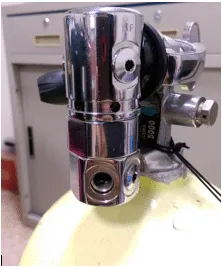
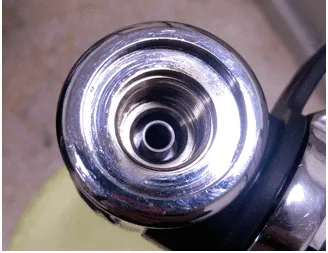
- After just three rapid bursts, every last water droplet on the first stage regulator was completely gone!!
Further viewing:
SCUBAPRO潛水調節器大解密!SCUBAPRO Diving Regulator Unboxing
APEKS 潛水調節器大解密!APEKS Diving Regulator Unboxing