Contents(11)
- Regulator Standards
- Common Types of First Stage Regulators
- Downstream Piston Regulator
- Downstream Piston Regulator: Advantages
- Downstream Piston Regulator: Disadvantages
- Balanced Piston Regulator
- Balanced Piston Regulator Advantages
- Balanced Piston Regulator Disadvantages
- Diaphragm First Stage Regulator
- Diaphragm First Stage Regulator Advantages
- Diaphragm First Stage Regulator Disadvantages
Regulator Standards
CE EN 250 is the most common standard for testing and marking open-circuit self-contained compressed-air diving breathing apparatus.
The standard contains limits on inhalation and exhalation pressures and overall work of breathing. It specifies the following, under test conditions of a breathing rate of 62.5 litres (2.2 cu ft) per minute and an ambient pressure of 6 bars (600 kPa):
- Work of breathing: <3.0 joules per litre
- Peak respiratory pressure: ±25 mbar (±2.5 kPa) (inhalation or exhalation)
- Inhalation work of breathing: <0.3 joule per litre
- Pressure spikes with no measurable positive work of breathing: <10 mbar (1 kPa)
- Pressure spikes with measurable positive work of breathing: <5 mbar (0.5 kPa)
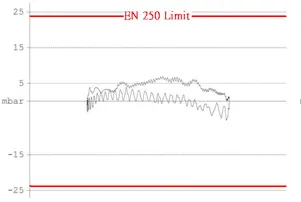
The primary unit of measurement is "joules per litre." Testing is conducted using a breathing simulator. The regulator is connected to a "test diver" (mannequin) and lowered to depth. An artificial lung inhales and exhales at a prescribed rate while breathing resistance is measured. Measurements are taken at various depths, temperatures, and supply pressures. The test data is analysed to construct a work of breathing (WOB) curve. Ideally, the curves should be evenly distributed close to the 0.0 line, with as small an area as possible between the inhalation (lower) and exhalation (upper) curves.
Although a regulator that meets the above limits will provide adequate air supply, this is only the minimum standard (3.0 joules/litre at 6 bar). High-performance regulators achieve a resistance value of less than 0.8 joules/litre at the same depth. When comparing WOB curves, the more tightly clustered the better. The EN 250 standard does not apply to icy water, as the minimum working temperature specified in the standard is 10°C.
The following WOB data was produced by manufacturers at a depth of 50m (6 bar), with a scuba tank / cylinder pressure of 300 bar, water temperature of 2° to 4°C, and a breathing rate of 25 breaths per minute.


Common Types of First Stage Regulators
All common regulator designs operate on the same fundamental principle: a spring pushes open the port between the high-pressure chamber and the intermediate-pressure chamber. As intermediate pressure rises and counteracts the spring force, the port seals shut, stopping high-pressure air from entering the intermediate-pressure chamber. As a result, when a first stage regulator fails, it will free-flow air rather than cut off the air supply (fail-safe).
Downstream Piston Regulator
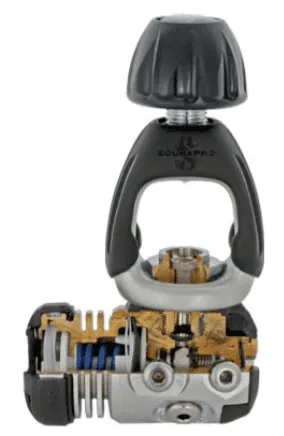
The downstream piston regulator uses piston movement to open and close the intake from the high-pressure chamber. A spring pulls the piston open to allow air into the intermediate-pressure chamber. A hole in the piston rod directs air into the piston cylinder; when the pressure inside the cylinder builds sufficiently to overcome the spring force, the piston is pushed back and closes the intake port.
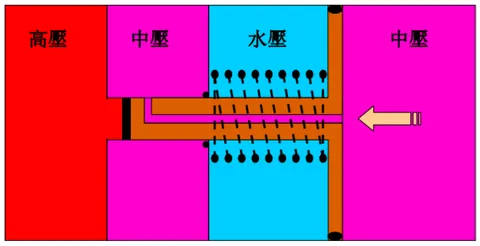
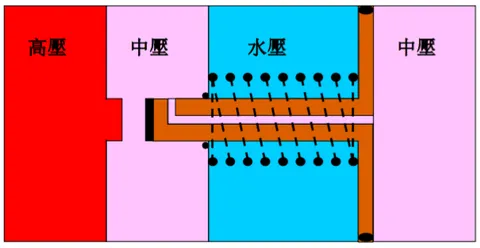
Opening force = Spring tension + Water pressure X Piston area + High pressure x High-pressure seat area
Closing force = Intermediate pressure x Piston area
Downstream Piston Regulator: Advantages
This classic design has few internal parts, a low price point, high reliability, and low maintenance requirements, making it the preferred choice for dive shop rental equipment.
Downstream Piston Regulator: Disadvantages
As the name implies, in a downstream design the piston and high-pressure inlet are aligned in the same direction, so piston movement must work against tank pressure. This means intermediate-pressure output fluctuates with the remaining tank pressure — a difference that becomes especially noticeable toward the end of a dive. In addition, piston-type regulators require an environmental port to allow seawater to contact the piston for depth-pressure compensation; thorough rinsing is essential after every use.
Balanced Piston Regulator
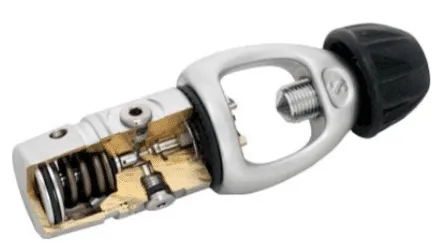
The balanced piston regulator also uses piston movement to open and close the intake from the high-pressure chamber, but the position of the high-pressure seat and the direction of airflow have been changed. A spring still pulls the piston open to admit air into the intermediate-pressure chamber, but the top of the piston rod has an opening that feeds air directly into the intermediate-pressure chamber (piston cylinder). When the pressure inside the cylinder builds sufficiently to overcome the spring force, the piston is pushed back and closes the intake port.
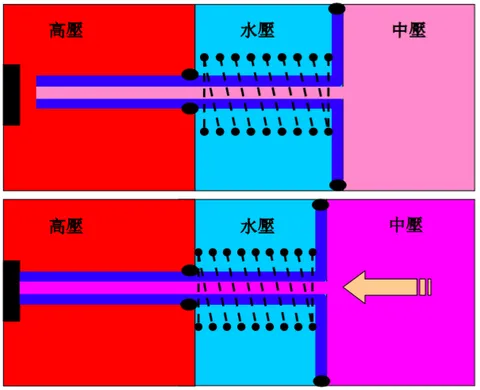
Opening force = Spring tension + Water pressure X Piston area
Closing force = Intermediate pressure x Piston area
Balanced Piston Regulator Advantages
Compared with other types, the balanced piston regulator delivers the highest air volume. Its specially designed high-pressure chamber provides a stable intermediate-pressure output that is completely unaffected by tank pressure. The piston uses a lighter composite material, allowing for more responsive movement. It continues to deliver a consistent air supply even at low tank pressure, enabling tired divers to breathe more comfortably during ascents or decompression stops. The balanced piston is the top choice for demanding sport divers and professionals, and performs equally well in both warm and cold water environments.
Balanced Piston Regulator Disadvantages
Piston-type regulators require an environmental port to allow seawater to contact the piston for depth-pressure compensation. Although some manufacturers have improved this by incorporating dual O-rings on the piston to enhance environmental sealing, thorough rinsing after use is still necessary. Currently, only one regulator on the market achieves complete environmental isolation through silicone oil filling and a fully sealed design, allowing it to operate even in polluted water.
Diaphragm First Stage Regulator
The diaphragm first stage regulator uses a diaphragm to separate the intermediate-pressure chamber from the external environment and the intermediate-pressure spring. As intermediate pressure rises, the diaphragm expands and counteracts the force of the intermediate-pressure spring and ambient pressure, causing the push rod beneath it to move upward and block the opening between the high-pressure chamber and the intermediate-pressure chamber. The diaphragm type delivers stable intermediate-pressure output with a fast response, making it well suited for use with high-pressure cylinders. Some designs add a second diaphragm over the environmental port, achieving a more thorough environmental seal — particularly useful when working in contaminated or muddy water.
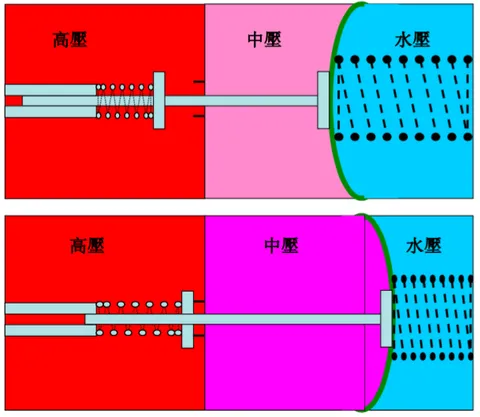
Opening force = Spring tension + Water pressure X Diaphragm area
Closing force = Intermediate pressure x Diaphragm area + High-pressure spring tension + (High pressure - Intermediate pressure) x High-pressure seat area
Diaphragm First Stage Regulator Advantages
The diaphragm first stage regulator is fully environmentally sealed, preventing water from entering its internal mechanism. Intermediate pressure can be adjusted simply by changing the tension of the external intermediate-pressure spring.
Diaphragm First Stage Regulator Disadvantages
The diaphragm first stage regulator has a relatively complex construction. Its sensitive moving metal components should be kept away from extremely cold environments, or a cold-water kit should be added to improve performance. Intermediate pressure may rise slightly as tank pressure decreases.