Contents(9)
Common Types of Second Stage Regulators
All common second stage regulator designs operate on the same fundamental principle: the negative pressure created during inhalation causes the diaphragm to flex inward, pushing a lever that opens the low-pressure valve seat and allows air to flow from the hose into the interior of the second stage regulator. This includes downstream valve designs and balanced piston designs. This article introduces the detailed functions of the second stage regulator, with the aim of giving beginner divers a deeper understanding of diving knowledge.


Downstream Valve Design
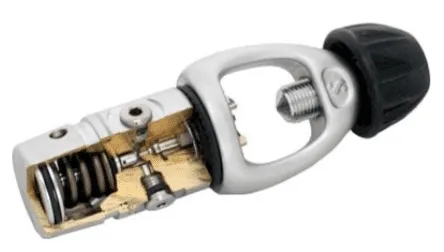
Simple in construction and highly stable, this design uses a spring to directly counteract the intermediate pressure from the hose. When you inhale, the lever uses the principle of torque to pull the spring and open the valve.
Disadvantage: A certain amount of suction is required to overcome the spring tension and open the valve.
Balanced Piston Design
Inside the second stage regulator, there is an elongated balance chamber. This balancing design partially offsets the intermediate pressure coming from the hose, allowing the spring tension to be reduced and achieving minimum inhalation resistance.
Venturi Effect (Vacuum Assist):
Once the valve opens during inhalation, the high-speed flow of gas creates a negative pressure inside the second stage that helps the diaphragm continue to flex inward, sustaining airflow. When inhalation stops, the excess gas pushes the diaphragm back to its original position and closes the valve. This means you do not need to continuously exert effort while inhaling, increasing overall comfort.
Venturi Lever (Airflow Deflector):
Commonly labeled Dive / Pre-Dive. When the purge button is pressed in open air, causing a large free-flow of air, the high-speed flow of gas generates negative pressure that draws the diaphragm inward. By changing the angle of the airflow deflector to create airflow resistance, the negative pressure is reduced, forcing the diaphragm back into position.
Inhalation Effort Adjustment Knob:
Uses the push force of an assist spring to increase inhalation resistance or to prevent air leakage.
One-Way Exhaust Valve:
There is generally a rubber diaphragm located at the bottom of the second stage. When you exhale, the air pressure inside the second stage exceeds the ambient pressure and is expelled through the exhaust valve. Because it opens in only one direction, water cannot flow in. However, be aware that if any foreign matter adheres to the valve, water may enter.
The second stage also incorporates certain port designs intended to improve airflow smoothness during inhalation. The purpose is to direct incoming air straight into the mouthpiece rather than filling the interior of the second stage and counteracting the inward push of the diaphragm.
Regulator Fail-Safe
Should the first stage regulator malfunction, it will release a large volume of air. The excessive intermediate pressure will force the second stage valve to remain open, allowing high-pressure air to flow freely from the mouthpiece. A well-trained diver should be able to breathe from the free-flowing air, providing enough supply to reach their dive buddy or the surface.
Regulator Performance and Selection
We should prioritize first stage regulators that deliver stable intermediate pressure and a high air volume output. When the intermediate pressure of a first stage fluctuates too greatly — for example, a downstream piston first stage with intermediate pressure ranging between 8–10 bar — the spring tension must be set for the maximum intermediate pressure of 10 bar in order to prevent the second stage from leaking at high intermediate pressure. This significantly increases inhalation resistance. The difference becomes even more pronounced during deep diving, as increased gas density raises flow resistance. Additionally, a higher air output volume ensures an adequate air supply during heavy exertion or when sharing air with a buddy. A quality regulator not only improves breathing comfort but also helps prevent rapid breathing and hyperventilation.
We hope that after reading this article, you now have a general understanding of regulators. If you have purchased a regulator, how should you go about routine maintenance and servicing?
Further reading: Regulator Routine Maintenance.