Contents(4)
Diving the Great Barrier Reef is a bucket-list item for many divers and working-holiday backpackers in Australia. Anyone who has dived in Australia or done their research online knows that getting a glimpse of the Great Barrier Reef doesn't come cheap — a day trip runs around AU$200, while longer liveaboards can cost hundreds, or even thousands, of Australian dollars! For budget travellers, that kind of expense can feel overwhelming. Today I'm sharing two boat operators in Cairns where you can work in exchange for diving — volunteer on board and explore the Great Barrier Reef for almost nothing!
DIVERS DEN
Address: 319 Draper St, Parramatta Park QLD 4870
How to apply: Visit the dive shop in person after 10 a.m. any day
Cost required: AU$35 (one work shirt)
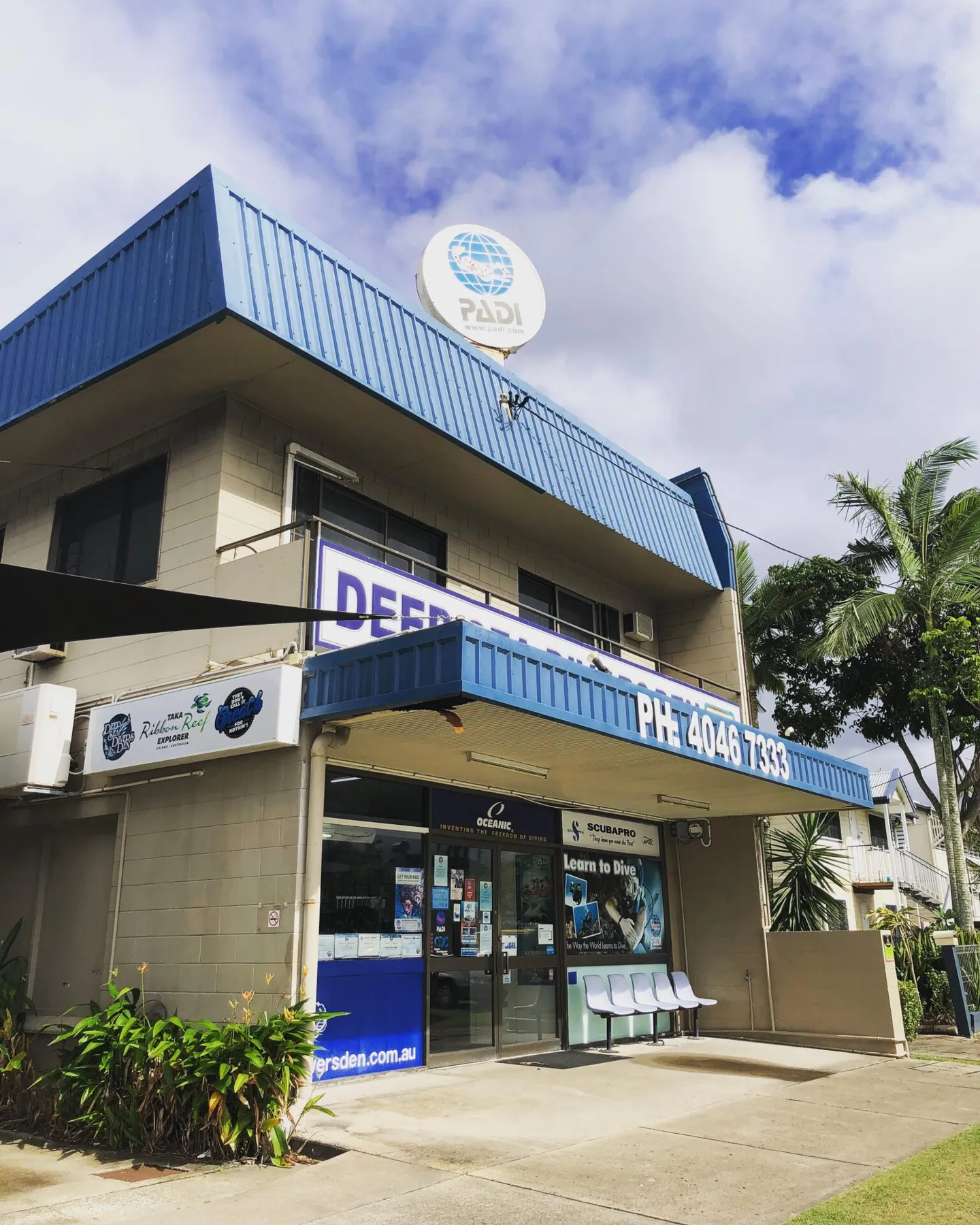
Divers Den dive shop


Working in Australia
If you've read my previous two articles, you probably know that I'm currently working at this dive shop! DIVERS DEN operates three boats in Cairns, offering day trips and liveaboard trips — all of which need volunteers. If you'd like to apply, you must visit the shop in person after 10 a.m. (no phone enquiries — please make sure you come in after 10 a.m., because before that the shop is busy with passengers departing for the day). Let the front desk staff know which dates you'd like to volunteer. Spots can fill up sometimes, so don't be discouraged — just try a different date! After filling in the paperwork at the shop, you'll need to purchase a volunteer T-shirt that you must wear while working on board. One shirt costs AU$35! One volunteer told me he has used his shirt seven times already, five of which were liveaboard trips.
A Day in the Life of a Liveaboard Volunteer
First-time volunteers are usually assigned to a day boat, where the main tasks include helping the crew prepare sandwiches, washing dishes, and cleaning up after the trip ends. Chatting with other volunteers, they all agreed that working only two to three hours in exchange for diving throughout the day is a great deal. How many dives you get depends on your efficiency, but day boats usually offer at least one to two dives. Non-divers are welcome to apply too — snorkeling at the Great Barrier Reef is a wonderful experience in its own right! If you perform well and your schedule allows, you can also apply to volunteer on a liveaboard vessel. How many nights you stay on board depends entirely on whether your availability lines up with the schedule. Liveaboard shifts involve slightly more work, but you get more dives per day in return.
MIKE BALL DIVE EXPEDITIONS
Address: 3 Abbott St, Cairns City QLD 4870
How to apply: Online application form open during the first week of each month
Cost required: AU$50 (two work shirts); AU$175 (equipment rental — waived if you bring your own full set of gear)
Mike Ball Dive Expeditions (hereafter "Mike Ball") has been rated by PADI (certification agency) Travel as one of the best mid-range liveaboard experiences on the Great Barrier Reef. Their website lists a seven-night trip at over AU$3,800 per person. A few weeks ago, I was lucky enough to join as a volunteer — and I had the best dive of my entire time in Australia! The bulk of this article is devoted to the Mike Ball experience.
To become a Mike Ball volunteer, simply fill out the application form on their website. The first week of each month is the open application window — and since spots are highly competitive, you need to apply three months in advance. The website outlines everything clearly, including daily tasks. Each volunteer must complete a full week on board. There are only two volunteer spots per week: one is the Domestic volunteer, who acts as the head chef's assistant — helping prepare meals and handling cabin tidying — and the other is a Dive Deck volunteer, who assists in the equipment area. The Dive Deck role requires a Divemaster (PADI cert) certification or above, plus dive liability insurance.
I also want to address something many people ask me: does your English need to be excellent? The Mike Ball website is quite clear on this — they need volunteers who can communicate comfortably with the crew and guests. If your English isn't perfect but you feel you can get by, give it a shot and be confident! That said, if communication is truly a barrier, it will be very tough.
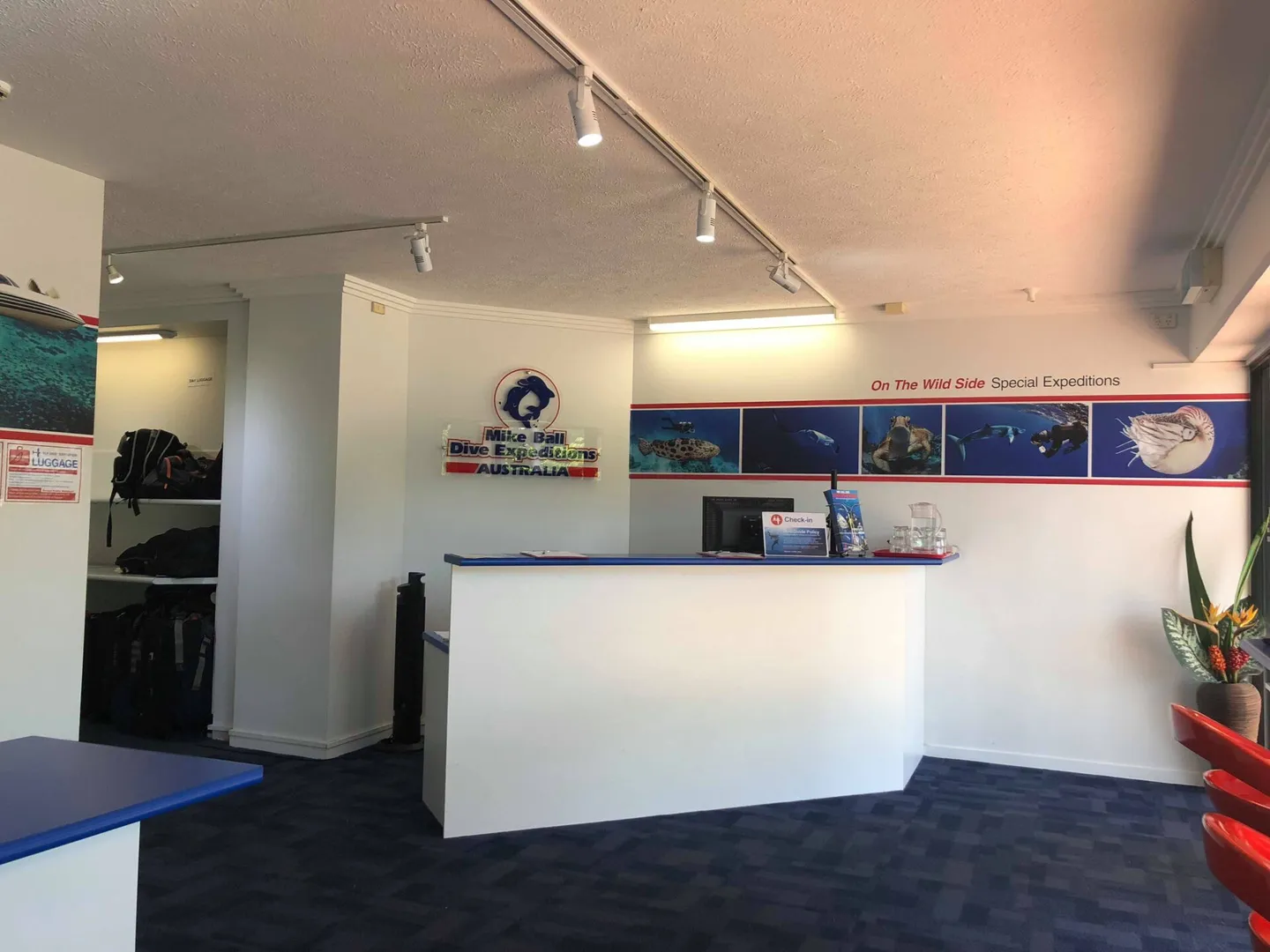
Once you've submitted your application and are fortunate enough to receive a confirmation notice, you'll need to reply to confirm your place, then send another confirmation email one week before departure. (I emailed two weeks out and was told it was too early — just follow their instructions!) You'll receive an email before departure detailing the itinerary and where to check in. Check-in is at the Mike Ball office; arrive around 11 a.m. to complete paperwork, then wait to board at 3 p.m.
I chose the Domestic volunteer role and was able to get around three dives per day. The crew never took advantage of us being volunteers by piling on extra work — quite the opposite. They kindly explained exactly what needed to be done, and proactively asked whether we had a nitrox certification, offering free nitrox cylinders to volunteers! (If you hold a Solo Diver certification, you can also request a smaller tank.) In fact, as soon as the work was done, the crew would ask if we wanted to go diving.
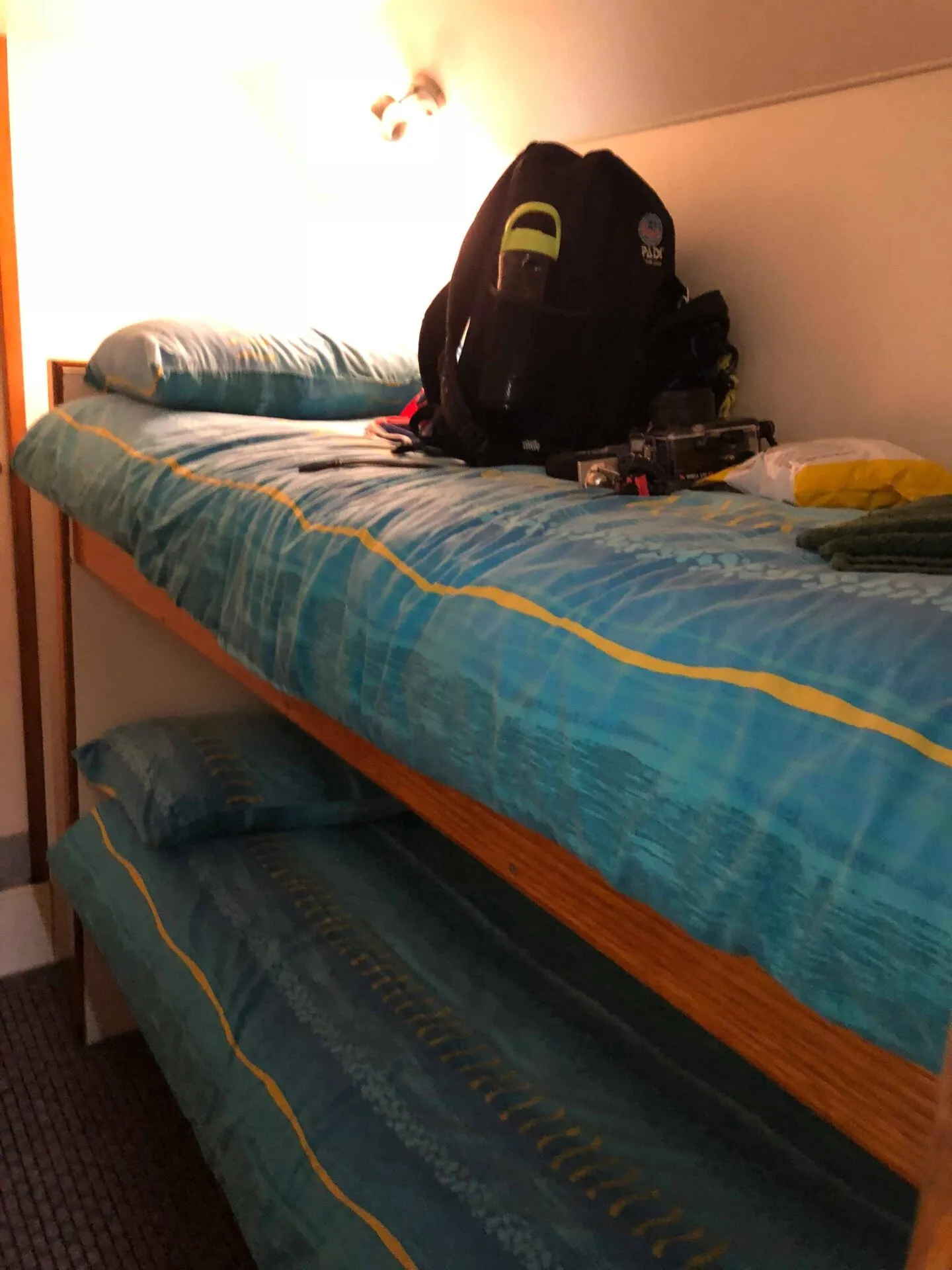
My cosy little space on board for the week
During my week on board, my main tasks were slicing fruit for guests, vacuuming the boat, and helping the chef prepare food. I shadowed the chef around the clock all week — between meal prep and all the food on offer, I never once went hungry. The other volunteer alongside me was an Australian Divemaster (PADI cert). Her duties were mainly in the equipment area: preparing towels for divers, slicing oranges for them when they returned to the boat, and occasionally helping with tank fills and acting as a surface watch.
The two volunteers were usually paired together as dive buddies, though sometimes we also dived with guests (in Australia, having a dive guide is not standard practice). On one particular dive, the First Mate asked if we wanted to see pygmy seahorses. We descended and the instructor led us to a spot that hadn't been mentioned in the dive briefing at all — we went deeper and deeper, finally stopping at around 32 metres in front of a small gorgonian / sea fan, where two pygmy seahorses sat side by side. The instructor then guided us through the shallow reef, weaving between coral formations while groups of Sweetlips drifted lazily around us. Visibility was at least 25 to 30 metres. There were no dramatic megafauna sightings, but it was my favourite dive of the entire trip to Australia!
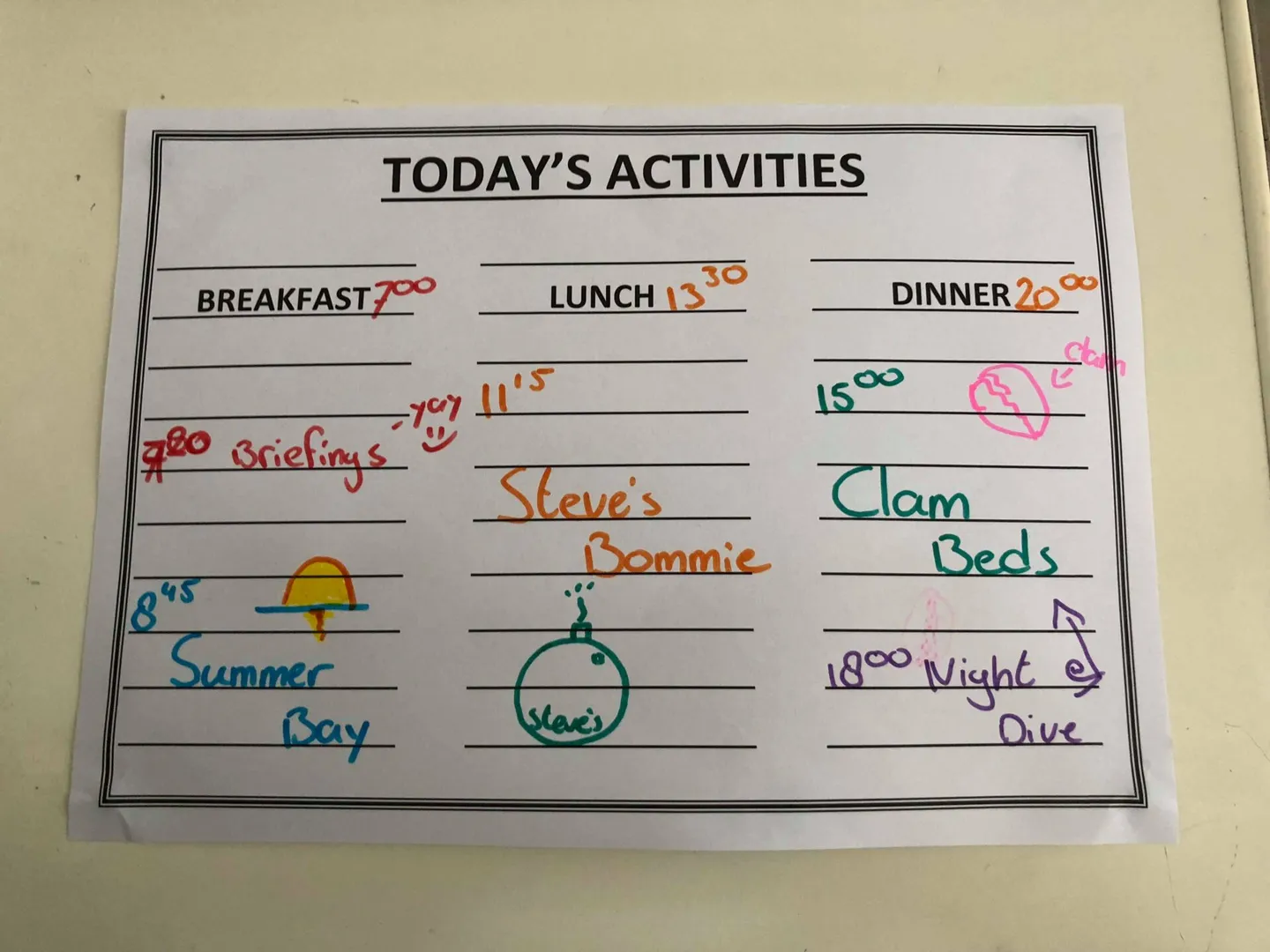
A handwritten daily schedule posted on board
During my volunteer week, there were two Party Nights. On those evenings, the First Mate handled the barbecue, the captain played guitar and sang, and the dive director led everyone in dancing — it was a brilliant time.
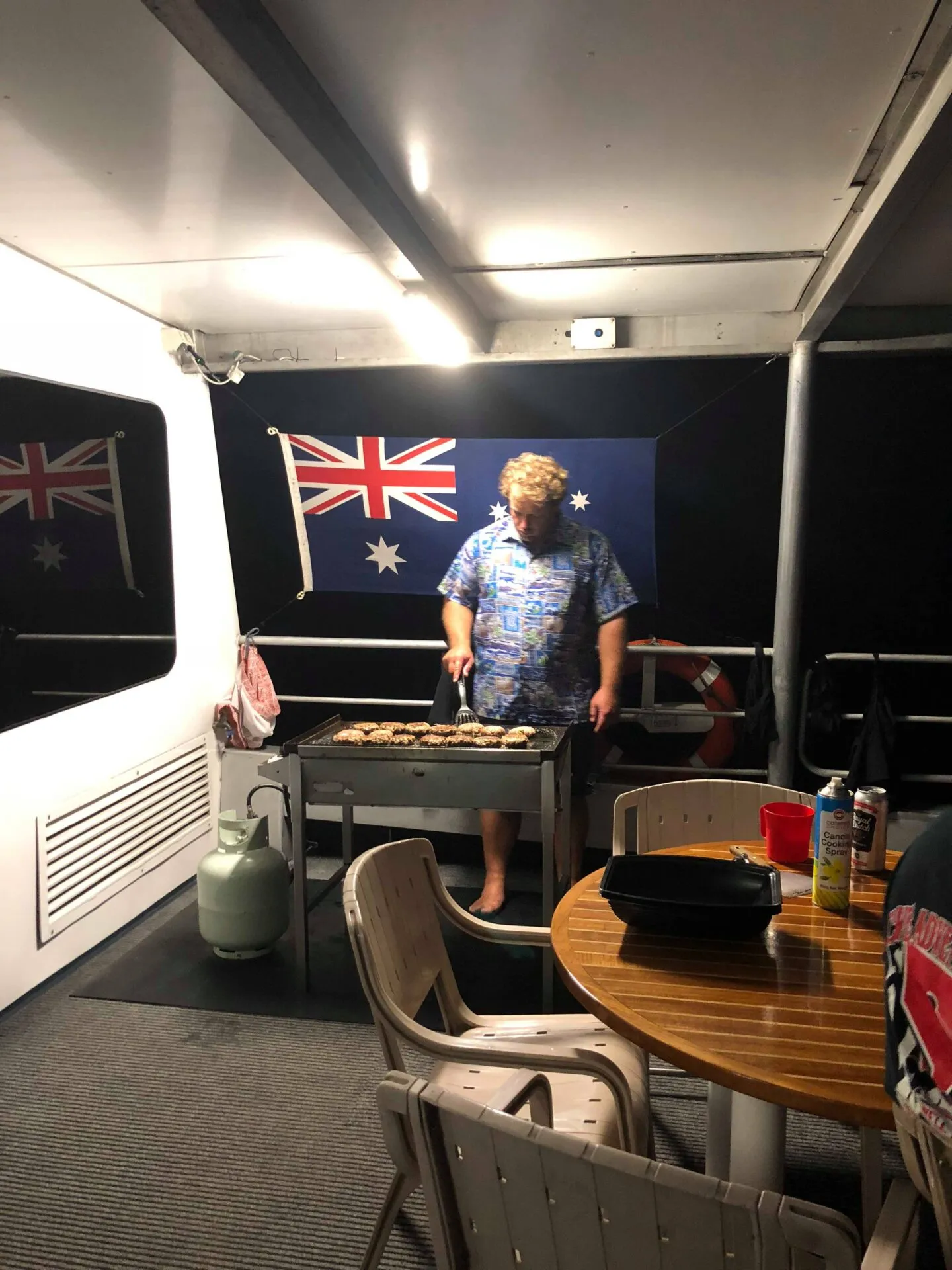
The First Mate, grilling and snacking at the same time
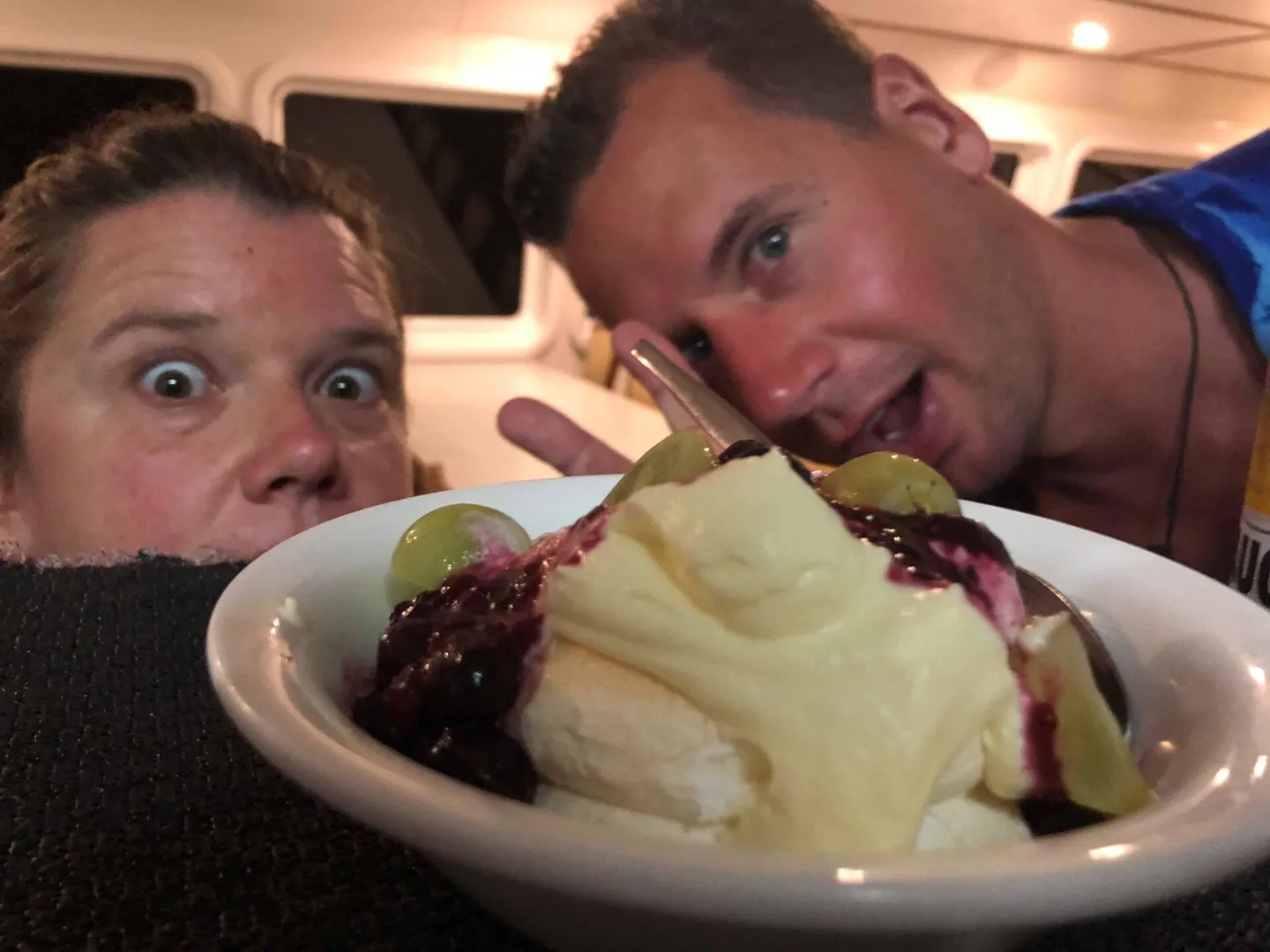
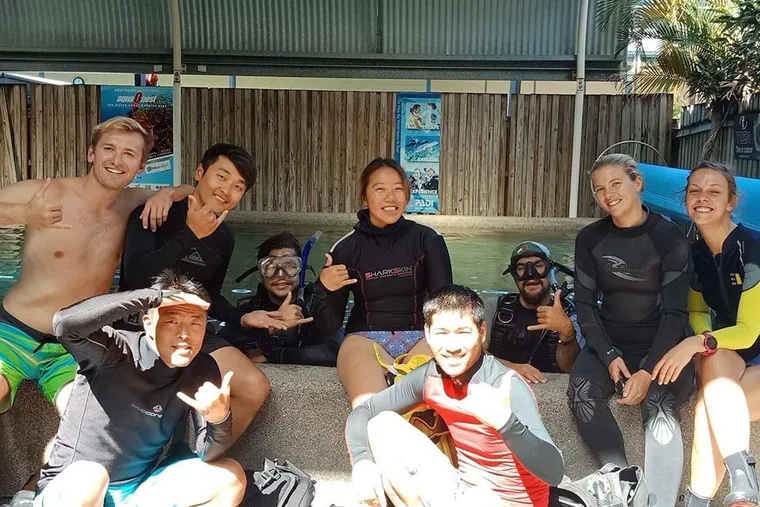
On the left is the Divemaster (PADI cert) who volunteered alongside me — the whole crew was wonderfully quirky
There were also two lectures per week on board: one on fish and one on coral — similar in content to the Reef Teach sessions held in Cairns city. Just let the supervisor know and you're welcome to sit in. Various courses were also available on board, including underwater photography, nitrox, and Solo Diver courses, among others. If staffing allowed, volunteers could join in too! (Additional fees apply.)
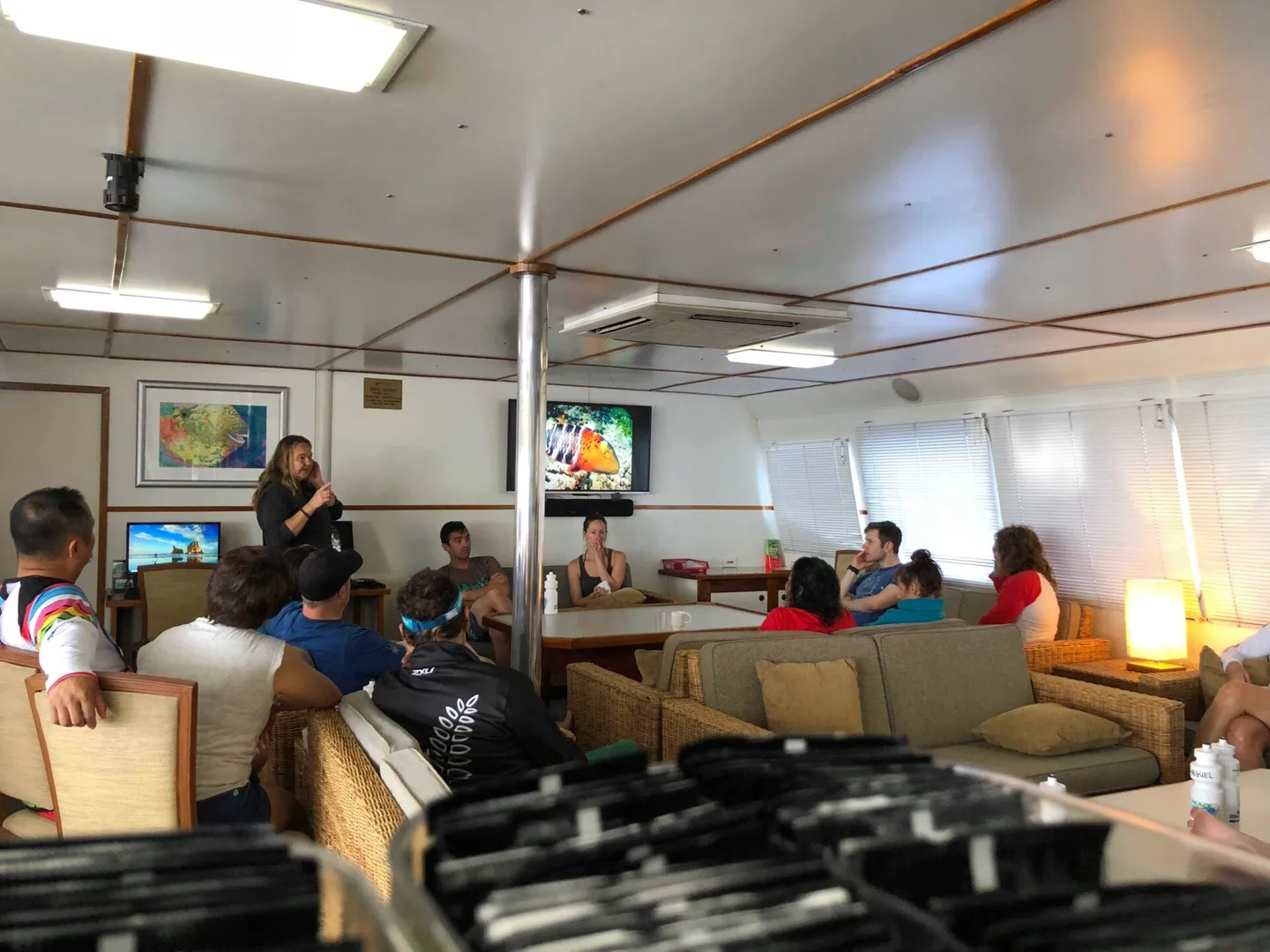
Divers listening attentively to the lecture
Postscript: When I wrote my previous article, I was still a Divemaster (PADI cert) — I have since started working in Cairns as a dive instructor! Every instructor at the company highly recommends Mike Ball, and now that I've experienced it firsthand, I wholeheartedly recommend it too (aside from the seasickness I suffered, it was an incredibly rewarding week). If you're spending a significant amount of time in Cairns or planning a trip there, seriously consider adding this liveaboard to your itinerary. If your English is decent, sign up as a volunteer to work your way to free dives — I might even try applying one more time before I leave Cairns!
Further reading:
Frequently Asked Questions
How is a BlueTrend dive trip different from an unknown, no-name dive group?
Choosing us means full peace-of-mind protection and a smooth experience from start to finish. Every trip we run holds to three things.
First, full legal protection and a professional dive leader: we strictly follow Taiwan's travel regulations and provide complete travel-agency liability insurance, travel insurance, trip-inconvenience insurance and dive insurance. Every group is accompanied by a certified, foreign-language dive leader who joins you on both the dives and the land itinerary, liaising seamlessly with local dive shops and operators on your behalf to keep things running smoothly — the person our travellers trust most.
Second, fully licensed with secure payments: every payment goes into a licensed travel agency's account, with multiple safe payment channels (bank transfer, credit card and more) and a legal collect-and-remit receipt, so every transaction is open, transparent and protected, avoiding the fraud and dispute risks of transferring money privately to an individual.
Third, hand-picked quality we vet in person: every trip, dive site and partner shop is scouted on the ground by our own team, from the guides' professionalism and safety standards to the food, lodging, environment and service details on land, all vetted by us so you don't get caught out.
I want to sign up for a dive trip. Are there certification-level or logged-dive requirements?
Each dive site is different, so the entry bar varies. 'Bali Tulamben', for instance, is relatively beginner-friendly. 'Malapascua in the Philippines' is also beginner-friendly, but since thresher sharks tend to cruise between 20 and 30 metres, we recommend AOW certification with 20+ logged dives to enjoy this trip comfortably. For 'the Maldives' or 'Palau', we suggest AOW with 50+ logged dives for a more relaxed experience. If you're not sure whether your experience fits the trip you want, message us and our dive editors will assess it and help you find the trip you'll feel safest on.
Can I join if I'm signing up alone? How are rooms arranged?
Plenty of our travellers sign up solo! For rooms and beds, we prioritise pairing you with a same-gender traveller, and if you'd rather have your own space you can pay the difference to upgrade to a single room. For the diving, our professional leader will pair you with a suitable buddy, and with the happy vibe on our trips you'll quickly make a great group of dive friends. Many people sign up alone, make new friends, and end up organising the next trip together!
Does the trip fee include dive insurance, gear rental, taxes and instructor tips?
It depends on the trip, the destination's regulations and the local operators. Every BlueTrend dive trip has a detailed web page with a clear 'included / not included' list, transparent and with no hidden charges. All payments are collected by a licensed travel agency, with a standard-form contract for your protection.
I'm a new diver / haven't dived in a long time — will I fall behind the group?
Before you complete your booking, our team assesses a suitable trip based on your certification level and experience. Before departure, we strongly recommend taking time to refresh in Taiwan with an instructor, or a fun dive to get your feel back. On the trip itself, our professional dive leader groups and pairs everyone by experience, keeps a close eye underwater on travellers who need extra care, and steps in to help right away.
Will the photos and videos taken during the trip be shared with us?
During the dives, 'safety' is always the leader's top priority, so whenever it's suitable and safe the leader will capture great shots and record the best moments. During or after the trip, we compile a cloud album for all travellers to download, so you go home loaded with memories!
Besides your scheduled trips, can you arrange a private group charter or independent travel for me and my friends?
Absolutely! Besides group trips, we also arrange private group charters and independent travel. We can communicate, enquire and coordinate services with local operators based on your needs, saving you time and effort and taking the language barrier off your plate, to tailor the smoothest, most reassuring dive trip just for you. Contact our LINE support and our editors will arrange it for you!