![[BlueTrend Mini-Class] Chameleons of the Sea? Coral's Best Ally – The Gender-Switching Parrotfish](/_images/68ab6a356089-1440w.webp)
Contents(9)
The Editor says: Have you ever heard a "click-click-click" sound while diving? Did you know that's actually the sound of parrotfish feeding! Their teeth are fused into beak-like dental plates that can efficiently scrape algae off rocky reefs and coral reefs, allowing coral to grow healthily — making them one of the ocean's most important "clean-up crew." Come learn about them with BlueTrend!
Introduction to the Parrotfish Family (Scaridae)
Parrotfish are primarily found along rocky reef coastlines, especially in tropical waters rich in coral.
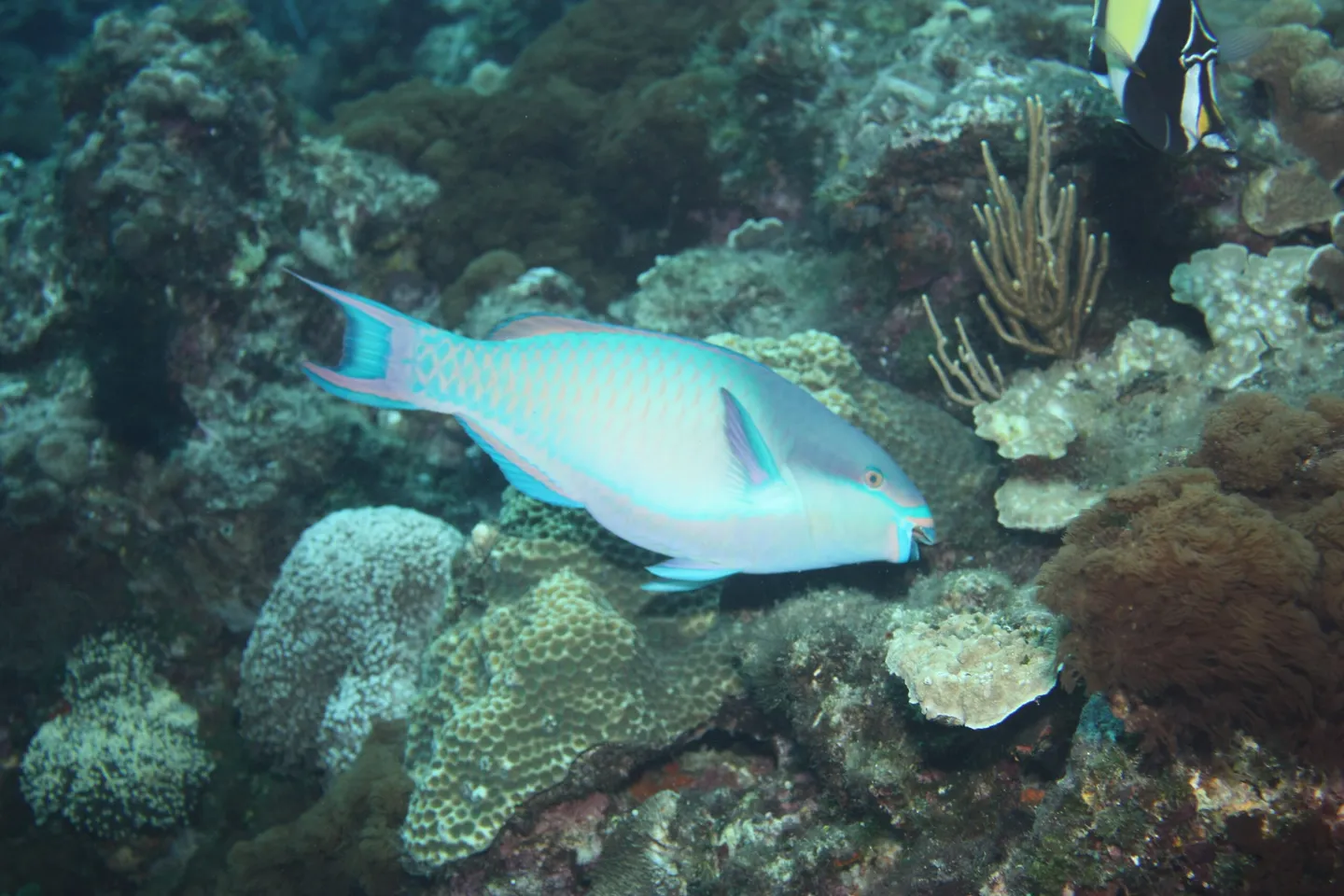
Parrotfish are mostly found in waters rich in coral. This photo was taken at Shilang, Green Island. Photo credit: Li Cheng-Lu
Parrotfish are primarily found along rocky reef coastlines, especially in tropical waters rich in coral reefs. Most parrotfish undergo a sex change from female to male as they grow, and their body coloration shifts with each phase. There is also an interesting behavior: when juvenile parrotfish school together, they display a uniform coloration — as if they are all wearing the same uniform.
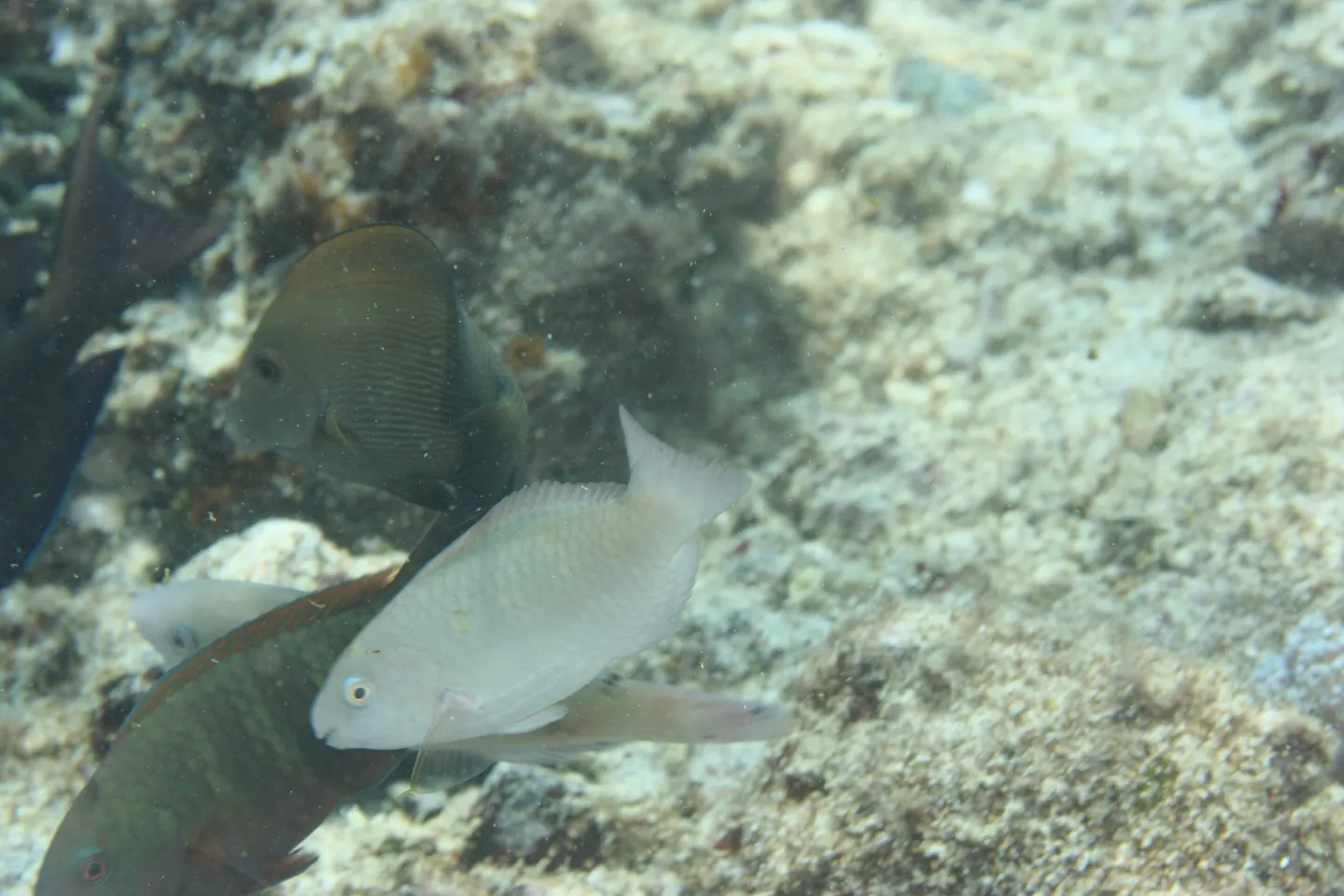
A school of Marbled parrotfish (Scarus rivulatus). Photo credit: Li Cheng-Lu.
Females are typically drab in color — reddish-brown or dark gray — which is why female parrotfish are sometimes nicknamed "oyster fish."
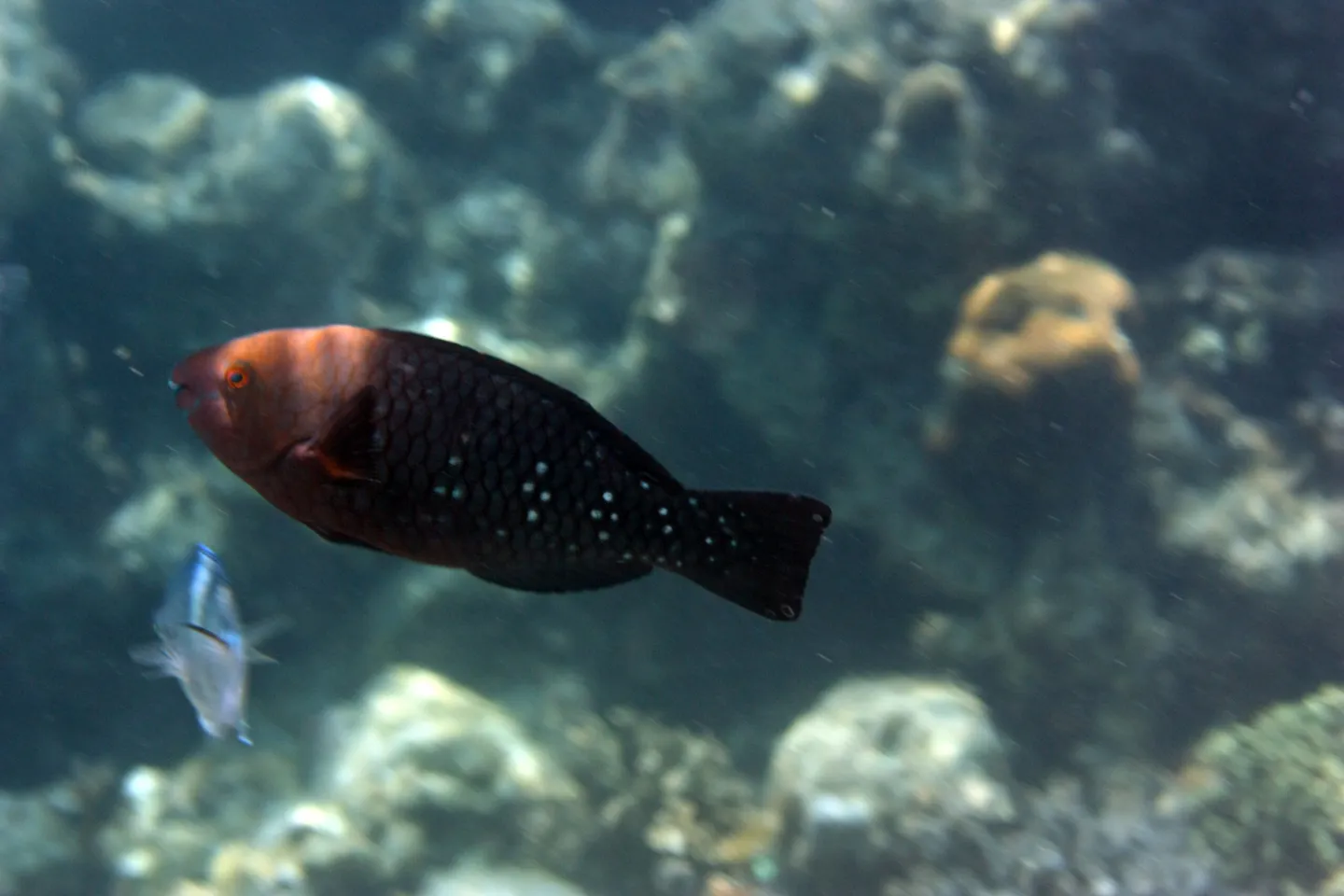
A female Singapore parrotfish ( Scarus prasiognathos ). Photo credit: Li Cheng-Lu.
Female parrotfish are generally drab in color — usually reddish-brown or dark gray — which is why they are also nicknamed "oyster fish." As they mature, some females undergo a sex change and become males, at which point their coloration gradually transforms into vivid blue-green patterning. This is why male parrotfish are also commonly called "green parrot" or "blue boy" in local parlance.
Because the same species of parrotfish cycles through several different color phases during its lifetime, and because males and females look so different, they have frequently puzzled ichthyologists and can be difficult to identify.
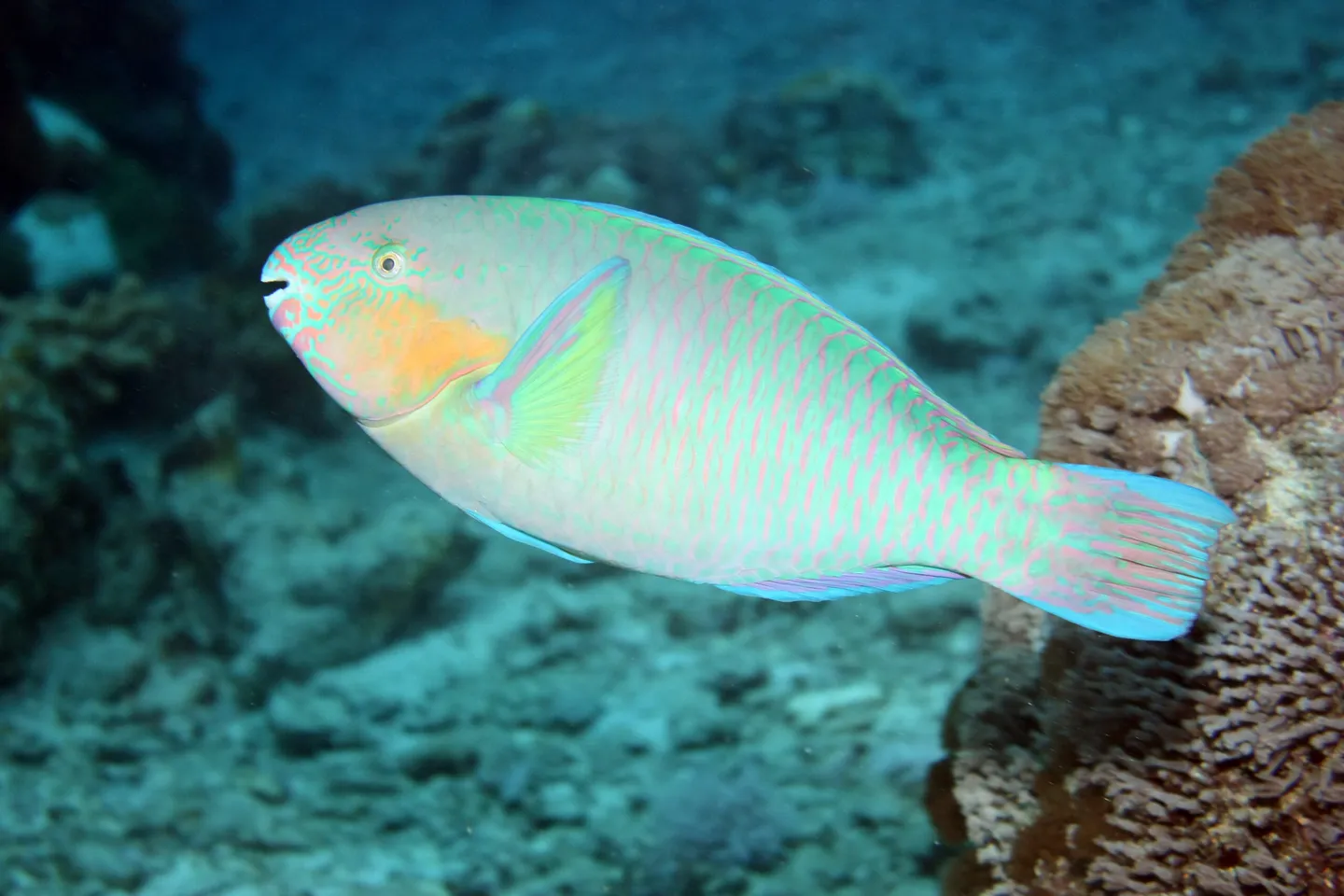
A brilliantly colored Marbled parrotfish — truly eye-catching. Photo credit: Li Cheng-Lu.


Guardians of the Coral Reef – Parrotfish
Coral plays many different roles in the ocean and is one of the keys to maintaining marine ecological balance. In the vast sea, coral not only needs to find a suitable place to grow but must also contend with rapidly proliferating algae threatening to "invade." This is where their "allied friends — parrotfish" become essential. Let's take a look at these three types of parrotfish!
Bioeroders (Large excavators)
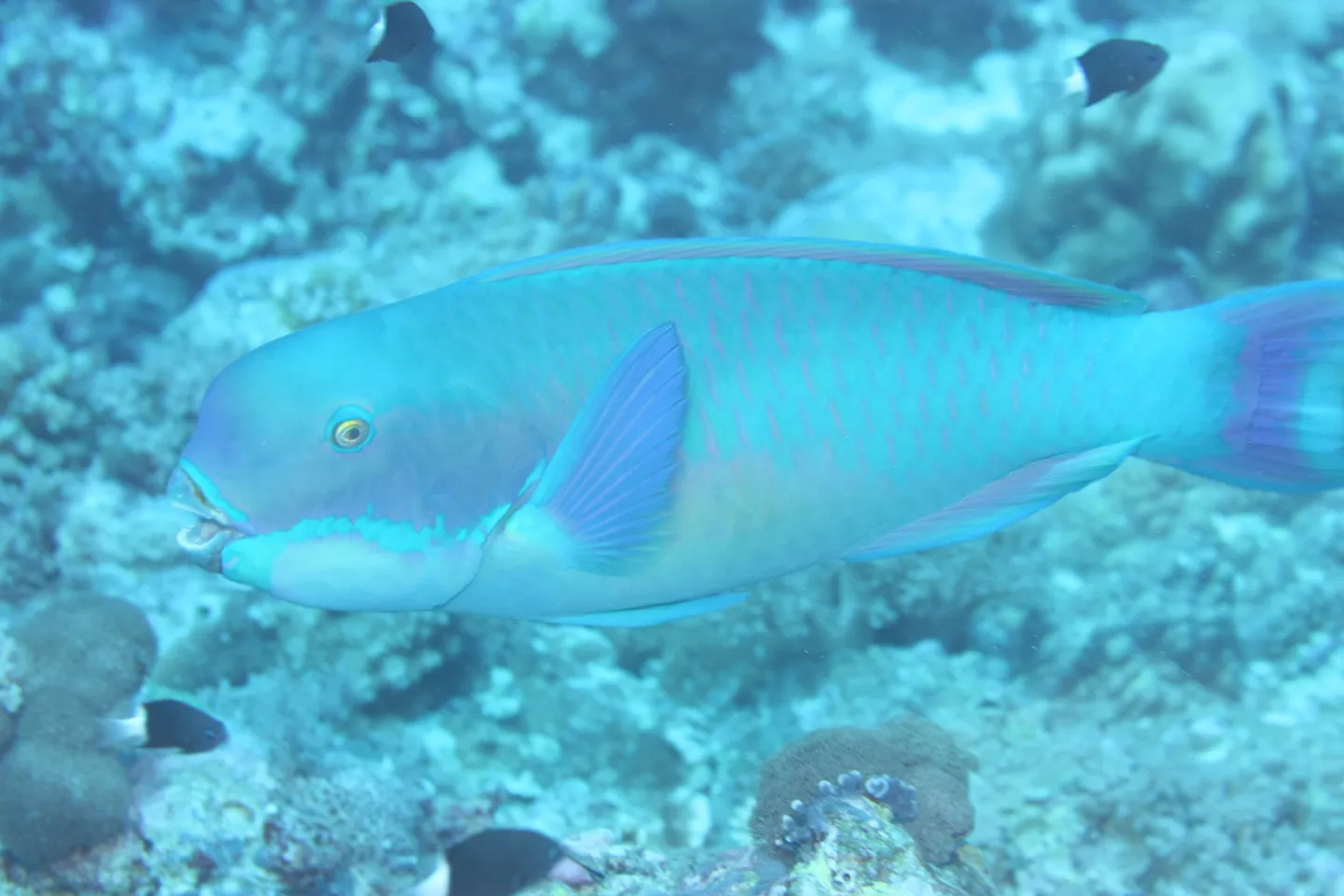
The Steephead parrotfish has a powerful, strong beak capable of excavating rock reefs. Reprinted from Marine Encyclopedia 2 | Near-Shore Coral Reefs, photography: Li Cheng-Lu.
These are mainly large parrotfish, such as the Steephead parrotfish and the Bumphead parrotfish. As the name suggests, they possess a strong, hard beak capable of boring into rock walls and crunching through reef rock. Although they damage some coral in the process, they also open up new substrate and help drive the turnover of the reef floor.
Scrapers (Small excavators)
These are mainly small-to-medium parrotfish, such as the Blue-barred parrotfish and the Swarthy parrotfish. Using a more pointed beak, they scrape the reef surface and clear encrusting algae from the substrate, giving small coral polyps more clean space to grow. When they feed, they often leave paired tooth marks on the coral surface.
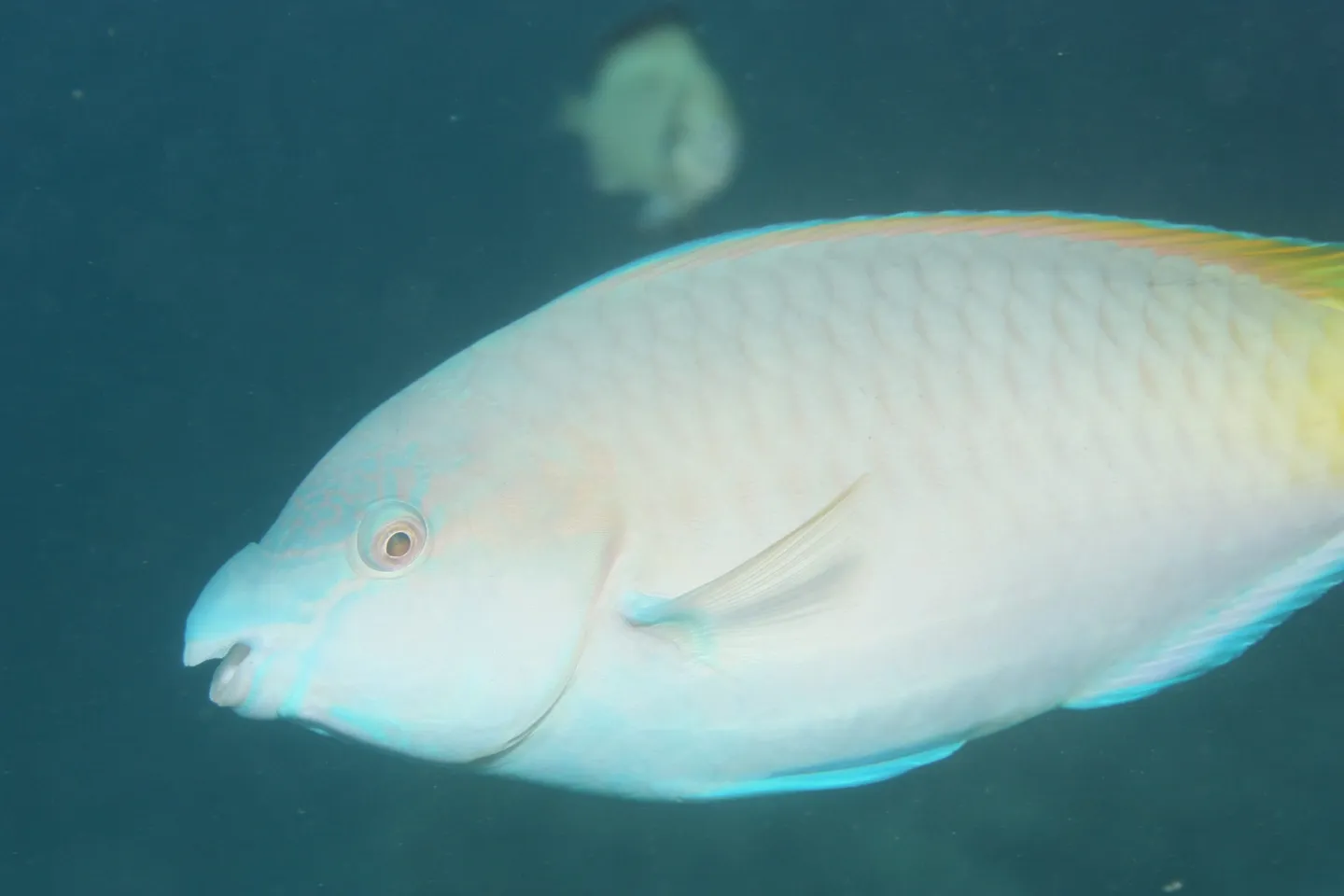
Smaller parrotfish mostly scrape surface algae. Reprinted from Marine Encyclopedia 2 | Near-Shore Coral Reefs, photography: Li Cheng-Lu.
Browsers
Representatives of browser-type parrotfish include the Carolines parrotfish and the Spinytooth parrotfish. Their uniquely hard teeth, paired with a remarkable digestive system, allow them to easily bite through large, leafy algae — tough Sargassum, toxic jointed algae, and more are all on the menu. With their large appetites, they effectively consume overgrown algae and are regarded as saviors of the coral reef.
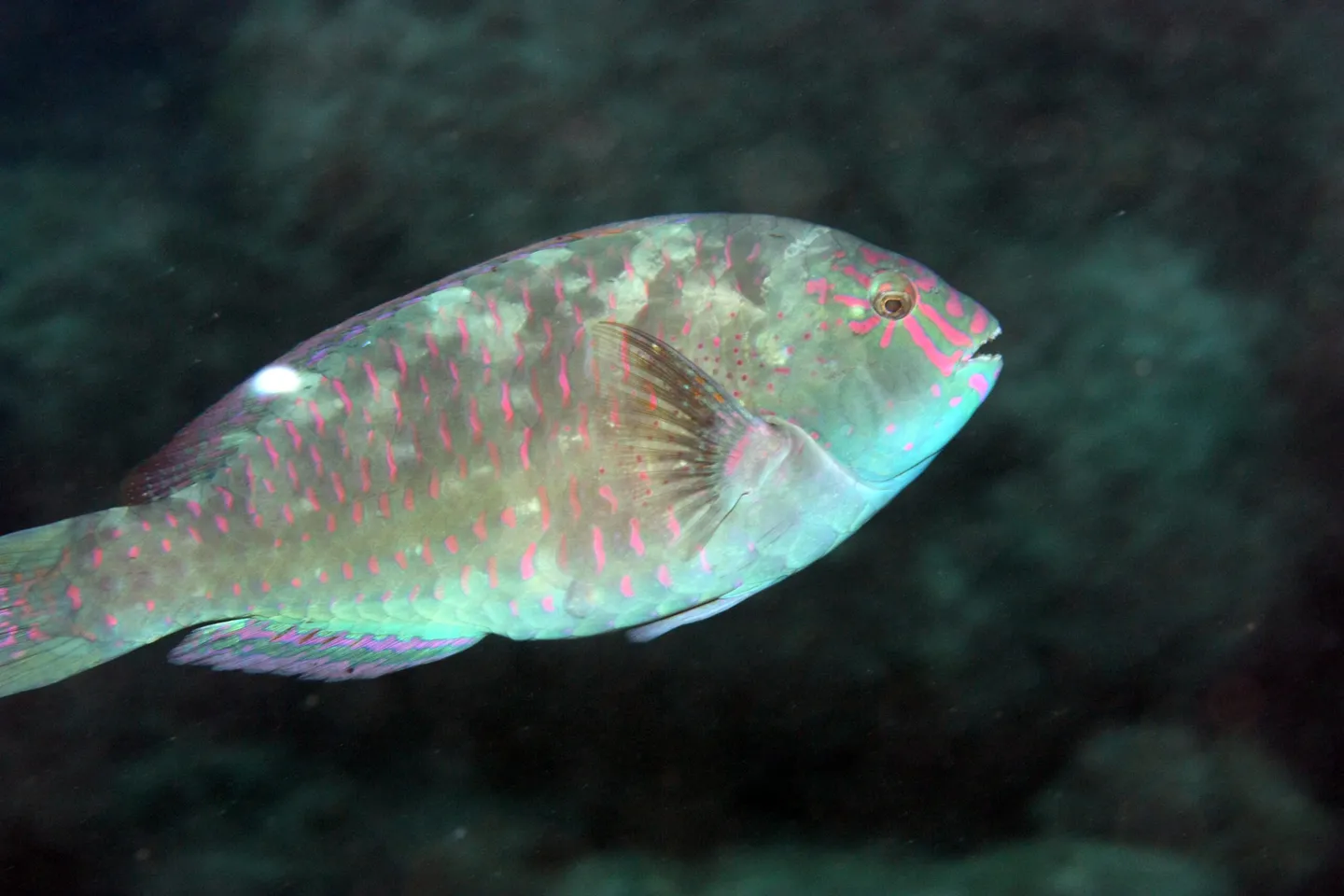
Carolines parrotfish ( Calotomus carolinus ) Photo credit: Li Cheng-Lu.
A Star Conservation Species – The Bumphead Parrotfish
Among all parrotfish, the massive Bumphead parrotfish is the largest species in the family.
The Bumphead parrotfish is dark gray in color, with a distinctive steep, vertical hump rising from its head to the top of its snout. This imposing fish has tiny eyes and a prominent set of hard, protruding teeth. It can reach a maximum length of 1.3 m and weigh over 50 kg — and it can even live for more than 40 years, making it a remarkably long-lived species!
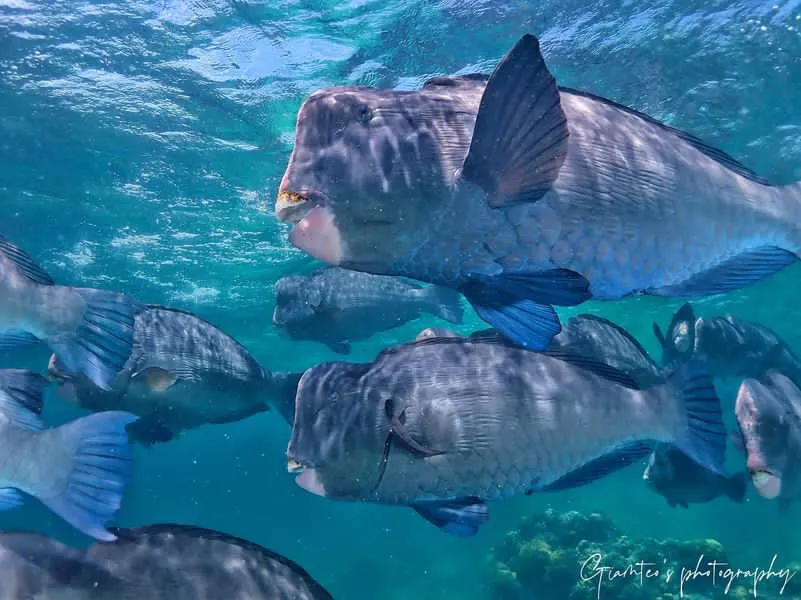
The Bumphead parrotfish with its noticeably protruding teeth — it looks charmingly dopey, but it actually has a rather aggressive personality! Photo credit: Giam
Their main diet consists of algae and coral, which they excavate and grind up using their hard teeth.
Bumphead parrotfish are gregarious; they typically rest at night in large, shaded caves, and sometimes even inside shipwrecks. Each morning they emerge and, once the sun rises, head to coral-rich areas to feed. Remarkably, they are quite intelligent — they periodically vary their foraging routes, giving bottom-dwelling organisms time to recover and regrow.
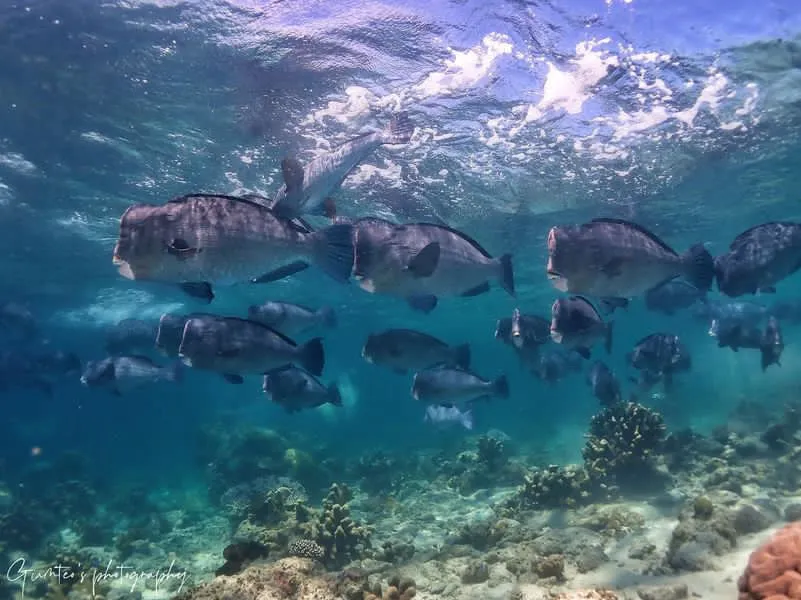
A school of parrotfish that love to patrol together in groups. Photo credit: Giam
In the past, Bumphead parrotfish were distributed across coral reefs throughout Taiwan, but due to overfishing, their numbers have become extremely scarce. On July 2, 2014, the Council of Agriculture listed them as a Category II protected wild animal.
Wanted in Xiaoliuqiu – Parrotfish Family
Do you have photos? Beep beep beep! Wanted!
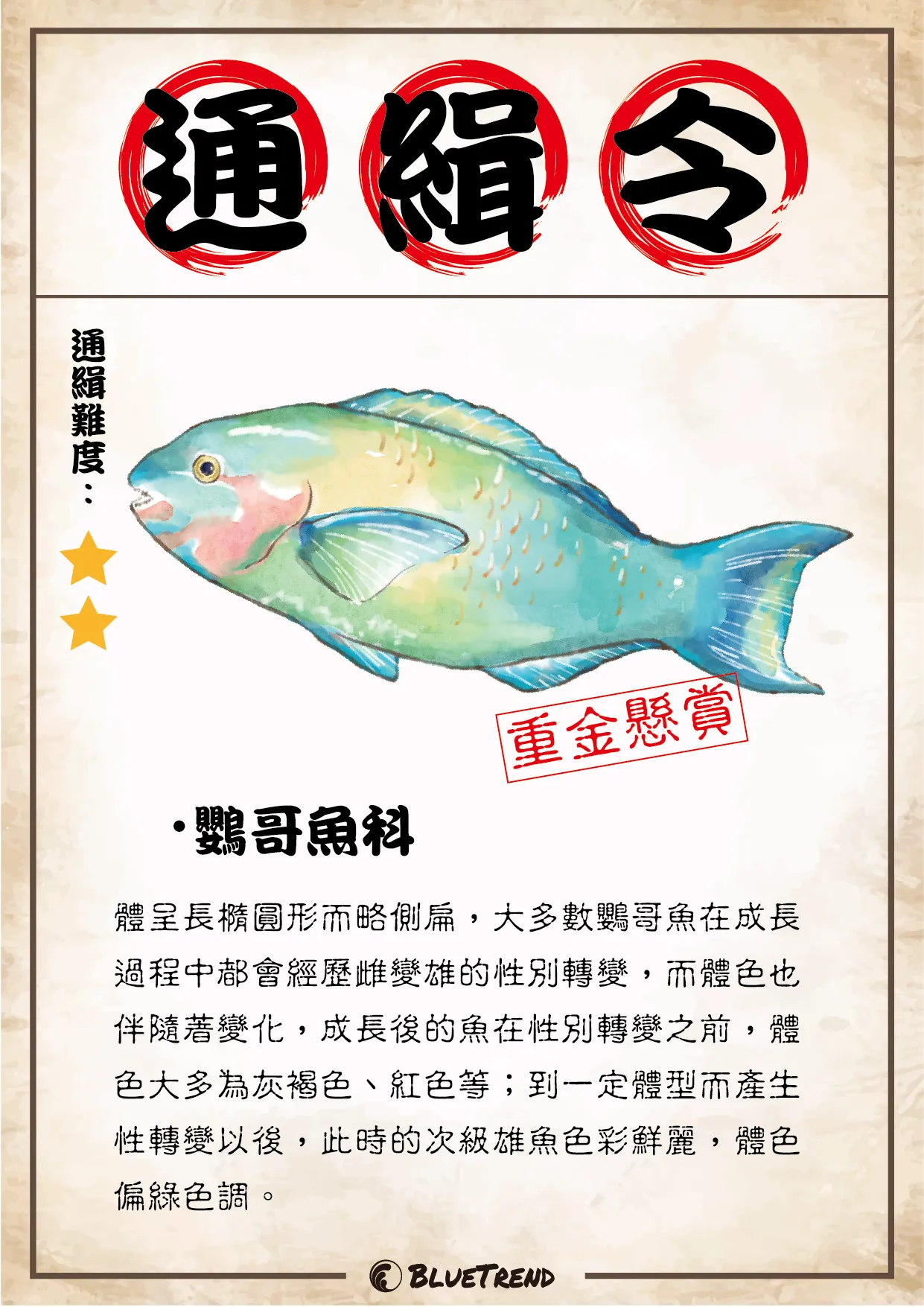
How to Participate:
-
Activity period: 11/8/15 to 112/9/30
-
Activity content: Upload photos or complete classifications during the period to earn raffle entries (winner drawn and announced on 10/2)
-
How to participate:
-
Upload Xiaoliuqiu wildlife photos to earn one raffle entry
-
Upload photos of the specified wanted species listed above and complete photo classification to earn an additional raffle entry
-
Raffle Prizes:
-
Wetsuit * 1 (valued at $11,600 / piece, men's or women's sizes available)
-
Fins * 2 (valued at $4,300 / pair, size selectable)
-
Booties * 3 (valued at $1,080 / pair, size selectable)
Further Reading

![[BlueTrend Classroom] The Most Beautiful Sea Cucumber — The Sea Apple Is Actually a Hidden Underwater Bomb?](/_astro/004_%E5%B8%83%E9%AD%AF%E5%B0%8F%E6%95%99%E5%AE%A4_vivipic_Z1c6nxu.webp)