the Editor says: The deep sea may be the very birthplace of life on Earth, yet our understanding of the ocean remains limited. What creatures still dwell in the deep? We cannot say with certainty. So as the age of deep-sea mining arrives, will it spark a conflict with the ecosystems down below? Follow along with BlueTrend to find out! Originally published in Science Monthly, Issue 500, "The Dawn of Deep-Sea Mining? The Conflict Between Seabed Mineral Extraction and Marine Ecosystems" 2023.08.15
The International Seabed Authority (ISA) — the body responsible for managing the international seabed, its related resources, and overseeing international deep-sea mining activities — recently held meetings at its headquarters in Kingston, Jamaica, to discuss whether companies may begin extracting minerals and precious metals from the ocean floor, including cobalt, nickel, and sulfides. Proponents of deep-sea mining argue that the rapid growth of electric vehicles and renewable energy battery research in recent years will drive up demand for precious metals, and that deep-sea mining could help meet today's demand while supporting a carbon-reduction economy. However, research has already shown that the potential ecological impact of deep-sea mining may be far greater than we imagine. A recent study published in Current Biology is the first to examine the effects that mining cobalt-rich crusts from the deep sea would have on the deep-sea environment.
What Impact Does Deep-Sea Mining Have on Marine Life?
In the deep sea, hard mineral-rich rock layers containing cobalt form parts of underwater mountain ranges and represent one of three types of deep-sea resources that nations have proposed to the ISA as mining targets. In 2020, the marine resource survey vessel Hakurei, operated by the Japan Organization for Metals and Energy Security (JOGMEC), conducted a two-hour excavation on an underwater mountain range in the northwest Pacific, extracting a 120-metre-long strip of cobalt-rich crust — marking a pioneering moment in deep-sea mining. To understand the ecological impact of the excavation, scientists reviewed seafloor footage collected by remotely operated vehicles (ROVs) and found that within one year of the mining activity, the density of active marine life in the area — such as shrimp and fish — had fallen by 43%, while the surrounding area saw a decline of 56%.
Travis Washburn, a benthic ecologist at Japan's National Institute of Advanced Industrial Science and Technology (AIST) and co-author of the study, said he had never previously considered what kind of impact this type of small-scale deep-sea mining would have on the ecosystem. The departure of fish and shrimp from the area may be due to the disruption of their food sources caused by mining activities and sediment pollution. Beyond the immediate mining zone, however, other findings revealed that the impact extended considerably to surrounding waters as well.
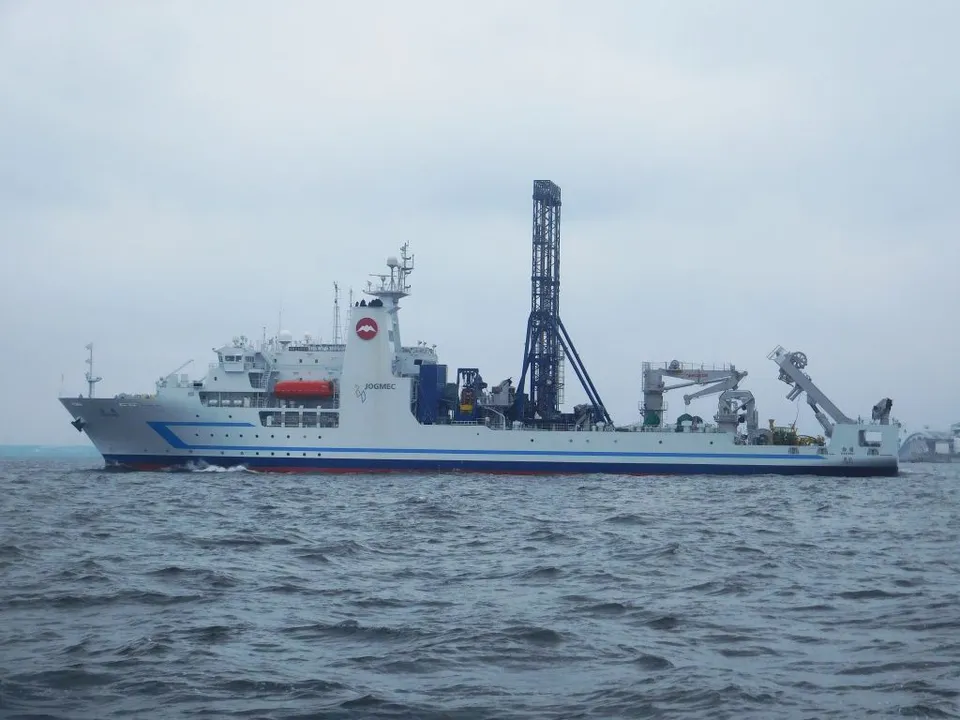
Japan's marine resource survey vessel Hakurei. (Ootahara, CC0, Wikimedia Commons)
Another recent study published in npj Ocean Sustainability by a team from the University of California, Santa Barbara (UCSB) found that the activities of tuna living near the ocean surface could be affected by mining operations. The researchers discovered that climate change will drive large numbers of tuna into the Clarion–Clipperton Zone (CCZ), located between Hawaii and Mexico in the eastern Pacific — a region that is also a major focus of mining activity.
photo credit:Irina Iriser
According to the study's projections, by the middle of the 21st century, the total population of skipjack tuna (Katsuwonus pelamis) in the zone will increase by approximately 31%, while yellowfin tuna (Thunnus albacares) will increase by around 23%. Although data on whether deep-sea mining affects surface-dwelling animals remains limited, Diva Amon, the lead author of the study, noted that deep-sea mining could harm tuna and other species, such as the leatherback sea turtle (Dermochelys coriacea). For instance, sediment plumes generated during mining operations — resembling clouds of smoke — could contaminate the water and damage the gills and filter-feeding organs of fish; the same problem could arise when mining waste is discharged back into the water. In addition, the noise produced by mining operations may alter the feeding and reproductive behaviours of tuna. The impacts of deep-sea mining may therefore extend from the surface of the ocean all the way to the seafloor.


Is Deep-Sea Mining More Destructive Than Land-Based Mining?
On the other side of the debate, The Metals Company, a mining start-up based in Vancouver, Canada, is a vocal advocate for deep-sea mining. The company is actively seeking permits to extract minerals from the seabed and argues that deep-sea mining will support the advancement of a green economy. It also maintains that the impact of sediment plumes can be minimised, and that current mining contractors are not targeting polymetallic nodules — mineral-rich seafloor sediment deposits in the deep ocean. In response, Amon argues that deep-sea mining is unlikely to replace land-based mining of precious metals, and that both will continue to operate, causing dual damage to two very different environments on Earth. Washburn, for his part, believes that while the direct destruction caused by deep-sea mining may be less severe than that of land-based mining, the large swaths of seabed disturbed during the process could significantly interfere with oceanic carbon sequestration.
At this stage, humanity's understanding of the deep sea — let alone deep-sea mining — remains far from sufficient. Amon believes that scientists must first gain a thorough understanding of what organisms inhabit the deep sea before they can begin to assess what scale of deep-sea mining would cause critical and severe damage to marine ecosystems. Deep-sea science advances slowly and at great expense; scientists need more time and funding to understand the full consequences of deep-sea mining.
Editor-in-Charge: Jenny Tsai
Further Reading: