Contents(3)
The Editor says: The true nature of the algal reef ecosystem is, in fact, a kind of ecological landscape that emerges under a variety of "unfavorable" conditions for normal ecosystem functioning. Depending on where you stand, the angle from which you view it differs — and scientific data is the best way to verify the truth. Follow along with the Editor to find out! Originally published in Science Monthly Issue 500, "What the Science Data Reveals About the True Nature of Algal Reefs" 2023.08.15
Since Taiwan's ecological conservation awareness began to rise in the 1980s, there has been only one case that captured the nation's attention, triggered a media frenzy, prompted the government to allocate enormous resources, and even required a public referendum: the "algal reef dispute" sparked by CPC Corporation's Third Natural Gas Receiving Terminal in the Datan area of Taoyuan. The word "dispute" is not entirely accurate, because decisions on ecological and environmental issues have never been — and should never be — about winners and losers. Rather, they should follow the principles of ecological functioning and find a balanced way forward amid diverse environmental and biological conditions. The real question is: how is that balance reached? That is the truly thorny issue. Making judgments based on science is in principle the most reasonable approach, yet scientific data can be interpreted from different angles, and disagreements or standoffs are par for the course. In the case of the algal reef, however, one-sided information was amplified relentlessly by news outlets, social media, and the public's instinctive sympathy for the underdog — with the result that straightforward scientific statements came to be seen as lending cover to the "tigers" (the government and state-owned enterprises). Now that the dust has settled, with no winners or losers to worry about, it is time to take a calm, clear-headed look at what those various scientific data points actually meant.
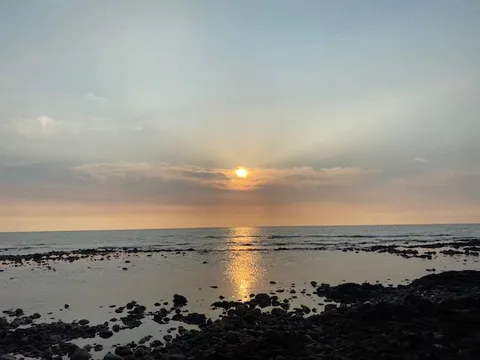
The sunset over the Guanxin Algal Reef is truly breathtaking.
But even if every data point is clarified, will the full picture of the algal reef's role in the ecosystem emerge? Honestly speaking: not necessarily — not yet, at least. But this is precisely the spirit of science: humility and the pursuit of progress. In the process of seeking the truth about algal reefs, the author and the research team built upon the work of predecessors, integrating and analyzing data from both sides of the argument — publicly verifiable data in the affirmative and the negative — combined with physical and chemical environmental parameters, and supplemented by ecological survey data from the surrounding waters that had rarely received much attention before. The goal was to sketch out what algal reefs truly look like, and why they have captivated so many people.
The results, however, were entirely unexpected: the reality of algal reef ecology turns out to be the polar opposite of the image that had been portrayed to the public.
The Two Faces of Algal Reef Ecology
What was the algal reef's original image? Social media and various news reports offer a great deal of explanation, but most of it is fragmentary, making it difficult to see the full picture. The most representative accounts, written jointly by several scholars and painstakingly compiled by professional editors, are largely found in the special feature in Science Monthly Issue 573 and the National Geographic report "Where Do Algal Reefs Go From Here?" Both accounts, without exception, draw an analogy between the algal reef ecosystem formed by crustose coralline algae in the Taoyuan area and the well-known tropical coral reef ecosystem — rich in biodiversity, highly productive, stable and structurally complex habitat, an important nursery for fish and shrimp larvae, making a pivotal contribution to the surrounding marine ecosystem, fisheries, and even the distribution and dispersal of marine life across East Asia.
This impression, however, may stem from an over-interpretation of a series of survey data, along with subjective connections and inferences drawn from surface observations and specialist knowledge. When the veil is finally lifted, the name remains the same — but the character beneath is entirely different.
From the perspective of the author's research team, the ecology of Taoyuan's algal reefs is broadly as follows:
For thousands of years, the western coast of Taiwan has been a marine ecosystem dominated by sandy shores. The narrow, elongated topography of the Taiwan Strait, combined with the northeast and southwest monsoons of winter and summer, has created the unique currents and tidal flows of these waters. The living organisms of the ocean — including those from the local area as well as from the surrounding South China Sea, East China Sea, and even the Pacific — have cleverly harnessed the characteristics of ocean currents, releasing their offspring into the flow so that they can "ride the sea" in search of new territories. The nearshore currents along Taiwan's western coast thus become a conveyor belt, teeming with larvae of every description: fish, shrimp, shellfish, worms, polychaetes, and even land crabs and coconut crabs that have already adapted to life on land. During this journey, the larvae are full of opportunity — but also full of danger.
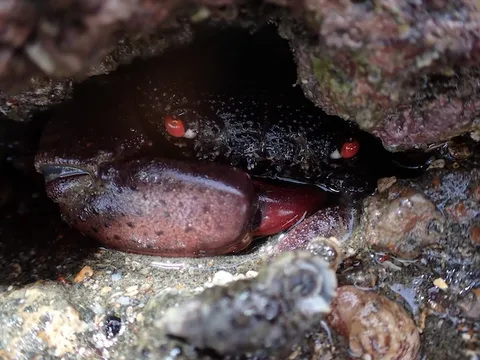
Flip over a rock and you'll find quite a few small crabs. photo credit:鳳筠
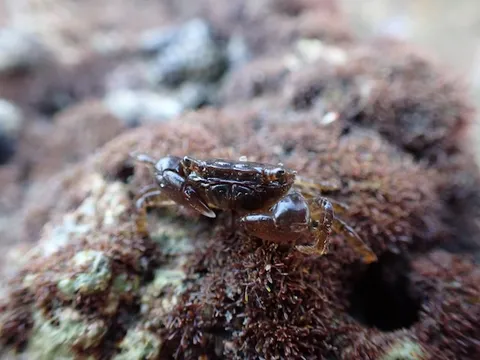
Crabs are a common sight throughout the algal reef. photo credit:鳳筠
Along the way, they fall prey to all manner of predators — from zooplankton at the small end to filter-feeding Whale Sharks at the large end. They also prey on each other; juvenile fish and shrimp that manage to consume coral eggs or embryos are getting truly "high-protein nutrition." So, unless they are oceanic organisms built for long-term pelagic life, any time they chance upon a place where they can settle and take shelter, they will seize the opportunity. For worms, snails, and bivalves that inhabit sandy-muddy bottoms, and for demersal fish such as flatfish, sand smelt, and flatheads, this is no problem — the western coast is a mud-and-sand marine ecosystem with plenty of suitable environments. But for organisms that require hard substrates for attachment — such as coral, oysters, and barnacles, as well as gobies, blennies, and moray eels — opportunities are far scarcer, and no potentially suitable spot can be overlooked. Along the long sandy shore, algal reefs are precisely such a place. Yet they are not found only at Datan in Taoyuan; across Taiwan, there are patches of varying sizes at Xinfeng, Danshui, and elsewhere. More broadly, many artificial hard-substrate areas along Taiwan's western coast — such as harbors and fishing ports — also represent opportunities for these organisms. The question is: can they actually survive in these environments?
If they encounter a tropical coral reef, their chances of survival are high, because the place they settle offers very high primary productivity — much like a place where humans live that has natural fruit trees or can grow rice, providing the environment and food that all manner of organisms need. Primary productivity is a fundamental condition for a thriving ecosystem; mangroves and seagrass beds, for instance, can also support very high biodiversity. But what about algal reefs? Their productivity is very low — only 65 g/m2 per year, even less than the 101 g/m2 of intertidal mudflats in sandy areas. For the organisms living here, eking out an existence is a genuine struggle.
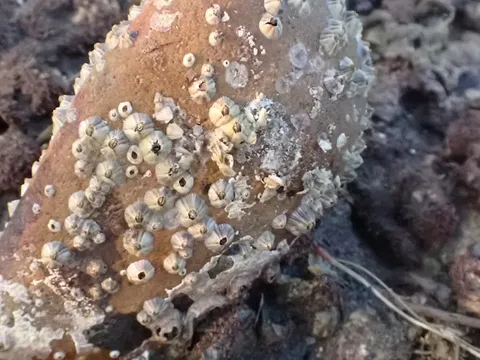
Barnacles are everywhere.
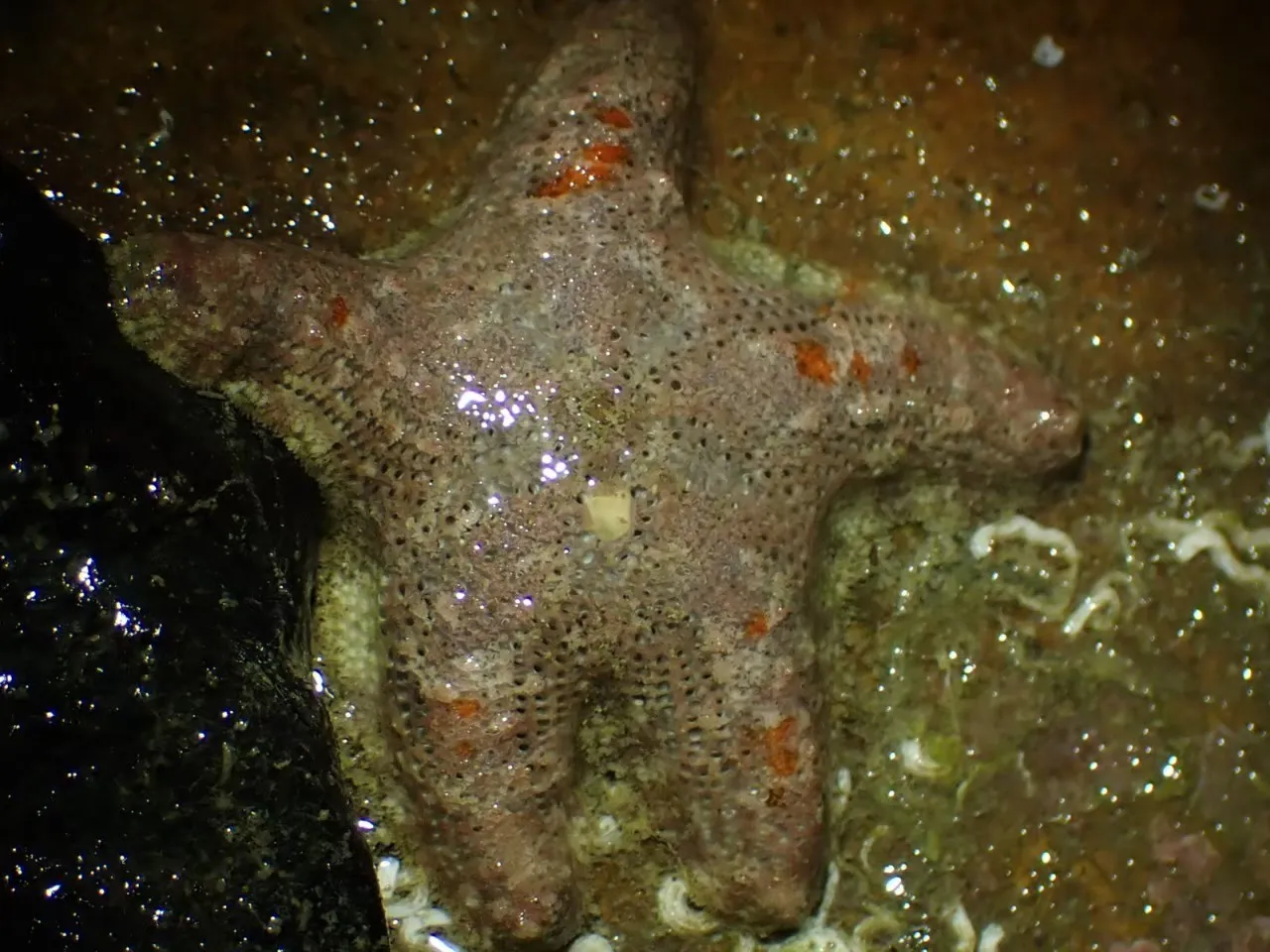
Sea stars are also frequent visitors to the Guanxin Algal Reef.
But this can hardly be blamed on the crustose coralline algae that form the reef — they can only grow a little each year. The entire algal reef grows by just 0.1 cm per year, and most of its body is the indigestible calcium carbonate that people simply gloss over, imagining it to be like ordinary algae: a granary that can feed a whole building full of tenants.
At the very least, it provides the function of housing! The reef structure formed by the accumulated remains of crustose algae has countless pores — isn't that exactly the kind of place where worms, polychaetes, and small shrimp and crabs can live? That is true enough, but this is a thousand-year-old ancestral home! It is far less stable than other reef structures such as coral reefs or oyster reefs; maintenance is already a challenge. On top of that, there is a whole host of natural disasters: the interaction of seasonal winds, waves, and currents ceaselessly causes sand and silt to accumulate over the algal reef. If the algae beneath cannot emerge in time, they truly become a dead reef — and the organisms living in the crevices perish along with them. Even if the accumulated sand is fortunately removed in time — usually during stronger wind and wave seasons, or even after a major typhoon, with erosion in the Datan area also caused by human-built embankments — allowing the algae and the small organisms that endured the burial to see the light of day again, that might be considered a blessing from above. But don't forget: the very harsh weather that saves them is another natural disaster that wreaks havoc on the reef's inhabitants. It is precisely because of these mutually contradictory, violent environmental disturbances that the mythology so often repeated — that "algal reefs are thriving, the organisms of algal reefs are extraordinary, and algal reefs are under persecution" — was born.
The thriving appearance comes from the coastal current, which delivers a ceaseless supply of new larvae. Whenever the algal reef is exposed, they rush to join in, striving to grow and desperately trying to fulfill their natural imperative to reproduce. Observations made during such moments naturally present a scene teeming with life — a grand spectacle of biodiversity, where just about any organism might appear. The "persecution," on the other hand, comes from the scouring and flushing action of sediment accumulation and powerful waves — two forces that work in opposite directions. Although both are pitiless killers of life, they happen to maintain the very conditions necessary for the algal reef to look the way it does.
How so?
It turns out that nature follows a principle of ecological succession: in a stable environment, many species rush to colonize a newly available habitat, and the organisms best adapted to that environment, being the most competitive, develop into dominant species that proliferate and monopolize resources, while less competitive species dwindle. In ecosystems with high primary productivity, weaker species might still get a share and survive, sustaining high biodiversity. But in low-productivity areas — especially in algal reefs with almost no productivity — biodiversity will inevitably decline over time due to competition and food scarcity.
Yet Taoyuan's algal reefs, precisely because of their harsh conditions — sediment accumulation, powerful waves, turbid water, and the violent disturbances brought by frigid cold currents — have their dominant species repeatedly cleared away and their habitats repeatedly reset. Larvae join again and again; the adults that manage to grow are kept at a population size that is not too large, but maintained in a state of dynamic equilibrium. And when this situation is assessed using surface-level scientific data, doesn't it look like a thriving ecosystem — one with many larvae coming and going, and rich biodiversity? Yet in reality, the actual biomass per unit is impoverished and cannot be high. From an academic perspective, this is simply an ecosystem stuck in an early successional state — a child that never grows up.
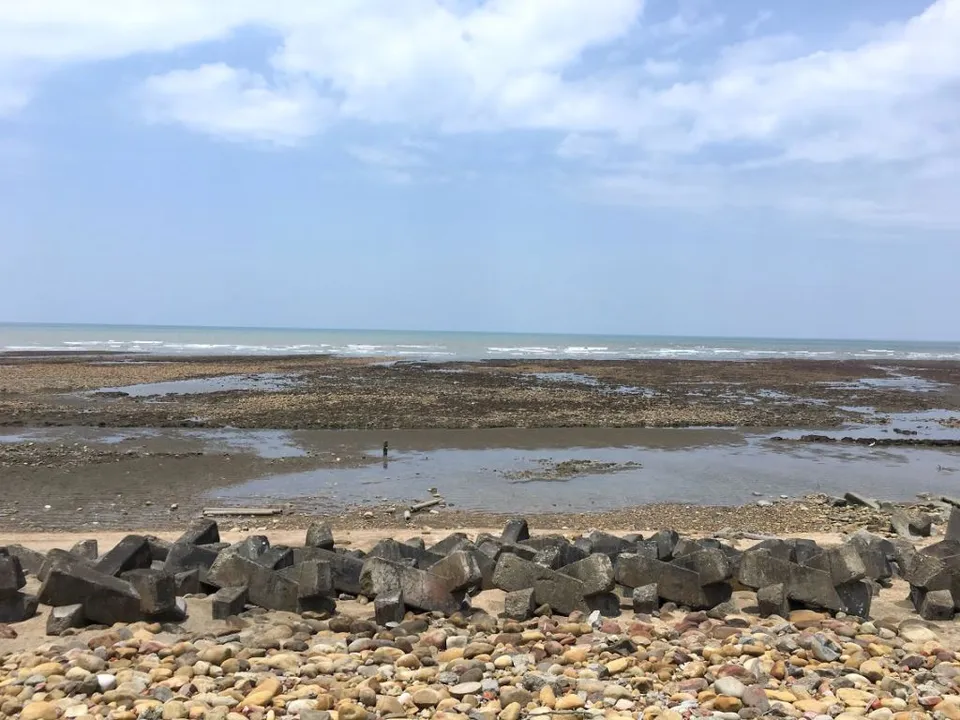
photo credit:謝馨慧,CC BY-SA 4.0,Wikimedia Commons


Rare Yet Abundant? A Beautiful Misunderstanding of Algal Reefs
In this kind of dynamic environment, the dominant species of productive ecosystems that the public knows well — such as coral assemblages and large macroalgae — struggle to gain a foothold. Instead, it is the broadly adaptable fringe species that thrive here: species that, in the main body of an ecosystem, lack the competitive edge and are constantly pushed to the margins, playing bit parts with small populations, limited influence, and rarely studied. In an algal reef, they find their niche — and may even flourish.
Take, for example, the nationally designated Category I protected species Polycyathus chaishanensis: its rarity may simply be a beautiful misunderstanding born of insufficient baseline information. After targeted surveys, it has been found at the Yong'an Natural Gas Terminal, along the Taitung coast, and even in corals legally exported from Indonesia to the Netherlands. As for the crustose coralline algae repeatedly described in algal reef reports as new species — given their life history and wide distribution, they may simply reflect the inadequacy of past scientific surveys in this field, rather than representing treasures unique to Taiwan.
The outlines of algal reef ecology are gradually coming into focus. But there is still one puzzle piece that has rarely attracted attention: in a place with such meager primary productivity, where does the food for the residents come from? The answer is that a large proportion of the food in algal reefs comes from the turbidity of the surrounding waters. The suspended matter there consists mostly of highly caloric organic detritus — unpalatable, perhaps, but the primary food source for filter feeders, detritivores, and omnivores such as barnacles, oysters, snails, bivalves, horn snails, shrimp, crabs, polychaetes, and worms — and the reason these organisms thrive as dominant groups in this environment. This organic matter originates from nearby rivers flowing into the sea, supplemented by organic material stirred up by the powerful waves; it is then transported and deposited into the algal reef by tidal surges and wave action, becoming a free, externally supplied food source for the reef's inhabitants. And if the season is right and luck is on their side, the passing water mass happens to carry large quantities of phytoplankton and zooplankton, pushed into the algal reef zone by the incoming tide or waves — and it truly becomes a feast day for the residents. Remarkably, the very environmental factors thought to harm organisms turn out to be the delivery service bringing meals to the algal reef's residents.
From another angle: how many organisms can an algal reef actually support? This is primarily limited by the modest productivity of the crustose coralline algae and the externally supplied suspended matter. Some argue that macroalgae bloom luxuriantly on the algal reef at specific times each year, making a significant contribution to primary productivity. But this description is not entirely accurate, because most of these macroalgae are washed back into the open sea and utilized by the surrounding ecosystem rather than by organisms within the algal reef itself — a comparison with the fate of the macroalgae in the green rock pools of the Northeast Coast makes this clear. Moreover, excessive macroalgae — too many, covering too large an area, surviving too long — are in fact the greatest competitors of crustose algae. The sediment accumulation so fiercely condemned by many conservationists actually functions to suppress the proliferation of macroalgae, serving as a "volunteer militia" that helps crustose coralline algae resist invasion by their rivals.
A Simple Sketch of the Algal Reef Ecosystem's True Nature
Taken as a whole, the true nature of the algal reef ecosystem is an ecological landscape that emerges under a variety of conditions "unfavorable" to the normal functioning of an ecosystem. To put it in plain, accessible terms, it is like this:
The algal reef itself is a thousand-year-old ancestral home. Ocean currents deliver all manner of stray children to its doorstep. Food within the home is severely scarce; turbid waves bring unappetizing sustenance, while relentless drifting sand culls the less fortunate — only the toughest, most resilient species manage to survive. The vacancies left by those that perish are just enough to allow new arrivals to keep joining in. To the eyes of an outsider, a thriving nursery — rich in biodiversity and home to rare species — appears to have emerged.
Once the true nature of the algal reef comes to light, its future fate and the strategies for how it should be managed become clear now that we understand it.
-
Will living algal reefs endure forever? Unlikely. They can only grow less than 0.1 cm in thickness per year, and under the increasingly severe trend of global warming, Taiwan's sea level is already rising at an average rate of 0.34–0.38 cm per year — and is expected to accelerate at least threefold over the next 30 years (projected to 2050). In other words, given that no living algal reefs currently exist below 6 m depth, the existing reefs will likely die off before long as the water becomes too deep.
-
Will dead algal reefs (geological reefs) endure forever? Hard to say. If sand burial is rapid enough, they may survive. But if coastal waves intensify as sea levels rise and erosion increases, the fragile, porous structure of algal reefs will be the first to suffer damage — the current situation already looks difficult to sustain for long.
-
Should sediment be removed? It appears unnecessary — unless people wish to alter the natural character of the algal reef — because the ebb and flow of sediment is a key factor in maintaining the algal reef ecosystem, and burial is also a necessary process in the formation of geological reefs.
-
Should construction-related turbidity be controlled? High turbidity from organic suspended matter is actually an important food source in the algal reef zone. Since turbidity caused by construction is relatively minor compared to the naturally occurring organic suspended matter in local waters, indiscriminately reducing turbidity may actually deprive algal reef inhabitants of their food supply.
-
Should crustose coralline algae or algal reefs be artificially cultivated?
-
If the aim is to protect the crustose coralline algae at this site: there is probably no need to worry too much, as they are naturally a widely distributed species — if this place cannot support them, they will find somewhere else.
-
If the concern is that crustose coralline algae will go extinct: simple ex situ conservation of germplasm is sufficient.
-
If the goal is to cultivate local "algal reefs": given that they can only grow at 0.1 cm per year on hard substrates under normal conditions, cultivating 50 cm would take an estimated 500 years — along with highly stable policies, budgets, topography, site selection, and 500 years of similar environmental parameters. Given the current pace of climate change and coastal erosion, this is an extraordinarily difficult undertaking.
-
Perhaps seeing and facing the truth clearly is itself an act that requires great magnanimity, courage, and wisdom. But is science's spirit, civilization's progress, and a better future not built precisely on this accumulation of seeking, reflecting, accepting, and seeking again? The remarkable story of algal reefs is the best example of all.
Editor-in-charge: Jenny Tsai
Further Reading: