Full article reprinted from "Decompression Theory Every Diver Should Know (Part 2), Author: Lin Youping"
In the previous installment, we discussed how Haldane's half-saturation time decompression model opened the door to decompression research in diving, with many scientists picking up where he left off. Among these contributions, the Bühlmann decompression algorithm was developed by Swiss physician Dr. Albert A. Bühlmann, who began building on Haldane's foundational research in 1959. The latest generation of Dr. Bühlmann's work, the ZHL-16C decompression model, was designed specifically for dive computers. ZHL-16C employs 16 theoretical compartments with half-saturation times ranging from 4 to 635 minutes, and refines the M-values for each compartment — setting higher upper limits for fast tissues (theoretical compartments). After continuous refinement and evolution, it emerged victorious in comparative decompression trials in the early twenty-first century and is now the widely recognized and adopted industry standard. It is also the decompression model used by Garmin dive computers.
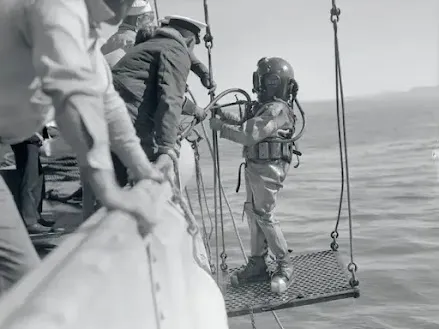
In Haldane's era, computers did not yet exist, so all decompression calculations had to be done by hand — making it naturally impossible to perform complex calculations with a large number of variables. Early diving also involved wearing heavy equipment and being supplied with air from the surface, meaning divers could not ascend or descend on their own and had to rely on diving bells and cages. The hoisting speed of the winch on the surface vessel was 1 foot per second, which is the origin of the dive ascent rate limit of 18 m/min.
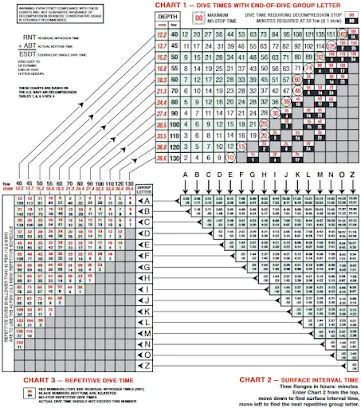
Given a fixed dive depth and discrete time increments (5–10–15–20–25–30……), it became possible to calculate the theoretical compartment saturation at each fixed time interval for that depth. Combined with the Time to Surface (TTS) — obtained by dividing the dive depth by the fixed ascent rate — one could also calculate the off-gassing process during the ascent and the continuing decline in compartment saturation during the surface interval. This is the origin of the dive planning tables you learned about in your Open Water Diver (PADI/SSI cert) course. Looking up a table always requires a single fixed depth and time, which feels like wearing an off-the-rack uniform — never quite as well-fitted as something tailor-made.
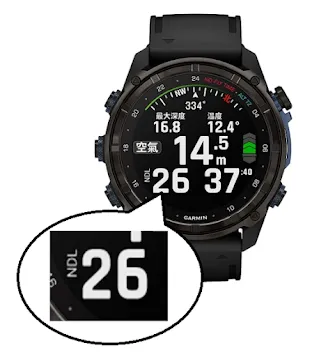
NDL (No Decompression Limit)
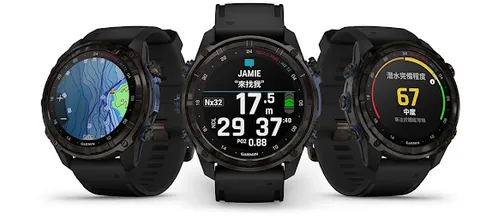
Dive computers can perform complex, real-time calculations, completing a sampling cycle in just a few seconds. Garmin dive computers leverage their powerful processing capabilities to update the sampling every single second, enabling an even more immediate response to changes in depth. We have long since moved past the era of winch-controlled ascents, although dive computers still use a built-in ascent rate of 10 m/min to estimate TTS (Time to Surface). While remaining at a given depth, the dive computer can calculate how much time is left for each of the 16 theoretical compartments before reaching their safe upper limits, as well as the estimated values for each compartment after off-gassing during the TTS ascent back to the surface. The compartment with the shortest remaining time is then displayed on the watch face as the No Decompression Limit (NDL). As you ascend during a dive, the NDL is not a fixed value — it gradually increases. By operating within the NDL shown on the dive computer, you can avoid absorbing excessive amounts of nitrogen.


GF (Gradient Factors)
The goal of scientific research is to identify the safe boundary (the M-Line), but in actual diving there is no need to push close to that boundary. As a result, the ZHL-16C model includes a user-adjustable conservatism margin. Taking GF 30/70 as an example: 30 is the GF Low, meaning that at the deepest point of the dive, 30% of the supersaturation range is used; 70 is the GF High, meaning that at the shallowest point (the surface), 70% of the supersaturation range is used. Connecting the two creates a gradient factor line (GF-Line) that gradually increases from deep (30%) to shallow (70%).
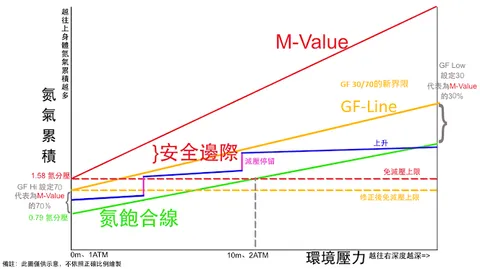
When the GF Low value is lower, the diver will begin decompression at a greater depth and the number of decompression stops will increase. When the GF High value is lower, residual nitrogen in the body upon returning to the surface will be lower, which means decompression time will increase. The following results were calculated using the decompression dive planning function on a Garmin dive computer, with air at 40 m for 30 minutes.
| Depth / GF | 30/70 | 30/80 | 40/80 | 40/90 | 50/95 |
|---|---|---|---|---|---|
| 18 | 1 | 1 | |||
| 15 | 4 | 3 | 3 | 2 | |
| 12 | 6 | 4 | 3 | 3 | 3 |
| 9 | 9 | 7 | 7 | 6 | 5 |
| 6 | 18 | 14 | 14 | 10 | 9 |
| 3 | 35 | 28 | 29 | 23 | 20 |
| Total time | 73 | 57 | 56 | 44 | 37 |
*With the same GF Low, a higher GF High results in shorter total decompression time
*With the same GF High, a lower GF Low means decompression begins at a greater depth
Does a lower GF value mean more conservative and safer? In terms of GF Low, a lower value means spending more time at depth. This may cause slow tissues to continue absorbing nitrogen and will also increase gas consumption. In terms of GF High, a lower value increases the overall dive time, which undeniably poses additional risks of fatigue and hypothermia.
For no-decompression dives, GF Low has no effect, since the entire dive does not involve any decompression phase — but the level of GF High does affect the length of the no-decompression time. The following no-decompression times at 25 m on air were calculated using a Garmin dive computer planner:
| GF | 30/70 | 30/80 | 40/80 | 40/90 | 50/95 |
|---|---|---|---|---|---|
| NDL | 12:43 | 16:11 | 16:11 | 20:34 | 23:36 |
With the rapid advancement of dive computer technology, divers' habits have evolved from carefully planning a dive with tables beforehand to passively adjusting their next move in real time based on the live information displayed on their dive computer. Yet once we understand the origins of the dive computer's decompression model, we realize it is ultimately the result of a mathematical model — one that cannot truly reflect the body's actual physiological processes. We can only say that, by comparing practical experience with dive computer operations, following the dive computer should be safe in the vast majority of situations. Certain physiological factors, however, remain beyond the scope of current decompression theory.
Editor in Charge: Jenny Tsai
Further Reading: