Republished in full from "Decompression Theory Every Diver Should Know (Part 1), Author: Lin Yu-Ping"
Q: Decompression? That has nothing to do with me… I'm just a recreational diver…
Q: No worries… I just need to follow my dive computer, do what it says, and everything's OK!
The truth is, in any type of diving, unless you never return to the surface, ascending from the bottom means you are decompressing.
-
What parameters are being used?
-
The dive computer isn't hooked up to our veins — how does it know how much nitrogen is in our bodies?
-
You sometimes hear about someone feeling unwell and ending up in a hyperbaric chamber — if they were wearing a computer, how did they still get decompression sickness (DCS)?
Plenty of people still get lost even when following GPS navigation. Only by building up your own knowledge can you develop the judgment to make good decisions. Knowledge is power — let's all read this diving lesson worth NT$4,500 with care!
Decompression Theory: Ambient Pressure
To begin, any discussion of modern dive decompression research must start with a fellow named Haldane. In 1905, Haldane conducted live experiments on goats, observing the effects of different depths, bottom times, and ascent profiles on their bodies. After sacrificing 85 goats — and putting himself through human trials as well — he reached a conclusion: the safe decompression limit for diving is an ambient pressure ratio of 2:1.
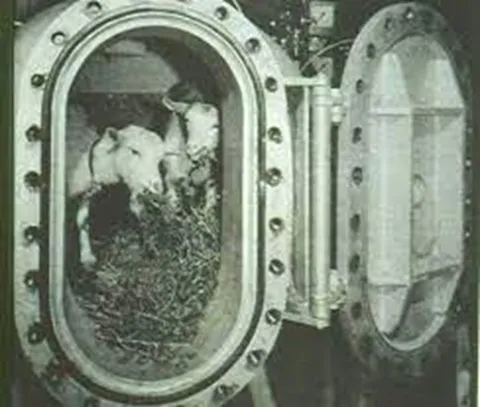
Goats inside a pressurized chamber
Let me walk through a few examples to illustrate:
First, we understand that given enough time, the nitrogen in our bodies will reach saturation equilibrium with the new ambient pressure. A simple everyday analogy: add a large spoonful of sugar to a glass of water — if you add too much, it won't dissolve, and you've reached a state of saturation. But if you heat the water, the solubility increases, the sugar disappears, and you can keep adding more sugar until it no longer dissolves — at which point you've reached a new saturation point in "hot water."

Pour the sugar water out and let it cool, and you'll notice sugar crystals forming at the bottom of the glass — another new state of saturation (cold water) has been reached. During the cooling process, the sugar water is in a supersaturated state, which is why the sugar precipitates out and forms crystals.
Now let's replace the heat with pressure, the water with the human body, the cooling with decompression, and the sugar with nitrogen. We can see that at different pressures, the human body will have different saturation levels of nitrogen.
Haldane's research found that after spending a long time at an ambient pressure of 2 atmospheres (10 m underwater) and reaching saturation, you can return to an ambient pressure of 1 atmosphere (the surface) without any adverse effects on the body.
And if you're at an ambient pressure of 4, you can ascend to an ambient pressure of 2 and stay for a while (the 2:1 ratio), waiting for your supersaturated body to reach a new saturation equilibrium before returning to the surface.
However, we know that the culprit behind decompression sickness (DCS) is nitrogen. At an ambient pressure of 2 atmospheres, the partial pressure of nitrogen in the breathing air is 1.58 atmospheres (since nitrogen makes up approximately 79% of air: 2 × 0.79 = 1.58). So after spending a long time at 10 m, the nitrogen partial pressure saturated in the body is 1.58 atmospheres. Returning to the surface at 1 atmosphere puts the body in a supersaturated state, but with no adverse effects. Later research refined this finding into the following statement:
The supersaturated nitrogen partial pressure the human body can tolerate is 1.58 times the ambient pressure.


What Is the M-Value?
From this, we can clearly define the upper tolerance limit for nitrogen in the human body at different ambient pressures (the deeper you go, the higher the tolerance). This limit is defined as the M-value, and the M-value depends on ambient pressure (depth). Since every dive ultimately ends at the surface, the lowest M-value occurs at the surface. In simple terms: as long as the nitrogen partial pressure in my body does not exceed 1.58 atm, it is safe for me to return to the surface. As long as you control the nitrogen partial pressure in your body to stay below 1.58 atm and maintain a safe ascent rate, you can head straight to the surface without any decompression stops — that is the definition of a no-decompression dive.

But… we can't always stay within 10 m, can we? If you dive deeper than 10 m and stay too long, the nitrogen partial pressure in your body may exceed 1.58 atm — so what do you do? This is where studying the rate at which nitrogen enters the body becomes essential. The goal is simply to ascend before the nitrogen in your body reaches the limit!
Haldane's Decompression Theory
Haldane understood that the human body is a complex physiological system that simply cannot be quantified in straightforward terms, so he made a bold assumption. Drawing on the concept of radioactive half-life from physics, he proposed a model based on half-saturation times.
The idea is that after a specific period of time, the tissue reaches half (50%) of full saturation; after a second half-saturation period, it increases by another half (reaching 75%); after a third, by another half again (reaching 87.5%).
Imagine you're absolutely starving and you walk into an all-you-can-eat hot pot restaurant. In the first 10 minutes you devour 4 plates of meat — your stomach is warming up but you're only "half full." In the next 10 minutes you manage just 2 plates, feeling somewhat full. In the 10 minutes after that, you can only slowly chat and pick at 1 plate.
The rate at which nitrogen enters the body follows a similar pattern — fast at first, but as time passes and more accumulates in the tissues, the rate of uptake gradually slows.
Haldane hypothesized a set of theoretical compartments (not representing any actual organ) with different half-saturation times assigned from fast to slow: 5, 10, 20, 40, and 75 minutes. Each theoretical compartment absorbs and off-gasses nitrogen according to its assigned half-time. For example, the fast compartment with a 5-minute half-saturation time reaches 50% after 5 minutes, and 75% after another 5 minutes. Through mathematical calculations, the nitrogen content of all five theoretical compartments can be determined, providing a range from which the compartment closest to its limit serves as the critical indicator.
| 5-min half-time | 10-min half-time | 20-min half-time | Absorption rate |
|---|---|---|---|
| Time elapsed | Time elapsed | Time elapsed | Full saturation |
| 0 | 0 | 0 | 0% |
| 5 | 10 | 20 | 50% |
| 10 | 20 | 40 | 75% |
| 15 | 30 | 60 | 87.5% |
| 20 | 40 | 80 | 93.8% |
| 25 | 50 | 100 | 96.9% |
| 30 | 60 | 120 | 98.5% |
But! Here comes another "but." The key to this model is not absorption — it's off-gassing!
If we only considered absorption, the fast compartments would always come out on top. But every dive involves an ascent and decompression! Fast compartments were defined from the start as absorbing quickly and off-gassing quickly — earn fast, spend fast, and in the end you're left with nothing. Take the fast compartment with a 5-minute half-time: after 10 minutes of absorption it's at 75%, but ascend to the surface and after just 5 minutes of off-gassing it's back down to 37.5%.
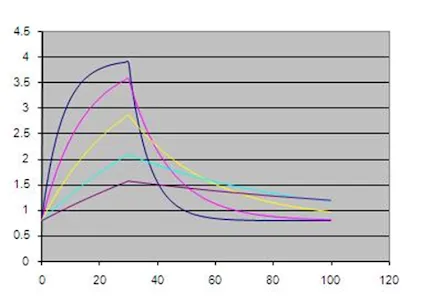
The blue line, which absorbs the fastest, also off-gasses the fastest — and quickly drops to the lowest level.
For those of you using a Garmin dive computer, press the lower-left button to enter the surface time view and see the oxygen toxicity information, then go to the next page to easily see the tissue nitrogen bar graph. As your surface interval increases, you'll notice that the peak shifts from the fast compartments toward the slow compartments. This is because the fast compartments quickly drop below the orange line, while the medium and slow compartments, though they absorbed less, also off-gas very slowly and therefore accumulate over time. This phenomenon becomes even more pronounced during repetitive diving — the medium and slow compartments that seemed insignificant at first end up becoming the critical compartments.
Back to history: Haldane used his half-saturation time decompression model to verify his experimental results and found that most of them matched. He then went further and used the model to plan a decompression dive to 50 m for 30 minutes, which he tested in real dives — ultimately confirming that the model was valid. In 1908, Haldane published his decompression model, and to this day we continue to rely on this half-time theory as the foundation of modern dive decompression models. After more than a century of testing and refinement, humanity has opened a door leading toward truth in dive safety.
Editor: Jenny Tsai
Further reading: