A photograph records not just a single moment, but the accumulation of years of experience — a journey traveled back and forth between the shutter and the delete button. It is a great joy that Xiaoliuqiu has become the dive site with the highest sea turtle density in Taiwan and even in the world. The endearing charm of sea turtles draws countless divers into the deep blue, all for the chance to swim alongside them. On Xiaoliuqiu, there is a professional underwater photography master dedicated to documenting sea turtles — Su Huai. This year, he personally captured precious footage of sea turtle mating on multiple occasions. We are delighted to invite Su Huai to share with us how he photographed sea turtle mating.
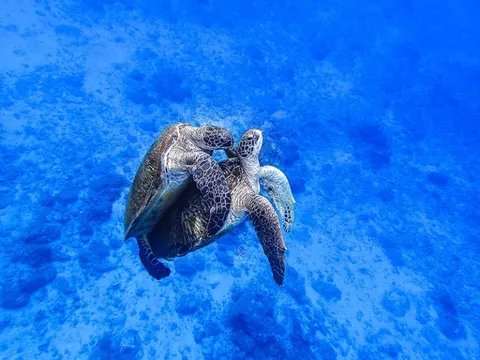
Photo Credit 島人海洋工作室
About the Author
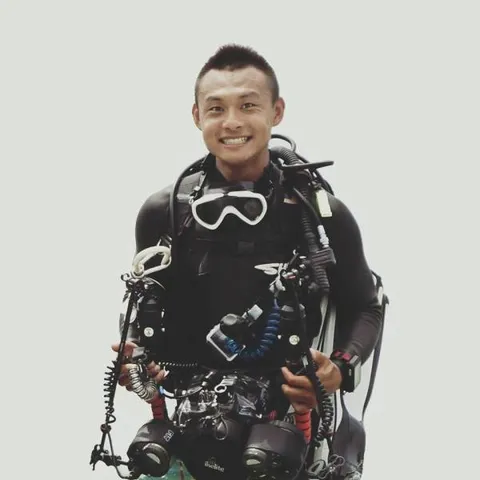
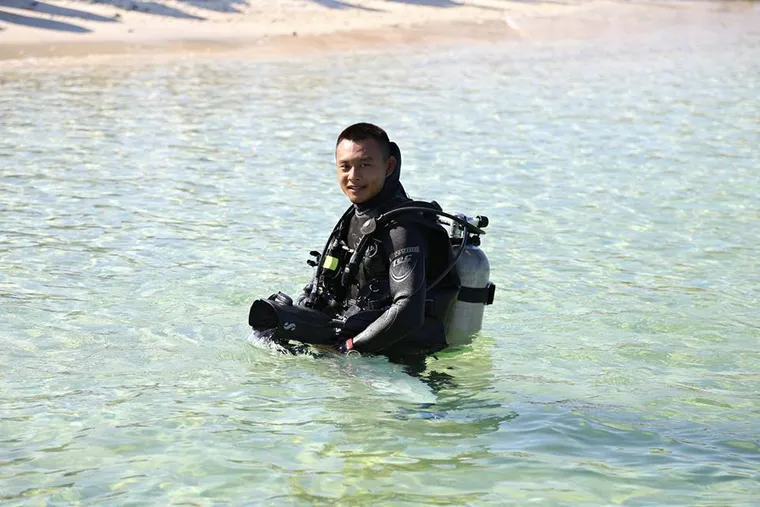
Su Huai, Founder of Islander Ocean Studio
On the far side of the vast Pacific Ocean, there is a beautiful little island. The people who live on that island are all "islanders."
We hope to bring people into the water with us — it is the most direct way to let the ocean flow into our lives. If you are willing to take that first step, we will always be waiting for you in the sea.
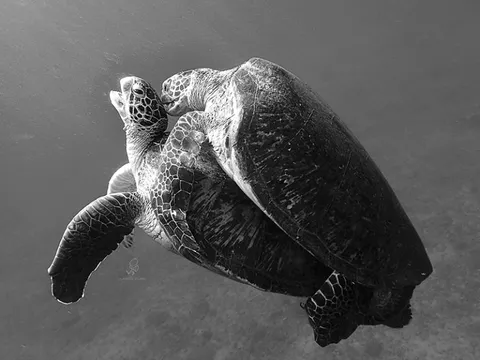
Photo Credit 島人海洋工作室
Someone asked: "How did you manage to photograph sea turtle mating?"
Of course, luck plays a very important role.
However, more often than not, luck is the result of many factors coming together to make it more likely to happen.
In the case of capturing clear underwater footage of sea turtle mating on Xiaoliuqiu, I personally believe it took me seven years to get there. From the very first time I tried diving and began to know the ocean, I bought my first underwater camera — a Canon S90. That camera accompanied me through four summers in Penghu and traveled with me to dive sites across Southeast Asia and Australia. During that time, diving was my main work, and marine life and underwater photography were my passions. I even used a spear gun to fish, which gave me a first-hand understanding of how fishermen exchange one life for another, living in rhythm with the waves and tides.
Because I devoted the vast majority of my time, energy, and life to the ocean, I gradually built up a sensitivity to the marine environment and marine life. I would never dare claim that I truly understand the sea, but I try to feel my way toward understanding through the tides, the currents, the surge, the sea breeze, and from the sea turtle's own perspective and point of view. And when it comes to the ocean, the environment, and life itself, a great deal of time, energy, and physical effort must be invested before you have even a small chance of drawing a little closer.
Since settling down on Xiaoliuqiu and dedicating my time to being with sea turtles, I've found that photographing sea turtles here is actually not difficult. Give anyone an underwater camera and they can do it, because the sea turtle density here is so high and many of the turtles are friendly and unafraid of people.
So plenty of people had already been shooting sea turtle images — and shooting more of them, and for longer, than I had. Take this precious sea turtle mating footage, for example: it was a local dive instructor who first captured it, and subsequently several different instructors recorded it at different locations. At the time, I was both excited and envious. I desperately wanted to witness it with my own eyes, experience it firsthand, and document that moment with my own hands.
So I began to think: "Is there any way I could photograph sea turtle mating myself?"
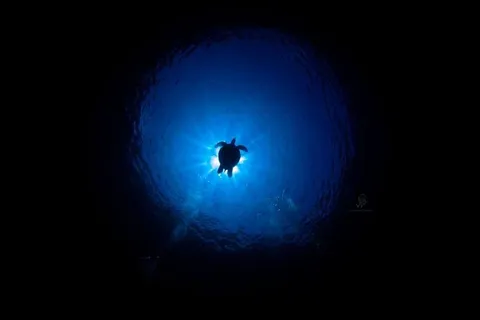
Photo Credit 島人海洋工作室
1. Timing
At the time I was teaching students a beginner scuba diving course, so I had very little free time and could only get in the water during the hours left over from work — roughly from 4 or 5 p.m. until dark.
2. Turtle Sighting Location
I chose Vase Rock (花瓶岩) as my location, since mating had been witnessed and photographed there more times than anywhere else. Because it was peak summer holiday season, Vase Rock attracts many tourists and divers snorkeling and diving in the area. On the days I went in, visibility near the shore and in the shallows was poor. I figured the chances of encountering mating sea turtles in a crowded, murky spot were relatively low, so I decided to swim against the current around the northern corner. In my experience, clean, clear water tends to flow in around that corner, visibility is better there, and almost no tourists or divers ever venture that far.
3. Diving Method
I chose snorkeling and freediving without scuba gear, because traveling light makes it easier to push against a current at the surface, allows a wider range of movement, and the underwater visibility around the corner was thirty meters at the time — the seabed was clearly visible from the surface. Additionally, mating sea turtles typically need to surface to breathe, so there was little need to strap on a scuba tank and descend. The "turtle islands" where sea turtles frequently appear in that area are mostly within ten meters depth; freediving is more than sufficient if a descent is needed.
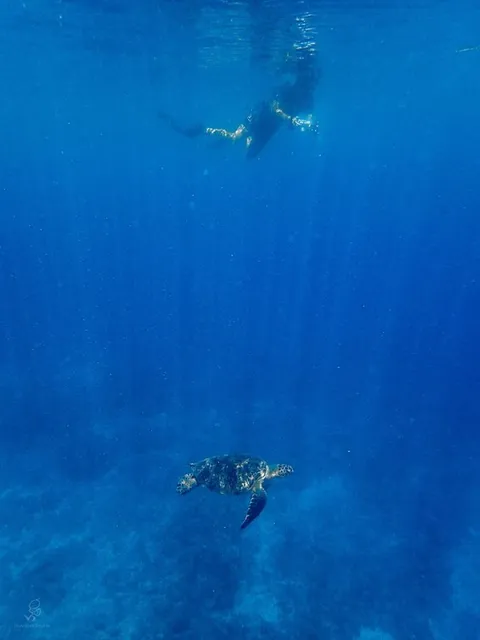
Photo Credit 島人海洋工作室
4. Camera Equipment
Beyond the basic snorkel gear, I kept my camera equipment light and simple: a GoPro for video and a TG4 for stills.
5. Target Subject
I focused on mature male turtles with long tails, as they are easier to identify. In the days leading up to this session, I had already noted and documented several individuals that appeared regularly in the area — I suspected they had come to mate or were preparing to do so.
6. Action
In total, I entered the water five days in a row. Fortunately, on the second day I encountered mating sea turtles and was able to document it at close range — and that was the only time mating was encountered across all five days. For the first three days, because of my teaching schedule, I was only in the water for about two hours each time looking for turtles. On the fourth day, after finishing my class, I got in the water in the afternoon for roughly half a day. On the fifth day I seized the window before a typhoon arrived and the swells grew too large, and I spent nearly five hours in the sea.
On every dive, I tailed several male turtles. Most could not be followed for long before they swam out to open water or headed into deeper areas. A handful that were resting, or that did not seem to mind being followed, could be tracked for tens of minutes or even a few hours.
As for the male turtle that was caught mating — he was one of several I had been tracking that day. The first few seemed completely uninterested in me, so I kept searching for new targets. Eventually I came across this particular male. At first he was resting. I waited for a while, and then he swam up to breathe. After that he began to circle repeatedly, sizing me up as I circled alongside him. From his eyes and behavior I could sense that he was different from the other males I had followed before — a feeling I cannot quite put into words. In the moment our eyes met, something about his energy simply felt different. It sounds almost mystical and is hard to describe in language, but when a sea turtle is about to do something different or something is about to happen, the aura it radiates and the look in its eyes are subtly unlike the ordinary.
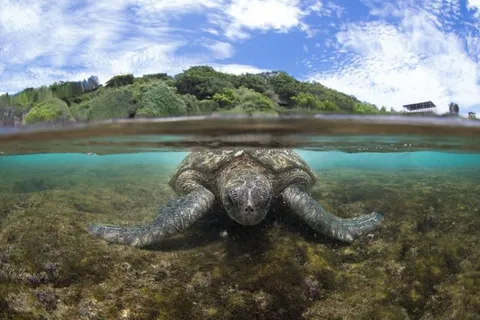
Photo Credit 島人海洋工作室
7. The Process of Photographing Sea Turtle Mating
Perhaps spending so much time with sea turtles has gradually cultivated a kind of sensitivity — maybe what you would call a "sixth sense."
Before I even picked up my camera, I felt that capturing underwater footage of sea turtle mating in Taiwan would be something truly precious — quite possibly the first, or one of very few, clear records ever documented here. So I began to think seriously and plan carefully about how to give my vision the best chance of becoming reality. During the actual execution, I immersed myself completely in the moment, communicating with the turtles through my body and senses. Afterward, I went back and reflected on and organized the entire process and record — much like putting together this very article.
As the six points above suggest, beyond good luck, I believe it is far better to actively do something to give the hoped-for event a greater chance of happening than to simply sit and wait for fortune to arrive. "One part talent, two parts luck, seven parts hard work." Underwater wildlife photography in particular demands far more factors to consider and capabilities to develop than photography on land — so every precious image placed before an audience represents not just a single instant, but the accumulation of decades and countless hours of effort.
This is my own personal approach to photographing wild sea turtles and spending time with them — I am still exploring and learning as I go, and every experience is a lesson drawn from trial, error, and failure. Perhaps these methods do not suit everyone; perhaps some of them will prove useful. I share them with anyone who is interested, and I always welcome any feedback or criticism. That's all for now — over and out!