Contents(5)
- Children Who Grew Up by the Sea: The Everyday Landscape of Baosheng
- From Living Space to Ecological Awareness: How Did the Algal Reef Enter Public Consciousness?
- The Meaning of a Lighthouse: Not Just Navigation, but a Symbol of Protection
- Photographing, Observing, Recording: Conservation Action in Baosheng Community
- Further Reading
Children Who Grew Up by the Sea: The Everyday Landscape of Baosheng
In Baosheng Community, the coastline is more than a geographical boundary — it is woven into the fabric of daily life. The community association chairperson, known affectionately as "Sister E," recalls how family members would watch the tides and check the weather before taking the children down to the shore to set nets and catch fish. At low tide, adults would wade in to fish while children played along the water's edge, waiting for the water level to drop to knee height before joining in. Fishing methods included beach seine netting, set-net fishing, and stake-net fishing — a testament to the diverse fishing culture of the Baosheng area.
"Our family fished for a living. As kids, we'd read the tides, check the weather, shoulder the nets and bamboo poles, and head out when the tide went out." These words are more than memories; they are proof of how Baosheng people have always coexisted with the sea. Even as fishing practices have changed over time, these traditions continue to be passed down within the community and remain part of everyday life in Baosheng.
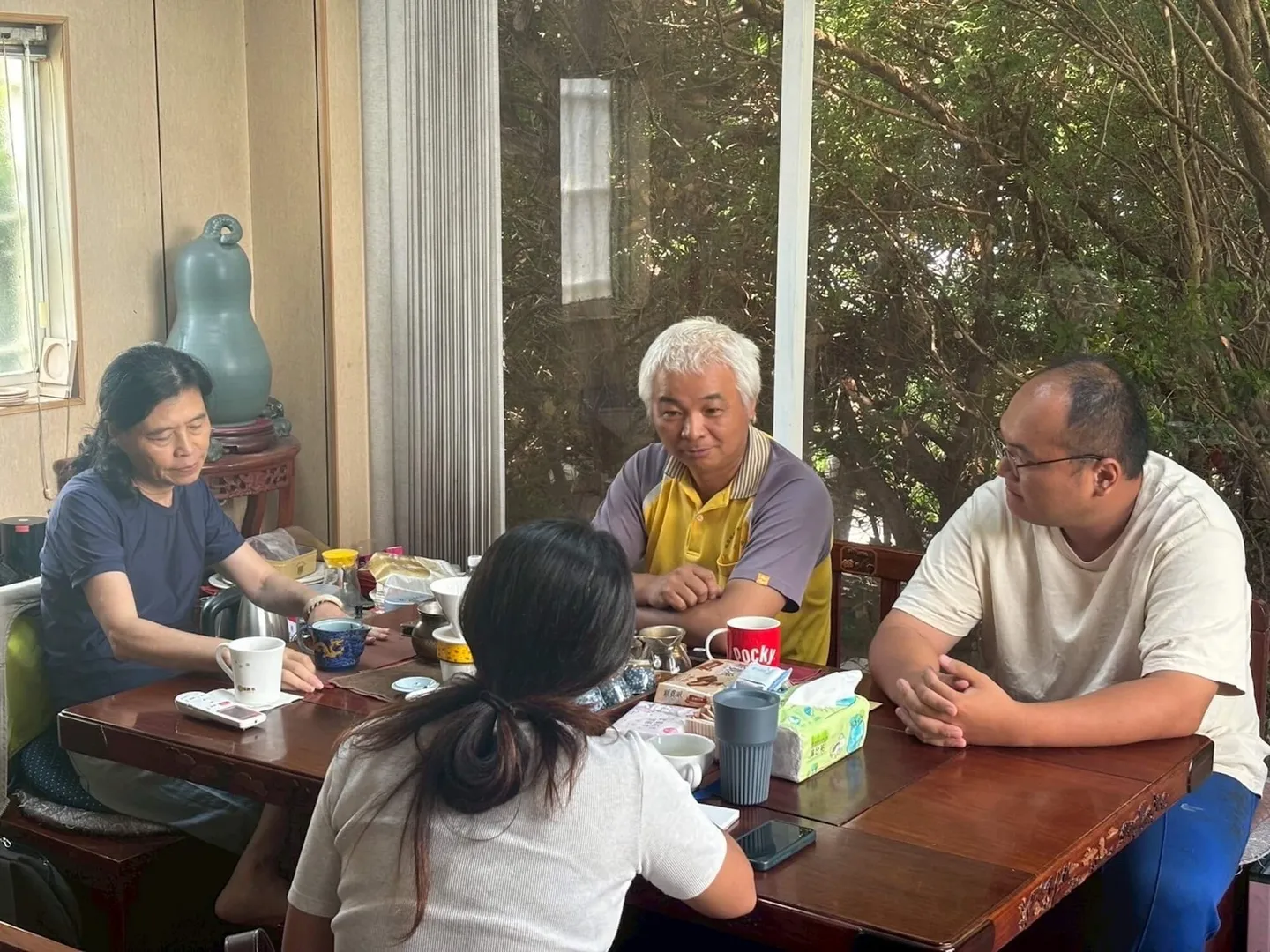
Visiting Sister E, chairperson of the Baosheng Community Development Association, and Secretary-General Brother Liao.


From Living Space to Ecological Awareness: How Did the Algal Reef Enter Public Consciousness?
For Baosheng residents, the algal reef was once simply part of their everyday world — a place to catch fish, collect shellfish, and play in the water at low tide, as natural as breathing. It wasn't until the development of the Datan Power Plant and the resulting changes to the coastline that people began to truly appreciate the reef's importance.
Sister E recalls the moment she noticed that the coastline no longer looked the way she remembered from childhood — no longer clear, no longer stable — and how that prompted her to learn more about how the algal reef formed and why it mattered ecologically. "Before, I didn't even know what an algal reef was. It wasn't until I saw the coastline change that I started wanting to understand how it actually formed," she said.
Baosheng Community then began organizing environmental education activities and ecological surveys, inviting experts and academics to give talks and guide residents in learning about the reef and its inhabitants. From that point on, community members were no longer simply people living by the sea — they became stewards of the algal reef.
Through monitoring and documentation, the community discovered that moray eels and crown sea stars were once regular visitors to this stretch of coast. Chance encounters even turned up sand bubbler crabs, and residents observed how algae shifted in color and growth patterns across the seasons. These discoveries not only enriched the community's collective knowledge but also gave everyone greater motivation to continue protecting this coastline.
The Meaning of a Lighthouse: Not Just Navigation, but a Symbol of Protection
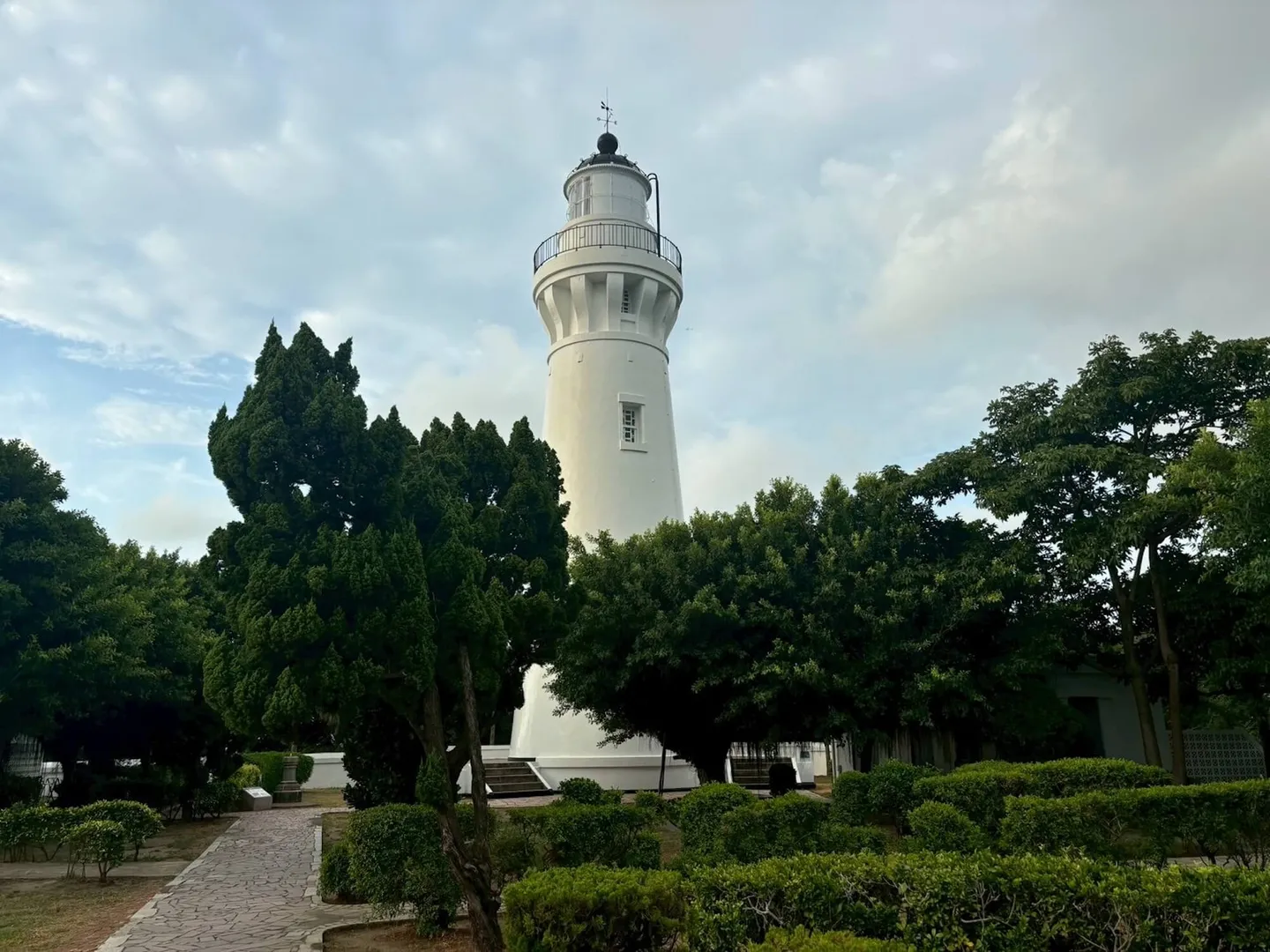
Baishajiao Lighthouse, with a history of over one hundred years.
Standing close to the Guanxin Algal Reef, Baishajiao Lighthouse is a century-old structure that has been in place since the Japanese colonial era. Unlike most lighthouses, its purpose is not to guide ships in — it is to warn them away. The flashing light pulses at a specific frequency and in particular colors to alert fishing vessels to keep clear of the reef and avoid damaging the ecosystem.
"This lighthouse was built to protect the algal reef — not to guide ships, but to warn them, to keep them from running aground on the rocks," Sister E explains. The lighthouse stands as a symbol of the relationship between people and nature, a reflection of mutual respect. It is not merely a beacon at sea; it is an extension of the community's commitment to protecting the reef.
The lighthouse is often included in guided tours of the area, paired with Ganquan Temple, making it a landmark where Baosheng's cultural and natural heritage intertwine. These sites are not simply tourist attractions — they are extensions of residents' lives and vessels of community memory.
Photographing, Observing, Recording: Conservation Action in Baosheng Community
Baosheng Community is one of the communities participating in the community conservation patrol program promoted by the Taoyuan City Environmental Protection Bureau. In fact, long before formally joining the program, Baosheng had already accumulated a wealth of photographic experience. The species identification guides in the community office are covered in sticky notes — the tangible record of years of observation and learning.
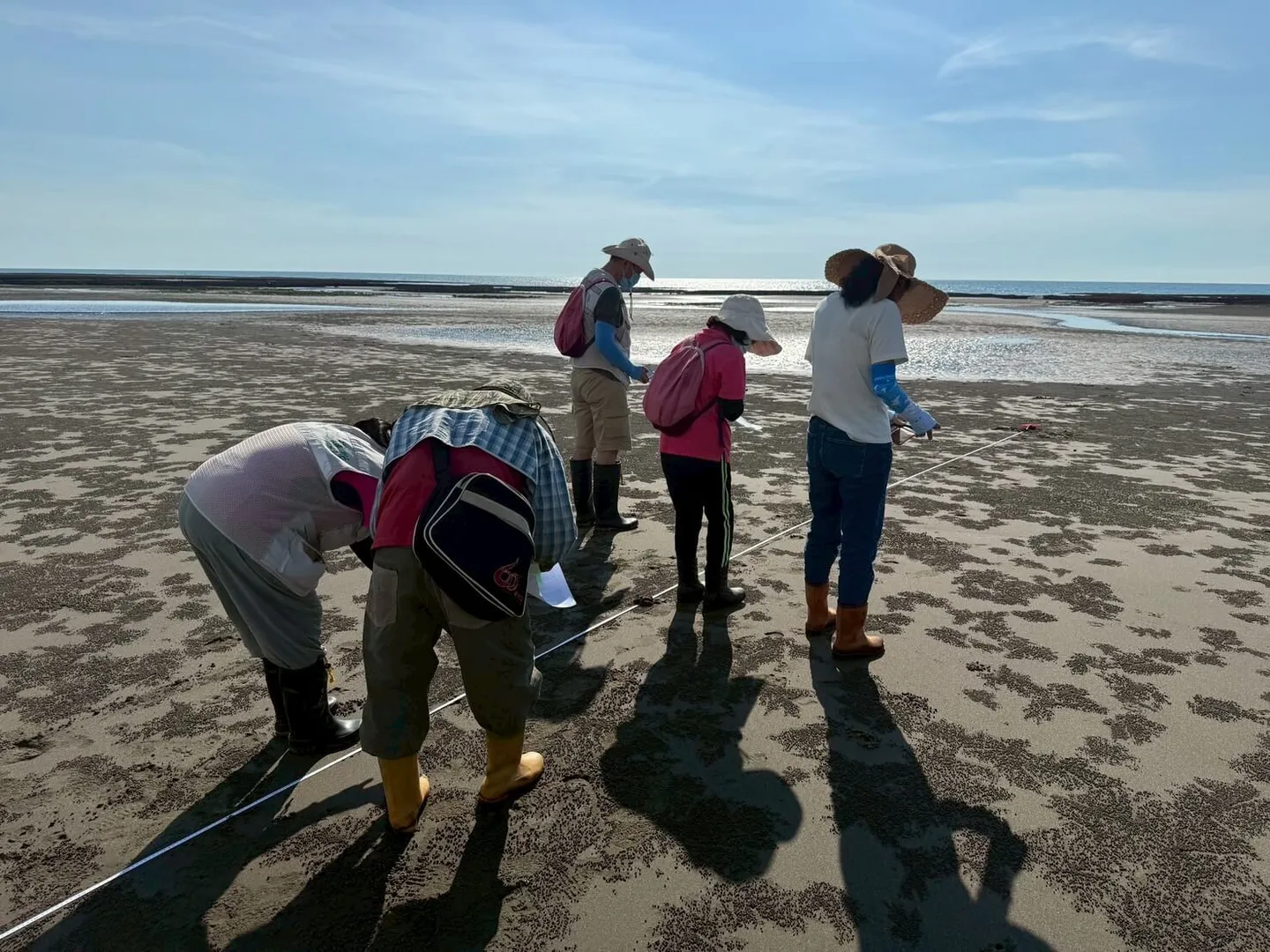
Because the substrate in the Baosheng area is highly varied — encompassing sand, gravel, and algal reef — sand-bubbler crabs are spotted here far more frequently than in Yongxing or Yong'an. These crabs are not only abundant but also fascinating to watch. Brother Liao and Sister E describe how the crabs, after emerging from their burrows, turn to face west and "bow," waving both claws repeatedly in what looks like a ritualistic gesture. Observations like these are not only delightful surprises but also reflect the depth of understanding community residents have developed for local wildlife behavior.
"To see the sand-bubbler crabs, you really have to be very quiet — we just wait, silently, for them to come out." This patience and enthusiasm are among the most precious assets Baosheng Community brings to its conservation work.
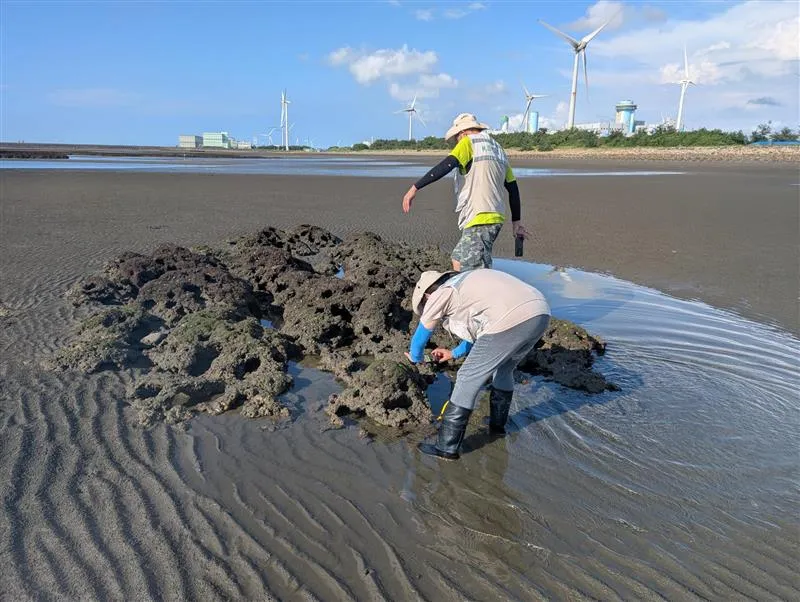
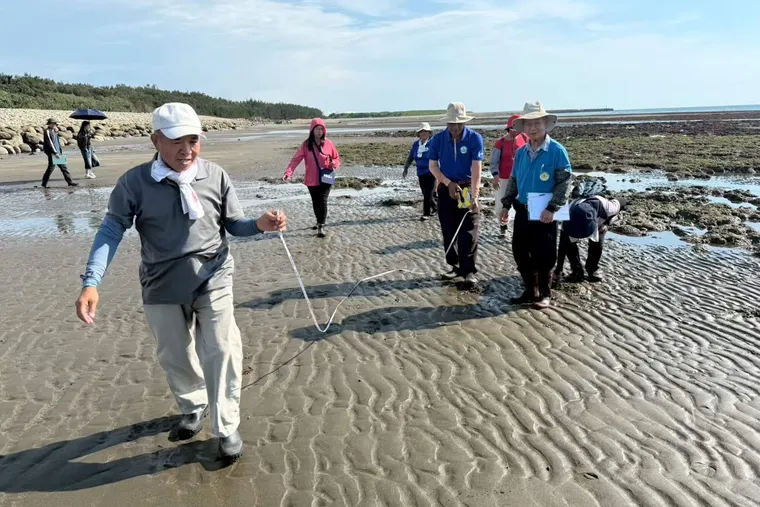
(Top) Community residents using their phones to document species at the Guanxin Algal Reef. (Bottom) Baosheng Community conducting community conservation patrols.
For Baosheng Community, protecting the coastline is not a slogan — it is part of life. Having grown up in this area, residents now spend their days visiting the algal reef to check on the creatures living there. This stretch of sea has always been part of who they are. The label "citizen science" may be new, but what they actually do hasn't changed: they walk out, phone in hand, and record what they see.
Further Reading